
The shared responsibility model is the cloud security framework that defines exactly which security tasks cloud providers handle and which remain the customer's obligation. Microsoft Azure states that customers own their data and identities, while providers secure the underlying infrastructure. Understanding why cloud security shared responsibility matters is not optional for IT managers. It is the foundation of every sound risk management and compliance program in a cloud environment.
Why cloud security shared responsibility matters for risk management
The shared responsibility model divides security ownership into two distinct lanes. Cloud providers secure physical infrastructure, hypervisors, and provider-managed services. Customers secure data, identities, applications, and configurations. The boundary between those lanes shifts depending on the service model in use, which is where most organisations run into trouble.
DigitalOcean emphases that a provider's security posture does not remove customer obligations. This is the single most important concept for IT managers to internalize. Assuming the provider handles everything is not a security strategy. It is a gap waiting to be exploited.

The importance of shared responsibility becomes clear the moment an organisation faces a breach or an audit. Regulators and auditors do not accept "the cloud provider was responsible" as a defence when customer-side controls were absent. Ownership must be documented, tested, and evidenced before an incident occurs.
How do cloud security roles shift across IaaS, PaaS, and SaaS?
Cloud security roles change significantly depending on which service model your organisation uses. The table below maps responsibility divisions across the three primary models.
| Security domain | IaaS | PaaS | SaaS |
|---|---|---|---|
| Physical infrastructure | Provider | Provider | Provider |
| Network controls | Customer | Provider/Shared | Provider |
| Operating system | Customer | Provider | Provider |
| Application security | Customer | Customer | Provider/Shared |
| Identity and access | Customer | Customer | Customer |
| Data protection | Customer | Customer | Customer |
| Tenant configuration | Customer | Customer | Customer |
Microsoft's documentation confirms that network and application security responsibilities shift with service type. In IaaS environments such as Azure Virtual Machines or AWS EC2, customers configure firewalls, patch operating systems, and manage application security. The provider secures the physical host and network fabric beneath the hypervisor.
In PaaS environments such as Azure App Service or Google Cloud Run, the provider manages baseline network security and the underlying runtime. Customers retain responsibility for application code, access controls, and data handling. The boundary is narrower, but it still exists.
In SaaS environments such as Microsoft 365 or Salesforce, the provider manages nearly all infrastructure and platform layers. Customers still own tenant configuration, user access management, and data classification. Misconfigurations in SaaS tenants are a leading cause of data exposure, precisely because teams assume the provider has covered everything.
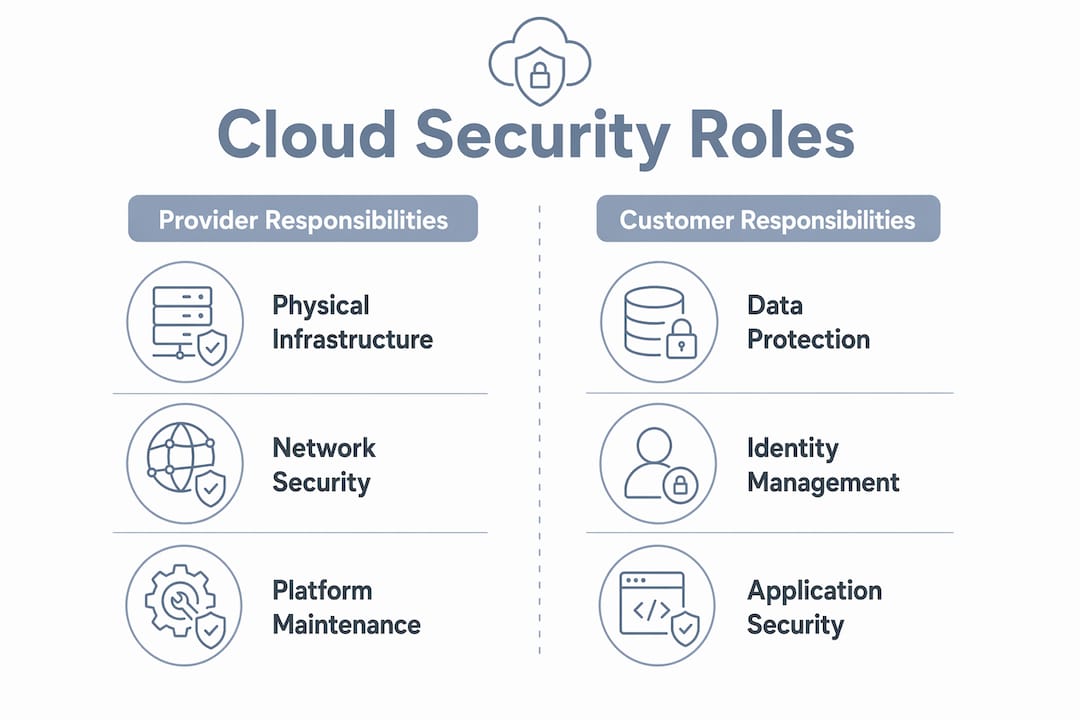
Pro Tip: Map your responsibility boundary for each cloud service your organisation uses, not just the primary platform. A single unreviewed SaaS integration can create a gap that bypasses every other control you have in place.
Why does shared responsibility reduce cloud security risk?
Clarity of ownership is the primary mechanism by which the shared responsibility model reduces risk. When every team member knows which controls belong to the customer, there are no blind spots created by assumption.
The most common pitfall is neglecting identity and access management. Organisations that treat identity as a provider concern routinely leave privileged accounts unreviewed, multi-factor authentication disabled, and service accounts over-permissioned. Microsoft stresses that customers retain meaningful ownership of identities and configuration, rejecting any "set-and-forget" approach to cloud security.
Application security is the second frequent gap. Teams deploying workloads on PaaS or IaaS platforms often focus on infrastructure provisioning and treat application-layer controls as a development concern rather than a security one. The shared responsibility model forces that conversation into the open.
Cloud security best practices for customer-side ownership include:
- Identity governance: Review privileged accounts and service principals quarterly. Enforce multi-factor authentication across all user identities.
- Configuration baselines: Define and enforce secure configuration standards for every cloud service type in use.
- Data classification: Label and protect data at the point of creation, not after a breach surfaces.
- Access reviews: Conduct formal access reviews at least twice per year for all cloud workloads.
- Logging and monitoring: Retain logs for all customer-managed resources and alert on anomalous access patterns.
Pro Tip: Treat your identity plane as the perimeter. In cloud environments, compromised credentials cause more breaches than network intrusions. Invest in identity protection before expanding your cloud footprint.
How does shared responsibility affect compliance audits?
Compliance audits expose shared responsibility gaps faster than any internal review. Frameworks like the CSA's Cloud Controls Matrix (CCM) and CAIQ require organisations to map each control to provider ownership, customer ownership, or shared ownership. That mapping becomes the backbone of your audit evidence package.
ISO 27001 Annex A.5.23 mandates documented security responsibilities across the full cloud service lifecycle. This includes acquisition, active use, and exit. Responsibility agreements between customer and provider must be in place and verifiable. Auditors will ask for them.
The critical mistake organisations make is presenting provider certifications, such as an AWS SOC 2 report or an Azure ISO 27001 certificate, as evidence of their own control effectiveness. Provider certifications cover only provider-managed controls. Auditors require separate, customer-generated evidence for every control the customer owns.
| Compliance framework | Shared responsibility requirement | Customer evidence needed |
|---|---|---|
| ISO 27001 Annex A.5.23 | Documented responsibility agreements per cloud service | Configuration records, access reviews, exit procedures |
| CSA CCM v4.1 | Control ownership mapped to provider, customer, or shared | CAIQ responses, control testing results |
| SOC 2 (customer scope) | Customer controls tested independently of provider scope | Monitoring logs, policy documentation, access governance |
Pro Tip: Build your compliance evidence package before the audit cycle begins. Configuration snapshots, access review records, and monitoring logs collected in real time are far more credible than reconstructed documentation.
How to implement shared responsibility in your cloud environment
Operationalising the shared responsibility model requires a structured programme, not a one-time exercise. Microsoft advises building a dynamic control inventory keyed by cloud service model, region or account, and workload type. That inventory becomes your single source of truth for ownership assignments.
The steps below give IT managers a practical path to implementation.
- Catalogue your cloud services. List every cloud service in use across the organisation, including shadow IT and SaaS tools adopted without IT approval. You cannot assign responsibility for services you do not know exist.
- Assign ownership by service model. For each service, document which controls belong to the provider, which belong to the customer, and which are shared. Use the IaaS, PaaS, and SaaS breakdown as your starting framework.
- Define internal owners. Assign a named individual or team to each customer-owned control. Unowned controls drift. Named owners do not.
- Collect baseline evidence. Capture configuration settings, access governance records, and monitoring logs for all customer-managed controls. This is your audit foundation.
- Review and update quarterly. Cloud environments change constantly. New services, new regions, and new workloads shift responsibility boundaries. A static responsibility matrix becomes inaccurate within months.
Multi-cloud environments require per-provider responsibility matrices. AWS, Azure, and Google Cloud each define their responsibility boundaries differently. A single unified matrix that ignores provider-specific nuances will produce gaps. Treat shared responsibility as a contract, configuration, and evidence programme for each provider separately.
Understanding customer obligations for identities and applications within cloud platforms is particularly relevant for technology companies managing multiple cloud tenants simultaneously. The complexity scales with the number of providers and service types in play.
Pro Tip: Integrate your responsibility matrix into your change management process. Every new cloud service adoption should trigger a responsibility assignment review before the service goes live, not after.
Key takeaways
The shared responsibility model is the single most important framework for preventing cloud security gaps, and every IT team must document, assign, and evidence their side of it.
| Point | Details |
|---|---|
| Ownership shifts by service model | IaaS customers own more controls than SaaS customers; map each service separately. |
| Identity is always a customer duty | Regardless of service model, identity and access management remains the customer's responsibility. |
| Provider certs do not cover your controls | Present customer-generated evidence for customer-owned controls during compliance audits. |
| Dynamic inventories prevent drift | Update your control inventory quarterly as cloud services, regions, and workloads change. |
| Multi-cloud needs per-provider matrices | Each provider defines responsibility boundaries differently; one unified matrix creates gaps. |
The part most organisations get wrong
Nick, Sr. Executive
After working with organisations across a range of cloud maturity levels, the pattern I see most often is not ignorance of the shared responsibility model. Most IT managers have heard of it. The problem is that they treat it as a vendor concept rather than an operational discipline.
I have seen organisations pass their first ISO 27001 audit by presenting Azure and AWS compliance certificates, only to fail the second audit when the auditor asked for customer-side evidence. The certificates were real. The customer controls were not documented. That gap took months to close and created significant internal friction.
The shift that actually works is treating shared responsibility as a living programme with named owners, scheduled reviews, and evidence collected continuously. The organisations that do this well do not scramble at audit time. They pull a report from their control inventory and hand it over.
Multi-cloud complexity makes this harder. When you are running workloads across Azure, AWS, and a handful of SaaS platforms, the responsibility boundaries are genuinely different for each one. A single responsibility matrix that tries to cover all of them will miss provider-specific nuances. The answer is not a simpler matrix. It is a more disciplined programme.
The organisations that build a proactive ownership culture, where every team member knows which controls they own and has evidence to prove it, consistently outperform their peers on both security posture and audit outcomes. That is not a coincidence.
— Nick, Sr. Executive
How AccountNext-Nexus supports shared responsibility management
Managing shared responsibility across multiple cloud environments is a programme, and AccountNext-Nexus is built to support it.
AccountNext-Nexus consolidates control mapping, compliance evidence management, and real-time monitoring under one platform. IT managers get clear visibility into which controls belong to the customer, which belong to the provider, and where evidence gaps exist before an auditor finds them. The platform supports cloud security management across IaaS, PaaS, and SaaS environments, with transparent pricing and access to experienced IT professionals. For organisations managing cybersecurity across outsourced IT arrangements, AccountNext-Nexus provides the structure needed to maintain clear ownership and reduce risk.
FAQ
What is the shared responsibility model in cloud security?
The shared responsibility model defines which security tasks the cloud provider handles and which the customer must manage. Providers secure physical infrastructure; customers secure data, identities, and applications.
Does the shared responsibility model change across IaaS, PaaS, and SaaS?
Yes. Customers own more controls in IaaS than in SaaS. Identity and data protection remain customer responsibilities across all three service models.
Why do provider compliance certificates not satisfy audit requirements?
Provider certifications cover only provider-managed controls. Auditors require separate, customer-generated evidence for every control the customer owns, including configuration records and access reviews.
What frameworks address shared responsibility for compliance?
CSA's Cloud Controls Matrix (CCM) and ISO 27001 Annex A.5.23 both require organisations to map and document control ownership between provider and customer as part of audit readiness.
How should organisations manage shared responsibility in multi-cloud environments?
Each cloud provider defines responsibility boundaries differently. Organisations should maintain a separate responsibility matrix per provider and treat the programme as a combination of contract review, configuration management, and evidence collection.