Finding a managed cybersecurity service that combines transparent pricing with effective response is more difficult than most mid-sized organisations expect. Many providers do not publicise flat-rate fees and require direct negotiation for scope and pricing, which delays quick budget alignment. This comparison highlights strengths and delivery models across three alternatives so organisations can match a managed service to their technology stack and compliance requirements without pricing guesswork.
Table of Contents
- AccountNext Nexus
- Cyflare
- CyberMSI Security & Cyber Risk Management Services
- Comparison of alternatives
AccountNext Nexus
At a Glance
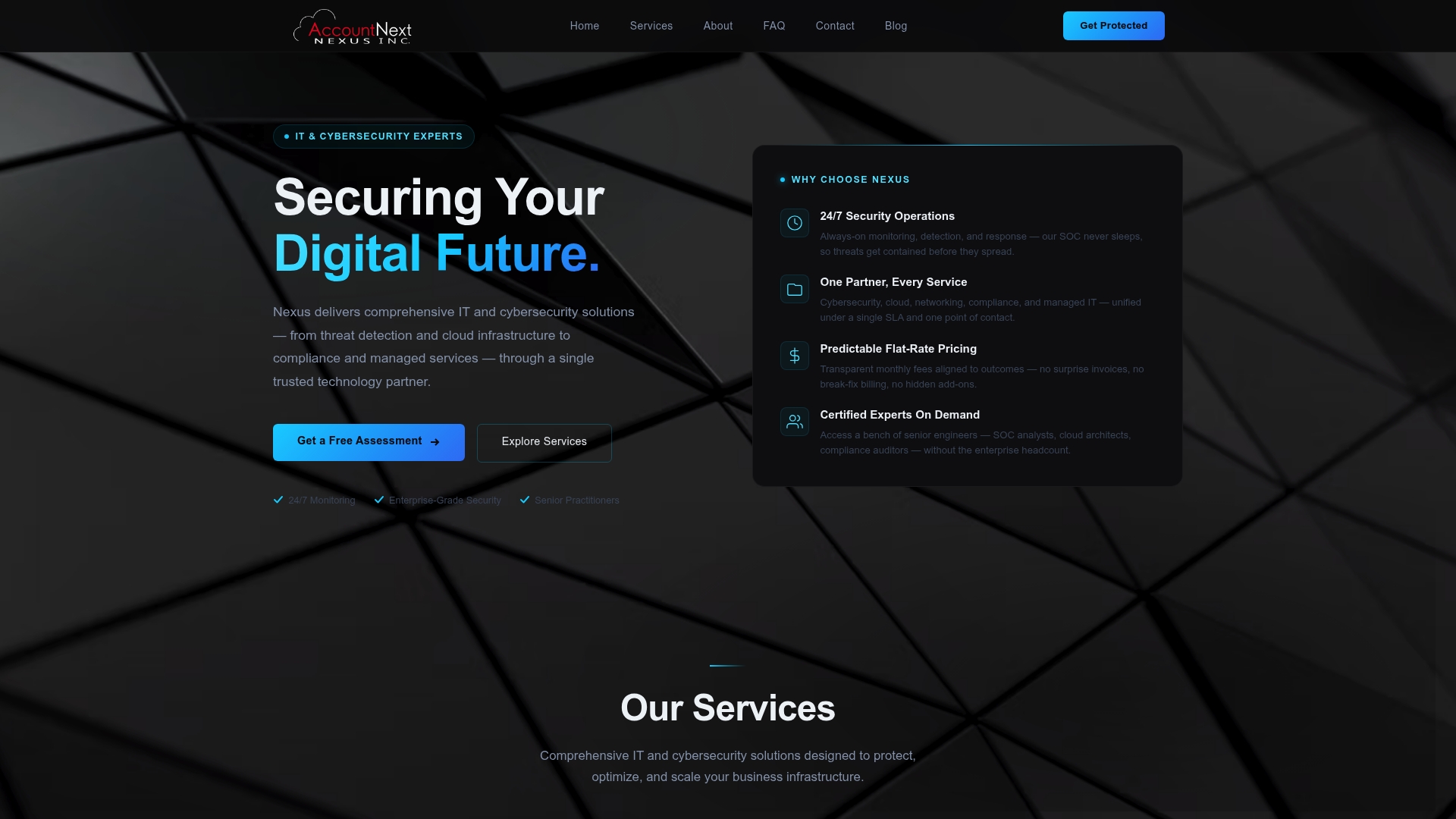
Predictable flat-rate pricing with transparent monthly fees anchors AccountNext-Nexus's managed services. The provider combines continuous security operations with senior engineers across cloud, networking, and compliance. Clients get a single service agreement that covers monitoring, incident response, and compliance support.
Core Features
AccountNext-Nexus runs 24/7 monitoring with threat detection and rapid incident response while managing cloud migration and infrastructure design. The offering groups cybersecurity, networking, compliance, and managed IT under a single service agreement and assigns senior practitioners to each engagement. The platform is built around Zero Trust principles and end-to-end encryption for data in transit and at rest.
Key Differentiator
The defining feature is a unified delivery model that places cybersecurity, cloud, networking, compliance, and managed IT with one team and one contract. That single SLA reduces the need to coordinate multiple vendors and clarifies escalation paths during incidents. The arrangement shortens time to resolution by centralising ownership of tools and playbooks.
Pros
Consolidating services into a single provider removes vendor fragmentation and reduces handoffs during incidents. Continuous security operations combined with senior engineers produce faster triage and clearer remediation steps. Transparent flat-rate billing removes surprise charges and creates predictable monthly costs for procurement and finance teams.
Cons
- Limited specific pricing details publicly available.
Who It's For
This fits mid-sized to large enterprises that need enterprise-grade cybersecurity plus full IT management under one supplier. It suits firms that must meet SOC 2, HIPAA, PCI-DSS, or ISO 27001 requirements while running multi-cloud environments. Organisations with existing fragmented vendors will see the most operational benefit.
Unique Value Proposition
AccountNext-Nexus bundles continuous threat detection, cloud migration, and compliance support into a predictable flat-rate model tied to a single SLA. That commercial structure shifts procurement from multiple contracts to one monthly fee and one point of contact. For finance and security teams this reduces vendor management overhead and helps align budgets with security outcomes.
Real World Use Case
A financial services firm consolidated its firewall vendor, cloud provider support, and compliance advisers into AccountNext-Nexus. The firm kept continuous monitoring and received consolidated reports for SOC 2 audits. Incident response time dropped by shortening internal handoffs and centralising responsibility.
Pricing
Pricing follows a predictable flat-rate monthly model with transparent fees under a single service agreement. Public granular rates are not listed and the vendor typically quotes after scoping the required services. Costs vary by scope, compliance needs, and cloud estate size.
Website: https://accountnext-nexus.com
Cyflare
At a Glance
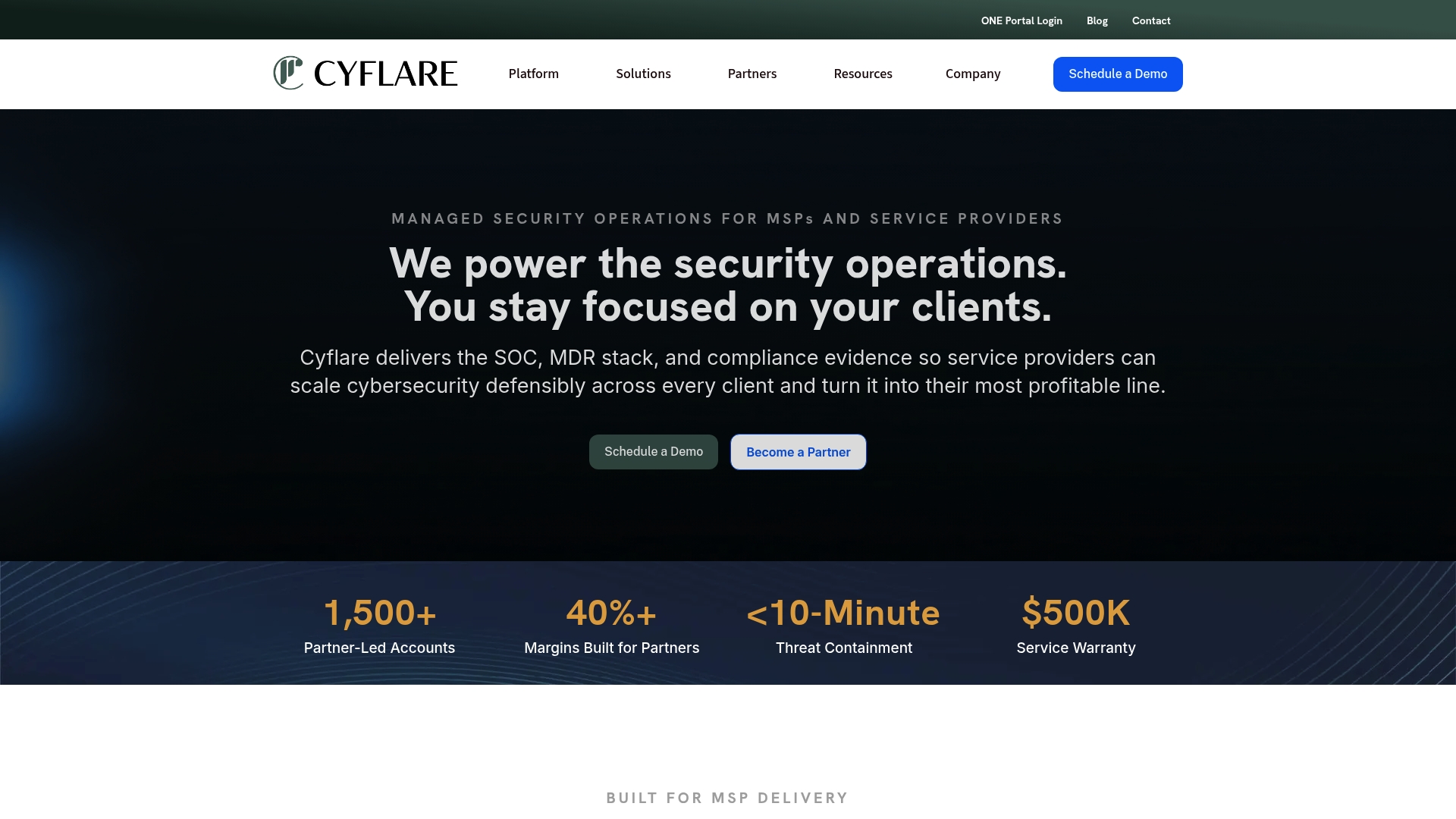
Cyflare reports a true positive rate above 98%. That figure suggests fewer false alerts and less manual triage for busy teams. The company focuses on letting MSPs scale security delivery without building internal security operations centres. Its channel-first approach targets service providers rather than direct end customers.
Core Features
Cyflare links existing security tooling into a unified operating layer and runs 24/7 monitoring, detection, and response across endpoints, identity, cloud, email, and network signals. The platform produces audit ready compliance reports and automates threat containment and response workflows to reduce repetitive operational work. Integrations include RMM and PSA systems to fit standard MSP workflows and accelerate onboarding.
Key Differentiator
Cyflare connects a service provider's current security stack into an automated operations system that scales without growing headcount. That focus on tool consolidation and workflow standardisation lets MSPs deliver consistent service across many clients. The model shifts effort from hiring analysts to configuring repeatable response playbooks.
Pros
The reported high true positive rate above 98% cuts alert noise and reduces hours spent on false leads. The platform is tool agnostic, so you can keep existing investments while unifying alerts and playbooks. Cyflare supports scalable delivery that avoids adding internal SOC staff, which helps margin for MSPs. Standardised workflows and audit ready reporting simplify compliance work for regulated clients. The vendor has industry recognition and certifications that back its channel credentials.
Cons
- No public pricing. The vendor does not list standard rates, which makes quick cost comparisons difficult.
- Limited public detail on deep customisation for highly specialised security environments.
- Channel only delivery means direct end user support is not available.
When It May Not Fit
If you need transparent, self-serve pricing then Cyflare will feel restrictive. Organisations that require heavily customised detection logic may find the platform too standardised without extra professional services. Direct enterprise buyers that expect vendor support rather than channel management will need a different supplier. Small single-site businesses without an MSP partner will not match Cyflare's channel model.
Notable Integrations
- Endpoint Security Tools
- Identity and Access Management
- Cloud Security Platforms
- Email Security Solutions
- Network Security Devices
- RMM and PSA systems
Who It's For
MSPs and service providers that want to automate detection, response, and compliance reporting across many clients will find this suited to their needs. The product fits teams aiming to scale managed security services without hiring sizeable SOC staff. MSPs that already use diverse security tools benefit most from the tool consolidation approach.
Real World Use Case
An MSP used Cyflare to onboard several new clients quickly while keeping the same engineering team. The MSP standardised alerts and response playbooks, delivered 24/7 monitoring, and met audit requests without hiring more analysts. That change converted security from a cost centre into a billed managed service.
Pricing
Pricing is not publicly listed. Cyflare appears to price via channel agreements and tailored proposals for MSP partners. Prospective buyers should contact Cyflare or an authorised channel partner for a demo and a custom quote.
Website: https://cyflare.com
CyberMSI Security & Cyber Risk Management Services
At a Glance
CyberMSI reports a 21-minute mean time to respond for incidents. That figure signals a focus on rapid containment and visibility. The firm pairs round-the-clock operations with Microsoft Sentinel for transparent incident reporting aimed at mid-market organisations.
Core Features
CyberMSI delivers managed detection and response through Microsoft Defender XDR and Sentinel, and it adds identity threat detection and response for accounts and access. The service includes data protection using Microsoft Purview, security exposure reviews for attack surface reduction, and an AI-assisted controls framework tied to CIS SecureSuite® for compliance automation.
Key Differentiator
CyberMSI combines generative AI with Microsoft security tooling to speed detection and automate initial response workflows. That pairing feeds incident context into transparent reporting in Sentinel, which helps clients see what actions occurred and why. The vendor emphasises trust and tailored mid-market deployment patterns.
Pros
Deep Microsoft integration stands out. The team configures Defender XDR, Purview, Entra, and Sentinel so tools share telemetry and context. The provider offers 24/7 monitoring and the MTTR above, which supports faster containment and clearer post-incident timelines. Automated compliance controls reduce manual checklist work. Dedicated account support gives clients a single contact for escalations and architecture questions.
Cons
- Limited public detail about enterprise customisation. Larger organisations may need a clearer roadmap for scale and bespoke controls.
- The service relies heavily on the Microsoft ecosystem. Environments built around other vendors may face integration gaps.
- Pricing information is not published. Prospective clients must engage directly to obtain fee structures and scope.
When It May Not Fit
If your environment mixes multiple cloud security vendors, CyberMSI may not match every integration need. Organisations seeking published, tiered pricing will need direct negotiation. Large enterprises that require extensive non-Microsoft tooling may find the offering narrowly aligned with Microsoft technologies.
Notable Integrations
- Microsoft Defender XDR for endpoint and cloud detection.
- Microsoft Sentinel for SIEM and incident transparency.
- Microsoft Purview for data governance and protection.
- Microsoft Entra for identity controls.
- Microsoft Copilot for Security for AI-assisted analysis.
Who It's For
This service fits mid-sized organisations that commit to Microsoft security tooling and want outsourced operations. It suits teams that lack a full in-house security operations centre and need continuous monitoring. It also suits firms that value vendor-managed compliance automation tied to known Microsoft products.
Real World Use Case
A mid-sized company onboarded CyberMSI to protect both cloud workloads and on-premises servers. The vendor deployed Defender XDR and Sentinel, then used AI-driven hunting to surface credential abuse and misconfigurations. Automated compliance workflows cut audit preparation time while incident timelines were shared with the internal security lead.
Pricing
Pricing is not specified publicly. The vendor indicates custom engagements and scope-based pricing, so costs vary by environment size and service mix. Contact CyberMSI for a tailored proposal and statement of work.
Website: https://cybermsi.com
Comparison of alternatives
Selecting the ideal managed cybersecurity service depends on balancing service breadth, pricing transparency, and operational adaptability. Each reviewed provider caters to distinct operational requirements, offering unique strengths aligned with specific organisational needs.
Scalability
Cyflare excels in scalability by enabling Managed Service Providers (MSPs) to streamline security operations across client portfolios. Its integrations support a wide array of existing tools, reducing onboarding and enhancing efficiency. MSPs benefit from automation of detection and response playbooks, ultimately allowing service expansion without proportionate increases in staff requirements. This aspect positions Cyflare advantageously for MSPs managing diverse client portfolios.
Service Breadth and Integration
CyberMSI prioritises integration within the Microsoft Security ecosystem, combining tools such as Defender XDR and Sentinel to deliver thorough protective coverage. This alignment is tailored to mid-sized organisations that rely heavily on Microsoft cloud environments and demand visibility and compliance workflows sourced from interconnected telemetry. Firms employing alternative cloud platforms might, however, face integration challenges.
Best fit
- Enterprises seeking unified service agreements across security, cloud, networking, and compliance benefit most from AccountNext Nexus's consolidated model.
- MSPs requiring scalable operations find Cyflare most suitable, leveraging its automated workflows and tool-agnostic integrations.
- Mid-sized organisations committed to Microsoft technologies will appreciate CyberMSI's deep dedication to the ecosystem and tailored deployment patterns.
Our pick
AccountNext Nexus stands out for organisations requiring streamlined vendor management alongside predictable pricing. Its unified service agreement reduces complexity inherent in multivendor strategies, aligning security and IT goals directly with procurement simplicity. Among these providers, AccountNext Nexus provides unified care that best meets complex operational requirements while maintaining adaptable scalability.
To select a managed cybersecurity service tailored to your organisational needs, below is a comparison of notable platforms highlighting their key attributes:
| Product Name | Core Features | Key Differentiator | Who It's For | Pricing | Notable Limitation |
|---|---|---|---|---|---|
| AccountNext-Nexus | 24/7 monitoring, incident response, compliance support | Unified delivery model combining IT, security, and compliance | Mid-to-large enterprises with multi-cloud environments | Price not published | Limited specific pricing details conveyed publicly |
| Cyflare | Unified security layer for multi-client environments | Focus on service providers with existing security tools integration | MSPs scaling security delivery without excessive staffing needs | Price not published | Channel-only delivery not for direct small business users |
| CyberMSI Security | Microsoft security integration, AI-assisted operations, compliance | Tailored Microsoft deployments leveraging technology ecosystem | Mid-sized organisations with Microsoft-centric environments | Price not published | Heavy reliance on Microsoft ecosystem compatibility |
Addressing Vendor Fragmentation and Compliance Challenges in Managed Security Services
Businesses seeking cyfy.ai alternatives often face fragmented security solutions with multiple contracts and vendors. That fragmentation slows incident response and clouds compliance efforts, especially in regulated industries. AccountNext-Nexus solves this by uniting cybersecurity, cloud, networking, and IT management under one service agreement. Clients benefit from faster triage and transparent flat-rate pricing that aligns with their security goals.
AccountNext-Nexus offers continuous threat detection, compliance support, and cloud infrastructure management led by senior engineers. This single contract reduces vendor overhead and simplifies escalation during incidents. Mid-sized and large organisations needing SOC 2, HIPAA, or ISO 27001 compliance gain a clear advantage.
See how AccountNext-Nexus can centralise your managed services and reduce operational costs at https://accountnext-nexus.com. Contact the team to receive a tailored proposal and start reducing your security complexity today.
FAQ
How does AccountNext-Nexus handle incident response and monitoring?
AccountNext-Nexus provides 24/7 monitoring combined with threat detection and rapid incident response. This emphasizes continuous security operations, ensuring timely intervention and support for clients' cybersecurity needs. Expect a proactive approach to threat management and strong support from senior practitioners.
What is the difference between Cyflare and AccountNext-Nexus?
Cyflare boasts a high true positive rate above 98%, reducing false alerts for service providers. While this allows Cyflare to effectively automate various security delivery tasks, AccountNext-Nexus excels in providing a unified delivery model that consolidates IT management and cybersecurity under a single service agreement, simplifying vendor communication for clients.
Which platform is better for mid-sized enterprises needing compliance support?
AccountNext-Nexus is better suited for mid-sized enterprises that require compliance support, including SOC 2, HIPAA, and PCI-DSS requirements. Its combination of continuous threat detection and compliance assistance aligns well with the needs of these organisations to manage security and regulatory obligations effectively.
Can I expect predictable pricing with AccountNext-Nexus?
Yes, AccountNext-Nexus follows a predictable flat-rate monthly pricing model with transparent fees. This structure helps organisations plan their budgets without worrying about unexpected costs, making it easier for teams to forecast their security expenditures.
How quickly does AccountNext-Nexus resolve incidents?
AccountNext-Nexus' structure is designed to shorten the time to resolution by centralising ownership of tools and processes. This streamlined approach facilitates quicker incident resolution compared to vendors that require coordination among multiple service providers.