
The enterprise vulnerability management process is a continuous, systematic approach to identifying, assessing, prioritizing, and mitigating security weaknesses across an organization’s entire technology environment. Unlike a one-time audit, vulnerability management is ongoing, covering the full lifecycle from discovery through remediation and governance. The industry term for this discipline is vulnerability management, and it sits at the intersection of technical security operations and enterprise risk management. Tools like Vectra AI and platforms built on the Exploit Prediction Scoring System (EPSS) now give large security teams the ability to cut through noise and focus on threats that actually matter.
What are the essential prerequisites and tools for an effective enterprise vulnerability management process?
A defined asset inventory is the non-negotiable starting point. You cannot protect what you cannot see, and in large organizations, shadow IT and cloud sprawl make asset discovery a genuine challenge. Before any scanning begins, your team must map every endpoint, server, container, cloud workload, and third-party integration in scope.
Automated scanning tools form the backbone of any vulnerability assessment strategy. Platforms like Tenable Nessus, Qualys VMDR, and Rapid7 InsightVM cover network and host-based scanning at scale. Manual review remains necessary for business logic flaws and configurations that automated tools miss.

The real differentiator in 2026 is contextual data. ML-driven tools reduce false positives by 92–98% by correlating runtime environment data, reachability analysis, and active exploit intelligence. That reduction matters because analyst time is finite, and chasing phantom alerts is the fastest way to burn out a security team.
Pro Tip: Before deploying any scanner, document your asset inventory in a configuration management database (CMDB). Scanners without a clean asset baseline produce results that are difficult to triage and nearly impossible to track over time.
Comparing core vulnerability management capabilities
| Tool / Feature | Automated Scanning | ML-Driven Prioritization | Cloud Coverage | EPSS Integration |
|---|---|---|---|---|
| Tenable Nessus | Yes | Limited | Partial | No |
| Qualys VMDR | Yes | Yes | Yes | Yes |
| Rapid7 InsightVM | Yes | Yes | Yes | Partial |
| Vectra AI | No | Yes | Yes | Yes |
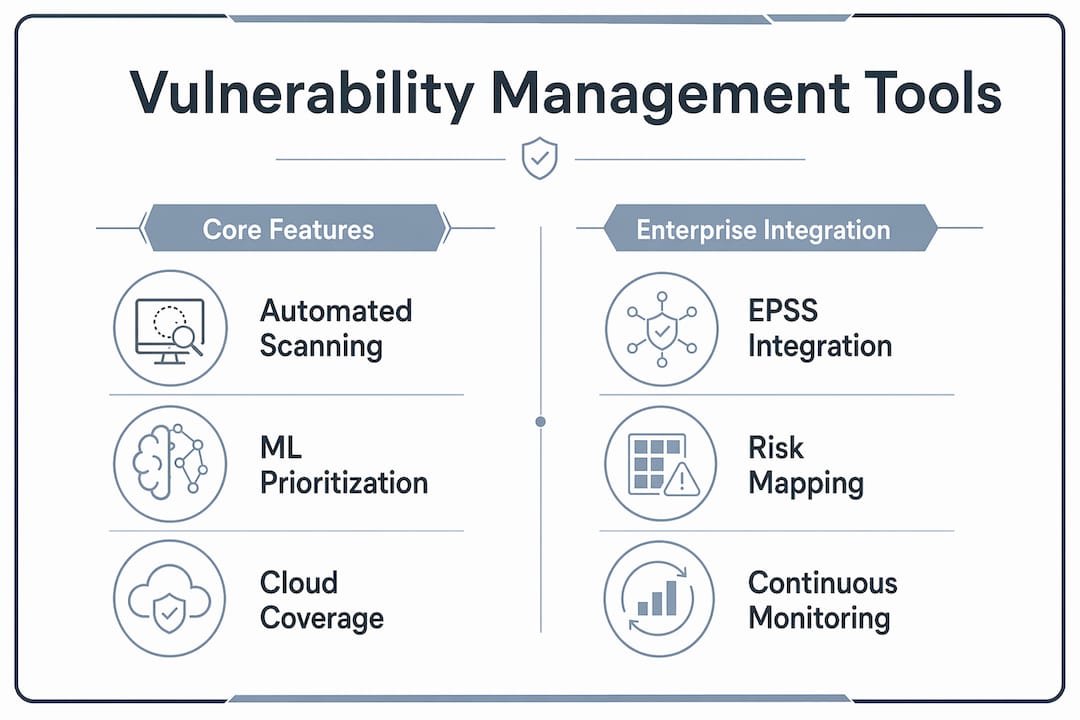
The table above shows that no single tool covers every requirement. Most enterprise security teams run two or more platforms in combination, pairing broad scanning coverage with ML-driven prioritization to reduce alert volume.
Key prerequisites before launching your program:
-
A complete, up-to-date asset inventory segmented by criticality
-
Defined scope boundaries covering on-premises, cloud, and OT environments
-
Stakeholder alignment between security, IT operations, and business units
-
Integration points with your ticketing system (ServiceNow, Jira) for remediation tracking
-
Baseline metrics to measure program improvement over time
How to execute the vulnerability assessment and risk prioritization steps?
Vulnerability assessment is a point-in-time snapshot. Assessment differs from management in that management is the ongoing motion picture, while assessment is a single frame. Both are necessary, but confusing them leads to programs that scan regularly but never close the loop on remediation.
The five-step assessment process runs as follows:
-
Plan. Define the assessment scope, rules of engagement, and success criteria. Identify which systems are in scope and what level of testing is authorized.
-
Discover. Run asset discovery scans to confirm your inventory is current. New assets appear constantly in enterprise environments.
-
Scan. Execute authenticated and unauthenticated scans using your chosen platform. Authenticated scans produce far more accurate results for host-based vulnerabilities.
-
Analyze. Correlate scan results with threat intelligence feeds, EPSS scores, and business context. This step separates mature programs from checkbox exercises.
-
Report. Produce findings reports segmented by severity, asset owner, and remediation timeline. Reports must be actionable, not just a raw CVE dump.
Why CVSS alone fails enterprise teams
CVSS scores measure technical severity in isolation. They do not account for whether a vulnerability is reachable from the internet, whether an exploit is publicly available, or whether the affected system processes regulated data. Less than 1% of known CVEs are ever weaponized. Prioritizing by CVSS alone means your team spends most of its time on vulnerabilities that attackers will never use.
Mature programs integrate EPSS alongside CVSS. EPSS predicts the probability that a CVE will be exploited within 30 days based on real-world threat data. Combining EPSS with business impact scores and active exploit intelligence narrows the field to the 1–2% of vulnerabilities that pose genuine, imminent risk.
Pro Tip: Set a hard rule: any vulnerability with an EPSS score above 0.5 and a CVSS score above 7.0 on an internet-facing asset goes to the top of the remediation queue, regardless of asset owner objections. That rule alone eliminates most of the prioritization debates that slow down enterprise programs.
Leveraging real-time exploit intelligence and reachability analysis keeps your team focused on what attackers are actually targeting, not what looks scary on paper.
What are best practices for remediation, verification, and continuous monitoring?
Remediation is where most enterprise programs stall. Security teams identify vulnerabilities faster than IT operations can patch them, and without clear service level agreements (SLAs), backlogs grow unchecked. The vulnerability management lifecycle closes the loop through identification, prioritization, remediation, verification, reporting, and continuous monitoring.
Not every vulnerability requires a patch. Remediation options include patching, configuration changes, compensating controls, and formal risk acceptance. Risk acceptance is legitimate when the cost of remediation exceeds the business impact of exploitation, but it must be documented and reviewed on a defined schedule.
SLA targets by severity give remediation structure:
-
Critical (CVSS 9.0+, active exploit): 24–72 hours
-
High (CVSS 7.0–8.9): 7–14 days
-
Medium (CVSS 4.0–6.9): 30 days
-
Low (CVSS below 4.0): 90 days or risk-accepted
Verification and retesting confirm that fixes work and do not introduce new issues. Retesting should be performed by the security team, not the team that applied the fix. That separation of duties catches regressions that self-reported remediation misses.
Continuous monitoring ties the program together. Integrate vulnerability data into your SIEM (Splunk, Microsoft Sentinel) and set automated alerts for new critical CVEs affecting your asset inventory. Connect vulnerability findings to your incident response playbooks so that active exploitation of a known vulnerability triggers an immediate escalation path.
“Effective vulnerability management treats the environment as a living system. A vulnerability closed today can reopen tomorrow through a configuration drift, a new deployment, or a third-party update. Monitoring never stops.”
How does integrating vulnerability management with enterprise risk management frameworks enhance cybersecurity?
Embedding vulnerability management into an enterprise risk management (ERM) framework shifts security from a technical function to a business governance function. Frameworks like COSO ERM 2017 and ISO 31000:2018 provide the structure to align vulnerability risks with strategic business objectives and board-approved risk appetite.
The practical step is mapping vulnerability categories to your enterprise risk register. A critical vulnerability in a payment processing system maps directly to financial and regulatory risk. That mapping gives the CISO language that boards and audit committees understand, and it connects security spend to business outcomes rather than technical metrics.
Good ERM sharpens decision-making by giving leaders visibility of principal risks with clear accountability and practical escalation paths. Applied to vulnerability management, this means each risk entry has an owner, a treatment decision, and a review date.
ERM integration: vulnerability risk mapping
| Vulnerability Category | Business Risk Domain | ERM Treatment | Review Cadence |
|---|---|---|---|
| Internet-facing RCE | Operational, Reputational | Immediate remediation | Weekly |
| Unpatched OS (internal) | Operational | Patch within SLA | Monthly |
| Third-party library flaw | Supply chain, Compliance | Compensating control | Quarterly |
| Misconfigured cloud storage | Regulatory, Financial | Configuration fix | Monthly |
Integrating vulnerability management into board-approved ERM frameworks enables better alignment of security spend with strategic business objectives. That alignment also makes it easier to justify budget requests, because every dollar spent on remediation ties to a quantified risk reduction.
Governance reporting should run on a defined cadence: operational metrics weekly for security teams, risk-level summaries monthly for IT leadership, and board-level risk appetite reviews quarterly. Cross-mapping vulnerability controls to compliance standards like PCI DSS, HIPAA, and SOC 2 reduces duplicated effort and strengthens audit readiness.
Key takeaways
The enterprise vulnerability management process succeeds when it combines continuous asset visibility, EPSS-informed prioritization, SLA-driven remediation, and ERM-level governance into one closed-loop program.
| Point | Details |
|---|---|
| Asset inventory first | Map every asset before scanning to avoid blind spots and wasted scan cycles. |
| Prioritize by real risk | Use EPSS and exploit intelligence, not CVSS alone, to focus on the 1–2% of CVEs that matter. |
| Define remediation SLAs | Set severity-based deadlines and track them in a ticketing system to prevent backlog growth. |
| Verify every fix | Retest remediated vulnerabilities independently to catch regressions before attackers do. |
| Embed in ERM | Map vulnerability risks to the enterprise risk register to align security spend with business goals. |
What I have learned from running enterprise vulnerability programs
The biggest failure mode I see in enterprise programs is treating vulnerability management as a scanning exercise. Teams run weekly scans, generate reports, and hand them to IT operations with no follow-through. Six months later, the same critical CVEs appear in the next report. The scan ran. The vulnerability did not get fixed.
The second failure mode is over-reliance on automation without human judgment. ML-driven tools are genuinely powerful. Vectra AI and similar platforms cut false positive rates dramatically, and that matters. But automation cannot tell you that a technically low-severity misconfiguration on a legacy system holds the keys to your most sensitive data. That judgment call requires a human analyst who understands the business context.
Cross-functional collaboration is the variable that separates programs that work from programs that produce reports. Security teams that build relationships with application owners, cloud architects, and finance get vulnerabilities fixed faster. Security teams that operate as a separate enforcement body get ignored.
Leadership buy-in is not optional. When the CISO presents vulnerability risk in ERM terms, boards engage. When vulnerability metrics appear only in technical dashboards, they stay invisible to the people who control remediation budgets. The programs I have seen succeed consistently are the ones where the CISO speaks the language of risk, not just the language of CVEs.
— Zulqurnain
How Accountnext-nexus supports your vulnerability management program
Security teams at large organizations face the same core problem: too many tools, too many alerts, and not enough context to act decisively. Accountnext-nexus consolidates IT and cybersecurity services under one platform, giving your team real-time threat detection, cloud infrastructure management, and compliance coverage without the overhead of managing five separate vendors.
Accountnext-nexus applies ML-driven correlation to cut false positive volume and surface the vulnerabilities that actually require attention. The platform integrates with existing ticketing and SIEM tools, so remediation workflows fit your current operations rather than replacing them. For security teams ready to move from reactive scanning to a governed, continuous program, Accountnext-nexus IT and cybersecurity solutions provide the infrastructure to make that shift without rebuilding from scratch.
FAQ
What is the enterprise vulnerability management process?
The enterprise vulnerability management process is a continuous lifecycle covering asset discovery, vulnerability scanning, risk prioritization, remediation, verification, and ongoing monitoring. It differs from a one-time assessment because it never stops adapting as the environment and threat landscape change.
How does EPSS improve vulnerability prioritization?
EPSS predicts the probability that a specific CVE will be exploited within 30 days using real-world threat data. Combining EPSS with CVSS scores and business impact context narrows remediation focus to the 1–2% of vulnerabilities that pose genuine risk.
What remediation options exist beyond patching?
Remediation options include patching, configuration changes, compensating controls, and formal risk acceptance. Risk acceptance is appropriate when remediation cost exceeds business impact, but it requires documentation and a scheduled review date.
How does ERM integration benefit vulnerability management?
Embedding vulnerability risks into ERM frameworks like COSO ERM 2017 or ISO 31000:2018 connects security decisions to board-approved risk appetite. That connection improves budget justification, governance accountability, and alignment between security spend and business objectives.
Why do ML-driven tools matter for large organizations?
ML-driven platforms reduce false positives by 92–98% by correlating runtime environment data, reachability, and exploit intelligence. For large organizations processing thousands of alerts weekly, that reduction directly lowers analyst workload and improves response speed.