
A cloud security posture is the cumulative security state of an organization’s cloud configurations, resources, and access controls at any given moment. The industry term for managing this state is Cloud Security Posture Management, or CSPM. CSPM tools continuously scan environments hosted on AWS, Azure, and Google Cloud Platform to detect misconfigurations, enforce compliance policies, and prioritize the risks that actually matter. For IT professionals and business leaders, understanding cloud security posture is not optional. Misconfigurations remain the leading source of cloud vulnerabilities, and no firewall fixes a storage bucket left publicly accessible by accident.
What is a cloud security posture, and why does CSPM exist?
A cloud security posture describes how well an organization’s cloud environment is configured, governed, and protected against known risks. CSPM is the automated discipline that measures and improves that posture continuously. Without CSPM, security teams rely on periodic manual audits, which become outdated the moment a developer spins up a new resource.
The need for CSPM is rooted in the shared responsibility model. Cloud providers like AWS, Azure, and GCP secure the physical infrastructure, the hypervisor, and the global network. The customer secures everything above that layer: configurations, access policies, data storage settings, and network rules. Misconfigurations represent the majority of exploitable vulnerabilities in cloud environments. That gap between what the provider controls and what the customer controls is exactly where CSPM operates.

CSPM tools address this gap by automating detection and remediation across Infrastructure as a Service (IaaS), Platform as a Service (PaaS), and Software as a Service (SaaS) deployments. They map every resource, check it against security benchmarks, and flag deviations in real time. Popular CSPM platforms include Wiz, Prisma Cloud by Palo Alto Networks, and Microsoft Defender for Cloud.
Key areas CSPM tools monitor include:
-
Storage permissions: Public S3 buckets, Azure Blob containers, or GCP Storage buckets with open access
-
Network exposure: Security groups or firewall rules that allow unrestricted inbound traffic on sensitive ports
-
Encryption gaps: Unencrypted databases, volumes, or data in transit
-
Identity misconfigurations: Service accounts with excessive permissions or inactive credentials left enabled
-
Compliance drift: Resources that no longer meet CIS Benchmarks, NIST, or HIPAA requirements
Pro Tip: Map your cloud accounts to a compliance framework like CIS Benchmarks before onboarding a CSPM tool. This gives you a baseline score and makes your first remediation sprint far more focused.
How do modern CSPM tools go beyond simple misconfiguration detection?
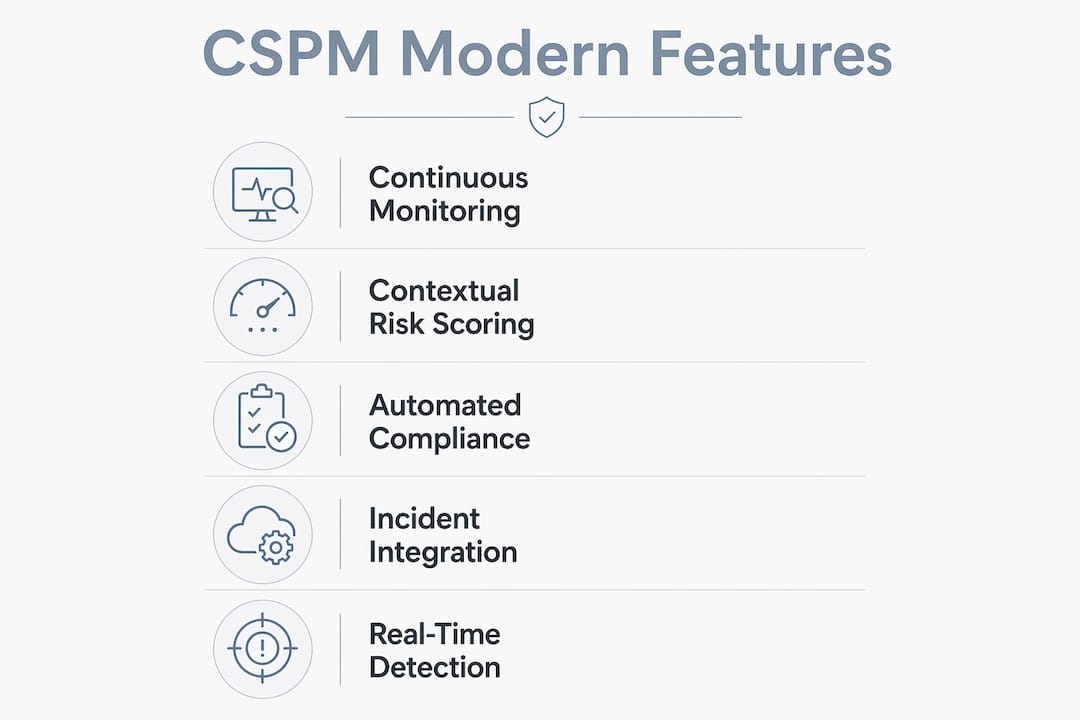
Early CSPM tools generated long lists of findings with no context about which ones posed real risk. Modern tools solve this with context-aware prioritization. Real-time monitoring with risk prioritization dramatically reduces alert fatigue by evaluating whether a misconfigured resource is actually reachable and exploitable. A publicly exposed port on an isolated development instance carries far less risk than the same exposure on a production database holding customer records.
The difference between static audits and continuous posture monitoring is significant. Static audits produce a point-in-time snapshot. Continuous monitoring tracks every configuration change as it happens, which matters in cloud environments where infrastructure changes dozens or hundreds of times per day.
| Feature | Static audit | Continuous CSPM |
|---|---|---|
| Frequency | Periodic (quarterly or annual) | Real time, every configuration change |
| Alert context | Finding with severity score | Exploitability, reachability, blast radius |
| Compliance reporting | Manual export | Automated, mapped to NIST, CIS, HIPAA |
| Remediation | Manual ticket creation | Guided or automated fix suggestions |
| Integration | Standalone report | Feeds into SIEM, SOAR, and ticketing systems |
Modern CSPM platforms integrate identity context, network topology, and data sensitivity into their risk scoring. A misconfigured role that grants write access to a production secrets manager is scored differently than one that grants read access to a public documentation bucket. This layered context is what separates mature CSPM from checkbox compliance tools.
Automated compliance reporting against frameworks like NIST, CIS, and HIPAA reduces manual audit workloads significantly. Teams can generate audit-ready reports on demand rather than spending weeks compiling evidence before a certification review.
Pro Tip: Connect your CSPM tool to your incident response platform, such as PagerDuty or Jira Service Management. Posture findings that sit in a separate dashboard rarely get fixed. Findings that create tickets get assigned, tracked, and closed.
How does CSPM fit into broader cloud risk management?
CSPM is one foundational layer in a defense-in-depth cloud security strategy, not a complete solution on its own. Security leaders need to integrate CSPM findings with incident response workflows and avoid treating posture dashboards as the end goal. A clean CSPM score does not mean an environment is secure if identity controls are weak.
Identity and Access Management remains the highest priority among all cloud security practice areas, because most major breaches involve identity failures rather than infrastructure misconfigurations. CSPM catches configuration drift, but IAM controls determine who can act on those configurations. Both must work together.
Effective cloud risk management combines CSPM with several complementary practices:
-
Least privilege IAM policies: Every service account, user, and role should have only the permissions it needs to function. Review and trim permissions quarterly.
-
Policy guardrails: Use AWS Service Control Policies, Azure Policy, or GCP Organization Policies to prevent non-compliant resources from being created in the first place.
-
Infrastructure as Code (IaC) security: Scan Terraform, CloudFormation, and Bicep templates before deployment using tools like Checkov or tfsec. Catching misconfigurations pre-deployment costs far less than remediating them in production.
-
Resource tagging: Tag every resource with owner, environment, and data classification. CSPM findings without clear ownership sit unresolved for months.
-
Continuous visibility: Without a unified view of the cloud attack surface, organizations cannot effectively protect multi-cloud environments. Visibility must come before risk scoring.
One common pitfall is granting CSPM tools excessive permissions. Unrestricted permissions granted to CSPM service accounts introduce serious risk. If the CSPM tool itself is compromised, an attacker inherits whatever access the tool holds. Configure CSPM service roles with read-only permissions scoped to the specific resources they need to assess.
What practical steps improve cloud security posture effectively?
Improving cloud security posture requires a structured approach, not a one-time audit. The following steps give IT teams and business leaders a repeatable process.
-
Establish a baseline. Run an initial CSPM scan across all cloud accounts and export findings mapped to a compliance framework like CIS Benchmarks or NIST CSF. This baseline score becomes your starting point and your board-level reporting metric.
-
Prioritize by exploitability, not volume. Focusing on exploitable attack paths reduces overwhelmed IT teams and improves security outcomes compared to fixing all misconfigurations equally. Start with exposed credentials, publicly accessible databases, and roles with excessive permissions.
-
Embed security checks into CI/CD pipelines. Treating cloud security posture as code means integrating automated checks in CI/CD pipelines to block misconfigurations before deployment. Tools like Checkov, Bridgecrew, and Snyk IaC scan templates at the pull request stage, so misconfigurations never reach production.
-
Automate compliance reporting. Configure your CSPM tool to generate scheduled compliance reports against HIPAA, SOC 2, or PCI DSS. Automated reporting eliminates the manual evidence-gathering sprint before audits and gives compliance teams continuous visibility.
-
Assign clear ownership and track remediation. Every CSPM finding needs an owner. Integrate findings into Jira, ServiceNow, or your existing ticketing system. Set SLAs by severity: critical findings resolved within 24 hours, high-severity findings within 7 days. Track closure rates as a security KPI.
-
Review and tune your CSPM rules regularly. Not every default check applies to your environment. Suppress findings that are intentional exceptions, and document the business justification. This keeps your signal-to-noise ratio high and prevents teams from ignoring alerts.
Key Takeaways
A strong cloud security posture requires continuous monitoring, context-aware prioritization, and tight integration between CSPM tools, IAM controls, and incident response workflows.
| Point | Details |
|---|---|
| CSPM fills the shared responsibility gap | Customers must secure configurations; CSPM automates detection of misconfigurations across AWS, Azure, and GCP. |
| Continuous monitoring beats static audits | Real-time CSPM tracks every configuration change, while periodic audits become outdated within hours. |
| Prioritize exploitable risks first | Fix exposed credentials and publicly accessible databases before addressing low-impact findings. |
| Treat posture as code | Embed CSPM checks in CI/CD pipelines using tools like Checkov to block misconfigurations pre-deployment. |
| Least privilege applies to CSPM tools too | Scope CSPM service accounts to read-only permissions to limit damage if the tool is compromised. |
Why I think most organizations are using CSPM wrong
Most teams I work with deploy a CSPM tool, watch the finding count drop after the first remediation sprint, and then declare victory. That is the wrong way to think about posture. Posture is not a score you achieve. It is a state you maintain, and cloud environments change fast enough that a clean score on monday can look very different by friday.
The second mistake is treating CSPM as a compliance checkbox rather than an operational signal. The organizations that get the most value from CSPM are the ones that pipe findings directly into their incident response workflows. When a new critical finding triggers a PagerDuty alert and creates a Jira ticket with an assigned owner, it gets fixed. When it sits in a dashboard, it ages.
The third mistake is ignoring IAM in favor of configuration findings. Identity failures drive the majority of cloud breaches, not misconfigured storage buckets. CSPM is necessary, and it is not sufficient. Pair it with quarterly IAM access reviews, enforce multifactor authentication on all privileged accounts, and treat your identity plane as the highest-value target in your environment. That combination is what actually reduces breach risk, not a green compliance dashboard.
— Zulqurnain
How Accountnext-nexus supports your cloud security posture
Accountnext-nexus consolidates cloud security posture management, compliance automation, and real-time threat detection under one service model, so your IT team stops managing fragmented tools and starts closing actual risks. The Accountnext-nexus team maps your AWS, Azure, or GCP environment against frameworks like NIST, CIS, and HIPAA, automates compliance reporting, and integrates findings directly into your incident response workflows. For organizations that need continuous visibility without building an internal CSPM practice from scratch, Accountnext-nexus IT and cybersecurity solutions provide the expertise and tooling to get there faster.
FAQ
What is cloud security posture management (CSPM)?
CSPM is the automated practice of continuously monitoring cloud configurations across AWS, Azure, and GCP to detect misconfigurations, enforce compliance policies, and prioritize security risks. It fills the customer side of the shared responsibility model by identifying gaps that cloud providers do not manage.
How does CSPM differ from traditional security audits?
Traditional audits produce a point-in-time snapshot that becomes outdated as soon as infrastructure changes. CSPM provides continuous, real-time monitoring that tracks every configuration change and flags new risks immediately.
What compliance frameworks do CSPM tools support?
Most enterprise CSPM platforms support CIS Benchmarks, NIST CSF, HIPAA, PCI DSS, and SOC 2 out of the box. Automated compliance reporting against these frameworks reduces manual audit preparation significantly.
Is CSPM enough to secure a cloud environment on its own?
No. CSPM addresses configuration risks, but identity failures cause the majority of cloud breaches. A complete cloud security strategy pairs CSPM with strong IAM controls, network segmentation, and integrated incident response.
How should organizations prioritize CSPM findings?
Focus first on findings that combine high exploitability with high impact, such as exposed credentials attached to roles with broad permissions or publicly accessible databases containing sensitive data. Fixing the highest-volume findings indiscriminately wastes remediation capacity.