
The strongest shortlist for Canadian procurement and compliance teams in 2026 comes down to eight platforms, each suited to a different operational reality. If you need one recommendation per use case: OneTrust for enterprise-scale third-party risk programmes, Vanta for SMBs that need fast deployment, Drata for continuous monitoring depth, Hyperproof for evidence automation and audit readiness, ProcessUnity for vendor lifecycle management, ServiceNow VRM for teams already on the ServiceNow platform, Panorays for supply-chain risk signals, and CyberVadis for scored vendor assessments at scale.
The Cloud Security Alliance is clear on this: periodic, point-in-time reviews leave organisations exposed because a vendor's security posture can change between audits. The platforms below are evaluated specifically on their ability to deliver continuous assurance, not just questionnaire management.
Quick shortlist for Canadian teams:
- OneTrust — best overall for enterprise third-party risk, with broad framework support (SOC 2, ISO 27001, PIPEDA) and Canadian data residency options
- Vanta — best for SMBs; fastest time-to-live, strong Microsoft 365 and cloud integrations, self-serve onboarding
- Drata — best for continuous monitoring; real-time control signals across cloud and identity providers
- Hyperproof — best for evidence automation and audit readiness; structured evidence workflows with clear remediation tracking
- ProcessUnity — best for full vendor lifecycle management, including offboarding controls and access revocation records
- ServiceNow VRM — best for enterprises already running ServiceNow; deep ERP and ITSM integration
- Panorays — best for external attack surface and supply-chain risk scoring
- CyberVadis — best for scored, third-party-verified vendor assessments at scale
Table of Contents
- How we selected and evaluated these platforms
- Detailed profiles of the top vendor compliance management tools
- How do you choose the right vendor compliance tracking software?
- When does a managed IT and compliance service make more sense than standalone software?
- Key takeaways
- What procurement teams often get wrong about vendor compliance
- AccountNext-Nexus managed compliance: a hands-on alternative for Canadian teams
- Useful sources and further reading
How we selected and evaluated these platforms
The shortlist above reflects evaluation against criteria that matter specifically to Canadian procurement and compliance teams, not just global feature checklists.
Selection criteria applied:
- Continuous monitoring capability (real-time signals vs. periodic questionnaires)
- Automated evidence collection and control population
- Framework mapping coverage: SOC 2, ISO 27001, NIST SP 800-218 (SSDF), PIPEDA, PCI DSS, and HIPAA where relevant
- Integration depth: IdP/SSO, cloud providers (AWS, Azure, GCP), ticketing, ERP, and SIEM connectors
- Vendor engagement model: portal-less or magic-link evidence collection to reduce vendor friction
- Pricing model transparency and total cost-of-ownership shape
- Canadian availability, data residency options, and local support
- Implementation services: self-serve vs. vendor-led, and realistic time-to-live
- Reporting and remediation workflow maturity
Sources used in this evaluation:
Gartner's IT vendor risk management solutions reviews provided analyst positioning and aggregated buyer feedback across implementation effort, support quality, and satisfaction. G2 user signals were cross-referenced for SMB and mid-market perspectives. Standards bodies including AICPA (SOC 2), NIST, PCI SSC, and the Cloud Security Alliance provided the framework benchmarks against which feature claims were assessed.
Canadian availability was verified by checking whether each vendor lists Canadian customers, offers data residency options within Canada or under Canadian-compatible data processing agreements, and provides support accessible to Canadian teams. EU data protection rules were also considered, since many Canadian organisations operate under cross-border data transfer obligations that require vendors to demonstrate adequate data handling controls.
Trust signals to verify before you shortlist:
Before committing to a demo, ask each vendor for: their current SOC 2 Type II report, ISO 27001 certificate (if claimed), a customer reference in a comparable Canadian organisation, their SLA terms in writing, and confirmation of data residency. These four asks alone will eliminate vendors who are not ready for a serious procurement process.
Pro Tip: Request a vendor's SOC 2 Type II report before the first demo, not after. Vendors who hesitate or offer only a Type I report are signalling that their controls programme is still maturing.
Detailed profiles of the top vendor compliance management tools
OneTrust
Best for: Enterprise organisations running mature third-party risk programmes across multiple frameworks and jurisdictions.
OneTrust's vendor risk module sits inside a broader GRC and privacy platform, which is its main strength and its main complexity driver. Continuous monitoring pulls signals from external threat intelligence feeds and internal assessment workflows. Evidence automation is strong, with automated control population tied to framework mappings across SOC 2, ISO 27001, NIST, and PIPEDA-aligned privacy controls. The full vendor lifecycle is covered, including structured offboarding workflows that generate access revocation records, which the Cloud Security Alliance identifies as a key audit differentiator.
Integrations span IdP/SSO providers, major ERP systems, Jira, ServiceNow, and cloud platforms. Canadian customers are documented, and data residency options are available. Implementation is vendor-led and typically runs 8–16 weeks depending on scope.
Pros:
- Widest framework coverage of any platform on this list
- Strong PIPEDA and cross-border privacy controls mapping
- Full lifecycle: onboarding, monitoring, offboarding with audit trail
- Documented Canadian customer base
Cons:
- High implementation complexity; requires dedicated internal resource
- Pricing is enterprise-tier and not publicly listed
- Feature breadth can slow time-to-value for smaller teams
Vanta
Best for: SMBs and mid-market teams that need to get a vendor compliance programme live quickly without a large implementation budget.
Vanta connects directly to cloud infrastructure (AWS, Azure, GCP), identity providers (Okta, Azure AD), and collaboration tools including Microsoft 365 to auto-populate controls in near real-time. The self-serve onboarding process facilitates quick deployment for teams moving off spreadsheets. Framework support covers SOC 2, ISO 27001, HIPAA, and PCI DSS. Offboarding automation is present but lighter than lifecycle-focused platforms; for complex offboarding requirements, you will need to supplement with manual process or a managed service.
Pricing starts around USD $1,000 per month for smaller programmes, though costs scale with vendor count and framework scope. Canadian teams should confirm data residency, as US data centres are the default.
Pros:
- Fastest self-serve deployment on this list
- Strong cloud and Microsoft 365 integrations for auto-evidence
- Accessible pricing for SMBs
- Clean, low-friction vendor portal
Cons:
- Offboarding controls are less mature
- US data centres by default; Canadian residency requires confirmation
- Less suited to complex multi-jurisdiction enterprise programmes
Drata
Best for: Teams where continuous monitoring is the primary requirement, not just periodic questionnaire management.
Drata's architecture is built around real-time control monitoring across more than 85 integrations, including Azure, AWS, GCP, GitHub, Okta, and Jira. Controls are continuously tested against framework requirements, and failures surface as prioritised remediation tasks rather than raw alerts, which reduces the noise that kills adoption in security operations teams. Evidence is auto-collected and mapped to SOC 2, ISO 27001, HIPAA, PCI DSS, and NIST controls. Deployment runs two to six weeks for most configurations.
For Canadian teams, Drata is available and widely used, but data residency should be confirmed in contract negotiations. Pricing scales with vendor count and framework scope, so model your total vendor population before committing.
Pros:
- Deepest continuous monitoring signal coverage
- Automated evidence collection with remediation prioritisation
- Fast deployment relative to enterprise GRC platforms
- Strong framework breadth
Cons:
- Pricing scales with vendor count; can grow quickly
- Offboarding automation less comprehensive than ProcessUnity
- Canadian data residency requires explicit contractual confirmation
Hyperproof
Best for: Compliance teams that need structured, auditable evidence workflows and clear remediation tracking across multiple frameworks simultaneously.
Hyperproof's strength is in how it organises evidence. Rather than dumping collected artefacts into a folder, it maps each piece of evidence to specific controls across multiple frameworks, so a single document can satisfy requirements in SOC 2, ISO 27001, and a PIPEDA-aligned privacy programme at the same time. This cross-framework evidence reuse reduces the documentation burden significantly. Integration with Microsoft 365 and Azure means evidence from cloud and identity systems populates automatically. Implementation typically runs four to eight weeks.
Hyperproof is available in Canada and can be hosted on Azure, which supports Canadian data residency discussions. Pricing is subscription-based and available on request.
Pros:
- Best-in-class evidence organisation and cross-framework mapping
- Microsoft 365 and Azure integrations support auto-evidence
- Azure hosting supports Canadian data residency
- Strong audit-readiness reporting
Cons:
- External attack surface monitoring is not a core capability
- Less suited to supply-chain risk scoring use cases
- Pricing not publicly listed
ProcessUnity
Best for: Organisations that need to manage the full vendor lifecycle, with particular emphasis on offboarding controls and access revocation audit trails.
ProcessUnity is purpose-built for third-party risk management across the entire vendor relationship, from initial onboarding assessments through active monitoring to structured offboarding. The offboarding module generates a complete relationship history including access revocation confirmation, which directly addresses one of the most common audit findings in vendor programmes. Continuous monitoring runs through periodic reassessment workflows and integration with external risk signals. Framework support covers SOC 2, ISO 27001, and NIST. Implementation is vendor-led and runs several weeks.
For vendor management strategies that go beyond compliance into performance governance, ProcessUnity's lifecycle model aligns well with mature supplier management programmes.
Pros:
- Strongest offboarding and lifecycle controls on this list
- Complete audit trail from onboarding to access revocation
- Purpose-built TPRM; less overhead than full GRC platforms
- Good ERP and IdP integration coverage
Cons:
- Vendor-led implementation adds time and cost
- Continuous monitoring is assessment-driven, not real-time signal-based
- Enterprise pricing; not suited to small vendor populations
ServiceNow VRM
Best for: Large enterprises already running ServiceNow for ITSM, HR, or ERP workflows who want vendor risk integrated into existing processes.
ServiceNow's Vendor Risk Management module is powerful precisely because it sits inside the ServiceNow platform. Risk findings trigger workflows, escalations, and remediation tasks that connect directly to existing ITSM and procurement processes. Evidence collection and framework mapping cover SOC 2, ISO 27001, and NIST. The integration story is strong for organisations already in the ServiceNow ecosystem, but the platform licence cost makes it a poor choice if you are buying ServiceNow solely for vendor compliance.
Implementation is vendor-led and typically runs multiple weeks, reflecting the platform's complexity. Canadian customers are documented, and data residency options exist.
Pros:
- Deep integration with existing ServiceNow workflows
- Strong enterprise scalability
- Full lifecycle coverage with workflow automation
- Canadian customers and data residency options documented
Cons:
- Very high TCO if not already a ServiceNow customer
- Longest implementation timeline on this list
- Overkill for SMBs or teams with simple vendor populations
Panorays
Best for: Organisations that need continuous external attack surface monitoring and supply-chain risk scoring alongside internal assessment workflows.
Panorays combines automated external scanning of vendor attack surfaces with internal questionnaire-based assessments, producing a combined risk score that updates continuously as external conditions change. This is the platform's differentiator: you get a signal when a vendor's exposed infrastructure changes, not just when their annual questionnaire is due. Framework support covers SOC 2 and ISO 27001. Integrations include IdP, ticketing, and SIEM connectors. Deployment is fast, typically two to four weeks.
Internal evidence automation is lighter than Hyperproof or Drata, so Panorays works best as a risk-scoring and monitoring layer rather than a full audit-readiness platform.
Pros:
- Best external attack surface monitoring on this list
- Continuous supply-chain risk signals
- Fast deployment
- Vendor-friendly assessment experience
Cons:
- Internal evidence automation is limited
- Not suited to full audit-readiness use cases
- Framework coverage narrower than enterprise GRC platforms
CyberVadis
Best for: Large organisations that need credible, third-party-verified vendor security scores at scale, particularly for procurement due diligence.
CyberVadis uses a hybrid model: vendors complete a detailed self-assessment, and CyberVadis analysts verify the responses against evidence before issuing a score. This verification step adds credibility that pure questionnaire platforms cannot match. Scores map to ISO 27001, NIST, and SOC 2 frameworks. The platform is available in Canada, and API connectors allow scores to feed into ERP and procurement systems. Deployment runs two to four weeks.
The trade-off is that CyberVadis is not a real-time continuous monitoring tool. Scores update when assessments are refreshed, which may be quarterly or annually depending on vendor tier.
Pros:
- Third-party-verified scores add procurement credibility
- Good for large vendor populations where internal assessment bandwidth is limited
- API integration with ERP and procurement systems
- Available in Canada
Cons:
- Not a continuous monitoring platform; score updates are periodic
- Less suited to real-time risk signal use cases
- Per-assessment pricing can scale quickly for large vendor populations
How do you choose the right vendor compliance tracking software?
The decision comes down to three variables: your vendor population size, your internal compliance bandwidth, and whether you need real-time signals or structured audit readiness. Getting those three parameters clear before you enter a demo will save you weeks of evaluation time.
Must-have vs. nice-to-have features
Must-have:
- Continuous monitoring with real-time or near-real-time signals (not just annual questionnaires)
- Automated evidence collection tied to specific framework controls
- Full vendor lifecycle support: onboarding, active monitoring, and offboarding with access revocation records
- Framework mapping for the standards your auditors actually require (SOC 2, ISO 27001, PIPEDA, PCI DSS, HIPAA as applicable)
- Integration with your IdP/SSO, cloud providers, and ticketing system
- Canadian data residency option or a data processing agreement compatible with PIPEDA and cross-border transfer obligations
- Reporting and remediation workflow that surfaces prioritised findings, not raw alert lists
Nice-to-have:
- External attack surface monitoring (Panorays-style)
- Third-party-verified vendor scores (CyberVadis-style)
- Magic-link or portal-less evidence collection to reduce vendor friction
- AI-assisted remediation prioritisation to reduce false-positive noise
- Pre-built ERP connectors for procurement system integration
Questions to ask vendors in demos and RFPs
- How does your platform collect evidence: agent-based, API, or vendor portal? What happens when a vendor does not respond?
- Which specific IdP, cloud, ERP, and SIEM connectors are available today, not on the roadmap?
- How does offboarding work? Does the platform generate a close-out record with access revocation confirmation?
- Where is data stored? Can you offer Canadian data residency or a PIPEDA-compatible DPA?
- What does your SLA cover, and what are the remedies for breach?
- Can you provide a SOC 2 Type II report and an ISO 27001 certificate?
- What does a typical implementation look like for an organisation our size? Who owns the work?
- Can you provide a reference from a Canadian customer in a comparable industry?
Understanding third-party cybersecurity risk types before entering vendor demos helps you ask sharper questions about which risk categories each platform actually monitors.
Red flags to watch for
- Evidence collection that relies entirely on vendor portal submissions with no automated signals
- No offboarding module or no access revocation confirmation record
- Continuous monitoring described only as "scheduled reassessments"
- SLA terms that are vague or exclude remediation support
- No SOC 2 Type II report available for the platform itself
- Data residency described as "flexible" with no contractual commitment
Implementation timeline and typical cost bands
| Complexity | Typical phases | Time-to-live | Cost drivers |
|---|---|---|---|
| SMB fast deploy (Vanta, Drata, Panorays) | Configuration, integration, vendor onboarding | 1–4 weeks | Subscription fee; minimal services cost |
| Mid-market phased (Hyperproof, ProcessUnity) | Scoping, configuration, integration, pilot, rollout | 4–8 weeks | Subscription + vendor-led services |
| Enterprise phased (OneTrust, ServiceNow VRM) | Discovery, design, build, UAT, phased rollout | — | Platform licence + significant services investment |
Total cost of ownership is driven by four factors: subscription or licence fees (typically per vendor or per user), implementation services (which can match or exceed first-year licence costs for enterprise platforms), ongoing managed services if you lack internal bandwidth, and integration development for custom ERP or SIEM connectors. For vendor performance management programmes that layer performance KPIs on top of compliance tracking, budget for additional configuration time.
When does a managed IT and compliance service make more sense than standalone software?
Software licences solve the tooling problem. They do not solve the bandwidth problem. For many Canadian organisations, the harder constraint is not finding the right platform; it is having the internal team to run it properly.
A managed service is the stronger choice when:
- Your compliance team has fewer than two dedicated FTEs available for vendor programme management
- You operate across multiple jurisdictions with different regulatory requirements (PIPEDA, HIPAA, PCI DSS, provincial privacy laws)
- You need 24/7 monitoring coverage but cannot staff a security operations function internally
- Your vendor population is growing faster than your team can absorb new onboarding and reassessment cycles
- You need consolidated SLAs across IT, security, and compliance rather than managing three separate vendor relationships
AccountNext-Nexus delivers managed compliance services that map directly to the evaluation criteria above. The service includes 24/7 real-time threat detection and monitoring, automated evidence collection for SOC 2, HIPAA, PCI DSS, and ISO 27001 readiness, structured vendor onboarding and offboarding support with access revocation documentation, incident response with defined SLAs, and cloud infrastructure monitoring across AWS, Azure, and Google Cloud. All of this runs under a single contract with transparent fixed-fee pricing, which eliminates the per-vendor scaling costs that surprise teams on SaaS platforms.
For a mid-size Canadian organisation moving from spreadsheet-based vendor reviews to continuous assurance, the operational shift is significant. A managed service absorbs that transition rather than placing it entirely on an already-stretched compliance team.
Consider how data sharing with vendors creates security risk for Canadian organisations: the monitoring and contractual controls that a managed service maintains continuously are exactly what reduces that exposure over time.
Pro Tip: Before selecting a SaaS platform, map your internal capacity honestly: who will own vendor onboarding, evidence review, and remediation follow-up week-to-week? If the answer is unclear, a managed service will deliver faster time-to-value than a licence that sits underutilised.
Key takeaways
The best vendor compliance tracking software for Canadian teams in 2026 is the one that matches your internal bandwidth, your framework requirements, and your need for continuous signals over periodic questionnaires.
| Point | Details |
|---|---|
| Continuous monitoring is the baseline | Platforms without real-time signals leave you exposed between audit cycles; prioritise this above feature count. |
| Offboarding controls matter for audits | Choose a platform that generates access revocation records; this is the most common audit gap in vendor programmes. |
| Canadian data residency needs a contract | "Available in Canada" is not the same as Canadian data residency; confirm in writing before signing. |
| Implementation cost often exceeds licence cost | For enterprise platforms, services and integration work can match or exceed first-year subscription fees. |
| AccountNext-Nexus as managed alternative | For teams without dedicated compliance bandwidth, AccountNext-Nexus managed services deliver 24/7 monitoring, evidence automation, and audit readiness under a single fixed-fee contract. |
What procurement teams often get wrong about vendor compliance
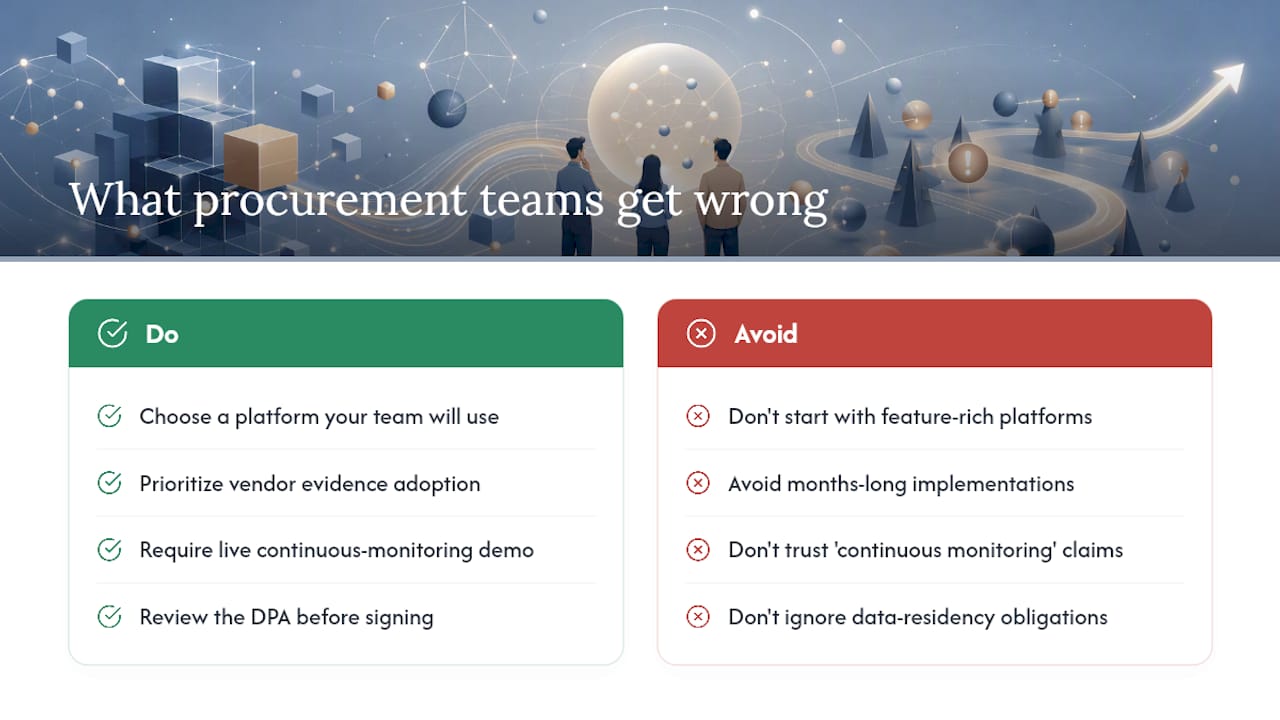
The conventional wisdom in vendor compliance is to start with the biggest, most feature-rich platform you can afford and grow into it. After watching Canadian organisations go through this cycle, the evidence points the other way.
Enterprise GRC platforms carry implementation timelines measured in months and require internal champions who understand both the technology and the compliance programme deeply. When those champions leave, or when the implementation partner disengages, organisations are left with a partially configured platform that collects evidence inconsistently and produces reports nobody trusts. The audit findings that were supposed to disappear come back.
The more useful question is not "which platform has the most features?" but "which platform will my team actually use in six months?" Vendor adoption of evidence requests is the single biggest predictor of programme quality, and it has almost nothing to do with platform sophistication. A tool that sends magic-link requests and auto-collects cloud signals will outperform a complex portal that vendors ignore.
There is also a persistent gap between what platforms promise on continuous monitoring and what they deliver. Real continuous monitoring means automated signals from cloud APIs, identity providers, and endpoint management systems, tested against framework controls daily. What many platforms call "continuous monitoring" is a scheduled reassessment workflow with a shorter interval. Ask vendors to show you a live control failure and the automated evidence that triggered it. That demonstration will tell you more than any feature comparison table.
For Canadian teams specifically: data residency is not a checkbox. Cross-border data transfer obligations under PIPEDA, and the implications of EU data protection rules for organisations with European vendor relationships, require contractual commitments, not just geographic marketing claims. Get the DPA reviewed before you sign.
AccountNext-Nexus managed compliance: a hands-on alternative for Canadian teams
For Canadian organisations that have evaluated the platforms above and concluded that the internal bandwidth simply is not there, AccountNext-Nexus delivers the compliance outcomes without the implementation overhead.
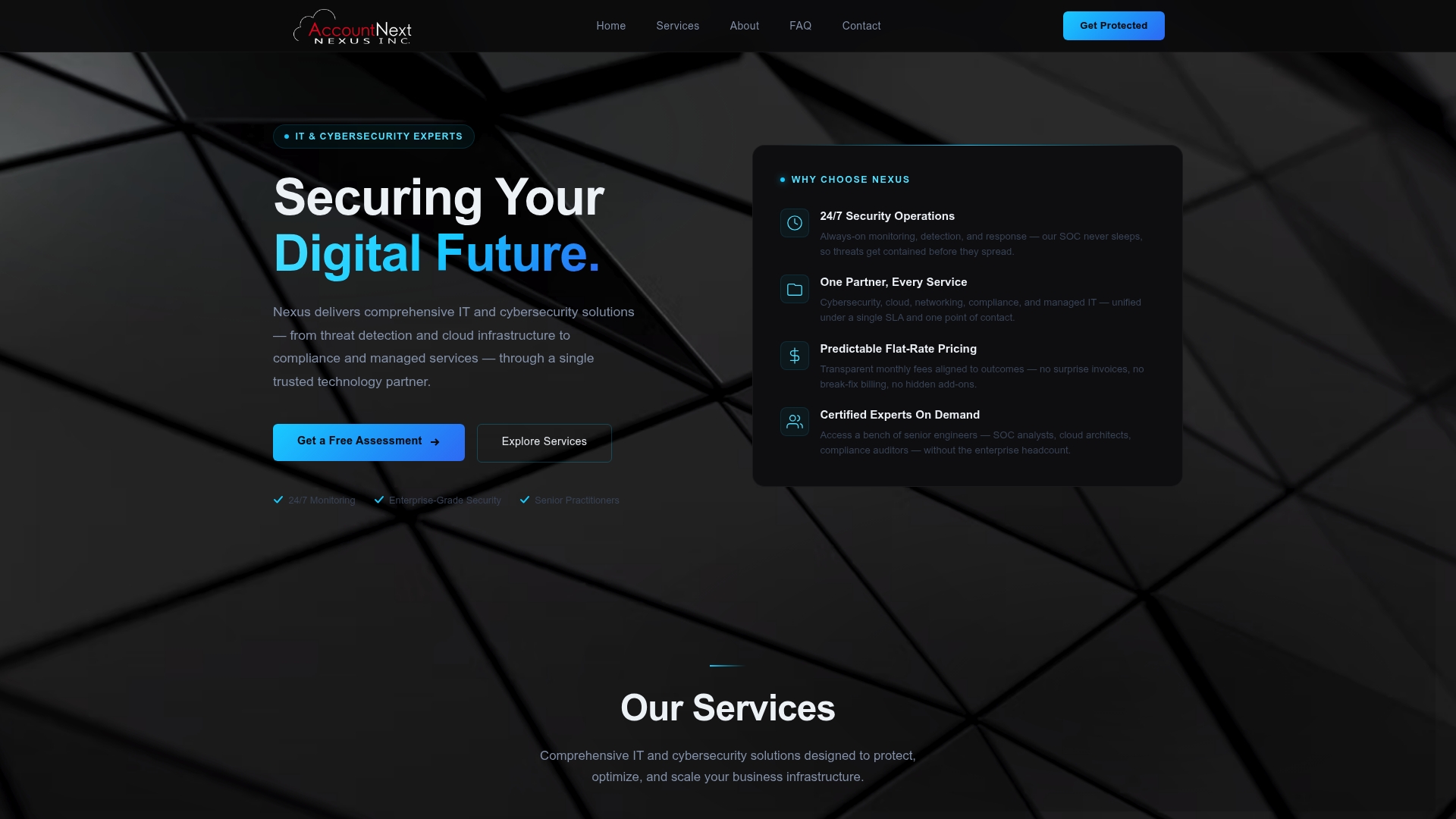
The managed service covers the capabilities that matter most in this evaluation: 24/7 real-time monitoring across your vendor environment, automated evidence collection mapped to SOC 2, HIPAA, PCI DSS, and ISO 27001, structured vendor onboarding and offboarding with documented access revocation, incident response under defined SLAs, and cloud posture monitoring across AWS, Azure, and Google Cloud. Everything runs under a single fixed-fee contract with no per-vendor scaling surprises.
Where SaaS platforms require your team to own configuration, integration, and ongoing programme management, AccountNext-Nexus absorbs that work. Canadian organisations get audit-ready evidence packs, consolidated reporting, and a single point of accountability for IT, security, and compliance.
To see how this maps to your current vendor programme, request a compliance assessment with the AccountNext-Nexus team.
Useful sources and further reading
- Cloud Security Alliance
- NIST CSRC — SP 800-218 (SSDF)
- AICPA — SOC 2
- PCI Security Standards Council
- European Commission — EU data protection rules
- U.S. Department of Health & Human Services — HIPAA
- Gartner — IT vendor risk management solutions reviews
- Microsoft — Microsoft 365
- Microsoft Azure
This article provides general information about vendor compliance tracking software and is not legal, regulatory, or professional compliance advice. Confirm current regulatory requirements with a qualified professional or the relevant primary authority for your jurisdiction.