
Sharing sensitive data with third-party vendors creates a material security and compliance risk — full stop. The moment data leaves your environment, you lose direct control over how it is stored, accessed, and protected. Under Canada's Personal Information Protection and Electronic Documents Act (PIPEDA) and provincial privacy legislation, your organisation remains the accountable party even when a vendor is the one holding the data. The NIST supply-chain guidance and industry security-rating frameworks like Bitsight both treat third-party risk as a continuous, not a one-time, problem.
Immediate actions to take right now:
- Stop all non-essential data sharing with vendors pending a classification review
- Classify data by sensitivity tier before any transfer is authorised
- Require a signed NDA and a minimum assurance level (SOC 2 Type II or ISO 27001) before transferring sensitive data
- Enforce multi-factor authentication (MFA) on every vendor-facing integration
- Demand written breach-notification timelines in every vendor contract (a reasonable baseline time frame)
- Limit scope: share only the fields a vendor genuinely needs to perform their function
Table of Contents
- Why data sharing with vendors risks security: the specific threat vectors
- Contracts alone won't protect you: Canadian legal and compliance implications
- Prioritised controls to reduce vendor data risk
- How to assess and continuously monitor vendors
- Contract language you should require from every vendor
- What to do when a vendor is breached: detect, contain, notify, remediate
- Typical costs and timelines for implementing vendor risk controls
- Why continuous monitoring and data minimisation deliver the highest ROI
- Real-world vendor incidents that show what the risks look like
- Secure data transmission techniques that reduce exposure in transit
- Emerging frameworks for third-party data sharing security
- Key takeaways
- The vendor risk gap most organisations are still ignoring
- AccountNext-Nexus manages vendor risk so your team doesn't have to carry it alone
- Authoritative Canadian sources and further reading
Why data sharing with vendors risks security: the specific threat vectors
Vendor relationships multiply your attack surface in ways that are easy to underestimate. Each integration, credential, and data copy you hand to a third party is a potential entry point your own security team cannot directly monitor.
Third-party breach and the detection gap
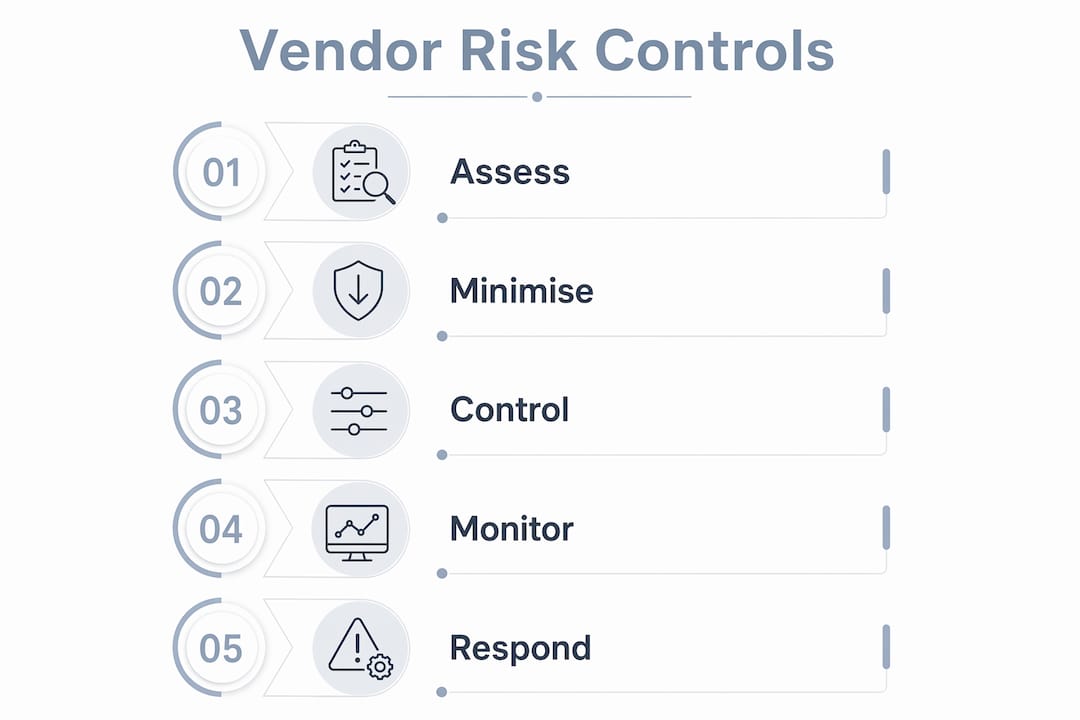
Over a third of reported breaches now originate through third parties, and they typically take longer to detect because discovery depends on the vendor noticing the incident first. A payroll processor or SaaS integrator may sit on a compromise for weeks before alerting clients. By then, attacker dwell time has extended the blast radius considerably.
Credential compromise and missing MFA
Stolen credentials and absent MFA are recurring root causes in vendor-originating incidents. A vendor employee reusing a password across personal and work accounts, or a shared service account with no MFA, gives an attacker a direct path into your data.
Unauthorised use, insider misuse, and misconfiguration
Vendors have their own employees, contractors, and offboarding processes. A disgruntled vendor employee, a misconfigured cloud storage bucket, or an overly permissive API token can expose your data without any external attacker involved. Modern SaaS and AI tools compound this: public AI systems often log and analyse inputs, so pasting real customer records into a vendor's AI assistant can constitute an unintended data transfer with its own retention and reuse implications.
Fourth-party (supply-chain) risk
Incidents often involve a vendor's sub-vendor — a cloud provider your payroll processor uses, or a code library your SaaS vendor embeds. You have no contractual relationship with that fourth party, which creates an audit blind spot. The attacker's path runs: your vendor's sub-vendor → your vendor's environment → your data.
Insecure integrations and API exposure
Poorly scoped API tokens, missing rate limiting, and unencrypted data-in-transit are common in integrations built quickly under commercial pressure. A cloud provider or integrator that stores your data in a misconfigured S3 bucket or exposes an unauthenticated endpoint puts your records at risk regardless of how strong your own perimeter controls are.
The business impacts compound quickly: regulatory breach notification obligations, potential fines under PIPEDA, operational disruption, reputational harm, and litigation exposure from affected customers. Explore the types of third-party cybersecurity risks in more depth to map these vectors to your specific environment.
Contracts alone won't protect you: Canadian legal and compliance implications
Data controllers in Canada remain legally responsible for personal information even after handing it to a vendor. Contracts reduce financial exposure but do not remove regulatory responsibility for breach notification or compliance with PIPEDA's accountability principle. An indemnity clause does not satisfy the Office of the Privacy Commissioner of Canada (OPC); your organisation still has to notify affected individuals and the OPC when a breach creates a real risk of significant harm.
Provincial privacy commissioners add another layer. Quebec's Law 25 (formerly Bill 64) imposes stricter breach notification timelines and data minimization requirements than PIPEDA, and Alberta's Personal Information Protection Act (PIPA) applies to private-sector organisations in that province. If your vendor operates across provinces or handles Quebec residents' data, you need to map which regime applies to each data flow.
Immediate compliance actions for your team:
- Map all data flows to vendors and record each processor relationship in a data inventory
- Identify which privacy regime applies to each flow (PIPEDA, Quebec Law 25, Alberta PIPA, or BC PIPA)
- Require vendors to provide breach notification within a defined contractual window (a reasonable starting point aligned with international norms)
- Request evidence of technical controls: SOC 2 Type II reports, ISO 27001 certificates, or equivalent attestations
- For cross-border transfers, document the legal basis and assess the destination jurisdiction's adequacy
- Involve your privacy officer and legal counsel before onboarding any vendor that will process sensitive personal information, health data, or financial records
The Thomson Reuters Practical Law resource on managing privacy and data security risks in vendor relationships is a useful reference for Canadian counsel drafting or reviewing vendor agreements.
Prioritised controls to reduce vendor data risk
The goal is to shrink both the attack window and the blast radius. These controls are ranked by implementation speed and impact.
Data minimisation and need-to-know (implement first)
Sharing only the minimum necessary information to perform a vendor's function is the single highest-ROI control. Classify your data before any transfer: public, internal, confidential, and restricted. Never share restricted fields unless the vendor's function is impossible without them. A marketing analytics vendor does not need full date-of-birth records; a pseudonymised age range does the same job.
Access controls: least privilege, JIT credentials, and MFA
Assign vendors scoped API tokens and segregated service accounts with the minimum permissions their function requires. Rotate credentials on a defined schedule and revoke them immediately when a vendor engagement ends. Just-in-time (JIT) access, where credentials are provisioned for a defined window and expire automatically, significantly reduces the period an attacker can exploit a compromised vendor account. MFA is non-negotiable on every vendor-facing integration.

Pro Tip: Automate credential expiry for vendor accounts using a privileged access management (PAM) tool or your identity provider's lifecycle policies. A vendor credential that expires automatically after 90 days — or after a specific project milestone — shrinks the attack window to near zero without requiring manual revocation.
Encryption and key management
Encrypt data in transit using TLS 1.2 or higher and at rest using AES-256 or equivalent. Retain control of encryption keys where possible: if a vendor holds both the data and the keys, a compromise of their environment exposes both. Tokenisation is worth the investment for high-value fields like payment card numbers or social insurance numbers — replace the real value with a token that is useless outside your own environment.
Operational measures
Centralise credential management, enforce logging on all vendor-facing integrations, and retain logs long enough to support a forensic investigation (logs retained long enough to support a forensic investigation). Where vendor contracts permit, require vendor employee background checks for staff with access to your sensitive data. Human error accounts for a substantial share of data leaks, so clear handling procedures and staff training at the vendor level matter as much as technical controls.
How to assess and continuously monitor vendors
A one-time questionnaire at onboarding is not a vendor risk programme. Vendor risk management must be continuous because vendors change staff, subcontract, and update tools after you sign the contract.
Vendor risk tier classification
| Risk tier | Typical data types / permissions | Minimum evidence required | Reassessment cadence |
|---|---|---|---|
| High | Sensitive personal data, health records, financial data, privileged system access | SOC 2 Type II, ISO 27001, annual penetration test, vulnerability management report | Annual + triggered by material changes |
| Medium | Internal business data, limited PII, read-only integrations | SOC 2 Type I or equivalent self-assessment, security questionnaire | Every 18 months |
| Low | Anonymised or aggregated data, no system access | Vendor security questionnaire | Every 2–3 years |
Assessment evidence checklist
Require the following from high- and medium-tier vendors before onboarding and at each reassessment:
- Current SOC 2 Type II report or ISO 27001 certificate (within 12 months)
- Most recent penetration test report (within 12 months) and remediation evidence for critical findings
- Vulnerability management programme documentation
- Security policies: access control, incident response, data retention, and acceptable use
- Employee security training records
- Subprocessor list and evidence that flow-down security obligations apply to each
For software vendors, NIST guidance recommends requiring vendor attestation and adopting SSDF practices, including software bills of materials (SBOMs) for supply-chain transparency.
Continuous monitoring and re-assessment triggers
Security ratings platforms provide ongoing visibility into a vendor's external security posture: open ports, certificate expiry, known vulnerabilities, and dark-web credential exposure. Integrate key vendor logs into your SIEM where contractually permitted. Re-assess immediately when a vendor: adds a new subprocessor, experiences a security incident, undergoes a merger or acquisition, or makes a significant product change that alters data flows.
Ownership matters: assign a named vendor risk owner in your security or procurement team, set approval gates for onboarding, and track reassessment due dates in your GRC tool. A practical risk assessment framework can help you build the classification and evidence-gathering workflow.
Contract language you should require from every vendor
A vendor agreement is your primary legal lever. Negotiate these clauses before signing, not after an incident.
Breach notification SLA: Require written notification within a short period after the vendor confirms a breach that may involve your data. The clause should specify the notification channel, the minimum content (nature of incident, data types affected, estimated scope), and escalation contacts.
Right to audit: Reserve the right to conduct or commission an independent security audit of the vendor's environment, with reasonable notice. Many vendors resist this; a compromise is requiring them to provide a third-party audit report on demand.
Subprocessor restrictions and flow-down: Prohibit the vendor from engaging new subprocessors without prior written notice. Require that all subprocessors are bound by security obligations at least as stringent as those in your agreement. This is the contractual mechanism for managing fourth-party risk.
Minimum security standards: Specify required controls: MFA, encryption standards, patch management timelines, and background checks for staff with data access.
Evidence and attestation requirements: Require annual delivery of SOC 2 reports, ISO 27001 certificates, or penetration test summaries. Tie continued contract validity to evidence delivery.
Liability and cyber-insurance minimums: Set a minimum cyber-insurance coverage level appropriate to the data volume and sensitivity. Avoid accepting vendor liability caps that are so low they would not cover your notification and remediation costs.
Negotiation tips: Insist on remediation timelines for critical findings (30 days is a reasonable standard). Push back on broad liability caps for security failures affecting your data specifically. Require timely access to forensic reports if the vendor is breached. Understand that an NDA covers confidentiality of information exchanged during the relationship; it does not substitute for specific security obligations, which belong in the vendor agreement itself. The role of procurement in cybersecurity is worth reviewing with your procurement team before contract negotiations begin.
What to do when a vendor is breached: detect, contain, notify, remediate
Speed and clarity of ownership determine how much damage a vendor incident causes your organisation.

Detection and initial triage (Day 0–1): Confirm whether data your organisation holds was stored in the vendor's affected environment. Check whether the vendor's network has a trusted connection into your own systems — if so, treat it as a potential beachhead and isolate it immediately. Attackers either steal data stored at the vendor or pivot via a trusted connection into your network; each scenario requires a different response plan.
Containment (Day 0–2): Revoke all vendor access credentials, suspend API integrations, rotate any shared keys or secrets, and isolate affected data sets. Do not wait for the vendor's investigation to conclude before taking these steps.
Notification (Day 1–3 and ongoing): Notify internal stakeholders (CISO, legal, privacy officer, executive team) within hours. Assess whether the breach triggers PIPEDA notification obligations: does it create a real risk of significant harm to individuals? If yes, notify the OPC and affected individuals as soon as feasible. Check contractual notification requirements with the vendor. Document every step with timestamps.
Remediation and conditions for restoring access (Week 2 onward): Require the vendor to provide evidence of remediation: patches applied, root cause analysis, new penetration test results, and updated security controls. Conduct independent verification where the risk warrants it. Restore vendor access only after your security team is satisfied with the evidence, not on the vendor's timeline alone.
Typical costs and timelines for implementing vendor risk controls
Budget planning for vendor risk management is often underestimated because the costs are spread across tools, people, and legal work.
-
Implement MFA and rotate vendor credentials (1–4 weeks): Primarily internal IT time. Low direct cost; high impact. The main investment is identifying all vendor-facing accounts and enforcing policy through your identity provider.
-
Vendor classification and baseline contractual updates (3–6 months): Requires a data inventory exercise, legal review of existing contracts, and negotiation of updated terms with high-tier vendors. Expect significant internal FTE time plus external legal fees for complex agreements.
-
Continuous monitoring programme (3–12 months to mature): Tool subscriptions for security ratings platforms, SIEM integration work, and ongoing analyst time to triage alerts. The programme produces value from month one but reaches operational maturity after several review cycles.
-
Privileged access management and tokenisation (3–9 months): PAM tool procurement, configuration, and integration with vendor-facing systems. Tokenisation projects for high-value data fields add development time depending on the systems involved.
-
Compliance assessments and legal review (ongoing): Annual SOC 2 or ISO 27001 review cycles, privacy impact assessments for new vendor relationships, and periodic legal counsel for contract updates.
The in-house versus managed service tradeoff is real. Building a mature vendor risk programme internally requires dedicated security and compliance FTE that many small and mid-sized organisations do not have. Outsourcing continuous monitoring and vendor assessment to a managed IT services provider compresses the timeline and converts capital-intensive hiring into a predictable operating cost.
Why continuous monitoring and data minimisation deliver the highest ROI
The expert consensus is clear: vendor risk is not a problem you solve at onboarding and revisit annually. Vendor posture degrades over time as vendors change staff, adopt new subprocessors, and update their tooling. A vendor that passed your assessment 18 months ago may have introduced a critical misconfiguration last quarter.
Statistic: Over a third of reported breaches now originate through third parties, and such incidents typically take longer to detect because discovery depends on the vendor identifying the compromise first.
Data minimisation addresses the blast radius problem directly. If a vendor holds only pseudonymised identifiers rather than full customer records, a breach of that vendor's environment exposes far less. The combination of minimisation (less data at risk) and continuous monitoring (faster detection) produces a compounding risk reduction that neither control achieves alone.
Pro Tip: Instrument one high-value detection improvement immediately: enrol your top five vendors in a credential-exposure monitoring service and ingest their authentication logs into your SIEM. This single step closes the detection gap for the most common vendor breach entry point — compromised credentials — without waiting for a full programme build-out.
Real-world vendor incidents that show what the risks look like
Abstract risk categories become concrete when you look at what has actually happened. The following incidents illustrate the main attack patterns.
Supply-chain pivot via a trusted integrator: In several high-profile incidents, attackers compromised a software vendor's build environment and used that access to distribute malicious updates to the vendor's clients. The attacker's entry point was the vendor; the target was every organisation that trusted the vendor's software. This is the supply-chain pivot pattern: the vendor's trusted relationship becomes the attack vector.
Credential theft at a payroll or HR processor: Payroll and HR vendors hold some of the most sensitive personal data an organisation generates. When a payroll processor's credentials are compromised, attackers gain access to employee names, social insurance numbers, banking details, and salary information for every client on the platform. The affected organisations had no visibility into the vendor's credential hygiene.
Misconfigured cloud storage at a marketing vendor: Marketing and analytics vendors routinely receive customer data for segmentation and campaign targeting. A misconfigured cloud storage bucket at a marketing vendor exposed customer records for multiple clients simultaneously. None of the affected organisations had contractual rights to audit the vendor's cloud configuration.
Fourth-party exposure through a sub-vendor: One of the more difficult scenarios to detect involves a vendor's sub-vendor being compromised. The primary vendor's security posture may be strong, but if their cloud infrastructure provider or code library supplier is breached, the data flows upstream. Without flow-down contractual clauses and subprocessor disclosure requirements, the affected organisation may not even know the sub-vendor exists until after the incident.
These patterns reinforce why B2B cybersecurity services must account for the full vendor chain, not just the direct relationship.
Secure data transmission techniques that reduce exposure in transit
How data moves to a vendor matters as much as what you share. Transmission is a distinct attack surface.
Secure APIs with scoped tokens: API integrations should use short-lived, scoped tokens rather than long-lived API keys with broad permissions. OAuth 2.0 with defined scopes, token expiry, and refresh rotation is the current standard. Avoid embedding API keys in application code or configuration files where they can be extracted.
TLS 1.2 or higher for all data in transit: Any data transmitted to a vendor over a network connection must be encrypted using TLS 1.2 at minimum; TLS 1.3 is preferable for new integrations. Verify that the vendor's endpoints enforce this — do not assume.
Data tokenisation: For high-sensitivity fields such as payment card numbers, social insurance numbers, or health identifiers, tokenisation replaces the real value with a surrogate token before transmission. The vendor receives and processes the token; the real value never leaves your environment. This is particularly effective for analytics and reporting use cases where the vendor needs to correlate records but does not need the underlying sensitive value.
Managed file transfer (MFT) for bulk data: When batch data transfers are unavoidable, use a managed file transfer solution with built-in encryption, audit logging, and delivery confirmation rather than email attachments or consumer-grade file sharing. Secure file sharing practices cover the operational steps for setting up and maintaining these transfers correctly.
Pseudonymisation before transfer: Replace direct identifiers with pseudonyms before sending data to a vendor whose function does not require the original values. Retain the mapping table internally. If the vendor is breached, the exposed data cannot be directly linked to real individuals without the mapping.
Emerging frameworks for third-party data sharing security
The security architecture conversation has shifted from perimeter defence to identity-centric, continuous-verification models. Several frameworks are directly applicable to vendor data sharing.
Zero trust applied to vendor access
Zero trust architecture treats every access request as untrusted by default, regardless of whether it originates inside or outside your network. Applied to vendor relationships, this means: never grant standing access; verify identity and device posture at every session; enforce least-privilege scoping on every API call or data query. The practical implementation involves your identity provider, PAM tool, and network segmentation working together to ensure a vendor credential, even if compromised, cannot move laterally through your environment.
NIST Cybersecurity Framework and SSDF for software vendors
The NIST Cybersecurity Framework provides a structured vocabulary for vendor risk conversations: Identify, Protect, Detect, Respond, Recover. Mapping your vendor assessment questionnaire to these functions makes it easier to identify gaps. For software vendors specifically, the NIST Secure Software Development Framework (SSDF) and software bill of materials (SBOM) requirements give you visibility into the components embedded in vendor software.
Continuous security posture monitoring
Security ratings platforms assess a vendor's external-facing security posture in near real-time: open ports, TLS configuration, known vulnerabilities in internet-facing systems, and dark-web credential exposure. Integrating these ratings into your vendor risk programme gives you an early-warning signal between formal reassessments. A vendor whose rating drops sharply warrants an immediate conversation, not a wait until the next annual review.
Privacy-enhancing technologies (PETs)
Differential privacy, federated learning, and secure multi-party computation are emerging approaches that allow vendors to derive analytical value from data without accessing the underlying records. These are not yet mainstream for most vendor relationships, but they are worth tracking for analytics and AI use cases where data minimisation alone is insufficient.
Key takeaways
Vendor data sharing creates a direct security and compliance liability for Canadian organisations, and the only durable defence combines strict data minimisation with continuous monitoring and contractual controls that survive vendor changes.
| Point | Details |
|---|---|
| Data minimisation first | Share only the fields a vendor genuinely needs; pseudonymise or tokenise high-sensitivity values before transfer. |
| Contracts reduce exposure, not liability | Under PIPEDA and provincial privacy law, your organisation remains accountable for breach notification even when a vendor holds the data. |
| Continuous monitoring is mandatory | Vendor security posture degrades over time; over a third of reported breaches now originate through third parties, often with extended detection lag. |
| JIT credentials shrink the attack window | Automate credential expiry for vendor accounts; a time-bound credential limits attacker dwell time even after a vendor compromise. |
| AccountNext-Nexus for managed execution | AccountNext-Nexus provides 24/7 vendor monitoring, incident response, and compliance assessments for organisations that prefer outsourced execution. |
The vendor risk gap most organisations are still ignoring
There is a pattern worth naming directly. Most organisations treat vendor security as a procurement checkbox: get the SOC 2 report, sign the DPA, move on. The problem is that a SOC 2 report is a point-in-time snapshot, often 12–18 months old by the time a vendor relationship matures. The vendor's security posture on the day you reviewed it is not the vendor's posture today.
What actually matters is the delta between assessments. A vendor that scored well 18 months ago but has since added three new subprocessors, rotated their CISO, and migrated to a new cloud region is a materially different risk than the one you assessed. The organisations that catch vendor incidents early are the ones running continuous monitoring and treating anomalies in vendor authentication logs as signals worth investigating, not noise to suppress.
The other underappreciated risk is the fourth-party problem. Most vendor risk programmes stop at the direct relationship. But the vendor's vendor, the cloud provider they use, the open-source library embedded in their product, these are all part of your risk surface. Flow-down clauses and subprocessor disclosure requirements are not bureaucratic overhead; they are the only contractual mechanism you have to see that part of the chain.
The organisations that handle vendor incidents well are the ones that have already decided, in writing, who owns the response, what triggers notification, and what conditions must be met before vendor access is restored. That decision made under pressure, in the middle of an incident, is always worse than the one made in advance.
AccountNext-Nexus manages vendor risk so your team doesn't have to carry it alone
Running a mature vendor risk programme — continuous monitoring, JIT access controls, compliance assessments, incident response — requires dedicated security expertise that most internal teams are stretched to provide on top of their existing responsibilities.
AccountNext-Nexus consolidates vendor risk management, 24/7 threat monitoring, and compliance assessments under a single managed service agreement. Your organisation gets continuous visibility into vendor security posture, automated credential lifecycle management, and a team that handles breach response coordination from detection through to regulatory notification. Onboarding is structured to produce immediate evidence: within the first 30 days, your top vendors are classified, baseline contractual gaps are identified, and monitoring is live. There are no fragmented tool subscriptions to manage and no gap between your IT, security, and compliance functions. See the full service offering and speak with a Nexus advisor about where your vendor risk programme stands today.
Authoritative Canadian sources and further reading
Office of the Privacy Commissioner of Canada (OPC) — priv.gc.ca: The primary federal regulator for PIPEDA compliance. Consult the OPC's guidance on accountability, data transfers for processing, and breach reporting obligations before onboarding any vendor that handles personal information.
Commission d'accès à l'information du Québec (CAI) — cai.gouv.qc.ca: Quebec's privacy regulator administers Law 25. Essential reading for any organisation handling Quebec residents' data, particularly on breach notification timelines and privacy impact assessments.
Office of the Information and Privacy Commissioner of Alberta (OIPC Alberta) — oipc.ab.ca: Administers Alberta's PIPA. Relevant for private-sector organisations operating in Alberta.
NIST Cybersecurity Framework and SSDF — nist.gov: The NIST CSF provides a structured framework for vendor risk conversations. The SSDF and supply-chain guidance are particularly relevant for software and SaaS vendor assessments.
OECD: Risks and challenges of data access and sharing — oecd.org: A thorough analysis of the systemic risks organisations face when sharing data, including supply-chain and confidentiality breach scenarios.
AccountNext-Nexus managed services — accountnext-nexus.com: For organisations that prefer managed execution over building in-house, Nexus's service catalogue covers vendor risk management, continuous monitoring, and compliance assessments aligned to PIPEDA, SOC 2, and ISO 27001.
This article is general information for security and compliance professionals, not legal or regulatory advice. Confirm current obligations with the OPC, your provincial privacy commissioner, or qualified legal counsel for your specific situation.