
Risk-tier the vendor first, then request evidence matched to that tier. That single decision separates a defensible compliance programme from a paper exercise. For a critical or high-risk vendor, request a current SOC 2 Type II attestation report, a signed data processing agreement (DPA or BAA where protected health information is involved), the most recent penetration test summary with remediation evidence, and documented incident response SLAs before any contract is executed. For lower-risk vendors, a completed questionnaire and a signed DPA may be sufficient. Risk-tiered assessments consistently outperform one-size-fits-all checklists because they concentrate scrutiny where exposure is highest.
Immediate evidence to request at onboarding:
- Current SOC 2 Type II report or ISO 27001 certificate with a recent verification date
- Signed DPA, and a BAA if the vendor will handle PHI
- Most recent penetration test summary, including remediation status
- Documented incident response SLA with a defined breach notification window
- Sub-processor list and any relevant flow-of-data diagram
AccountNext-Nexus supports this process end-to-end, from evidence collection through continuous monitoring, using a framework aligned with NIST SP 800-161r1 guidance on supply chain risk management.
Table of Contents
- What does vendor compliance actually mean in Canada?
- What every vendor compliance programme must include
- Practical checklist: what to request and what to verify
- Step-by-step process to assess a vendor and reach a decision
- How often should you review vendors, and what records do you keep?
- Key takeaways
- Why the compliance checkbox is the wrong mental model
- How AccountNext-Nexus supports your vendor compliance programme
- Useful sources for further reading
What does vendor compliance actually mean in Canada?
Vendor compliance is the documented, evidence-based confirmation that a supplier meets your organisation's contractual requirements, applicable regulatory obligations, and internal security and privacy controls. It is not a one-time checkbox. A vendor that passed your assessment 18 months ago may have lost its ISO 27001 certification, been acquired, or suffered a breach that was never disclosed.
In Canada, the regulatory and contractual obligations that shape vendor compliance assessments include:
- PIPEDA and provincial privacy legislation (including Quebec's Law 25, which imposes strict data residency and breach notification requirements)
- ISO 27001 as the dominant international information security management standard
- SOC 2 Type II attestation, which is the most commonly requested independent report for cloud and SaaS vendors
- NIST SP 800-161r1 for supply chain risk management, particularly relevant for federal and critical infrastructure organisations
- PHIPA (Ontario) and equivalent provincial health privacy statutes, which trigger BAA requirements for any vendor handling personal health information
Vendor compliance is the foundation of trust in any third-party relationship. Non-compliant vendors expose your organisation to financial loss, reputational damage, and operational disruption — not just regulatory penalties. The role of compliance in vendor selection is to actively mitigate those risks before a contract is signed, not to audit them after an incident.
A data processing agreement defines how the vendor may collect, use, store, and delete your data; a BAA is the health-sector equivalent and is legally required when a vendor processes, stores, or transmits protected health information. Both must be executed before data flows to the vendor, not after.
What every vendor compliance programme must include
A repeatable, audit-ready programme has six structural components. Missing any one of them creates gaps that regulators and internal auditors will find.
Risk tiering and scoping
Classify every vendor into one of four tiers before you design the assessment: critical (direct access to sensitive data, single-point-of-failure services), high (significant data access or operational dependency), moderate (limited data access, replaceable), and low (no data access, commodity services). The tier determines assessment depth, evidence requirements, and review frequency. Procurement alone should not make this classification; security and compliance teams must validate it based on data classification and operational criticality.

Due diligence and evidence collection
For critical and high-tier vendors, due diligence means independent attestation reports, not vendor marketing pages. A SOC 2 Type II report covers the Trust Services Criteria over a defined period (typically 6–12 months) and is far more reliable than a self-attested security questionnaire. ISO 27001 certification from an accredited body confirms a management system is in place. Penetration test reports from a named third-party firm, with remediation evidence, confirm that identified vulnerabilities were actually fixed.
High-value proof documents:
- SOC 2 Type II report (not Type I, which covers only design, not operating effectiveness)
- ISO 27001 certificate with the issuing body named and expiry date visible
- Penetration test report from an independent firm with a recent date
- Business continuity and disaster recovery test results
Contractual controls
Every contract with a non-trivial vendor should include: a right-to-audit clause, a breach notification window (A short notification window aligned with Canadian regulatory expectations), a sub-processor disclosure obligation, data deletion and return provisions on contract termination, and defined service level commitments. These clauses are your legal recourse if a vendor fails. Without them, you have a commercial relationship but no compliance mechanism.
Continuous monitoring
Vendor risk changes between assessments. Certificate expiry, ownership changes, publicly disclosed breaches, and new critical vulnerabilities all alter a vendor's risk profile. Continuous monitoring supports scheduled reviews and triggers unscheduled reassessments when material changes occur. Automate certificate expiry alerts and subscribe to breach notification feeds for your critical vendors.
Governance and roles
Compliance, security, procurement, and the business owner of the vendor relationship each have distinct responsibilities. Compliance owns the regulatory mapping and final sign-off. Security validates technical controls. Procurement manages contractual execution. The business owner is accountable for ongoing monitoring and escalation. Without defined ownership, assessments stall and remediation items go unresolved.
Pro Tip: When a vendor provides a SOC 2 report or ISO certificate, verify that the scope covers the specific services and data environments you are using. A vendor may hold a valid certificate for one product line while the service you are procuring sits outside that scope entirely.
Practical checklist: what to request and what to verify
A well-structured vendor questionnaire is modular: a core set of questions applies to every vendor, with additional modules activated by risk tier and sector. The checklist below separates onboarding from ongoing monitoring.
Onboarding checklist
For critical and high-tier vendors:
- Completed vendor security questionnaire (covering security, privacy, resilience, sub-processors, and change management)
- Current SOC 2 Type II report or ISO 27001 certificate with scope confirmed
- Penetration test summary with remediation status
- Business continuity and disaster recovery plan, with evidence of a recent test
- Sub-processor list with data residency locations
- Signed DPA (and BAA if PHI is involved)
- Incident response plan with defined notification SLAs
- Evidence of cyber liability insurance coverage
For moderate-tier vendors:
- Completed core questionnaire
- Signed DPA
- Self-attestation of security controls, with supporting policy documents
For low-tier vendors:
- Signed DPA (recommended)
- Confirmation of data classification and access scope
Contractual clauses to insist on
- Right to audit: your organisation's right to conduct or commission an independent audit of the vendor's controls, with reasonable notice
- Breach notification: vendor must notify you within 72 hours of discovering a suspected breach affecting your data (align to your sector's regulatory window)
- Sub-processor disclosure: vendor must list all sub-processors and notify you before adding new ones
- Data deletion and return: on contract termination, vendor must delete or return all data within a defined period (30 days is common) and provide written confirmation
- Service level commitments: defined uptime, response times, and remediation SLAs with financial consequences for breach
Sample questionnaire questions
These questions work across security, privacy, and resilience domains:
- Do you hold a current SOC 2 Type II attestation or ISO 27001 certification? If so, provide the report and confirm the scope covers the services we are procuring.
- Where is our data stored, processed, and backed up? Are any locations outside Canada?
- How do you manage and disclose sub-processors that handle our data?
- What is your defined process and timeline for notifying clients of a security incident?
- When did you last conduct a penetration test, and can you provide the summary report with remediation evidence?
- How do you manage privileged access to our data environment, and can you provide evidence of access reviews?
For technical due diligence on high-risk technology vendors, consider requesting configuration evidence specific to your tenancy rather than relying on generic attestations.
Step-by-step process to assess a vendor and reach a decision
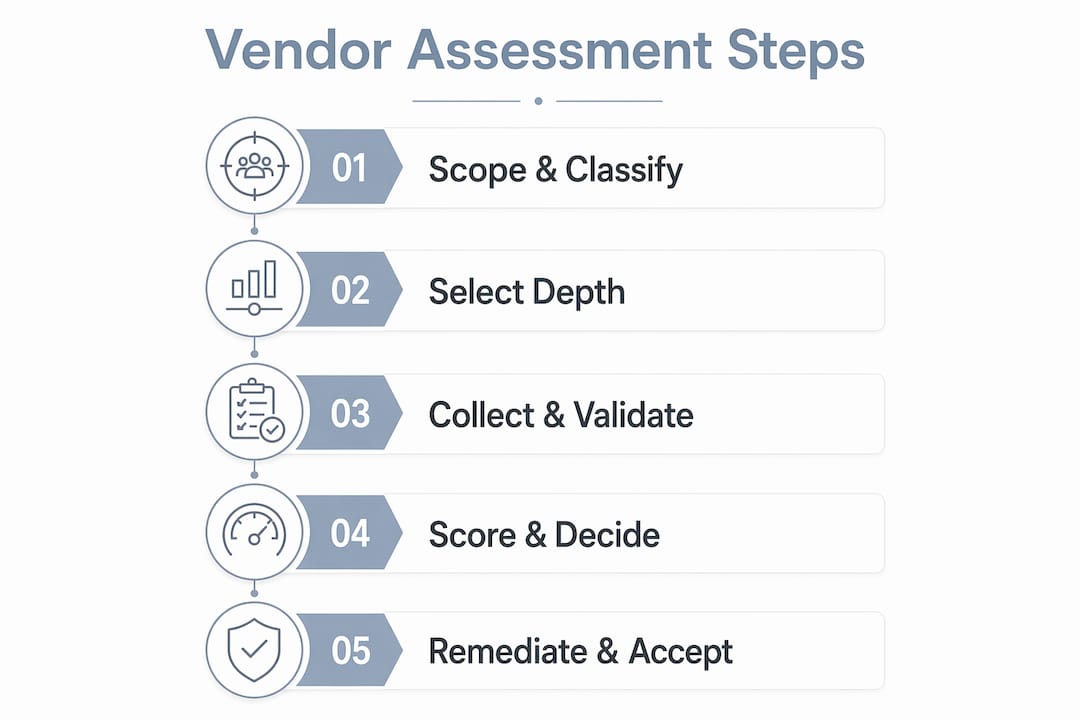
A repeatable assessment workflow has five steps. Skipping any step creates gaps that surface during audits or, worse, during incidents.

Step 1: Scope and classify
Identify what data the vendor will access, what services they will provide, and what your operational dependency looks like. Assign a risk tier (critical, high, moderate, low) based on data classification, access level, and criticality. This classification determines everything that follows.
Step 2: Select assessment depth
| Risk Tier | Assessment Type | Evidence Pack |
|---|---|---|
| Critical | Full assessment | SOC 2 Type II, ISO 27001, pen test, BC/DR, DPA/BAA, full questionnaire |
| High | Standard assessment | SOC 2 or ISO, pen test summary, DPA, core + security questionnaire |
| Moderate | Light assessment | Core questionnaire, DPA, self-attestation |
| Low | Minimal | DPA (recommended), data access confirmation |
Step 3: Distribute, collect, and validate
Send the questionnaire and evidence request to the vendor with a defined response deadline (10–15 business days is reasonable for a full assessment). When responses arrive, validate them. A vendor that claims MFA is enforced should be able to provide a configuration screenshot for your specific account or tenancy. Compliance evidence must be documented and repeatable, not just asserted.
Step 4: Score and decide
Score responses by category using a weighted rubric. A practical starting point:
| Category | Weight | Scoring Guidance |
|---|---|---|
| Data security controls | 30% | Independent attestation = full marks; self-attestation only = partial; no evidence = zero |
| Privacy and data handling | 25% | DPA signed, residency confirmed, sub-processors disclosed |
| Resilience and availability | 20% | BC/DR plan recently tested, RTO/RPO defined |
| Incident response | 15% | Notification SLA defined, process documented, tested |
| Contractual compliance | 10% | All required clauses present and signed |
A score above 80% typically supports acceptance. 60–79% triggers a remediation plan before go-live. Below 60% warrants escalation to the business owner and legal, and may mean declining the vendor or delaying onboarding until gaps are resolved.
Step 5: Remediate, accept, or escalate
For vendors scoring in the remediation band, document specific gaps, assign remediation owners, and set a deadline (typically 30–60 days for critical gaps). Re-assess the affected categories after remediation. If a vendor cannot or will not remediate a critical gap, escalate to the business owner with a written risk summary. The business owner, not the compliance team, accepts residual risk in writing.
Pro Tip: Never accept a vendor's generic "we are SOC 2 compliant" statement as evidence. Request the actual report, read the scope section, and check whether the services you are procuring fall within it. A surprising number of vendors hold certifications that exclude their newest or most relevant product lines.
The role of procurement in cybersecurity is to execute contracts and manage timelines, but technical and compliance teams must own the control validation.
How often should you review vendors, and what records do you keep?
Review cadence by risk tier
| Risk Tier | Scheduled Review | Continuous Monitoring | Trigger-Based Review |
|---|---|---|---|
| Critical | Quarterly | Yes (automated alerts) | Any breach, ownership change, or certification lapse |
| High | Semi-annual | Recommended | Material change in services or data access |
| Moderate | Annual | Optional | Contract renewal, significant scope change |
| Low | Biennial or at renewal | No | Scope change only |
Healthcare IT vendor assessments should follow the critical or high cadence for any vendor handling PHI, given the sensitivity of the data and the regulatory consequences of a breach under provincial health privacy legislation.
Evidence retention
Retain the following for a minimum of seven years, or longer if your sector requires it:
- Executed DPAs and BAAs
- Completed vendor questionnaires and assessment reports
- SOC 2 and ISO 27001 reports received at each review cycle
- Penetration test summaries and remediation confirmations
- Scorecard outputs and decision records (including risk acceptance sign-offs)
- Incident notification records and response timelines
Canada-specific notes
Quebec's Law 25 requires that any cross-border transfer of personal information be preceded by a privacy impact assessment (PIA) confirming that the receiving jurisdiction offers adequate protection. For vendors storing or processing data outside Canada, document the PIA and retain it alongside the DPA. Ontario's PHIPA and equivalent provincial statutes require a BAA for any vendor that will access, use, or disclose personal health information on your behalf. For federal organisations and critical infrastructure operators, NIST SP 800-161r1 provides a supply chain risk management framework that maps well to Canadian regulatory expectations and supports audit-ready documentation.
Sample onboarding and review timeline:
- Day 0: Vendor identified, risk tier assigned, evidence request sent
- Day 10–15: Vendor questionnaire and documents received
- Day 20: Assessment scored, gaps documented
- Day 30: Remediation plan agreed (if required) or acceptance signed
- Day 60: Remediation verified (critical gaps) or first monitoring alert configured
- Month 3 (critical vendors): First quarterly review initiated
Vendor risk changes continuously. Continuous monitoring is not a luxury for critical vendors; it is the mechanism that catches the incidents your scheduled reviews would miss.
Key takeaways
A risk-tiered vendor compliance assessment, backed by independent attestation and documented evidence, is the only approach that holds up under regulatory scrutiny and protects your organisation when a vendor fails.
| Point | Details |
|---|---|
| Risk-tier first | Classify every vendor before selecting assessment depth; the tier determines evidence requirements and review frequency. |
| Minimum evidence for critical vendors | Always request a current SOC 2 Type II report, signed DPA or BAA, penetration test summary, and documented incident response SLAs. |
| Review cadence matters | Critical vendors need quarterly reviews plus continuous monitoring; moderate vendors annually; low-tier vendors at renewal. |
| Remediation triggers escalation | Scores below 60% require written escalation to the business owner; residual risk acceptance must be documented in writing. |
| AccountNext-Nexus | Supports the full assessment cycle, from evidence collection and questionnaire distribution through continuous monitoring and remediation tracking. |
Why the compliance checkbox is the wrong mental model
The conventional framing of vendor compliance as a procurement gate, something you clear once and then file, is the source of most third-party risk failures. The vendors that cause the most damage are rarely the ones that failed your initial assessment. They are the ones that passed it, then changed.
Ownership changes. Certifications lapse. A key engineer leaves and the security programme quietly degrades. A new product feature is deployed that falls outside the original SOC 2 scope. None of these events trigger a vendor-initiated notification, and none of them show up in the questionnaire you collected 18 months ago.
The more useful mental model is that compliance sign-off at onboarding is a starting position, not a destination. The assessment tells you where the vendor stood on a specific date. Continuous monitoring and scheduled reviews tell you where they stand now. For regulated functions, the compliance team is effectively co-signing how that function is executed every day the vendor relationship continues. That is a different level of accountability than a one-time gate.
What most organisations underinvest in is the evidence validation step. Questionnaire responses are easy to generate and easy to inflate. The organisations that catch real gaps are the ones that ask for configuration screenshots, tenancy-specific attestations, and named third-party test firms rather than accepting a generic "yes, we do that" response. That follow-up takes an extra hour per vendor. It is the hour that matters.
How AccountNext-Nexus supports your vendor compliance programme
Vendor compliance assessments are only as strong as the team and tools behind them. For many compliance and procurement teams, the bottleneck is not knowing what to ask; it is having the capacity to validate responses, track evidence across dozens of vendors, and maintain continuous monitoring without adding headcount.
AccountNext-Nexus consolidates IT, cybersecurity, and compliance services under one programme, which means your vendor assessments, monitoring alerts, and incident response workflows are coordinated rather than siloed. The team brings direct experience with SOC 2, ISO 27001, and NIST-aligned assessments, and can support evidence collection, questionnaire distribution, scorecard development, and remediation tracking for vendors at any risk tier. For organisations in regulated sectors, AccountNext-Nexus also assists with DPA and BAA review and cross-border data flow documentation.
Ready to build a repeatable, audit-ready vendor compliance programme? Request an assessment or visit AccountNext-Nexus to speak with a compliance specialist.
Useful sources for further reading
The sources below offer templates, regulatory crosswalks, and framework guidance for teams building or refining their vendor compliance programme.
- NIST SP 800-161r1 — The definitive U.S. federal guidance on supply chain risk management, widely used by Canadian federal and critical infrastructure organisations. Best for framework alignment and audit-ready control mapping.
- AICPA SOC Suite of Services — Authoritative source on SOC 1, SOC 2, and SOC 3 report types, scope, and what each covers. Use this to understand what you are actually receiving when a vendor provides an attestation report.
- Vendor Risk Assessment Toolkit — SecureEveryone — Practical templates for evidence collection, contractual clauses, and audit documentation. Good starting point for teams building their first formal programme.
- Vendor Risk Assessment Questionnaire Guide — LearnTPRM — Detailed guidance on modular questionnaire design, scoring rubrics, and question counts by risk tier.
- Building Vendor Risk Frameworks for Healthcare IT — Censinet — Sector-specific guidance for healthcare IT vendor assessments, including cadence recommendations and PHI-related obligations. Relevant for any Canadian organisation subject to PHIPA or equivalent provincial health privacy legislation.
- The Role of Compliance in Vendor Vetting — GovRAMP — Useful framing for government and public-sector organisations on why compliance vetting is a risk management function, not a procurement formality.
- Types of Third-Party Cybersecurity Risks — AccountNext-Nexus Blog — Practical overview of supply chain and third-party risk categories, useful for scoping which vendor relationships warrant the deepest assessment.
- Enterprise Incident Response Checklist — AccountNext-Nexus Blog — Reference for defining and validating vendor incident response SLAs and breach notification requirements during the assessment process.