
A cybersecurity maturity model is a structured framework that measures how well an organisation's security controls are embedded, operated, and improved over time. Unlike a compliance checklist, it defines progressive capability levels so leaders can see exactly where their security programme stands and where it needs to go. Three frameworks dominate the space in 2026: CMMC 2.0, NIST CSF 2.0, and DOE C2M2. Each uses a tiered scale to move organisations from reactive, ad hoc security toward repeatable, continuously improving practices. Understanding what a cybersecurity maturity model is, and how to apply one, is the starting point for any serious security investment.
What is a cybersecurity maturity model and how does it work?
A cybersecurity maturity model measures how security controls are embedded and operated in practice, not just documented. The distinction matters enormously. A firewall policy reviewed quarterly, tested against current threat intelligence, and updated accordingly is mature. A policy untouched since 2019 is not, regardless of whether it appears on a compliance checklist.
The model works by assigning maturity levels to specific security domains, such as access control, incident response, and risk management. Assessors evaluate each domain against defined criteria, then score the organisation's current state. The result is a capability map that shows strengths, gaps, and a prioritised path forward.

Maturity models differ from compliance audits in a fundamental way. A compliance audit verifies that a control exists at a point in time. A maturity model evaluates whether that control is effective, consistent, and improving. Passing an audit does not mean your organisation is mature. It means your documentation was in order on audit day.
The frameworks also share a common logic: progression. Every model moves organisations from an initial, unmanaged state toward a defined, optimised one. The labels change across frameworks, but the underlying principle does not.
What are cybersecurity maturity levels across leading frameworks?
Three primary frameworks dominate cybersecurity maturity modelling: CMMC 2.0, NIST CSF 2.0, and DOE C2M2. Most use a 3–5 level scale to guide organisations from reactive to optimised security. The progression logic is consistent across all three, even though the labels differ.
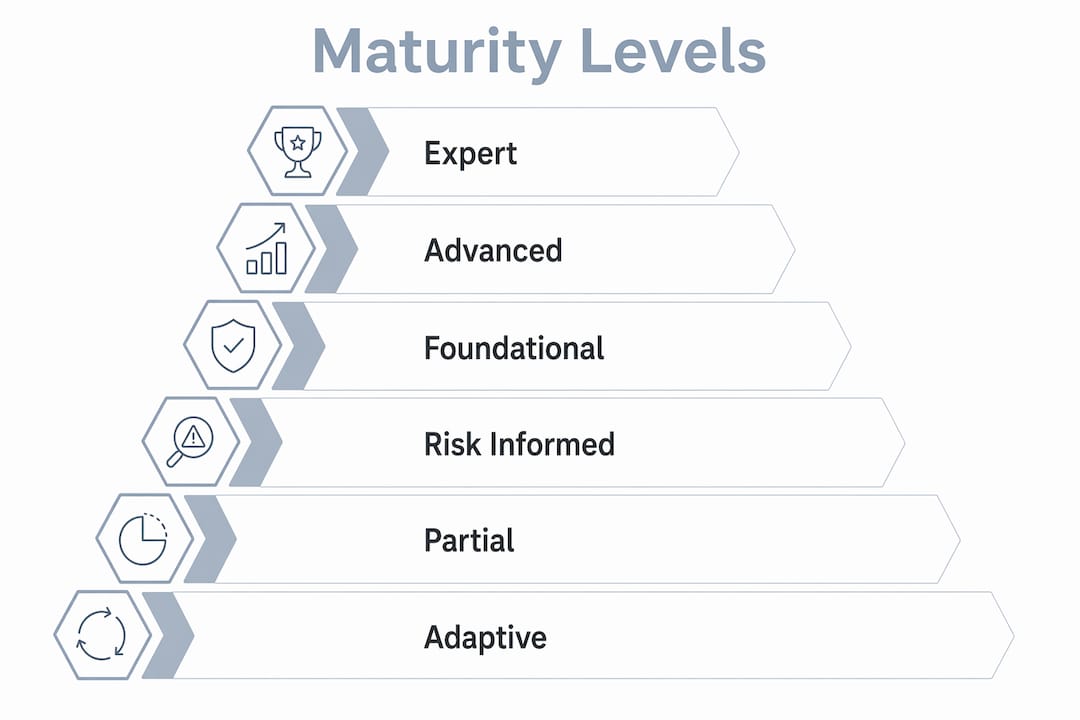
CMMC 2.0 applies to organisations in the U.S. defence supply chain and uses three levels: Foundational, Advanced, and Expert. NIST CSF 2.0 uses four implementation tiers: Partial, Risk Informed, Repeatable, and Adaptive. DOE C2M2 uses four Maturity Indicator Levels, commonly called MILs, ranging from MIL1 to MIL4. Each level represents a meaningful jump in how consistently and deliberately security practices are applied.
| Framework | Levels | Top Level Name | Primary Use Case |
|---|---|---|---|
| CMMC 2.0 | 3 | Expert | U.S. defence contractors |
| NIST CSF 2.0 | 4 | Adaptive | Broad industry use |
| DOE C2M2 | 4 | MIL4 | Energy sector organisations |
The table above shows that level labels differ but the progression logic is consistent. An organisation at the top level in any framework has moved from reacting to incidents to anticipating and adapting to threats proactively.
Pro Tip: Start with NIST CSF 2.0 if your organisation is new to maturity modelling. Its four tiers are broadly applicable, well documented, and map cleanly to other regulatory frameworks you likely already reference.
Understanding where your organisation sits on this scale gives leadership a concrete, defensible position when discussing security investment. It replaces vague claims about being "secure" with a specific, evidence-based capability rating.
How does a maturity assessment differ from a compliance audit?
Compliance audits verify control existence at a moment in time, while maturity assessments evaluate how effectively controls operate consistently across an enterprise. This is not a subtle difference. It changes what you learn, what you fix, and how much protection you actually have.
A compliance audit answers the question: "Do you have this control?" A maturity assessment answers: "Does this control work, does it work every time, and is it getting better?" An organisation can pass a SOC 2 audit while still having an incident response plan that nobody has tested in three years.
High maturity scores ease compliance audits by embedding processes into daily operations. When controls are consistently applied and regularly tested, audit preparation becomes a documentation exercise rather than a scramble. The compliance benefit is real, but it is a byproduct of genuine maturity, not the goal itself.
Common misconceptions include:
- Compliance equals security. Documented controls that are never tested provide false confidence.
- Certification means maturity. Certifications confirm a point-in-time state. Maturity is ongoing.
- Maturity is only for large enterprises. Frameworks like NIST CSF 2.0 scale to organisations of any size.
- Higher maturity always requires more budget. Moving from Level 1 to Level 2 often requires process discipline more than new tools.
Pro Tip: After any compliance audit, run a maturity gap analysis against the same controls. You will almost always find controls that passed the audit but are inconsistently applied in practice. That gap is your real risk.
How to evaluate cybersecurity maturity: the assessment process
A cybersecurity maturity assessment involves five core steps: scope definition, framework mapping, capability evaluation, validation through offensive testing, and roadmap creation. Each step builds on the last, and skipping any one of them produces an incomplete picture.
- Define scope. Identify which business units, systems, and data types the assessment will cover. Scope creep is the most common reason assessments stall before producing results.
- Map to a framework. Select CMMC 2.0, NIST CSF 2.0, DOE C2M2, or another recognised model based on your industry and regulatory context. This gives the assessment a consistent measurement standard.
- Evaluate current capabilities. Review policies, interview staff, observe processes, and examine technical configurations. The goal is to determine how controls actually function, not how they are described in documentation.
- Validate through offensive testing. Self-assessment is prone to bias. Penetration testing and red team exercises confirm whether your reported maturity reflects security reality. Without this step, gaps remain hidden until an attacker finds them.
- Build a prioritised roadmap. The output is not a score. It is a risk-ranked list of improvements tied to business objectives and budget cycles.
The assessment cycle is iterative. Organisations that treat it as a one-time project consistently fall behind those that schedule reassessments annually or after major infrastructure changes. Connecting the roadmap to business objectives also makes budget conversations with leadership far more productive. You are not asking for security spending. You are presenting a risk reduction plan with measurable milestones.
Pro Tip: Pair your maturity roadmap with your annual budget cycle. Presenting security investments as risk reduction tied to specific maturity improvements gives finance and the board a concrete framework for approval decisions.
Reviewing common employee cybersecurity vulnerabilities alongside your capability evaluation often surfaces gaps that technical assessments miss, particularly in access management and phishing susceptibility.
Why cybersecurity maturity models matter for business strategy
Maturity models give CISOs a common language to communicate cybersecurity risk and resource needs aligned with business objectives. That language matters because security teams and boards often speak entirely different dialects. A maturity score translates technical risk into a business-level conversation.
Advanced maturity often involves CISO participation in strategic board-level meetings. This is not coincidental. When security is measured, tracked, and tied to business outcomes, it earns a seat at the table where resource decisions are made.
The practical benefits of applying a cybersecurity maturity framework include:
- Regulatory alignment. Cross-mapping maturity models with HIPAA or GDPR allows concurrent compliance and maturity progress without redundant effort. One assessment cycle can satisfy multiple regulatory requirements.
- Resource prioritisation. Maturity scores reveal which domains need investment most urgently, preventing budget from flowing to already-strong areas while critical gaps go unfunded.
- Vendor and partner assurance. A documented maturity level gives procurement teams and partners evidence of security capability without requiring full technical disclosure.
- Incident response readiness. Organisations at higher maturity levels have tested, documented, and rehearsed their incident response plans. Response times are faster and damage is contained more effectively.
Effective use of maturity models ties cybersecurity resilience directly to business objectives through leadership engagement at the board level. Maturity is not a destination. It is an ongoing risk management programme that grows alongside the organisation. Understanding your cloud security posture is one practical area where maturity model principles apply directly, particularly as more organisations move critical workloads off-premises.
Key takeaways
A cybersecurity maturity model is the most effective tool for translating security capability into business risk language that leaders can act on and fund.
| Point | Details |
|---|---|
| Maturity vs. compliance | Maturity measures control effectiveness over time; compliance only verifies control existence at a point in time. |
| Three leading frameworks | CMMC 2.0, NIST CSF 2.0, and DOE C2M2 each use 3–4 levels with consistent progression logic. |
| Validation is non-negotiable | Penetration testing and red teaming confirm whether self-assessed maturity reflects actual security capability. |
| Assessment is iterative | Annual reassessments tied to business objectives produce better outcomes than one-time evaluations. |
| Board-level language | Maturity scores give CISOs a concrete, evidence-based framework for budget and risk conversations with leadership. |
Why I stopped treating maturity scores as the goal
After working with organisations across multiple industries, the pattern I see most often is this: a team completes a maturity assessment, receives a score, and then spends the next 18 months trying to raise that score. The score becomes the objective. That is exactly backwards.
The score is a diagnostic tool. The objective is a security programme that actually reduces risk to the business. I have seen organisations reach Level 3 on CMMC 2.0 while still failing basic phishing simulations because they focused on documentation rather than behaviour change. The framework gave them a passing grade. The threat actors would not.
The organisations that get the most value from maturity models are the ones that use the roadmap, not just the score. They take the gap analysis, connect it to their top three business risks, and fund improvements in that order. They also validate. Every time. Offensive testing is not optional if you want an honest picture of where you stand.
My strongest recommendation for leadership teams is to stop asking "what is our maturity level?" and start asking "what does our maturity level tell us about our actual exposure?" That shift in framing changes how security teams prioritise work and how boards allocate budget. It also makes the entire programme more defensible when something goes wrong, because you can show the board a documented, risk-based improvement plan rather than a score that did not prevent an incident.
— Nick, Sr. Executive
How AccountNext-Nexus supports your security maturity programme
Building and maintaining a security maturity programme requires more than a framework. It requires consistent execution, real-time visibility, and the technical depth to validate what your assessments reveal.

AccountNext-Nexus delivers 24/7 threat detection and monitoring that aligns directly with the continuous improvement principles at the core of every major maturity framework. Whether your organisation is working toward CMMC 2.0 compliance, advancing through NIST CSF 2.0 tiers, or preparing for a DOE C2M2 assessment, AccountNext-Nexus provides the managed security expertise to close gaps, validate controls, and keep your programme moving forward. Explore the full range of IT and cybersecurity solutions to see how consolidated security services reduce both risk and operational complexity.
FAQ
What is a cybersecurity maturity model in simple terms?
A cybersecurity maturity model is a framework that defines progressive levels of security capability, from ad hoc and reactive to defined, repeatable, and continuously improving. It helps organisations measure where they are and plan where to go next.
What are the main cybersecurity maturity levels?
Most frameworks use 3–5 levels. CMMC 2.0 uses Foundational, Advanced, and Expert. NIST CSF 2.0 uses Partial, Risk Informed, Repeatable, and Adaptive. DOE C2M2 uses four Maturity Indicator Levels (MIL1 through MIL4).
How does a cybersecurity maturity assessment work?
An assessment defines scope, maps to a recognised framework, evaluates current capabilities, validates findings through offensive testing such as penetration testing, and produces a prioritised improvement roadmap tied to business objectives.
Why is a cybersecurity maturity model important for compliance?
High maturity embeds controls into daily operations, which makes compliance audits faster and more reliable. Cross-mapping a maturity model with frameworks like HIPAA or GDPR allows organisations to satisfy multiple regulatory requirements through a single assessment cycle.
How often should an organisation conduct a maturity assessment?
Organisations should reassess annually at minimum, and after any major infrastructure change, merger, or significant security incident. Maturity is an ongoing programme, not a one-time certification.