
Cyber threat evolution is the continuous process by which attackers refine their tools, tactics, and targets to outpace existing defences. The pace of that evolution has accelerated sharply. AI-enabled adversaries increased activity by 89% year on year, with attack breakout times falling to just 29 minutes in 2025. That figure means a threat actor can move from initial access to full network compromise before most IT teams have finished their morning stand-up. The Verizon Data Breach Investigations Report 2025 confirms that 60% of breaches still involve a human element, proving that even the most sophisticated attackers rely on the oldest trick: exploiting people. Understanding how cyber attacks change is no longer optional for business owners and IT managers. It is the foundation of every sound security decision.
How do cyber threats evolve? The key shifts since 2020
Cyber threat evolution is not random. Attackers follow money, opportunity, and the path of least resistance. When defences improve in one area, threat actors pivot to another. The shifts since 2020 have been significant and worth mapping clearly.
Traditional attacks relied on brute force and opportunistic malware. Modern attacks are far more targeted. Phishing has moved from generic mass emails to highly personalised messages generated by AI, making them nearly indistinguishable from legitimate correspondence. Phishing-as-a-service platforms have industrialised this process, allowing low-skill criminals to rent ready-made attack toolkits on a subscription basis. The result is a massive increase in attack volume without a corresponding increase in attacker expertise.

Supply chain risk has grown dramatically. Supply chain and third-party breaches have quadrupled over five years, meaning your organisation's security is now only as strong as your weakest vendor. Credential theft remains a persistent problem, with credential abuse accounting for 22% of breaches despite widespread awareness of the risk.
The major shifts in how cyber attacks change include:
- AI-generated phishing that mimics writing style, tone, and context with high accuracy
- Ransomware-as-a-service models that allow affiliates to deploy attacks without technical knowledge
- Multi-stage supply chain attacks that compromise trusted software before it reaches the end user
- Credential stuffing at scale using automated tools against stolen username and password databases
- Social engineering via deepfake audio and video to impersonate executives and authorise fraudulent transfers
- MFA bypass techniques that intercept authentication tokens in real time
Each of these represents a deliberate adaptation by threat actors to the defences businesses have built. That pattern of adaptation is the defining feature of how cyber risks develop over time.
How is AI transforming the cyber threat landscape?
AI has changed the economics and the capability ceiling of cyberattacks simultaneously. Previously, a sophisticated multi-stage attack required a skilled team with deep technical knowledge. That barrier no longer exists at the same level.
Frontier AI models like GPT 5.5 Cyber enable multi-step reasoning that maps entire attack chains, lowering the skill barrier for complex cyberattacks. An attacker can now describe a target environment and receive a detailed plan for exploitation. That capability, once reserved for nation-state actors, is now accessible to organised criminal groups and even individuals.
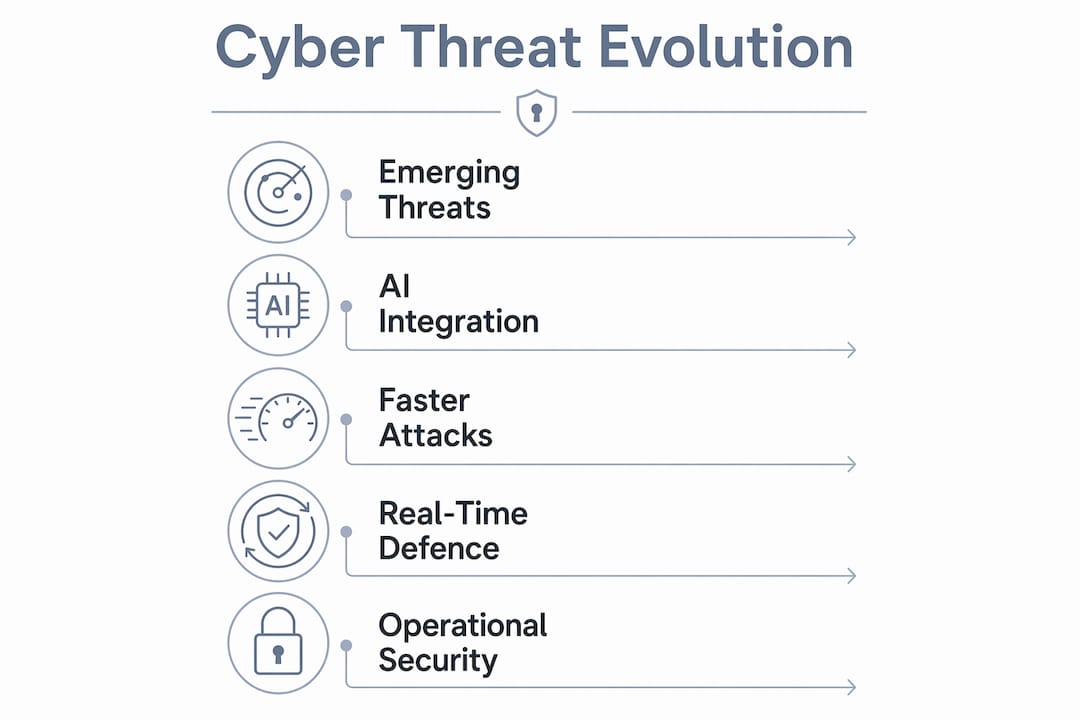
AI also erodes the predictability that traditional security models depend on. AI systems operate autonomously and interact dynamically with other systems, challenging the assumption that threats behave in known, detectable patterns. A signature-based detection tool looks for known bad behaviour. An AI-driven attacker generates novel behaviour that has no prior signature. Prevention-only defence fails in that environment.
Attackers are also abusing the AI tools that businesses have built for legitimate purposes. Internal AI tools and development platforms have become major attack surfaces, exploited through compromised API keys, prompt injection, and model manipulation. A generative AI tool connected to your internal data is a high-value target. Most organisations have not yet built governance frameworks around these tools.
Pro Tip: Require your security team to complete structured AI literacy training, not just general cybersecurity training. Teams that understand how AI models work are far better positioned to identify when those models are being manipulated or abused.
Why speed and real-time defence are critical in 2026
Speed has moved from being an operational metric to being a core security control. Adapting security posture as quickly as AI-enabled threats evolve is now a fundamental requirement, not a best practice. The gap between when an attacker enters your environment and when your team detects it determines the scale of the damage.
Some intrusions now occur within seconds, with data exfiltration beginning minutes after initial access. That timeline leaves no room for manual detection and response processes. Organisations that rely on weekly vulnerability scans and monthly security reviews are operating on a schedule that attackers have already outpaced.
The challenge is compounded by AI systems that change their own behaviour after deployment. A security control validated at the time of deployment may be ineffective against the same system six weeks later. Over-reliance on static, pre-deployment security controls fails to address the runtime risks posed by AI agents interacting unpredictably with your environment. Continuous observability is the only answer.
| Security dimension | Past approach | Current requirement |
|---|---|---|
| Breach detection time | Days to weeks | Minutes to hours |
| Attack breakout time | Hours to days | 29 minutes or less |
| Vulnerability scanning | Weekly or monthly | Continuous, real-time |
| Threat response | Manual investigation | Automated, immediate containment |
| Security posture review | Quarterly | Ongoing, adaptive |
Pro Tip: Implement endpoint detection and response tools that operate autonomously. Waiting for a human to review an alert before acting is no longer a viable model when attackers move in under 30 minutes. Learn how endpoint detection and response works to evaluate your current gap.
What practical steps can businesses take against evolving threats?
The most important mindset shift is moving from prevention to containment. Prevention assumes you can stop every attack. Containment assumes some attacks will succeed and focuses on limiting the damage. Both are necessary, but containment is the one most organisations underinvest in.
Here are the priority steps for effective modern cyber defence:
-
Adopt continuous monitoring. Replace periodic scans with real-time visibility across your network, endpoints, and cloud environments. Threats that go undetected for hours cause exponentially more damage than those caught in seconds.
-
Secure your AI tools and development platforms. Audit every AI tool connected to internal data. Apply access controls, monitor API usage, and establish clear governance policies. Your AI stack is now part of your attack surface.
-
Reduce employee vulnerability. Social engineering remains the entry point for the majority of breaches. Invest in regular, realistic phishing simulations and training programmes. Review the most common employee vulnerabilities your organisation faces and address them systematically.
-
Enforce multi-factor authentication with phishing-resistant methods. Standard SMS-based MFA is now routinely bypassed. Move to hardware security keys or app-based authenticators that resist token interception.
-
Build a vendor risk programme. Given that supply chain breaches have quadrupled, every third-party tool or service connected to your environment requires a security assessment. Treat vendor access as an extension of your own attack surface.
-
Invest in your enterprise vulnerability management process. A structured programme that identifies, prioritises, and remediates vulnerabilities continuously is far more effective than reactive patching.
-
Test your incident response plan. Run tabletop exercises that simulate AI-accelerated attack scenarios. Your team needs to practise making decisions in compressed timeframes before a real incident forces them to.
The organisations that handle emerging cyber threats well share one trait: they treat security as an ongoing operational discipline, not a one-time project. Static defences built for yesterday's threat actors will not hold against today's automated, AI-assisted attacks.
Key takeaways
Cyber threat evolution is driven by AI-enabled automation, faster attack timelines, and expanding attack surfaces that require continuous, real-time defence rather than static prevention models.
| Point | Details |
|---|---|
| AI lowers attacker skill barriers | Frontier AI models enable complex, multi-step attacks without deep technical expertise. |
| Human element remains the top entry point | 60% of breaches involve phishing or social engineering, making staff training non-negotiable. |
| Speed is now a security control | Attack breakout times have fallen to 29 minutes, making real-time detection mandatory. |
| AI tools are attack surfaces | Internal generative AI platforms require governance, monitoring, and access controls. |
| Supply chain risk has quadrupled | Third-party vendor access must be assessed and monitored as part of your core security programme. |
The uncomfortable truth about where cyber defence is heading
Nick, Sr. Executive
I have spent years watching organisations invest heavily in perimeter defences and then express genuine surprise when attackers walk straight through them via a compromised vendor or a well-crafted phishing email. The uncomfortable truth is that the perimeter never was the whole story. AI has simply made that fact impossible to ignore.
What concerns me most right now is not the sophistication of the attacks themselves. It is the pace at which the gap between attacker capability and defender readiness is widening. Most security teams are still operating on quarterly review cycles while attackers are iterating daily. That mismatch is the real vulnerability.
The organisations I see handling this well are not necessarily the ones with the biggest security budgets. They are the ones that have built a culture of continuous learning and rapid adaptation. Their security teams understand AI, not just as a defence tool, but as an attack vector. Their business leaders treat cyber readiness as a board-level conversation, not an IT department problem.
My practical advice is this: stop measuring your security programme by the controls you have in place and start measuring it by how quickly you can detect and contain a breach. That shift in metric changes everything about how you prioritise investments, staff your team, and evaluate your tools. The future of cyber defence belongs to organisations that are fast, not just fortified.
— Nick, Sr. Executive
How AccountNext-Nexus helps you stay ahead of evolving threats
The cyber threat landscape is not going to slow down. Attackers will continue to adopt AI faster than most organisations can respond, and the window between breach and damage will keep shrinking.

AccountNext-Nexus provides 24/7 monitoring and threat detection designed for exactly this environment. Real-time visibility, autonomous threat containment, and compliance management are delivered under one programme, so your team is not stitching together fragmented tools while attackers move at machine speed. AccountNext-Nexus works with business owners and IT managers to build adaptive security programmes that evolve as the threat actors do. Contact AccountNext-Nexus to discuss a protection strategy built for the pace of modern attacks.
FAQ
How fast do cyber threats evolve today?
Cyber threats now evolve at machine speed. AI-enabled attack breakout times have fallen to 29 minutes, meaning attackers can move from initial access to full compromise faster than most manual response processes can react.
What is the biggest driver of cyber threat evolution?
Artificial intelligence is the primary driver. AI lowers the skill barrier for complex attacks, automates phishing at scale, and enables multi-step attack planning that previously required expert-level knowledge.
Why do phishing attacks still work despite widespread awareness?
Phishing-as-a-service platforms and AI-generated content have made phishing messages highly personalised and contextually accurate. The Verizon Data Breach Investigations Report 2025 confirms that 60% of breaches still involve a human element, which reflects how effective these techniques remain.
Are AI tools inside my organisation a security risk?
Yes. Internal AI tools and development platforms have become primary attack surfaces. Threat actors exploit compromised API keys and prompt injection techniques to access internal data through tools your organisation built for legitimate use.
What is the single most important defence shift for 2026?
Moving from static, prevention-only security to continuous, real-time monitoring and containment is the most critical shift. Speed of detection and response is now a core security control, not just an operational goal.