
Consolidation makes sense once your security stack has more vendors than your team can meaningfully manage, when integration overhead is eating hours your analysts don't have, or when compliance auditors keep flagging the same visibility gaps. It rarely makes sense for the specialist tool catching threats nobody else sees. The right call almost always balances real operational savings against the loss of best-of-breed depth, not one or the other.
TL;DR:
- Consolidation is advisable when managing more than 15 to 20 security tools with overlapping functions that rarely communicate, leading to inefficiencies.
- Contract renewal timing, pending audits, or repeated integration failures should prompt evaluation for consolidation to reduce operational complexity.
- A vendor inventory and capabilities matrix are critical first steps; skipping this often causes project stalls and unforeseen gaps.
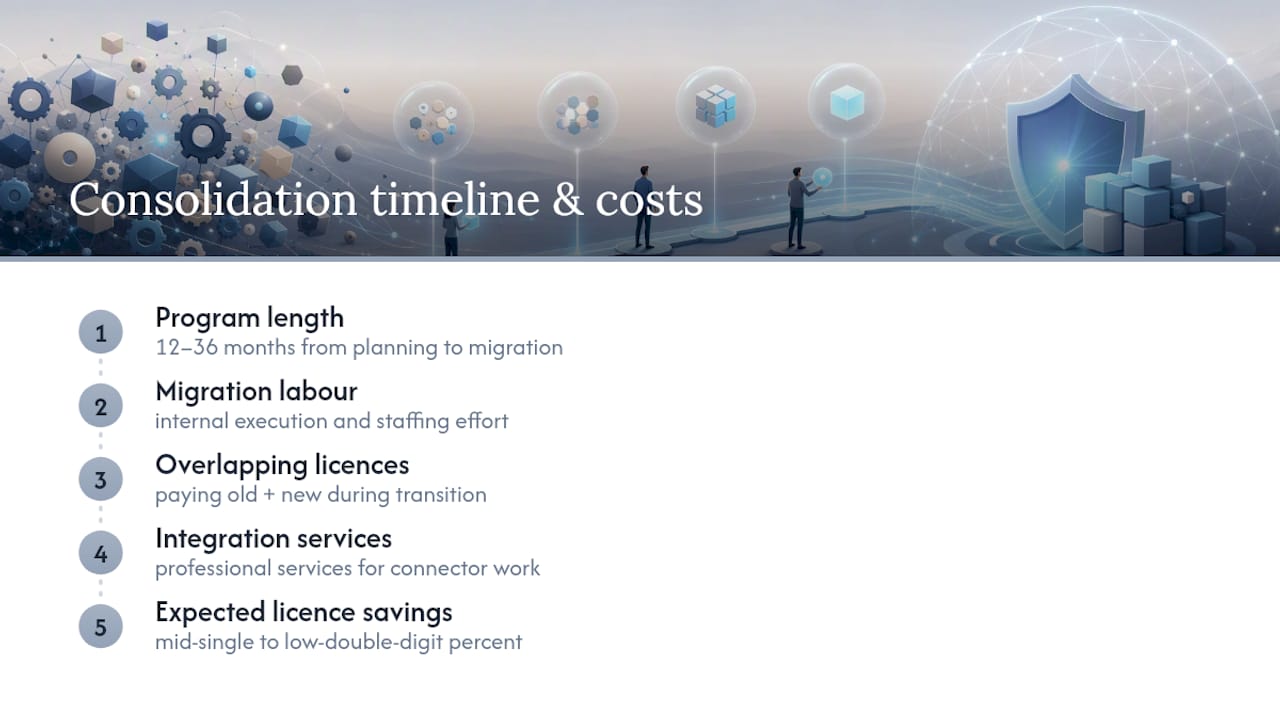
- Consolidation programs typically span 12 to 36 months, requiring budgeting for migration labor, overlapping licenses, and professional services, with savings in the low-double digits.
- Proper sequencing, validation, and clear ownership are necessary to prevent gaps, concentration risks, and vendor lock-in during migration.
Table of Contents
- What is security vendor consolidation and why does it matter now?
- How do you know it's time to consolidate?
- A step-by-step planning playbook for consolidation
- What can go wrong, and how do you prevent it?
- How long does consolidation take, and what does it cost?
- Implementation checklist for a smooth migration
- How Nexus approaches vendor consolidation
- The one planning decision that determines consolidation success
- Ready to consolidate without losing coverage?
- Sources
- FAQ
What is security vendor consolidation and why does it matter now?
Security vendor consolidation means reducing the number of separate security tools and providers a company relies on, replacing a patchwork of point solutions with fewer, broader platforms or a single managed partner. The interest is no hype. A Gartner survey found 75% of organisations were pursuing vendor consolidation in 2022, up sharply from just 29% in 2020.
That shift reflects operational reality more than budget pressure. Security teams running a dozen or more disconnected tools spend a disproportionate share of their week stitching data together instead of acting on it.
Operational benefits:
- Centralised policy management across endpoints, cloud, and network instead of a dozen separate consoles
- Fewer integration points, which means fewer places for alerts to fall through the cracks
- Simplified vendor management and single-point accountability during incidents
Financial and strategic benefits show up in negotiating leverage and lower administrative overhead. Consolidation programs commonly deliver savings in the mid-single to low-double-digit percent range on addressable spend, though cost is rarely the leading motivator compared to improved visibility and reduced integration toil.
The trade-offs are just as real: concentration risk if one vendor has an outage or breach, coverage gaps if a niche capability gets dropped in the transition, and vendor lock-in that can weaken your negotiating position down the road.
How do you know it's time to consolidate?
Deciding isn't a gut call. A handful of measurable signals tell you whether now is the right window.
- Count your vendors and map overlap. If you're running more than 15 to 20 security tools with duplicate licences or telemetry that never talks to each other, you likely have consolidation-ready waste.
- Check your business drivers. An approaching SOC 2 or HIPAA audit, a cloud migration to AWS or Azure, or headcount pressure on the security team all tip the scale toward action.
- Watch for integration failures. Repeated broken integrations, inconsistent log formats across tools, or analysts manually correlating alerts between dashboards are signs the current stack has outgrown itself.
- Line up contract renewals. If three or four major security contracts expire within the same 12 to 18 months, that's a natural consolidation window without early-termination penalties.
If none of these apply and your current tools are performing well individually, you may be better served tightening integration between them rather than replacing them outright.
A step-by-step planning playbook for consolidation
Treat consolidation as a governed program, not a procurement sprint. The order matters.
- Build a full vendor inventory and capabilities matrix. List every security tool, its owner, its core function, and where it overlaps with another tool. TechTarget's CISO guidance treats this inventory as the non-negotiable first step, and skipping it is the single most common reason consolidation projects stall.
- Run a spend analysis using the 80/20 rule. Roughly 20% of your vendor relationships usually account for 80% of your addressable spend. Start there.
- Define governance and non-negotiables. Decide up front which functions require dual sourcing (email security, endpoint detection) regardless of consolidation pressure.
- Plan contract timing with procurement and legal. Align SLA terms, renewal dates, and exit clauses before signing anything new.
- Pilot before you commit. Validate that the new platform matches your existing telemetry and detection coverage, then migrate in stages tied to renewal dates rather than a single cutover weekend.
Pro Tip: Run your pilot against last quarter's actual incident data, not synthetic test cases. If the consolidated platform can't reproduce the alerts your old tools caught, you've found your gap before it costs you.
What can go wrong, and how do you prevent it?
Consolidation fails in predictable ways, and most failures trace back to skipped validation steps.
- Concentration risk: one vendor outage now affects multiple security functions at once. Mitigate this by keeping dual-source coverage for anything mission critical, and by testing failover before you need it.
- Coverage gaps: a platform replacing three point tools rarely matches all three feature-for-feature on day one. Validate telemetry and feature parity before decommissioning anything.
- Vendor health risk: a consolidated partner's financial stability and R&D investment matter more, not less, since you now depend on them for broader coverage. Check references and roadmap commitments before signing multi-year terms.
- Weak contract protections: ambiguous SLAs, no data portability clause, or a punitive termination fee can trap you with an underperforming platform for years.
Pro Tip: Never let a vendor decommission a legacy tool until its replacement has run in parallel for at least one full reporting cycle, ideally 30 to 60 days. That overlap period is where you catch the gaps a sales demo never shows you.
How long does consolidation take, and what does it cost?
Most consolidation programs run 12 to 36 months from planning to full migration, not weeks. That range surprises leaders who expect a quick platform swap. Gartner's research on consolidation timelines points to multi-year efforts, largely because contract cycles and integration complexity dictate the pace more than technical readiness does.
Budget for three cost buckets: migration labour, overlapping licence periods where you pay for old and new tools simultaneously, and professional services for integration work. On the return side, expect administrative savings and negotiated licence reductions in the mid-single to low-double-digit percent range of your addressable security spend, a figure consistent across multiple industry surveys.
Implementation checklist for a smooth migration
Sequencing prevents the worst outcomes. Follow this order rather than migrating everything at once.
- Sequence integrations by risk, not convenience. Move lower-risk functions first and run parallel systems where feasible instead of a single cutover.
- Preserve log continuity. Map event schemas between old and new tools so retention policies and audit trails survive the transition intact.
- Set acceptance tests and rollback triggers before migrating, not after something breaks. Define the exact monitoring thresholds that would trigger a rollback.
- Assign clear task ownership and communicate status weekly. Migration failures are as often about unclear accountability as they are about technology.
A centralized monitoring approach simplifies this sequencing considerably once the underlying platforms support it, and pairing consolidation with a zero trust roadmap tends to reduce the number of access control tools you need to migrate in the first place.
How Nexus approaches vendor consolidation
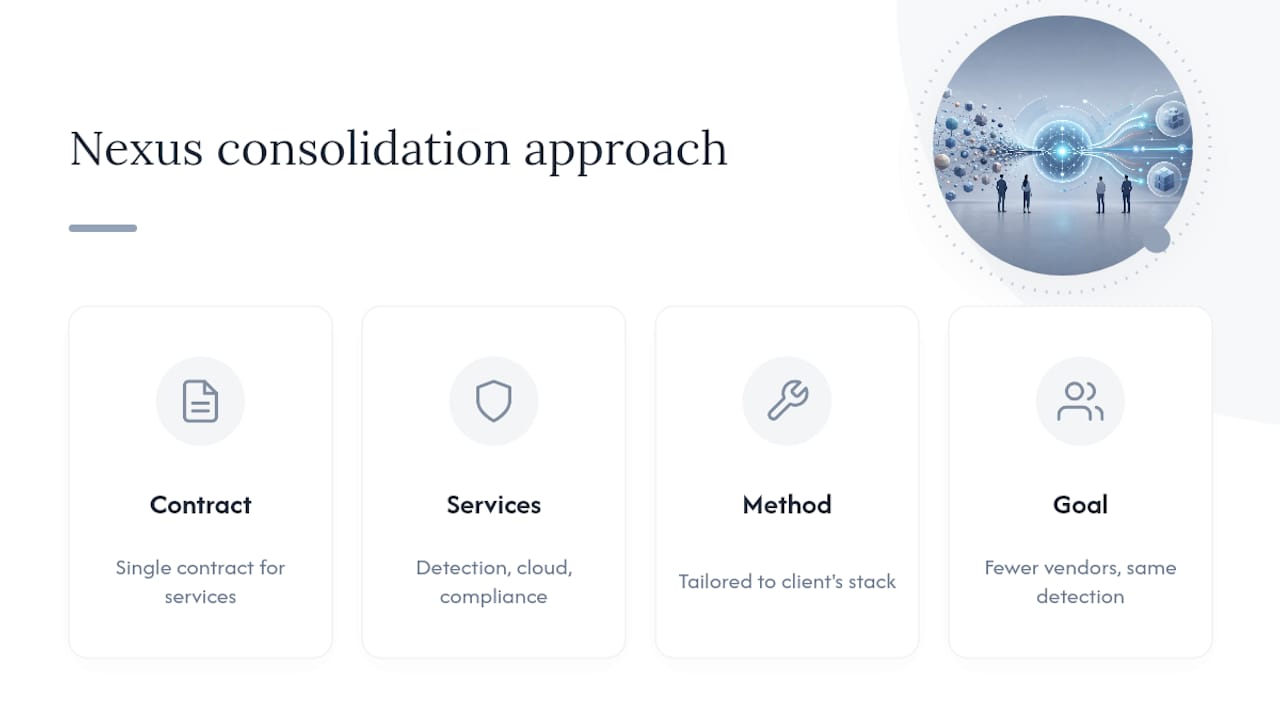
A provider consolidates fragmented security environments by delivering IT and cybersecurity services under one contract, covering real-time threat detection, cloud infrastructure management, and compliance work for standards like SOC 2 and HIPAA. Each engagement uses methodologies tailored to the client's existing stack rather than a one-size migration template, with the goal of cutting the number of vendor relationships a security team has to manage without cutting detection coverage.
The one planning decision that determines consolidation success
Most consolidation failures come down to governance, not technology. Whoever owns the contract renewal calendar owns the leverage. Assign that ownership early, keep dual-source protection on anything mission critical, and pilot before you cut over. The orchestration is the hard part, not the platform.
— Nick - Sr. Executive
Ready to consolidate without losing coverage?
Running a discovery workshop before you sign anything is the difference between a consolidation project that saves money and one that quietly creates blind spots. A managed services provider builds the vendor inventory, maps your capabilities matrix, and runs migration execution alongside monitoring and compliance support, so the transition happens without a gap in coverage.
Where a traditional consolidation project leaves a team managing procurement, integration testing, and rollback planning simultaneously, a managed services provider can run that work as one coordinated engagement rather than three separate workstreams to stitch together. That single point of accountability can shorten the timeline without cutting corners on validation. If your contract renewals are lining up in the next year, that's the window to act in. Book a discovery call with Nexus to map your current vendor stack and get a straight answer on whether consolidation makes sense for your environment right now.
Sources
- Most enterprises looking to consolidate security vendors | CSO
- Gartner press release: survey showing 75% pursuing consolidation
- 6 Tips for a Successful Security Vendor Consolidation | Akamai
FAQ
What is vendor consolidation?
Vendor consolidation means reducing the number of separate suppliers or tools an organisation relies on for a given function, replacing multiple point solutions with fewer, broader platforms or a single integrated provider.
Can you make $500,000 a year in cybersecurity?
Top-tier roles like CISO or senior security architect at large enterprises can reach that range in total compensation, but it depends heavily on company size, industry, and location rather than being typical across the field.
What is the 80/20 rule in cybersecurity?
Applied to vendor consolidation, it means roughly 20% of your vendor relationships typically account for 80% of your addressable spend, so prioritising that smaller group during a spend analysis delivers most of the available savings.
What is a SOC 2 vendor?
A SOC 2 vendor is a service provider that has undergone an independent audit confirming its security, availability, and confidentiality controls meet the SOC 2 framework, a common requirement when evaluating consolidation partners handling sensitive data. Nexus performs SOC 2 compliance assessments as part of its consolidated service offering.