
Enterprise-grade 24/7 security monitoring is continuous, outsourced detection and response coverage across endpoints, cloud, network, and identity, staffed by analysts under SLA-backed response times. Done right, it cuts mean time to detect (MTTD) and mean time to respond (MTTR) far below what most internal teams can sustain alone. Done wrong, it's a dashboard nobody reads and an alert queue nobody triages fast enough to matter.
The reason continuous monitoring beats periodic checks comes down to dwell time: attackers who sit undetected for days have room to move laterally, escalate privileges, and exfiltrate data before anyone notices. A provider mapping detection coverage to the MITRE ATT&CK framework and reporting outcomes tied to NIST CSF 2.0 closes that window.
Which operating model fits depends on what your team already has:
- Full MDR for outcome-driven coverage when you want a provider to detect, investigate, and contain, not just alert.
- Co-managed SOC when you want to keep response ownership but need extra eyes and tooling.
- Monitoring-and-escalation only if your internal team can actually triage and act on what gets flagged.
The question isn't whether you need eyes on your environment at 3 a.m. It's whether those eyes belong to analysts who can act, or just a system that pages someone who then has to figure out what happened from scratch.
Key Takeaways
Continuous, cross-surface monitoring backed by SLA-staffed analysts is the single factor that most reliably cuts detection and containment time for real incidents.
| Point | Details |
|---|---|
| Match model to capability | Choose full MDR, co-managed SOC, or monitoring-and-escalation based on your internal response capacity. |
| Demand production metrics | Require MTTD/MTTR figures from live customer environments, not lab benchmarks. |
| Run a real POC | Insist on 30 to 60 days of live telemetry testing before signing any contract. |
| Plan for 60 to 120 days | Full tuned detection coverage takes phased onboarding, not instant deployment. |
| Consolidate under one SLA | AccountNext-Nexus unifies endpoint, cloud, network, and identity monitoring under one accountable contract. |
Table of Contents
- What does 24/7 security monitoring actually cover?
- What ROI should you expect from continuous threat monitoring?
- How do you choose the right 24/7 SOC monitoring provider?
- What do 24/7 monitoring services typically cost?
- How long does onboarding take to reach full coverage?
- How do you measure whether monitoring is working?
- What does a managed SOC team actually optimize for?
- Get real-time coverage without stitching together five vendors
- Frequently asked questions
- Sources
What does 24/7 security monitoring actually cover?
A monitoring contract is only as good as its ingestion list. If a provider can't name every telemetry source feeding their detection engine, you have a gap you won't discover until an incident exposes it.
The baseline surfaces: endpoint detection and response (EDR/XDR), cloud control-plane and workload logs across AWS, Azure, and Google Cloud, identity provider telemetry (Okta, Entra ID, and similar), SaaS application logs, and network detection (NDR). Identity and SaaS are the surfaces vendors quietly skip most often, and they're also where account takeover and business email compromise actually happen, a gap the SC Media buyer's guide flags directly.
| Surface | Typical signals | Why it matters |
|---|---|---|
| Endpoints | Process execution, memory anomalies, file behaviour | Where most malware and ransomware first execute |
| Cloud control plane | IAM changes, API calls, config drift | Misconfigurations are the leading cause of cloud breaches |
| Identity | Login anomalies, MFA bypass attempts, token abuse | Compromised credentials bypass every other control |
| Network (NDR) | Lateral movement, C2 traffic, DNS anomalies | Catches what endpoint tools miss |
| SaaS applications | OAuth grants, data exfil patterns | Often invisible to traditional SOC tooling |
Beyond ingestion, ask who owns response decisions, what the analyst coverage model looks like shift by shift, and whether escalation SLAs differ on weekends and holidays. A provider should be able to show you their detection scope mapped surface-by-surface to MITRE ATT&CK, not just a marketing slide claiming "full coverage."
Pro Tip: Ask for the ingestion matrix before the pricing sheet. A provider that leads with price before showing you exactly what they can see is selling a subscription, not a security outcome.
What ROI should you expect from continuous threat monitoring?
The board doesn't care about alert counts. It cares about three things: how fast you'd catch a real incident, how much damage it does before someone stops it, and whether the annual security bill is predictable or a surprise.
Continuous, real-time threat detection improves all three. Reduced MTTD and MTTR shrink the blast radius of any single incident. Fixed-fee managed contracts replace the unpredictable spike of incident response retainers and emergency forensics bills with a monthly number finance can plan around, a trade-off explained well in small business MSSP guidance, which notes that MDR packages typically cost more than basic monitoring but include active containment that basic monitoring doesn't.
There's also a talent argument that gets underweighted. Senior security analysts capable of 24/7 SOC rotations are scarce and expensive to hire directly. Outsourcing that shift coverage is often the only realistic way a mid-sized company gets access to that skill level around the clock.
Track these outcomes after deployment:
- Percentage of incidents contained before measurable business impact
- Time-to-contain, not just time-to-alert
- False-positive rate trending down over the first 90 days
- Hours saved on compliance evidence-gathering and audit prep
A managed program that cuts your organization's exposure window from days to hours is doing the one thing an internal, understaffed SOC almost never can: watching everything, all the time, without burning out the people doing the watching.
How do you choose the right 24/7 SOC monitoring provider?
Procurement for continuous security monitoring goes wrong in a predictable way: buyers compare price and marketing language instead of production evidence. Fix that by demanding specifics at every stage.
- Request production MTTD/MTTR figures from existing customers, not lab benchmarks or industry averages. A provider unwilling to share real numbers from live environments is hiding something.
- Get the surface-by-surface ingestion matrix in writing. Every telemetry source they claim to monitor should be listed, along with which ones require professional services to onboard.
- Confirm the analyst staffing model. Ask how many analysts cover each shift, what their escalation SLA is at 2 a.m. versus 2 p.m., and whether weekends carry the same coverage.
- Ask for a sample board-level report that shows dwell time and containment trends, not a screenshot of a ticket queue.
- Require a scoped, live-telemetry POC, ideally 30 to 60 days, using a real subset of your production data rather than a demo environment, a practice recommended in the MSSP evaluation and selection guide.
Red flags worth walking away from: SLAs written in vague language like "rapid response," blanket coverage claims with no scoped ingestion list, resistance to a POC on real telemetry, or an inability to integrate your existing EDR and identity providers. Any of those signals a sales process built on confidence rather than capability.
Pro Tip: During the POC, count how many escalations were actually actionable versus how many just restated an alert you already had. That ratio tells you more about analyst quality than any sales deck.
Write incident response ownership into the contract explicitly. "24/7 monitoring" means little if nobody has committed, in writing, to who acts when something fires at 4 a.m. on a long weekend.
What do 24/7 monitoring services typically cost?
Pricing for continuous security monitoring generally falls into a few shapes: per-endpoint or per-device fees, per-user pricing, tiered flat-fee packages scoped to your environment size, or hybrid bundles combining a base monitoring fee with add-on services.
Per-device pricing suits organizations with a stable, well-inventoried endpoint count. Flat-fee tiered models work better for companies with complex, mixed environments where per-unit counting gets messy fast. Basic managed monitoring tends to sit at a lower price point than full MDR, since MDR bundles in active containment and remediation work that basic alerting doesn't, a distinction the small business MSSP guide draws out clearly.
Whatever the model, confirm what's excluded. Professional services for custom integrations, extended log retention beyond a baseline window, and after-hours incident response beyond standard triage are common carve-outs that show up as surprise invoices later.
Demand these SLA terms in writing:
- Alert ingestion and acknowledgement time
- Analyst triage SLA by severity tier
- Customer notification SLA for confirmed incidents
- Containment action time, if containment is included in scope
- Financial credits or remedies when SLAs are missed
The real test of "24/7" is operational, not contractual: how many analysts staff the overnight and holiday shifts, and what's the escalation path when the on-call analyst needs a second opinion at 3 a.m. on New Year's Day?
How long does onboarding take to reach full coverage?
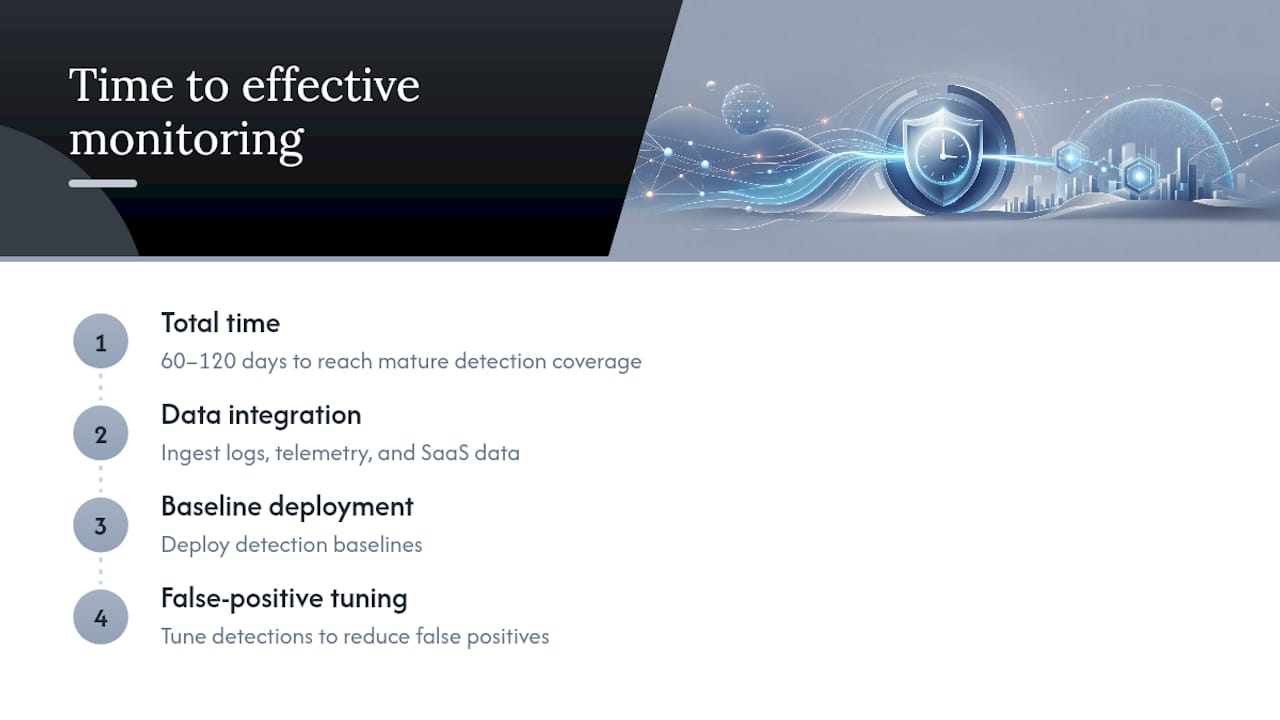
Plan for 60 to 120 days before a monitoring program reaches its full detection quality, a realistic window the MSSP evaluation and selection guide lays out in phases. Anyone promising instant, tuned coverage on day one is setting expectations that won't survive contact with your actual environment.
The typical sequence:
- Weeks 1 to 4: Data-source integration across endpoints, identity, and cloud.
- Weeks 4 to 8: Baseline establishment and detection rule deployment.
- Weeks 8 to 16: Tuning cycles to reduce false positives and sharpen fidelity.
Before signing, confirm which EDR, SIEM, and identity platforms the provider natively supports, and which of your systems will need professional services to connect. During any POC, insist on real alert volume and real analyst communication rather than a curated demo.
- Prioritize the highest-value telemetry first: EDR, identity, and cloud control plane.
- Hand over incident response playbooks and named responder contacts on day one.
- Set a weekly tuning cadence for at least the first two months.
How do you measure whether monitoring is working?
Five numbers matter more than everything else on a SOC dashboard: MTTD, MTTR, the percentage of incidents contained before business impact, the false-positive rate, and mean time to acknowledge. Everything else is noise dressed up as a metric.
Reporting cadence should match the audience. SOC and IT operations need weekly dashboards. The board needs monthly summaries showing trend lines in dwell time and containment speed, not raw alert counts, since boards respond to risk reduction, not ticket volume, a point the SC Media buyer's guide makes directly. Quarterly reviews should tie those numbers back to business risk, not just security operations.
| Reporting audience | Cadence | Focus |
|---|---|---|
| SOC / IT operations | Weekly | Alert volume, triage status, tuning progress |
| Executive / board | Monthly | Dwell time trend, containment speed, risk reduction |
| Compliance / audit | Quarterly | Control mapping, evidence retention, residency |
Before signing, ask to see a sample report and confirm it maps to NIST CSF 2.0 functions rather than an internal scoring system unique to the vendor. Also nail down data retention periods and residency terms in writing, especially if you operate under HIPAA or PCI-DSS obligations where evidence retention has specific requirements.
What does a managed SOC team actually optimize for?
Cross-surface visibility matters more than any single tool. An analyst who can only see endpoints but not identity logs will miss the account takeover that led to the ransomware deployment they eventually catch too late.

At AccountNext-Nexus, our detection methodology and analyst processes exist to cut false positives before they ever reach a client's inbox, because an overwhelmed security team stops trusting alerts, and an ignored alert is functionally the same as no monitoring at all. Documented SLAs aren't paperwork. They're the only way a client can hold us accountable for what "24/7" actually means at 3 a.m. on a Sunday.
When an incident gets complex, clients get access to senior responders directly, not a support queue.
Get real-time coverage without stitching together five vendors
Most organizations evaluating 24/7 security monitoring end up choosing between point solutions that each cover one surface and require separate contracts, separate SLAs, and separate finger-pointing when something slips through the cracks. AccountNext-Nexus consolidates endpoint, cloud, network, and identity monitoring under one SLA-backed contract, so there's a single team accountable for detection and response instead of three vendors each claiming the gap was someone else's telemetry.
Our 24/7 monitoring and threat detection services give you access to seasoned analysts, transparent fixed-fee pricing, and compliance support mapped to SOC 2, HIPAA, PCI-DSS, and ISO 27001. If you're evaluating providers right now, request a scoped POC on your own live telemetry and ask to see a sample board report before you sign anything. That single step will tell you more about a provider's real capability than any pitch deck.
Frequently asked questions
What is the difference between 24/7 security monitoring and MDR? Basic 24/7 monitoring alerts you to suspicious activity. Managed detection and response (MDR) goes further by actively investigating, containing, and remediating threats, which is why MDR typically costs more than monitoring alone but reduces the operational burden on your internal team.
How fast should a 24/7 SOC respond to a critical alert? Response speed should be defined by contract, not assumed. Ask for specific SLA numbers covering alert acknowledgement, analyst triage, and customer notification, with financial remedies if those thresholds are missed.
Can 24/7 monitoring cover cloud and identity, not just endpoints? It should. A modern provider needs to ingest cloud control-plane logs, identity provider telemetry, and SaaS application data alongside endpoint signals, since identity compromise is one of the most common breach paths that endpoint-only tools miss.
How long until a new monitoring provider is fully effective? Expect 60 to 120 days to reach mature, well-tuned detection coverage, moving through data integration, baseline deployment, and false-positive tuning in phases.
Does 24/7 monitoring help with compliance requirements like HIPAA or PCI-DSS? Yes, when the provider maps its detection scope and reporting to the relevant framework and can produce audit-ready evidence of continuous monitoring, retention practices, and incident response documentation.
Sources
- Beyond 24/7 monitoring: what CISOs should ask before choosing an MSSP | buyers-guide | SC Media