
Centralised security monitoring is defined as the practice of aggregating security data from network, endpoint, cloud, and physical access sources into a single unified platform for detection and response. Enterprises that fail to consolidate this data operate with blind spots that attackers exploit. A security operations centre built on centralised visibility gives IT managers and cybersecurity professionals the unified view needed to detect threats faster, meet compliance requirements, and reduce the operational cost of managing fragmented tools. This guide covers the prerequisites, implementation steps, and governance practices required to centralize security monitoring enterprise-wide in 2026.
What core tools and data sources are needed to centralize enterprise security monitoring?
Centralised monitoring starts with knowing what data you need before choosing any platform. The most common mistake enterprises make is buying a SIEM first and then discovering their data sources are incompatible.
Key data sources to consolidate
Every centralised monitoring programme draws from the same core categories:
- Network logs: firewall events, DNS queries, NetFlow records, and intrusion detection alerts
- Endpoint telemetry: process execution, file changes, and authentication events from workstations and servers
- Cloud logs: activity from AWS CloudTrail, Azure Monitor, or Google Cloud Audit Logs
- Identity and access logs: Active Directory, LDAP, and privileged access management systems
- Physical security feeds: video surveillance, badge access control, and alarm sensors
Centralised platforms provide visibility across 60 or more distinct data sources into a single dashboard, reducing alert volume and response times. That breadth matters because attackers rarely stay in one layer of your environment.
Essential technology components
A Security Information and Event Management (SIEM) platform is the core engine. It collects, normalises, and correlates log data. Security Orchestration, Automation, and Response (SOAR) tools sit alongside SIEM to automate containment actions. Cloud-native platforms add agentless collection from SaaS and IaaS environments.

Open APIs and native connectors are the integration layer that makes these components work together. Without them, each tool operates in isolation and analysts spend time manually copying data between consoles. The most effective deployments treat interoperability as a design requirement, not an afterthought.
| Data source | Compatible tool category |
|---|---|
| Firewall and network logs | SIEM, NDR platforms |
| Endpoint telemetry | EDR, XDR platforms |
| Cloud activity logs | Cloud-native SIEM, CSPM tools |
| Identity and access events | SIEM with UEBA capabilities |
| Physical access and video | Unified security platforms |
Pro Tip: Before onboarding any data source, document its log format and volume. Mismatched formats are the leading cause of failed SIEM deployments.
How to centralize security monitoring across an enterprise: step by step
A phased approach is the only reliable way to build a centralised monitoring system without overwhelming your SOC team on day one.
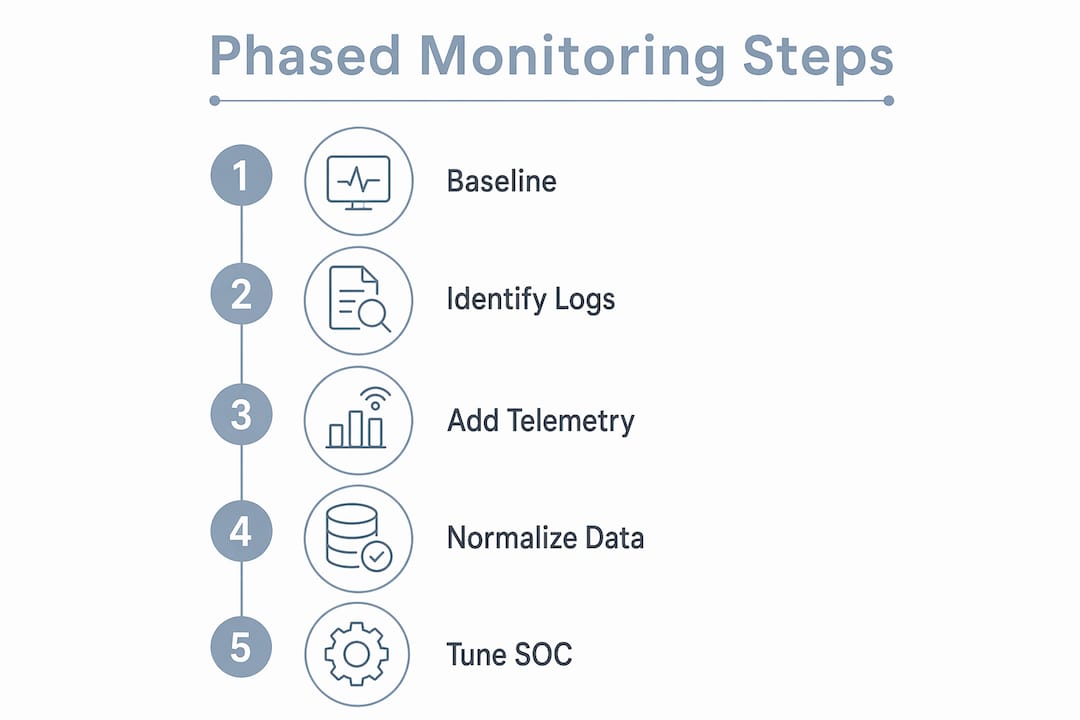
Phase 1: Establish your baseline
Start with a security risk assessment to map your existing data sources, tools, and coverage gaps. Document which assets generate logs, which do not, and which logs are currently reviewed by anyone. This baseline tells you where centralisation will have the most immediate impact.
Phase 2: Onboard identity and network logs first
Phased integration starting with identity and network logs allows SOC teams to tune detection rules incrementally and avoid alert floods upon go-live. Identity logs reveal lateral movement and privilege abuse. Network logs reveal command-and-control traffic and data exfiltration. Together, they cover the two most common attack paths in enterprise environments.
Phase 3: Add endpoint and cloud telemetry
Once detection rules are tuned against identity and network data, add endpoint and cloud sources. This sequence matters because endpoint data is high volume. Adding it before your correlation rules are stable produces thousands of low-fidelity alerts that analysts cannot action.
Phase 4: Normalise and enrich your data
Raw logs from different vendors use different field names for the same concepts. A normalisation layer maps all sources to a common schema, such as the Elastic Common Schema or OCSF. Enrichment adds context: geolocation for IP addresses, asset ownership for hostnames, and user department for account names. Enriched alerts give analysts the context to make decisions in seconds rather than minutes.
Phase 5: Onboard your SOC team and tune detection
Detection tuning is an ongoing process, not a one-time task. Run your new platform in parallel with existing tools for 30 days before cutting over. Use that period to suppress known-good activity and validate that high-severity alerts are accurate.
Pro Tip: Set a maximum alert volume target before go-live. If your platform generates more than your analysts can review in a shift, tune it down before adding new data sources. Volume without quality is noise.
How does centralized monitoring align with enterprise risk management and compliance?
Enterprise Security Risk Management (ESRM) is the framework that reframes security as a strategic risk function embedded in business decision-making. ESRM requires aligning security activities with executive-level risk priorities rather than treating every alert as equally urgent. A centralised monitoring platform makes that alignment possible by producing data that maps directly to business risk categories.
Connecting monitoring outputs to executive reporting
Centralised platforms generate metrics that translate into board-level language: mean time to detect, mean time to respond, coverage percentage by asset class, and compliance posture by framework. These metrics give CISOs the evidence they need to justify security investment and demonstrate programme maturity.
Governance workflows benefit directly from centralised data. When all security events flow through one platform, audit logs are complete and consistent. Regulators reviewing your controls see a single, coherent record rather than a patchwork of exports from a dozen tools.
Automating compliance tracking
Enterprise platforms automate compliance with frameworks like NIST SP 800-53 and FISMA, reducing audit preparation time and supporting continuous monitoring. Automation replaces the manual process of collecting evidence from each tool separately. That reduction in manual effort is significant: compliance evidence collection is one of the most time-consuming activities in a security programme.
Centralised monitoring must provide executive-level visibility to facilitate risk-informed decision-making at the board level. Security data that stays inside the SOC never influences the business decisions that determine an organisation's actual risk exposure.
Key compliance use cases for centralised monitoring include:
- Continuous control monitoring: automated checks against NIST, ISO 27001, or SOC 2 controls
- Audit trail generation: complete, tamper-evident logs for regulatory review
- Policy violation alerting: real-time detection of actions that breach security policy
- Risk reporting: dashboards that show risk posture by business unit or geography
Common challenges in sustaining centralised security monitoring
Alert fatigue is the most damaging long-term threat to a centralised monitoring programme. When analysts receive more alerts than they can investigate, they begin ignoring them. That behaviour defeats the entire purpose of centralisation.
| Challenge | Mitigation tactic |
|---|---|
| Alert fatigue | Tune detection rules monthly; suppress known-good activity |
| Data overload | Audit and categorise logs before ingestion; filter by risk priority |
| Siloed teams | Establish shared SOC workflows and cross-team escalation paths |
| Tool sprawl | Consolidate to fewer platforms with native integration |
| Executive disengagement | Produce monthly risk dashboards in business language |
Ingesting excessive logs without filtering leads to data swamp and high costs. The fix is to audit every log source before onboarding it. Classify each source by its risk relevance and volume. High-volume, low-risk sources should be filtered or sampled rather than fully ingested.
Executive sponsorship determines whether a centralised monitoring programme survives organisational change. Without a sponsor at the VP or C-suite level, budget cuts and team restructuring will fragment the programme over time. Sponsors need regular reporting that connects security metrics to business outcomes, not just technical counts.
Pro Tip: Review your detection rule library every quarter. Rules that never fire are either wrong or covering a risk that no longer exists. Rules that fire constantly are either too broad or pointing at a real problem you have not addressed.
How does centralised monitoring improve incident response?
Centralised monitoring accelerates detection, investigation, and response by reducing tool sprawl and enabling analysts to operate from one console. The practical impact is measurable: analysts spend less time switching between tools and more time on analysis.
Single-pane-of-glass visibility means an analyst investigating a phishing alert can immediately see the affected user's authentication history, the endpoint's process execution log, and any outbound network connections, all without leaving the platform. That context collapses what used to be a multi-hour investigation into minutes.
SOAR playbooks automate the containment steps that follow detection. When a compromised account is identified, a playbook can disable the account in Active Directory, isolate the endpoint, and notify the affected manager, all within seconds of the alert firing. Manual containment of the same incident typically takes 20 to 40 minutes and requires coordination across multiple teams.
Key operational benefits of centralised incident response include:
- Faster containment through automated SOAR playbooks
- Complete audit trails for post-incident review and regulatory reporting
- Consistent response procedures regardless of which analyst handles the case
- Reduced cross-tool switching, which lowers analyst error rates
- Improved cloud security posture visibility during active investigations
Key takeaways
Centralising enterprise security monitoring requires a phased data integration approach, aligned governance, and continuous tuning to sustain detection quality and compliance readiness.
| Point | Details |
|---|---|
| Start with identity and network logs | Onboard these sources first to tune detection rules before adding high-volume endpoint data. |
| Audit logs before ingestion | Classify every data source by risk relevance to avoid data swamp and runaway costs. |
| Align monitoring with ESRM | Map security metrics to business risk categories so executives can make informed decisions. |
| Automate compliance tracking | Use platform automation against NIST SP 800-53 and FISMA to reduce manual audit effort. |
| Sustain with governance | Assign executive sponsorship and review detection rules quarterly to maintain programme quality. |
What I have learned from centralising security monitoring in complex enterprises
The hardest part of centralising security monitoring is not the technology. It is the organisational change that comes with it.
Every enterprise I have worked with had at least one team that treated their security tool as their territory. Network teams owned their firewall logs. The cloud team owned their AWS alerts. Getting those logs into a shared platform felt like a threat to their autonomy. The technical integration was straightforward. The conversation about data ownership took months.
The second lesson is that automation without human judgement creates a false sense of security. SOAR playbooks are powerful, but they are only as good as the scenarios they were designed for. Novel attack techniques will not match your playbooks. You need analysts who understand the environment well enough to recognise when something looks wrong even if no rule fired. The cybersecurity maturity model concept is useful here: centralisation is a capability milestone, not the destination.
My strongest advice is to resist the temptation to ingest everything on day one. The enterprises that succeed at centralisation are the ones that start small, prove value quickly, and expand deliberately. The ones that fail try to boil the ocean and end up with a platform full of noise that nobody trusts.
— Nick - Sr. Executive
How AccountNext-Nexus supports enterprise security centralisation
AccountNext-Nexus delivers 24/7 monitoring and threat detection built specifically for enterprises that need to consolidate fragmented security tools into a single, managed programme. The team brings together cybersecurity, IT management, and compliance under one operational model, so your SOC gains unified visibility without the burden of building and maintaining the platform internally.
AccountNext-Nexus works with IT managers and cybersecurity professionals to design phased integration plans, tune detection rules, and produce compliance-ready reporting aligned with NIST and FISMA requirements. Transparent pricing and direct access to experienced professionals mean your programme scales without hidden costs. Visit AccountNext-Nexus to see how centralised monitoring fits your environment.
FAQ
What is centralised security monitoring in an enterprise?
Centralised security monitoring is the practice of aggregating security data from all sources, including network, endpoint, cloud, and physical access systems, into one unified platform. It gives SOC teams a single console for detection, investigation, and response.
What tools are required to centralise enterprise security monitoring?
The core tools are a SIEM platform for log collection and correlation, a SOAR platform for automated response, and cloud-native connectors for SaaS and IaaS environments. Open APIs are required to integrate physical security systems like video and access control.
How does centralised monitoring support compliance frameworks?
Enterprise platforms automate compliance checks against frameworks like NIST SP 800-53 and FISMA, generating continuous audit trails and reducing manual evidence collection. This keeps organisations audit-ready without dedicated compliance sprints.
What is the biggest risk when centralising security monitoring?
Data swamp is the most common technical risk. Ingesting logs without filtering by risk relevance drives up costs and buries high-fidelity alerts in noise. Audit and categorise every log source before onboarding it to the platform.
How long does it take to centralise security monitoring across an enterprise?
A phased approach typically takes six to twelve months for a mid-to-large enterprise, depending on the number of data sources and the maturity of existing tooling. Starting with identity and network logs in the first phase allows the SOC to demonstrate value within the first 90 days.