
A security risk assessment is a structured evaluation that identifies threats, vulnerabilities, and potential impacts to an organisation's information systems and operations. Formally defined under frameworks like ISO 31000, the process is known in the industry as a cybersecurity risk assessment. It differs fundamentally from a vulnerability scan, which only surfaces technical flaws without measuring their business consequences. Risk assessments prioritise remediation by evaluating vulnerabilities in the context of threat likelihood, business impact, and attack paths. For business owners and managers, this distinction matters because it determines whether your security spending actually reduces real risk or simply checks a box.
What is a security risk assessment and how does it work?
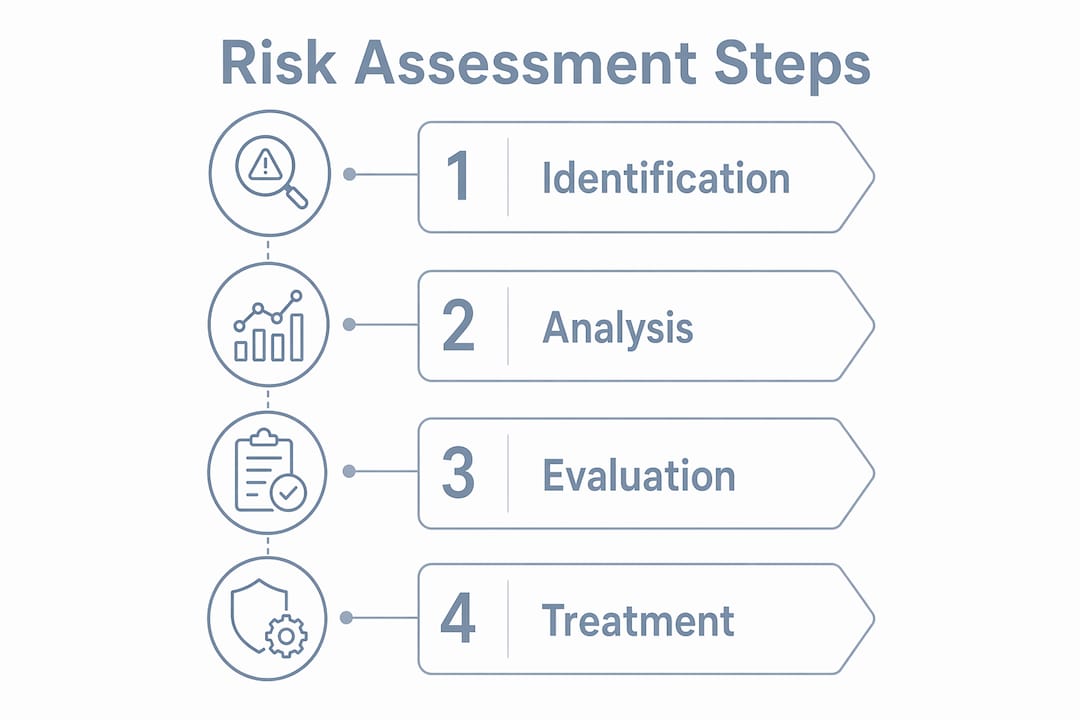
A cybersecurity risk assessment is a systematic process built on four interrelated stages: identification, analysis, evaluation, and treatment. Each stage guides organisations in recognising risks, analysing impact and likelihood, assigning acceptability thresholds, and selecting mitigation strategies. Miss any stage and the entire assessment loses its practical value.
The four stages explained
- Risk identification. Map every asset your organisation relies on, including hardware, software, data, and personnel. Threat modelling at this stage asks: who would want to compromise this asset, and how?
- Risk analysis. Assign likelihood and impact scores to each identified threat. Risk is a function of both threat and vulnerability; both must coexist for risk to be present. A threat with no exploitable vulnerability produces zero risk.
- Risk evaluation. Compare each risk score against your organisation's defined tolerance. Some risks are acceptable; others require immediate action. This stage produces a prioritised risk register.
- Risk treatment. Select a response: mitigate, transfer (through insurance or contracts), accept, or avoid the risk entirely. Each decision should be documented and assigned to a named owner.
Pro Tip: Build your asset inventory before anything else. Organisations that skip this step routinely discover mid-assessment that they have no idea what data lives where, which makes accurate risk scoring impossible.
| Stage | Core activity | Output |
|---|---|---|
| Identification | Asset inventory and threat modelling | Risk register draft |
| Analysis | Likelihood and impact scoring | Risk scores per asset |
| Evaluation | Comparison against risk tolerance | Prioritised risk list |
| Treatment | Mitigation, transfer, acceptance, or avoidance | Risk treatment plan |

Mature assessments also incorporate external threat intelligence alongside internal telemetry. Integrating both sources produces context-rich risk scenarios that reflect real-world attack likelihood rather than theoretical worst cases. This is what separates a useful assessment from a document that sits in a drawer.
How does a risk assessment differ from a vulnerability scan?
A vulnerability scan is a technical tool. It probes your network for known weaknesses, misconfigurations, and unpatched software. A cybersecurity risk assessment is a business tool. It places those same weaknesses inside the context of your operations, your people, and your supply chain.
Risk assessments offer broader context than vulnerability scans by evaluating people, processes, policies, and potential impacts on business operations. A vulnerability scan might flag an unpatched server. A risk assessment asks whether that server holds your customer payment data, whether a breach would trigger regulatory penalties, and whether the cost of patching outweighs the cost of the risk.
What vulnerability scans routinely miss
- Human factors. Phishing susceptibility, weak password practices, and insider threats do not appear in a network scan.
- Supply chain exposure. A third-party vendor with access to your systems is an attack surface. Scans rarely reach beyond your own IP ranges.
- Physical security gaps. Unlocked server rooms and unmonitored access points are real risks that no software scan captures.
- Business impact context. A scan scores severity technically. An assessment scores it financially and operationally.
Scoping neglect is one of the most common assessment failures, and it happens precisely because teams limit their scope to IP addresses rather than the full organisational environment. Expanding scope to include physical, personnel, and supply chain risks greatly enriches the evaluation and leads to more effective mitigation planning.
What are the common pitfalls in security risk assessments?
The most damaging pitfall is treating compliance as a substitute for risk management. Passing a SOC 2 audit or meeting a regulatory checklist does not mean your organisation has assessed its actual risk exposure. Many organisations confuse compliance checklists with true risk management, which leads to misallocation of security resources without targeted risk prioritisation.
A second major pitfall is the absence of executive sponsorship. Without a named decision-maker who holds authority to accept or reject risk, assessments become academic exercises. Governance frameworks with clear decision-makers improve the practicality and implementation of risk assessments. Every risk treatment decision needs someone accountable for it.
- Narrow scoping. Limiting the assessment to internal IT systems while ignoring cloud services, contractors, and physical premises creates blind spots.
- No business impact mapping. Listing vulnerabilities without connecting them to financial, operational, or reputational consequences makes prioritisation guesswork.
- One-and-done thinking. Threats evolve. An assessment completed two years ago does not reflect your current risk profile.
- Siloed execution. Running the assessment inside the IT team alone misses the operational and financial context that other departments hold.
Pro Tip: Invite your finance, legal, and operations leads into the risk evaluation stage. They will identify business impacts that your IT team would never think to flag, and their buy-in makes risk treatment decisions far easier to implement.
How do you apply assessment results to strengthen cybersecurity?
A completed risk assessment is only valuable if it drives decisions. The output, a prioritised risk register, should directly inform your security budget, your policy updates, and your incident response planning.
- Prioritise by risk score. Address high-likelihood, high-impact risks first. A cybersecurity risk assessment transforms security from a reactive cost centre to a strategic function by quantifying risk exposure and focusing investments where they reduce the most risk.
- Integrate findings with existing controls. Map each identified risk against your current policies and technical controls. Gaps become your remediation roadmap.
- Assign risk ownership. Every risk in the register needs a named owner who is responsible for monitoring and reporting on its status. Designating an executive sponsor responsible for risk acceptance ensures assessments result in pragmatic treatment decisions aligned to business priorities.
- Schedule reassessment cycles. Quarterly reviews for high-risk items and annual full assessments keep your risk register current as your environment and the threat landscape change.
- Communicate results to leadership. Translate risk scores into business language. "This vulnerability has a 70% likelihood of causing a data breach that would cost an estimated $500,000 in regulatory fines" is more useful to a CEO than a CVSS score of 8.5.
Risk assessment now supports not only loss prevention but also the identification of growth and innovation opportunities through risk-informed decisions. Organisations that treat their risk register as a living document gain a genuine competitive advantage: they can move faster because they understand their exposure.
Key takeaways
A security risk assessment is the single most effective tool for aligning cybersecurity spending with actual business risk, covering people, processes, and technology in one structured process.
| Point | Details |
|---|---|
| Four-stage process | Identification, analysis, evaluation, and treatment form the backbone of every effective assessment. |
| Broader than a vulnerability scan | Risk assessments include human factors, supply chain exposure, and business impact that technical scans miss. |
| Compliance is not enough | Meeting regulatory checklists does not replace a genuine risk assessment with prioritised findings. |
| Executive ownership is required | Every risk treatment decision needs a named accountable owner to move from paper to action. |
| Continuous reassessment | Threats evolve; annual full assessments and quarterly reviews keep your risk register accurate. |
Why risk assessments are the most underused business tool
Most business owners I speak with have either never completed a formal risk assessment or completed one years ago and filed it away. Both situations leave organisations exposed in ways that are entirely preventable.
The framing is usually wrong. Risk assessments get positioned as an IT project, which means they get scoped by IT, executed by IT, and read by IT. The findings never reach the people who control budgets and make strategic decisions. That is not a technology problem. It is a governance problem.
What I have seen work consistently is treating the assessment as a business planning exercise that happens to involve technology. When the CFO understands that a specific unpatched system represents a quantified financial liability, the remediation budget appears. When the COO sees that a supplier relationship is a documented risk, the contract conversation changes. The assessment findings do not change. The audience does.
The organisations that get the most value from risk assessments are the ones that run them before a crisis, not after one. Post-incident assessments are useful, but they are expensive lessons. A proactive assessment completed before a breach costs a fraction of the incident response bill and gives you the information you need to prevent it entirely.
My advice to any business owner reading this: treat your first formal risk assessment as the foundation of your security programme, not a one-time audit. Build the governance structure around it, assign ownership, and schedule the next one before you finish the current one.
— Nick - Sr. Executive
How AccountNext-Nexus supports your risk assessment programme
Running a thorough risk assessment requires expertise, time, and the right methodology. AccountNext-Nexus provides IT and cybersecurity services that cover the full assessment lifecycle, from asset discovery and threat modelling through to risk treatment planning and ongoing monitoring.

AccountNext-Nexus combines 24/7 threat detection with compliance-aligned risk governance, so your assessment findings translate directly into active protection. The team brings external threat intelligence and internal telemetry together to build risk scenarios grounded in real-world attack patterns. For business owners who want a risk programme that actually drives decisions, AccountNext-Nexus's monitoring and threat detection services provide the continuous visibility your risk register requires to stay current and credible.
FAQ
What is a security risk assessment in simple terms?
A security risk assessment is a structured process that identifies what could go wrong in your organisation's systems, how likely it is, and what the business impact would be. It produces a prioritised list of risks so you can focus your security resources where they matter most.
How often should a business conduct a security risk assessment?
Most organisations benefit from a full assessment annually, with quarterly reviews for high-priority risks. Any significant change to your environment, such as a new cloud platform, a merger, or a major software deployment, should also trigger a targeted reassessment.
What is the difference between a risk assessment and a risk analysis?
A risk analysis is one stage within a broader risk assessment. It covers the scoring of likelihood and impact for each identified threat. A full risk assessment includes identification, analysis, evaluation, and treatment as a complete cycle.
Why is risk assessment necessary for small and mid-sized businesses?
Smaller organisations are frequent targets precisely because attackers assume their defences are weaker. A formal risk assessment identifies the specific gaps in your environment and gives you a clear, cost-effective remediation plan rather than requiring you to protect everything equally.
How do you conduct a security assessment without a dedicated IT team?
Engaging a managed cybersecurity provider is the most practical path for organisations without in-house expertise. A qualified provider brings the structured methodology needed to scope, execute, and document the assessment to recognised industry standards.