
Enterprise threat detection integration is the process of unifying disparate security data sources, normalising telemetry, deploying detection rules, and automating centralised response workflows to identify and mitigate cyber threats across the enterprise. Security information and event management (SIEM) platforms, security orchestration, automation, and response (SOAR) tools, and frameworks like MITRE ATT&CK form the backbone of any mature integration programme. Without a deliberate architecture connecting these components, security teams operate with fragmented data and slow response times. This enterprise threat detection integration guide gives IT and security managers a practical, step-by-step path from architecture design through ongoing optimisation.
What are the foundational architectural components of enterprise threat detection integration?
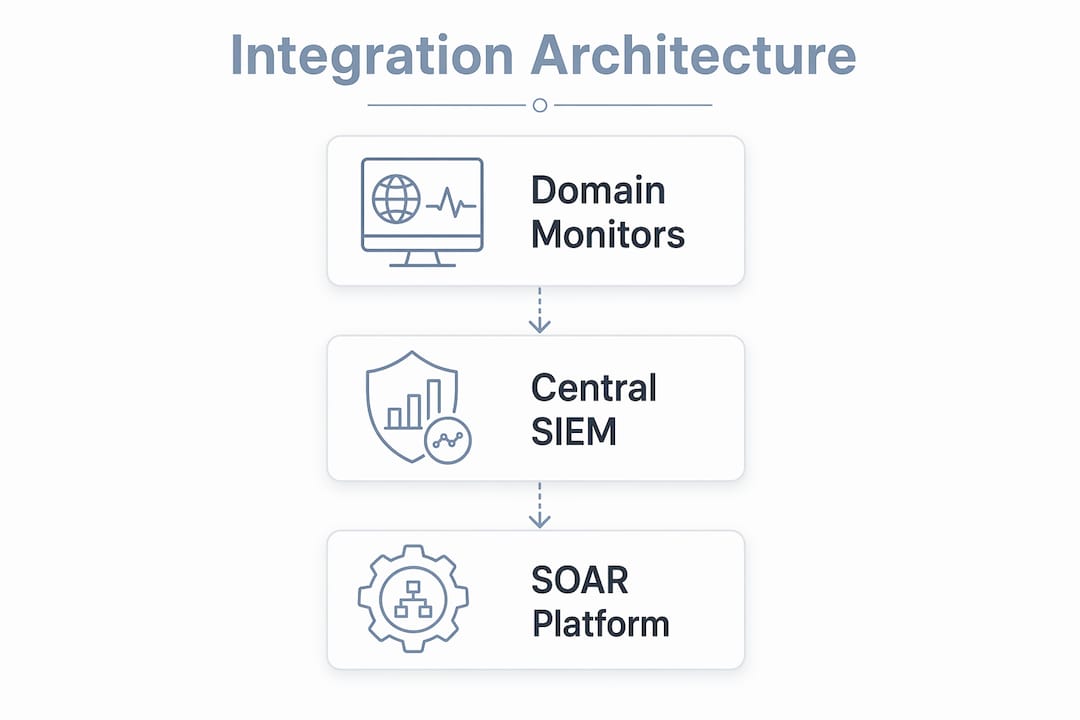
Effective enterprise threat detection integration requires a three-tier architecture: domain-specific monitors at the collection layer, a centralised SIEM at the correlation layer, and a SOAR platform at the response layer. Each tier has a distinct job, and the value of the architecture comes from the handoffs between them.
Domain-specific monitors
Domain-specific monitors collect application-layer and infrastructure telemetry that generic agents miss. A tool like SAP Enterprise Threat Detection (SAP ETD), for example, captures business-application events that a standard endpoint agent cannot see. These monitors feed raw, context-rich events upward into the SIEM. Without this layer, your correlation engine works with incomplete data.

Centralised SIEM
The SIEM receives telemetry from every domain monitor, normalises it into a common schema, and runs correlation rules to produce alerts. Multi-source correlation is the SIEM's primary value. A single failed login means nothing. Fifty failed logins across three systems in two minutes, correlated with a lateral movement indicator, is an incident. The SIEM makes that connection visible.
SOAR platform
The SOAR platform sits above the SIEM and automates the investigation and response workflow. When the SIEM produces a correlated alert, the SOAR triggers a playbook: it enriches the alert with threat intelligence, assigns tasks to analysts, and executes containment actions. This automated incident lifecycle reduces mean time to respond and creates an auditable record of every action taken.
The table below maps each tier to its primary function and the failure mode when it is absent.
| Architecture tier | Primary function | Failure mode without it |
|---|---|---|
| Domain-specific monitors | Collect application and infrastructure telemetry | Blind spots in application-layer activity |
| Centralised SIEM | Normalise and correlate multi-source events | Isolated alerts with no cross-source context |
| SOAR platform | Automate investigation and response workflows | Manual triage bottlenecks and slow containment |
Pro Tip: Avoid point-to-point connections between tools. Centralising credential storage and data normalisation in a single integration hub makes adding new tools straightforward and keeps correlation reliable.
Which tools and prerequisites does enterprise security integration require?
A sound integration depends on four telemetry source categories: network traffic, endpoint activity, identity events, and cloud workload logs. Missing any one of these creates a detection gap that attackers routinely exploit. For cloud and hybrid environments, logging in cloud security is a prerequisite, not an afterthought.
Normalisation is the most underestimated prerequisite. The Open Cybersecurity Schema Framework (OCSF) provides a vendor-agnostic schema that lets teams write detection logic once and run it across more than 50 diverse data sources without re-engineering pipelines. Without a normalisation framework like OCSF, every new data source requires custom parsing work that compounds over time.
Detection rule management requires a software-like lifecycle. The key prerequisites are:
- Syntax validation: Confirm that every rule compiles correctly before it reaches production.
- Semantic validation on live data: Confirm that the rule fires on real events, not just test cases. A rule can be syntactically valid but semantically broken due to parser changes or schema drift.
- Staged rollout with version control: Deploy rules to a staging environment first, track changes in a version control system, and require peer review before promotion.
- Investigation guides embedded in rules: Each rule should include a triage guide and documented false-positive examples. This context-first approach reduces mean time to respond and cuts alert noise for analysts working under pressure.
Pro Tip: Treat detection rules exactly as you treat application code. Peer reviews, automated tests, and version history are not optional extras. They prevent production outages and detection failures.
How to execute the integration process step by step
A clear execution sequence prevents the most common integration failures. Follow these steps in order.
-
Inventory your telemetry sources. List every network device, endpoint agent, identity provider, and cloud workload that generates security-relevant logs. Identify gaps against the four source categories: network, endpoint, identity, and cloud.
-
Implement OCSF normalisation at ingestion. Map each source to the OCSF schema at query time rather than at storage time. This eliminates ongoing ETL maintenance and makes your detection logic portable.
-
Build your centralised integration hub. Centralise credential management, severity governance, and data format normalisation in one place. Avoid the point-connector anti-pattern where each tool wires directly to all others. That approach creates unmaintainable pipelines that break silently.
-
Deploy correlation rules in the SIEM using a staged rollout. Start with high-confidence, low-noise rules aligned to MITRE ATT&CK tactics. Validate semantically on live data before promoting to production.
-
Configure SOAR playbooks for your top incident types. Map each SIEM alert category to a playbook that handles enrichment, analyst notification, and initial containment. Automate the repetitive steps and reserve analyst judgement for decisions that require context.
-
Validate end-to-end with simulated attack scenarios. Run tabletop exercises and purple team tests to confirm that telemetry flows from source through SIEM to SOAR without gaps. Document the results and update rules accordingly.
-
Monitor for detection drift. Silent changes in parsers or normalisation can break detections without triggering syntax errors. Schedule weekly semantic validation checks to catch blind spots before attackers find them.
The most common pitfall is alert fatigue caused by high-volume, low-precision rules. Siloed tools operating in isolation produce fragmented data that forces analysts to manually correlate context, which slows response and increases errors. A unified integration layer eliminates that problem by design.
Pro Tip: High-noise detection rules that generate too many alerts should be converted into threat hunting queries. This shifts the burden from reactive alerting to proactive investigation and reduces analyst fatigue without losing coverage.
What are best practices for ongoing threat detection management?
Integration is not a one-time project. The threat environment changes, telemetry sources evolve, and detection rules drift. Ongoing management requires deliberate practices across four areas.
- Routine rule tuning: Review detection rule performance weekly. Retire rules with consistently high false-positive rates. Promote threat hunting queries to production rules when they reliably surface true positives.
- Continuous semantic validation: Parser updates and schema changes break rules silently. Automated semantic tests run against live data catch these breaks before they create blind spots.
- Playbook maintenance: SOAR playbooks become outdated as your environment changes. Review each playbook quarterly and update enrichment sources, escalation paths, and containment actions.
- Cross-team collaboration: Security operations, IT operations, and compliance teams must share context. Detection outputs should feed directly into your enterprise IT service management (ITSM) system so that incident records are complete and audit-ready.
- Alignment with compliance requirements: Map active detection rules to the regulatory controls they satisfy. This makes audit evidence collection straightforward and demonstrates that your detection programme is purposeful, not reactive.
Siloed operations remain the leading cause of integration failure. Successful integration creates a unified, intelligence-driven detection strategy that goes well beyond simple log collection. That requires shared ownership, not just shared tooling.
How can integration work with legacy infrastructure?
Most enterprises cannot replace legacy systems on a security-driven timeline. The practical answer is an integration layer that acts as connective tissue between old and new tools. Avoiding rip-and-replace by orchestrating existing identity, logging, and monitoring tools through a centralised hub preserves continuity while enforcing consistent security controls.
The integration layer handles credential normalisation, severity mapping, and data format translation. Legacy tools connect to the hub rather than to each other. Adding a new tool means configuring one connection to the hub, not re-wiring every existing integration. This approach also supports Zero Trust implementation because the hub enforces consistent access and data-handling policies across all connected tools, regardless of their age.
The table below compares the two approaches for managing legacy and modern tools together.
| Approach | Complexity | Cost to add a new tool | Control consistency |
|---|---|---|---|
| Point-to-point connections | High, grows exponentially | High, requires multiple new connectors | Inconsistent across tools |
| Centralised integration hub | Low, grows linearly | Low, one connection to the hub | Consistent, policy-enforced |
For teams managing endpoint detection and response alongside legacy network monitoring tools, the integration hub is the only practical path to unified visibility without a full infrastructure replacement.
Key takeaways
Effective enterprise threat detection integration depends on a three-tier architecture, OCSF normalisation, and treating detection rules as code with a full software lifecycle.
| Point | Details |
|---|---|
| Three-tier architecture | Domain monitors, a centralised SIEM, and a SOAR platform must work together as a unified pipeline. |
| OCSF normalisation | Normalising telemetry at ingestion lets detection logic run across 50+ sources without re-engineering. |
| Detection rules as code | Syntax validation, semantic testing, and version control prevent silent detection failures. |
| Avoid point-to-point wiring | A centralised integration hub keeps pipelines maintainable and correlation reliable as tools change. |
| Ongoing tuning is non-negotiable | Weekly semantic validation and quarterly playbook reviews prevent drift and maintain detection coverage. |
Why integration complexity is the real security problem
Nick, Sr. Executive
After years of working with enterprise security teams, the pattern I see most often is this: organisations invest heavily in individual tools and then wonder why their detection programme still feels unreliable. The tools are rarely the problem. The connections between them are.
The shift that changes everything is treating your integration architecture with the same rigour you apply to your detection rules. Most teams version-control their code but not their integration configurations. A parser update silently breaks three detection rules, and nobody notices until a threat actor has already moved laterally. That is not a tool failure. It is a process failure.
The other thing I have learned is that context inside a detection rule is worth more than most teams realise. An analyst triaging an alert at 2:00 AM does not have time to reconstruct the investigation logic from scratch. A rule that includes a triage guide, known false-positive patterns, and a link to the relevant MITRE ATT&CK technique cuts response time in half. That is not a nice-to-have. It is the difference between a contained incident and a breach.
My recommendation: start your integration programme by fixing the connective tissue before adding more tools. A well-wired environment with 10 data sources outperforms a fragmented environment with 30.
— Nick, Sr. Executive
AccountNext-Nexus: enterprise threat detection integration support
Fragmented security tools create the exact gaps that attackers exploit. AccountNext-Nexus consolidates threat detection, cloud infrastructure management, and compliance under one programme, giving your security team unified visibility without the overhead of managing disconnected point solutions.
AccountNext-Nexus provides 24/7 monitoring and threat detection with integration expertise that spans legacy infrastructure and modern cloud environments. The team applies the same three-tier architecture and detection engineering lifecycle described in this guide, tailored to your specific environment. For enterprises looking to understand why managed detection has become the standard approach, the 2026 managed detection guide explains the business case in detail. Reach out to AccountNext-Nexus to assess your current integration gaps and build a detection programme that holds up under real conditions.
FAQ
What is enterprise threat detection integration?
Enterprise threat detection integration is the process of connecting domain-specific monitors, a centralised SIEM, and a SOAR platform into a unified pipeline that ingests, normalises, correlates, and responds to security events across the enterprise.
Why do most threat detection programmes fail?
Siloed tools operating in isolation produce fragmented data and missing context, which forces analysts to manually reconstruct incidents. A unified integration layer eliminates this by centralising correlation and automating response.
What is OCSF and why does it matter for integration?
The Open Cybersecurity Schema Framework (OCSF) is a vendor-agnostic normalisation standard. It lets security teams write detection logic once and apply it across more than 50 data sources without rebuilding pipelines for each new tool.
How do you prevent detection rules from breaking silently?
Active semantic validation on live data catches rules that are syntactically valid but no longer firing correctly due to parser or schema changes. Schedule these checks weekly as part of your detection operations routine.
Can legacy infrastructure integrate with modern threat detection tools?
Yes. An integration layer connects legacy and modern tools through a centralised hub that handles credential normalisation and data format translation, enforcing consistent controls without requiring a full infrastructure replacement.