
Business continuity planning is the documented, enterprise-wide programme that keeps critical business functions running during a disruption, and keeps financial loss, reputational damage, and regulatory exposure contained when they can't run at full strength. It covers people, premises, technology, and third parties, not just servers and backups. If your organization doesn't have a current plan, the single most useful thing you can do this week is start a business impact analysis. Everything else in a continuity programme flows from what that analysis tells you.
TL;DR:
- Conduct a recent business impact analysis to identify critical functions and establish recovery time, point objectives, and maximum tolerable downtime.
- Map third-party vendors and review their disaster recovery commitments to prevent dependency failures that could halt operations during disruptions.
- Assign clear ownership and decision-making authority across the enterprise, including board-level oversight and a crisis leadership team, to ensure rapid actions during incidents.
- Develop practical, easy-to-follow playbooks covering people, premises, technology, and communication, and keep contact information accessible offline.
- Test the plan regularly through simulations and exercises at least annually, updating it based on identified gaps and changing operational dependencies.
Table of Contents
- What is a business continuity plan and why it matters
- What are the core steps in the business continuity planning lifecycle?
- How do you conduct a business impact analysis and set recovery objectives?
- How do you assess risk and map third-party dependencies?
- Who owns continuity decisions during a disruption?
- How do you document continuity strategies and playbooks?
- How does business continuity planning align with IT disaster recovery?
- How often should you test and exercise your continuity plan?
- How do you maintain and improve a business continuity plan over time?
- What templates and resources help you get started right now?
- Why most continuity plans fail when they're actually needed
- Getting your continuity and recovery capabilities tested, not just written
- Sources
What is a business continuity plan and why it matters
A business continuity plan identifies the functions your organization cannot afford to lose and lays out how those functions keep operating, or get restored fast, when something breaks that, that "something" could be a ransomware attack, a burst pipe, a key supplier going dark, or a regional power outage. NIST frames the core objective as minimizing financial loss while continuing service to customers and stakeholders, and containing damage to liquidity, reputation, and market position.
This is why continuity planning belongs to the whole enterprise, not just IT. A payroll failure, a warehouse fire, and a data breach all threaten the same outcomes: revenue, trust, and compliance standing.
- Financial risk: unplanned downtime bleeds cash faster than most budgets account for.
- Reputational risk: customers remember how you handled the disruption more than the disruption itself.
- Regulatory risk: several industries treat a documented, tested plan as a compliance requirement, not a nice-to-have.
The all-hazards framing matters here: build the plan around the impact of losing a function, not around a list of specific disaster scenarios you're guessing at.
What are the core steps in the business continuity planning lifecycle?
The lifecycle that FEMA's continuity planning curriculum and Protiviti's BCM guide both describe runs in a fixed order, and skipping steps is exactly why so many plans fail when tested for real.
- Prepare and set policy. Get executive sponsorship, define scope, and assign a programme owner before anyone drafts a single procedure.
- Run the business impact analysis. Identify which functions matter most and how fast they need to come back.
- Assess risk. Score the threats most likely to hit those functions and estimate their severity.
- Design continuity strategies. Decide how people, sites, systems, and suppliers will keep operating or recover.
- Document the plan. Turn strategies into playbooks a stressed team can actually follow.
- Test, train, and maintain. Run exercises at least annually, then update the plan based on what breaks.
Ownership matters as much as sequence. Assign a named owner to each step, not a committee, and put testing on the calendar before the plan is even finished. A plan nobody has rehearsed is a plan nobody trusts when it counts.
How do you conduct a business impact analysis and set recovery objectives?
The business impact analysis is where continuity planning stops being theoretical. You're scoring every critical function against two questions: how much does losing this cost per hour or per day, and how quickly does it need to come back before that cost becomes unacceptable.
Start by interviewing function owners, not just reading org charts. Ask what happens to customers, revenue, and legal obligations if this process stops for one hour, one day, one week. Score each function on financial impact, customer impact, and compliance exposure, then rank them.
From those scores you derive three numbers every plan needs:
- Recovery Time Objective (RTO): how long the function can be down before the damage is unacceptable.
- Recovery Point Objective (RPO): how much data loss, measured in time, the function can tolerate.
- Maximum Tolerable Downtime (MTD): the absolute outer limit before the business itself is at risk.
Map dependencies as you go. Order fulfillment might depend on a warehouse system, a payment processor, and a single logistics vendor. That dependency map becomes the thing you actually use to decide where to spend your continuity budget.
Pro Tip: Present RTOs to leadership in days to resume revenue, not server names. Boards fund business outcomes, not infrastructure lists.
How do you assess risk and map third-party dependencies?
Risk assessment answers a different question than the BIA: not "what does losing this cost" but "what's actually likely to cause the loss." Score each threat on likelihood and impact, then focus your continuity strategies on the scenarios that land in the top corner of that matrix, not the scariest headline scenario.
Third-party mapping deserves its own pass. Modern operations depend on cloud providers, payment processors, logistics partners, and specialist vendors, and a disruption at any one of them can stop your business just as effectively as an internal failure.
- List every vendor tied to a critical function identified in your BIA.
- Review contracts for continuity clauses, SLAs, and their own disaster recovery commitments.
- Flag any single point of failure where you have no fallback vendor or manual workaround.
A closer look at third-party cybersecurity risk shows how quickly a vendor's weakness becomes your outage. Dependency data like this should shape your test scenarios later, not just sit in a spreadsheet nobody revisits.
Who owns continuity decisions during a disruption?
Continuity programmes stall without clear ownership, and they collapse during an actual incident without clear decision authority. FFIEC guidance is explicit that this has to be an enterprise-wide responsibility with board-level oversight, not a task delegated entirely to IT or facilities.
A working governance model needs three tiers:
- Board and executive sponsors who fund the programme and receive regular reporting on readiness.
- A crisis leadership team with the authority to declare an incident and activate the plan without waiting for consensus.
- Business owners and recovery teams assigned to specific functions, with a documented RACI so nobody is guessing who calls the shots.
Set the declaration trigger in advance. Waiting to decide, mid-crisis, whether something qualifies as an "incident" wastes the exact hours your RTOs assume you have.
How do you document continuity strategies and playbooks?
A playbook is only useful if someone under pressure can follow it without calling five other people first. Structure each one around triggers, first-hour actions, a stepwise recovery sequence, and a current contact list, not a wall of policy language.
Strategy sections should cover the four pillars that actually break during a disruption:
- People: who's authorized to make decisions, and who backs them up if they're unreachable.
- Premises: an alternate site or remote-work fallback if the primary location is unavailable.
- Technology: backup systems, manual workarounds, and who can restore them.
- Communications: pre-drafted templates for staff, customers, and regulators, so nobody is writing a public statement from scratch during an outage.
Keep contact lists and escalation trees in a format accessible even if your primary systems are down, a printed binder or an offline app, not just an intranet page that dies with the network.
Pro Tip: Draft your external communications templates now, while calm. The wording you need during an outage should already exist, not be improvised under pressure.
How does business continuity planning align with IT disaster recovery?
Business continuity, IT disaster recovery, and incident response solve overlapping but distinct problems. Continuity planning defines what the business needs (which functions, by when). Disaster recovery defines how IT restores the systems those functions depend on. Incident response defines how you contain and investigate the event, particularly a cyber incident, without making things worse.
The link between them is the dependency map you built during the BIA: it tells IT which systems map to which business function, and in what order to restore them.
- Translate business RTOs into technical recovery runbooks IT teams can execute step by step.
- Validate backup restores under realistic conditions, including network segmentation and credentials, not just in an isolated test environment.
- Run joint exercises where business and IT teams rehearse the same scenario together, not in separate silos.
A well-built enterprise incident response checklist closes the gap between a continuity plan that looks good on paper and one that actually holds up during a ransomware event.
How often should you test and exercise your continuity plan?
Untested plans fail in ways that look obvious in hindsight and invisible on paper. A backup that restores cleanly in isolation can still fail during a real recovery if it needs network access or credentials nobody remembered to provision.
- Tabletop exercises: low-cost, discussion-based walkthroughs that build muscle memory and surface obvious gaps quickly.
- Functional exercises: test specific systems or teams in action, such as an actual failover of a single application.
- Simulation exercises: run a realistic scenario across multiple teams to test coordination, not just individual pieces.
- Full-scale exercises: the highest-confidence test, involving real systems, real people, and often external partners.
FEMA recommends testing plans at least annually using tabletop exercises and simulations, with higher-risk functions tested more frequently and reviewed independently. Document every gap the exercise reveals, and treat that document as an input to the next plan revision, not a file that gets archived and forgotten.
How do you maintain and improve a business continuity plan over time?
Treat the plan as a living document, not a project with an end date. Version control matters here: date every revision, log who approved it, and note what triggered the change.
- Review critical assumptions quarterly, especially staffing, vendors, and system dependencies that shift faster than annual reviews catch.
- Track KPIs like test pass rate, actual time-to-recover against your RTOs, and training completion rates across the teams who'd execute the plan.
- Commission an independent review or audit periodically, separate from the team that wrote the plan.
- Report readiness metrics to the board in business terms: days to resume revenue-generating functions, not a list of patched servers.
Embed continuity requirements into procurement contracts too, so new vendors meet the same standard the ones already mapped in your BIA do.
What templates and resources help you get started right now?
You don't need to build every document from scratch. Ready include templates, checklists, and training videos built specifically for running realistic tabletop exercises. The FFIEC/FDIC business continuity booklet is the reference most auditors and boards expect to see referenced if your organization operates in a regulated sector.
Start with a one-page dependency map and a simple BIA worksheet scoring each function by financial, customer, and compliance impact. Then this week: verify your emergency contact list is current, run one tabletop exercise on your highest-risk scenario, and test one backup restore end to end.
Why most continuity plans fail when they're actually needed
The plans that fall apart under real pressure almost always share the same root cause: someone skipped the business impact analysis, or did it once and never touched it again. A dependency map built two years ago doesn't know about the vendor you switched last quarter or the system you decommissioned in the spring. Practitioner guidance from FEMA's continuity curriculum is blunt about this: static document reviews miss operational gaps that only show up during a real exercise.
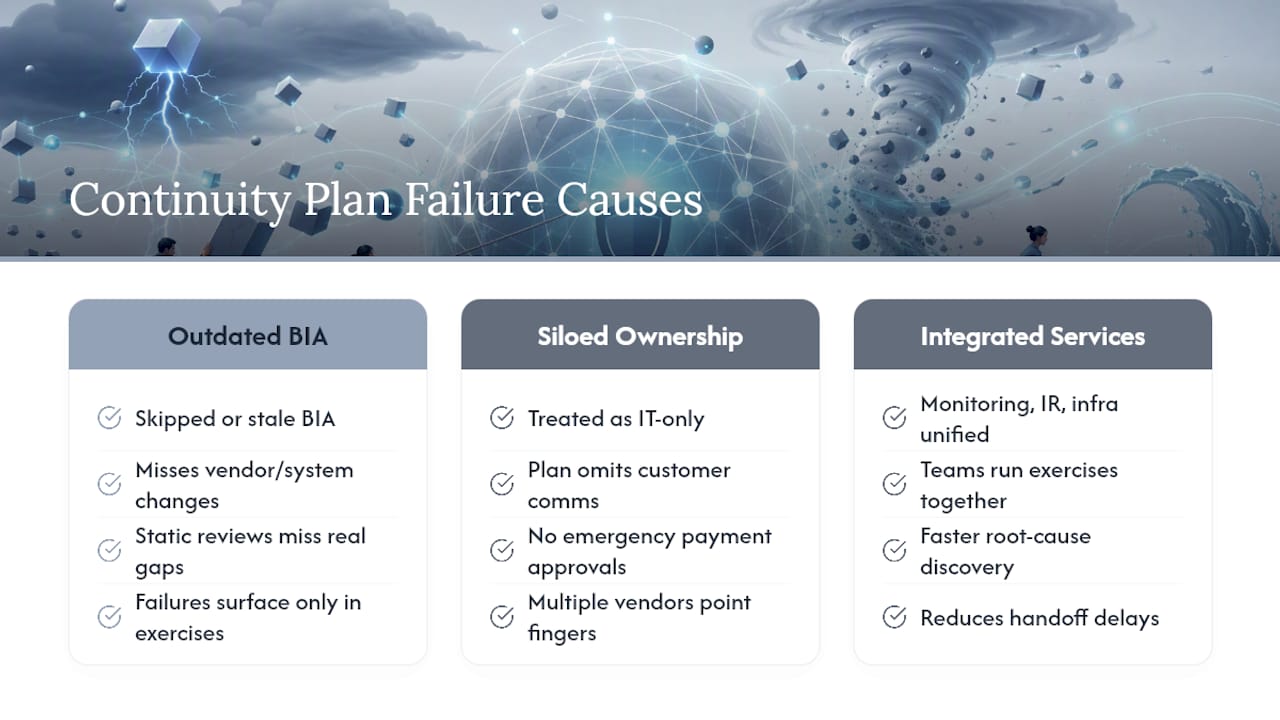
The second failure mode is siloed ownership. Continuity gets treated as an IT problem, so the plan covers server recovery in detail and says almost nothing about how customer service communicates during an outage or who approves an emergency vendor payment.
Integrated IT and cybersecurity services close a real gap here. When monitoring, incident response, and infrastructure management sit under one team instead of three vendors pointing fingers at each other, the time it takes to identify root cause and coordinate recovery drops substantially, because nobody's waiting on a handoff between providers who've never run an exercise together.
— Nick - Sr. Executive
Getting your continuity and recovery capabilities tested, not just written
A plan sitting in a shared drive doesn't tell you anything about whether it works. Some providers give continuity planners an integrated team running monitoring, incident response, and recovery rehearsals together, so tabletop exercises actually reflect how systems, vendors, and staff would respond in a real event.
Clients can get 24/7 threat monitoring backed by a defined SLA, joint exercises that test both the technical failover and the human decision-making around it, and dependency mapping support that feeds directly into a BIA rather than sitting in a separate silo. That's the difference between a plan that looks complete and one that's actually been proven under pressure.
If your continuity plan hasn't been stress-tested against a real incident scenario in the past year, that's the gap worth closing first. Explore Nexus's IT and cybersecurity services to see how a consolidated monitoring and recovery partner fits into your continuity programme, or visit the Nexus homepage to get a sense of the full range of support available before your next test cycle.
Sources
- Business continuity planning (NIST)
- FEMA MGT-381: Business continuity planning course
- Business continuity planning booklet (FFIEC/FDIC)