
A cyber incident response plan (IRP) is a documented, approved, and practised set of procedures your business uses to detect, contain, and recover from cybersecurity incidents. Without one, a ransomware attack or data breach forces your team to improvise under pressure, which multiplies both damage and cost. This cyber incident response plan guide walks Canadian small and mid-sized business owners through the core phases, regulatory obligations, and practical steps needed to build a plan that actually works when it matters most. Standards like NIST SP 800-61 and the updated NIST CSF 2.0 form the backbone of every credible IRP today.
What are the core components of a cyber incident response plan?
NIST SP 800-61 outlines seven core phases for incident response, typically grouped into four main phases: Preparation, Detection and Analysis, Containment/Eradication/Recovery, and Post-Incident Activity. That grouping gives your team a clear mental model without drowning in complexity. Each phase has defined entry and exit criteria, so no one guesses when to move forward.
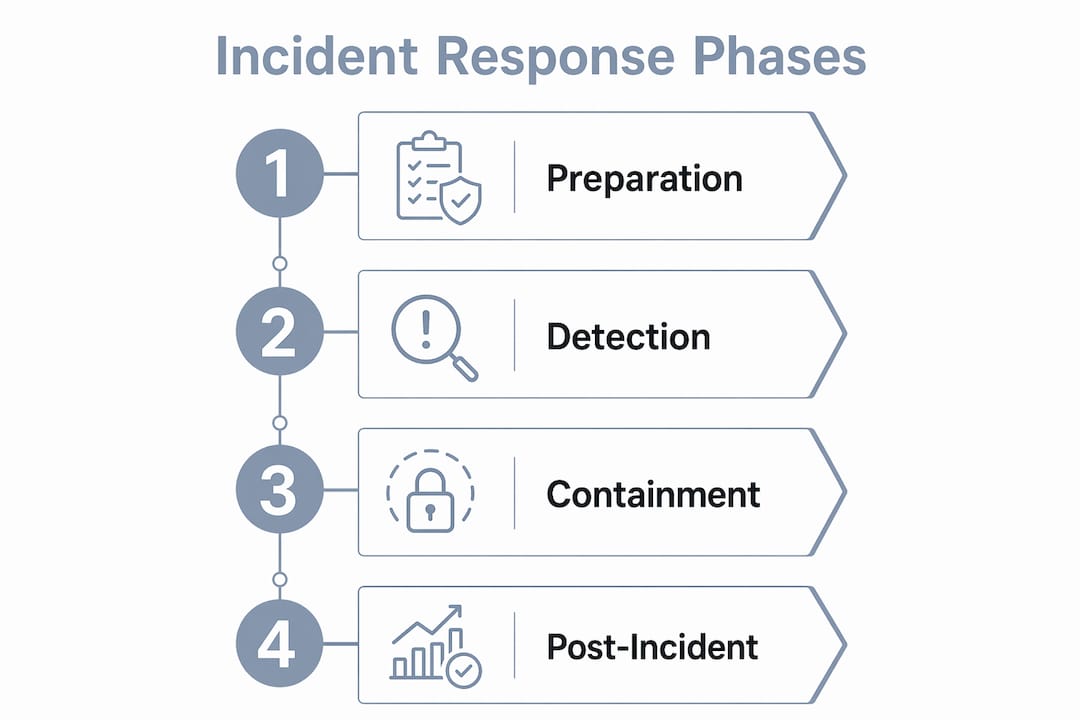
The four phases explained
1. Preparation covers everything you do before an incident occurs. This includes assembling your incident response team, assigning roles, acquiring tools, and drafting playbooks for common attack types.

2. Detection and Analysis is where your team confirms that an event is a real incident. Correlating at least one additional data source beyond SIEM alerts is the recommended practice to avoid acting on false positives or delaying action waiting for certainty.
3. Containment, Eradication, and Recovery is the operational heart of the plan. Containment limits the spread. Eradication removes the threat. Recovery restores normal operations in a controlled, verified sequence.
4. Post-Incident Activity closes the loop. Your team documents what happened, what worked, and what failed. Post-incident reviews should be treated as control improvement engines, not just administrative wrap-up.
Why playbooks matter more than a generic plan
Incident response playbooks specific to scenarios like ransomware, denial-of-service attacks, and data breaches improve response efficiency and consistency. A generic plan tells your team to "contain the threat." A ransomware playbook tells them exactly which systems to isolate, in which order, and who authorises each step. That specificity is what separates a plan that works from one that sits in a folder.
Your IRP must also function as a living document. Threat actors change tactics. Regulations change. Your business changes. A plan that was accurate in 2024 may leave critical gaps in 2026 if it has never been updated.
Pro Tip: Assign a named owner to each playbook, not just a role title. When an incident hits at 2:00 AM, your team needs to know exactly who to call.
How do regulatory requirements affect your incident response plan?
Regulatory obligations set hard deadlines that your IRP must be built around. Missing them carries legal and financial consequences that often exceed the direct cost of the incident itself.
| Regulation | Obligation | Deadline |
|---|---|---|
| SEC Form 8-K | Disclose material cybersecurity incidents | 4 business days |
| HIPAA Breach Notification | Notify affected individuals and HHS | 60 days |
| PIPEDA (Canada) | Report breaches of significant harm to OPC | As soon as feasible |
| Provincial privacy laws | Notify affected individuals | Varies by province |
Businesses must meet disclosure deadlines such as the SEC's 4-business-day Form 8-K filing and HIPAA's 60-day breach notification to avoid legal consequences. For Canadian businesses with U.S. clients or publicly traded status, both frameworks may apply simultaneously. That overlap demands a clear materiality assessment workflow inside your IRP, not a post-incident scramble.
PIPEDA requires organisations to report breaches that pose a real risk of significant harm to the Office of the Privacy Commissioner of Canada as soon as feasible. "As soon as feasible" is not defined by a fixed number of days, which makes internal escalation criteria even more critical. Your IRP should define exactly what constitutes significant harm for your specific business context.
Pro Tip: Build your regulatory notification checklist directly into your containment phase, not as a separate post-incident task. By the time you reach recovery, deadlines may already be running.
Understanding how your cloud security posture affects data residency and breach scope is also part of meeting these obligations accurately.
What are the step-by-step actions for responding to a cyber incident?
A practical incident response checklist gives your team a sequence they can follow under stress. The steps below reflect current best practices for small and mid-sized businesses.
- Verify the alert. Confirm the incident using at least one data source beyond your primary alert system. A single SIEM notification is not sufficient to trigger a full response.
- Declare the incident and assign severity. Use your pre-defined severity classification to set the response level immediately. This determines who gets notified and how fast.
- Activate your incident response team. Contact team members through your pre-agreed out-of-band channel. Do not use email or messaging platforms that may be compromised.
- Contain first, investigate second. Immediate containment in the first 60 minutes prioritises limiting damage over thorough investigation. Isolate affected systems, revoke suspicious credentials, and block known malicious IPs.
- Preserve evidence. Capture logs, memory dumps, and network traffic before you begin eradication. Courts and insurers require this documentation.
- Engage legal counsel and cyber insurance. Notify your insurer and legal team early. They influence what you can disclose, to whom, and when.
- Eradicate and recover. Remove malware, patch vulnerabilities, and restore from verified clean backups. Verify integrity before bringing systems back online.
- Notify affected parties. Follow your regulatory notification checklist. Document every notification with timestamps.
- Conduct a post-incident review. Hold a structured debrief within two weeks. Identify what failed and assign owners to each remediation item.
"Electronic communication channels may be compromised during an active incident. Pre-agreed encrypted out-of-band methods, such as a dedicated secure messaging app or an out-of-network phone bridge, are the only reliable way to coordinate your response team when your primary systems are under attack."
Understanding how endpoint detection response works is directly relevant to steps one through four, where speed and visibility determine the outcome.
What common pitfalls should businesses avoid in their incident response plans?
Most IRP failures trace back to a small set of recurring mistakes. Recognising them before an incident is far cheaper than learning from one.
- Using an unmodified template. Templates are mere skeletons; effectiveness requires customisation to your specific business environment, systems, and team structure. A template that lists "IT team" as a contact is useless if your IT team is a single contractor who works part-time.
- Skipping severity classification. Failure to define severity levels before incidents is a common mistake that delays response and worsens impact. Without pre-set thresholds, every incident feels like a crisis, and real crises get treated like minor events.
- Relying on compromised communication channels. If your primary email server is part of the affected environment, your team cannot use it to coordinate. Out-of-band secure communication must be established and tested before an incident occurs.
- Skipping tabletop exercises. Regular tabletop exercises and plan updates are required for effective team coordination under pressure. A plan that has never been tested is a plan that will fail at the worst possible moment.
- Treating post-incident reviews as optional. Every incident contains information about gaps in your controls. Skipping the review means paying the same price twice.
Common employee cybersecurity vulnerabilities are a frequent root cause of incidents, and your IRP preparation phase should address them directly.
Pro Tip: Run at least one tabletop exercise per year that specifically tests your out-of-band communication plan. Most teams discover their backup channel is either untested, outdated, or unknown to half the team.
Key takeaways
A well-built cyber incident response plan integrates regulatory deadlines, pre-defined severity levels, and tested playbooks into a single operational programme your team can execute under pressure.
| Point | Details |
|---|---|
| Follow NIST SP 800-61 phases | Structure your plan around Preparation, Detection, Containment/Recovery, and Post-Incident Activity. |
| Build regulatory deadlines in | Embed SEC, HIPAA, and PIPEDA notification timelines directly into your containment phase workflow. |
| Write scenario-specific playbooks | Generic plans fail under pressure; ransomware and breach playbooks with named owners perform far better. |
| Test with tabletop exercises | Run at least one annual exercise that includes your out-of-band communication channel. |
| Treat every incident as a learning event | Post-incident reviews improve your security controls and reduce the likelihood of repeat incidents. |
Why I think most SMB incident response plans are built backwards
Nick, Sr. Executive
Most small and mid-sized businesses build their IRP as a compliance artefact. They download a template, fill in the blanks, file it with their insurance broker, and consider the job done. I have seen this pattern repeatedly, and it consistently produces plans that collapse within the first 20 minutes of a real incident.
The businesses that respond well treat their IRP as an operational programme, not a document. They invest in training their people, not just writing procedures. They run exercises that deliberately break their assumptions. They update their plan after every near-miss, not just after a confirmed breach.
Regulatory compliance is a floor, not a ceiling. Meeting PIPEDA or HIPAA deadlines keeps you out of legal trouble. It does not mean your business will survive the incident intact. The real measure of a mature cybersecurity response strategy is how quickly your operations return to normal and how much you learned in the process.
The businesses I respect most treat each incident, however minor, as a data point. They ask what the event revealed about their detection gaps, their communication weaknesses, and their recovery assumptions. That mindset is what turns a static plan into genuine security maturity.
— Nick, Sr. Executive
How AccountNext-Nexus supports your incident response planning
Building a credible IRP takes more than a template. It requires 24/7 visibility into your environment, a team that knows your systems, and the expertise to act fast when alerts fire.

AccountNext-Nexus provides 24/7 monitoring and threat detection that feeds directly into the detection and analysis phase of your IRP. The team supports businesses in developing tailored playbooks, defining severity classifications, and meeting regulatory notification timelines under PIPEDA, HIPAA, and SEC requirements. With all cybersecurity, IT management, and compliance services consolidated under one provider, your incident response capability is built on a foundation that is always current, always tested, and always available. Contact AccountNext-Nexus to build an IRP that works when it counts.
FAQ
What is a cyber incident response plan?
A cyber incident response plan is a documented set of procedures for detecting, containing, and recovering from cybersecurity incidents. It defines team roles, communication protocols, and regulatory notification timelines before an incident occurs.
What are the four phases of NIST SP 800-61?
NIST SP 800-61 groups incident response into Preparation, Detection and Analysis, Containment/Eradication/Recovery, and Post-Incident Activity. Each phase has defined actions and exit criteria to guide your team through a structured response.
How quickly must businesses disclose a cybersecurity incident?
SEC-registered companies must file a Form 8-K within 4 business days of determining an incident is material. HIPAA-covered entities have 60 days to notify affected individuals, and Canadian businesses under PIPEDA must report to the OPC as soon as feasible.
Why do incident response plans fail during real incidents?
Plans most often fail because they were never tested, use generic templates without customisation, or rely on communication channels that are compromised during the incident itself. Regular tabletop exercises and out-of-band communication protocols directly address all three failure points.
How often should a business update its incident response plan?
Your IRP should be reviewed at least annually and updated after every significant incident, major system change, or regulatory update. A plan that reflects your current environment performs far better than one written for a business that no longer exists.