
Integrated IT service providers consolidate security, deliver predictable costs, and cut downtime, turning IT from a cost centre into a measurable business enabler. The evidence points the same direction whether you're a CFO tracking spend or a CISO tracking incidents.
The top payoffs decision-makers should expect:
- Security: unified threat detection and 24/7 monitoring shrink the gap between attack and response.
- Cost predictability: fixed monthly fees replace unpredictable capital spending, converting IT from CapEx to OpEx.
- Uptime and compliance: bundled disaster recovery and compliance support reduce both downtime and audit risk.
Providers offering managed IT services report that this shift toward predictable operating costs also cuts the overhead of hiring and retaining internal IT staff, a benefit that compounds every budget cycle.
Key Takeaways
Integrated IT service providers succeed when unified monitoring, fixed pricing, and governed accountability work together, not when vendors are merely bundled under one invoice.
| Point | Details |
|---|---|
| Predictable costs | Fixed monthly contracts convert unpredictable capital spending into forecastable operating budgets. |
| Faster incident response | Unified telemetry and 24/7 monitoring shorten the time between detection and containment. |
| Governance prevents debt | A named service integrator and shared KPIs stop integration from recreating old silos. |
| Pilot before scaling | A 90-day trial with baseline metrics proves fit before an enterprise-wide rollout. |
| AccountNext-Nexus alignment | AccountNext-Nexus bundles 24/7 monitoring, incident response, and compliance under one SLA with transparent pricing. |
Table of Contents
- What are the operational and financial benefits of integrated IT service providers?
- How does integration improve cybersecurity and incident response?
- Where does the cost efficiency actually come from?
- What governance model prevents integration from creating technical debt?
- How do you pilot an integrated IT service provider?
- What proof should you look for in an integrated provider?
- Requesting a pilot or savings assessment
- An executive's take on avoiding the integration trap
- Sources
What are the operational and financial benefits of integrated IT service providers?
The biggest shift isn't technical. It's how your budget behaves. Fixed monthly contracts turn IT from lumpy capital spending into a flat operating line, which means your finance team can forecast twelve months out instead of bracing for surprise server replacements or emergency contractor invoices. That predictability alone changes how boards approve technology budgets.
The second shift is expertise. Hiring a full internal team covering networking, cloud architecture, compliance, and incident response costs far more than most mid-sized businesses can justify, and the talent is hard to retain. An integrated provider gives you that bench without the payroll burden, and OneAdvanced's research on managed IT services confirms this substitution effect is one of the clearest reasons organizations switch.
Downtime is where the numbers get concrete. Proactive maintenance and unified monitoring catch failing hardware and misconfigurations before they become outages, and bundled disaster recovery planning means restorations happen in hours rather than days.
Three things CFOs should track once they make the switch:
- Cost per user, month over month — confirm the fixed fee actually beats your blended in-house cost.
- Downtime minutes per quarter — the clearest proxy for productivity loss.
- Percentage of IT spend on innovation versus maintenance — a rising number means the provider is doing its job.
Pro Tip: Ask any prospective provider for a 90-day downtime and ticket-resolution report from an existing client before you sign. Vague promises about "improved uptime" mean nothing without a number attached.
How does integration improve cybersecurity and incident response?
Fragmented security tools create blind spots. When your firewall, endpoint protection, and network monitoring live with three different vendors, nobody owns the full picture, and threats slip through the seams between systems. Integration fixes that by putting all telemetry in one place, so a suspicious login on one system can be correlated instantly against unusual traffic on another.

That correlation is what actually shortens mean time to respond. A 24/7 security operations centre watching unified data can flag and contain an incident while a fragmented setup is still waiting on someone to notice. OneAdvanced's benefits research ties this directly to managed cybersecurity services that combine round-the-clock monitoring, vulnerability assessment, and rapid response under one contract.
Bundling security with compliance under a single SLA carries a regulatory upside too: one audit trail, one set of controls, one vendor accountable for SOC 2, HIPAA, or PCI-DSS evidence instead of three separate reports that don't line up.
Security KPIs worth putting in front of your board:
- Mean time to detect (MTTD) and mean time to respond (MTTR)
- Number of incidents escalated versus contained at the monitoring layer
- Percentage of endpoints under active monitoring
- Time to close audit findings after a compliance assessment
Where does the cost efficiency actually come from?
Direct savings show up fast: fewer redundant licenses, no duplicate monitoring tools, and a smaller internal headcount dedicated to babysitting infrastructure. Vendor overlap is the quiet budget killer most companies never audit, and consolidation forces that audit to happen.
Indirect savings take longer to show but matter more. Every hour of avoided downtime is revenue that didn't stall, and faster recovery after an incident means fewer emergency contractor invoices. OneAdvanced also notes that a consolidated provider can modernize your data infrastructure, which pays a second dividend if your business is preparing for AI-driven tools, since clean, secured data is a prerequisite for any of that working reliably.
Metrics finance should ask for in any proposal:
- Cost per user per month, benchmarked against current blended spend
- Downtime minutes avoided, tracked quarter over quarter
- Percentage of IT budget shifting from maintenance to innovation projects
A simple cost assessment: pull twelve months of invoices across every current IT and security vendor, tag each line as maintenance or innovation, then compare that split against what an integrated provider quotes for the same scope.
What governance model prevents integration from creating technical debt?
Consolidating vendors under one contract doesn't automatically fix anything if nobody owns the outcomes. That's the trap: businesses buy "integration" expecting simplicity and end up with the same silos, just relabelled. CAST's research on technical debt makes the point plainly. Integration strategies have to align with actual business objectives, not just get bolted onto existing architecture.
Service Integration and Management, known as SIAM, solves this by installing a dedicated service integrator role that owns cross-vendor accountability, consolidated SLAs, and shared reporting dashboards. That structure is what closes the ownership gaps that let technical debt accumulate quietly.
Common failure modes: scope left vague at contract signing, no shared KPIs between vendor and client, and dashboards that report activity instead of outcomes.
Governance checklist before you sign anything:
- Name a single service integrator accountable for cross-system performance.
- Define shared KPIs both parties report against monthly.
- Confirm consolidated dashboards exist before day one, not as a future roadmap item.
Pro Tip: Insist on seeing a sample SLA report before signing. If it reads like a list of completed tickets instead of business outcomes, the governance model isn't mature enough yet.
How do you pilot an integrated IT service provider?
Start small and time-boxed. A 90-day pilot covering one business unit or one service category (security monitoring is a common first choice) gives you enough data to judge fit without betting the whole IT budget on an untested relationship.
Procurement checklist before signing:
- SLA terms with named response times, not vague language
- Clear escalation paths and named points of contact
- Documented compliance capabilities (SOC 2, HIPAA, PCI-DSS as relevant)
- Transparent, itemized pricing with no hidden project fees
Baseline metrics to gather before day one:
- Current downtime minutes per month
- Current mean time to resolve incidents
- Current spend across all IT and security vendors combined
Compare those numbers against the same metrics 90 days into the pilot. If the provider performs, build a scaling plan that covers data migration timing, a communication plan for affected teams, and a governance model (see the SIAM section above) before rolling out enterprise-wide.
What proof should you look for in an integrated provider?
Look for a provider whose service map actually mirrors the benefits above rather than a generic list of offerings. AccountNext-Nexus structures its services around exactly that alignment: 24/7 real-time monitoring and threat detection, a single unified SLA covering security and compliance together, and audit support spanning SOC 2, HIPAA, and PCI-DSS under one contract instead of three.
Clients working with integrated providers typically report the outcomes this article has walked through:
- Faster incident containment once monitoring and response sit under one team
- Clearer audit posture when compliance evidence comes from a single source
- More predictable monthly spend once fixed-fee contracts replace ad hoc invoices
Readers wanting more operational detail can review case studies on managed security outcomes for a closer look at how this plays out for small and mid-sized businesses specifically.
Requesting a pilot or savings assessment
AccountNext-Nexus builds its service around the exact gaps this article has covered: fragmented telemetry, unpredictable invoices, and compliance evidence scattered across vendors nobody fully owns. Rather than selling point tools, AccountNext-Nexus puts 24/7 monitoring, incident response, and compliance assessments under one SLA, with pricing that's transparent from the first quote.
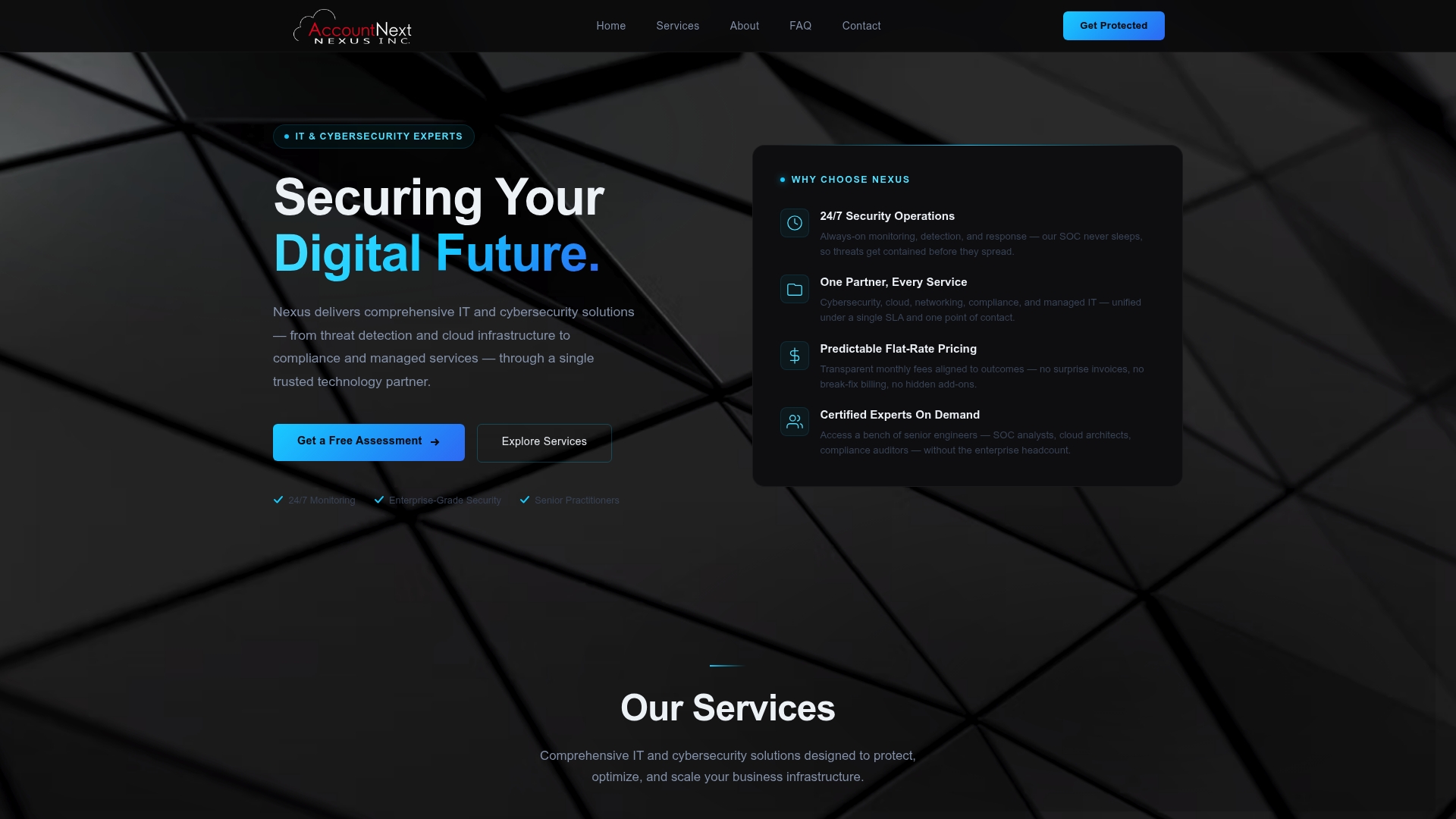
If your current setup has you juggling three vendors and still can't answer "what's our mean time to respond," that's the exact problem a consolidated model is built to fix. Request a pilot or a savings assessment through the AccountNext-Nexus services page and get a baseline read on where your current spend and risk actually stand before you commit to anything larger.
An executive's take on avoiding the integration trap
Consolidating vendors isn't the win. Consolidating accountability is. Bring finance and security into procurement on day one, or you'll just relabel your silos and call it integration.
— Nick - Sr. Executive
Sources
- Top 12 Benefits of Managed IT Services in 2026 | OneAdvanced
- Intentional management of technical debt while modernizing systems | CAST