
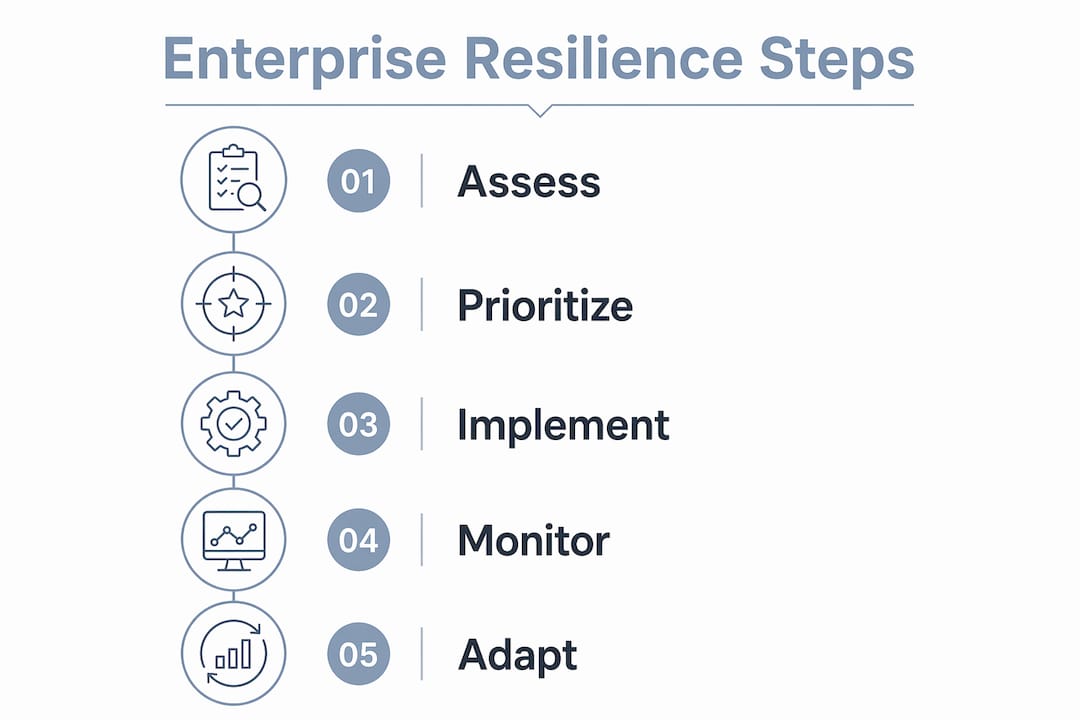
Enterprise resilience is defined as an organisation's capacity to absorb disruptions, adapt to change, and maintain critical operations without catastrophic loss. The role of IT in enterprise resilience is not peripheral. IT systems, governance structures, and risk management capabilities form the operational backbone that determines whether a business survives a crisis or collapses under it. Research confirms that organisations with advanced AI control capabilities protect 55% more operating profit from AI disruptions than those with limited control. For IT leaders, that gap is the clearest possible argument for treating resilience as a core IT mandate.
How does IT infrastructure support operational continuity?
IT infrastructure is the first line of defence when disruptions hit. High-availability systems, failover environments, and automated monitoring determine how quickly an organisation recovers. Without these components in place, even a minor outage can cascade into a multi-day business interruption.
The most effective infrastructure strategies build resilience in layers:
- High-availability architecture. Redundant systems and load balancing prevent single points of failure from taking down critical services.
- Automated failover. Systems that switch to backup environments without human intervention reduce recovery time from hours to minutes.
- Continuous monitoring. Real-time observability tools detect anomalies before they become outages, giving IT teams time to act.
- Dependency mapping. Automated resilience discovery tools reduce infrastructure mapping time from weeks to 2–4 hours, surfacing hidden dependencies that manual audits consistently miss.
- CI/CD pipeline integration. Embedding resilience tests into development cycles catches fragile components before they reach production.
The dependency mapping point deserves emphasis. Hidden runtime dependencies are the silent killers of IT continuity. A service that appears stable in isolation can fail catastrophically when a downstream dependency changes. Automated discovery tools integrated into CI/CD pipelines surface these risks continuously, not just during quarterly audits.
Pro Tip: Prioritise infrastructure components by recovery time objective (RTO) and recovery point objective (RPO). Not every system needs the same level of redundancy. Rank them by business impact and invest accordingly.

Understanding cloud infrastructure principles is foundational to this prioritisation work. Architectural decisions made at the infrastructure level ripple through every other resilience capability the organisation builds.
What role does IT governance play in resilient decision-making?
Technical systems alone do not produce resilience. IT resilience depends on two pillars: IT service quality that empowers people, and IT governance that embeds clarity and accountability in processes. When a crisis hits, failover systems mean nothing if staff do not know who makes decisions or what steps to follow.
Effective IT governance for resilience includes:
- Clear accountability structures. Every critical system needs a named owner responsible for recovery decisions during an incident.
- Documented escalation paths. Staff must know exactly who to contact and in what order when systems degrade.
- Resilience as a design principle. Governance frameworks should require resilience reviews at the architecture stage, not as an afterthought.
- Deliberate technical debt management. Documenting technical debt deliberately helps organisations balance modernisation urgency with stability, avoiding the brittleness that rushed upgrades create.
The technical debt point is frequently underestimated. IT leaders often treat debt as something to eliminate as fast as possible. The more disciplined approach is to document it, understand which components are fragile, and sequence modernisation to avoid breaking dependencies that the business relies on daily.
Advanced-stage businesses generate 38% more revenue per employee by integrating stable technology, security, and planning. That figure reflects what governance maturity actually produces at the business level. Boards and investors increasingly regard operational resilience and governance maturity as indicators of long-term valuation, not just operational hygiene.
Pro Tip: Run a governance gap analysis before your next major IT project. Map every critical system to an accountable owner and a documented recovery process. Gaps found before a crisis are far cheaper to close than gaps discovered during one.
How does IT risk management connect to enterprise resilience strategies?
Risk management is where IT strategy and business continuity planning must converge. Enterprise resilience requires unified decision models connecting IT disaster recovery, business continuity, and third-party risk management. Siloed recovery planning produces organisations that can restore a server but cannot resume business operations.
The key risk domains IT leaders must address are:
- AI vendor dependency. Only 7% of organisations operate at an advanced AI control level, yet 71% find vendor or model switching difficult. That combination creates concentrated operational risk that most enterprises have not fully priced into their continuity plans.
- Cybersecurity. A breach does not just expose data. It disrupts operations, triggers regulatory obligations, and erodes customer trust simultaneously. Understanding how cyber threats evolve is a prerequisite for building a resilience posture that holds under real attack conditions.
- Third-party risk. Supplier and cloud provider outages are now among the most common causes of enterprise disruption. Resilience plans must account for dependencies outside the organisation's direct control.
- Business process alignment. Disaster recovery tests must align IT recovery with business process capabilities. Restoring a system that the business cannot operationally use is not recovery. It is a false sense of security.
| Risk domain | Primary IT control | Business impact if unaddressed |
|---|---|---|
| AI vendor dependency | Dependency mapping, multi-vendor architecture | Operating profit exposure during model disruptions |
| Cybersecurity | Threat detection, endpoint response, compliance | Data loss, regulatory penalties, operational shutdown |
| Third-party outages | Supplier risk assessments, redundant providers | Service interruptions outside direct IT control |
| Business process gaps | Joint DR and BCP testing | IT restoration without operational recovery |
The cybersecurity maturity model provides a structured way to assess where your organisation sits across these domains and what investments close the most critical gaps first.
What emerging IT trends are shaping enterprise resilience in 2026?
The most significant shift in enterprise resilience right now is the move from reactive recovery to proactive anticipation. IT leaders must blend proactive, active, and reactive resilience measures, including pressure-testing employees and systems, continuous monitoring, and failover infrastructure. No single measure is sufficient on its own.
The trends accelerating this shift include:
- AI-powered failure mode automation. AI tools now simulate failure scenarios at a scale and speed that manual testing cannot match, identifying weaknesses before they surface in production.
- Observability platforms. Modern observability goes beyond uptime monitoring. These tools correlate signals across infrastructure, application, and network layers to anticipate degradation before it becomes an outage.
- Continuous resilience testing in CI/CD. Embedding chaos engineering and resilience tests into development pipelines means every code release is validated against failure scenarios, not just functional requirements.
- Automated AI dependency discovery. As AI components proliferate across enterprise systems, automated dependency discovery integrated into CI/CD pipelines becomes the only reliable way to track runtime relationships that manual audits cannot see.
The timing of technology modernisation is also a resilience decision. Upgrading core systems too quickly, without mapping fragile dependencies first, introduces instability at exactly the moment the organisation needs predictability. The organisations that get this right treat modernisation as a sequenced programme, not a sprint.
The enterprise vulnerability management process is one practical framework for sequencing these decisions. It connects vulnerability identification to remediation priority in a way that keeps stability intact while the organisation moves forward.
Key takeaways
IT infrastructure, governance, and integrated risk management together determine whether an organisation can absorb disruptions and continue operating without catastrophic loss.
| Point | Details |
|---|---|
| Infrastructure layers matter | High-availability systems, automated failover, and dependency mapping each address different failure modes. |
| Governance drives human readiness | Clear accountability and documented escalation paths are as critical as technical failover systems. |
| Unified risk models are non-negotiable | Connecting IT disaster recovery, business continuity, and third-party risk prevents siloed planning failures. |
| AI dependency is an underpriced risk | Only 7% of organisations have advanced AI control, leaving most exposed to vendor-driven disruptions. |
| Modernisation timing is a resilience decision | Sequencing upgrades to avoid breaking fragile dependencies protects stability during change. |
The part of resilience planning most IT leaders get wrong
The organisations I have seen struggle most with resilience are not the ones with bad technology. They are the ones where IT and business operations have never actually tested recovery together. The IT team restores the system. The business team discovers they cannot process orders because a manual workaround that existed three years ago was quietly retired. Nobody documented it. The test passes. The real crisis does not.
The CIO's role has shifted from acceleration advocate to stability custodian, designing systems to tolerate ambiguity and partial failure. That framing is exactly right, but it requires a different kind of conversation with the business. Resilience planning cannot live inside the IT department. It has to be a joint exercise where IT leaders and business process owners sit in the same room and agree on what "recovered" actually means for each critical function.
The other thing I would push back on is the instinct to modernise everything at once. Speed feels like progress. But rushing modernisation through brittle dependencies is how organisations create the very outages they were trying to prevent. Document the debt. Sequence the work. Stability is not the enemy of progress. It is the foundation that makes progress sustainable.
— Nick - Sr. Executive
How AccountNext-Nexus supports your resilience programme
Fragmented IT and security tools create exactly the gaps that disruptions exploit. AccountNext-Nexus consolidates cybersecurity, IT management, and compliance under one programme, giving IT leaders a single, coherent view of their resilience posture.
AccountNext-Nexus delivers 24/7 monitoring and threat detection with real-time response capabilities, so threats are contained before they become outages. The team brings deep expertise in cloud infrastructure management, compliance, and incident response, with transparent pricing and no hidden complexity. For IT leaders building or stress-testing a resilience strategy, AccountNext-Nexus provides the integrated coverage that point solutions cannot. Visit AccountNext-Nexus to see how the full service catalogue maps to your organisation's continuity requirements.
FAQ
What is enterprise resilience in IT terms?
Enterprise resilience is an organisation's ability to absorb disruptions, maintain critical operations, and recover without catastrophic loss. IT systems, governance, and risk management are the primary mechanisms that deliver this capability.
How does IT governance improve resilience?
IT governance improves resilience by establishing clear accountability, documented escalation paths, and resilience requirements at the design stage. Research confirms that technical failover systems fail when staff are unprepared for crisis decision-making.
Why is AI vendor dependency a resilience risk?
Only 7% of organisations have advanced AI control capabilities, yet 71% find switching AI vendors or models difficult. That combination concentrates operational risk and leaves most enterprises exposed when a vendor experiences disruptions.
How often should disaster recovery tests include business process validation?
Every disaster recovery test should include business process validation, not just IT system restoration. Restoring a system that the business cannot operationally use does not constitute recovery and creates a false sense of preparedness.
What is the fastest way to identify hidden IT dependencies?
Automated resilience discovery tools reduce infrastructure mapping from weeks to 2–4 hours and surface hidden runtime dependencies that manual audits miss. Integrating these tools into CI/CD pipelines provides continuous visibility rather than point-in-time snapshots.