
Outsourcing IT is often the right move for US healthcare organizations facing staffing gaps, ageing infrastructure, or rising cyber risk, but only when the vendor signs a Business Associate Agreement, submits to verifiable security controls, and accepts governance-backed SLAs. Skip any of those three, and the arrangement becomes a liability rather than a fix. The rest of this guide walks through what to outsource, how to vet a partner, and how to roll the engagement out without losing control of patient data.
TL;DR:
- Outsourcing IT functions like security, EHR management, and cloud migration only becomes beneficial if vendors sign a proper BAA, implement security controls, and accept governance SLAs.
- Contracting with vendors outside the U.S. or across multiple locations increases compliance complexity and requires scrutiny of data residency and breach-notification processes.
- Strong governance and active oversight are essential to realize benefits, as outsourcing alone does not guarantee modernization speed, cost savings, or improved security.
- Risks such as PHI breaches, vendor lock-in, and knowledge loss can be mitigated through contractual clauses, documentation, overlap periods, and regular reviews.
- Consolidating multiple vendors under one provider can reduce incident response time, improve visibility, and clarify responsibilities, especially during breach events.
Table of Contents
- What does healthcare IT outsourcing cover today?
- What are the real benefits of outsourcing healthcare IT?
- What compliance and security requirements apply to healthcare IT outsourcing?
- What risks come with outsourcing healthcare IT, and how do you mitigate them?
- How do you evaluate and select an outsourcing partner?
- How long does a healthcare IT outsourcing rollout actually take?
- How does a consolidated IT and cybersecurity partner change the equation?
- What should healthcare leaders actually prioritize first?
- Why AccountNext-Nexus fits organizations tired of managing four vendors at once
- Sources
What does healthcare IT outsourcing cover today?
Healthcare IT outsourcing spans a wider set of functions than most leaders expect. It is no longer just "hire someone to answer help desk tickets." Health systems now hand off entire technical domains, sometimes to one vendor, sometimes to several running in parallel.
The most commonly outsourced services include:
- Help desk and end-user support for clinical and administrative staff, often around the clock.
- Electronic health record (EHR) management, including upgrades, custom builds, and interface support.
- Cloud migration and management, moving workloads to platforms like AWS, Azure, or Google Cloud while keeping data residency and access controls straight.
- Managed detection and response (MDR) or security operations centre (SOC) services, which is real-time monitoring for intrusions and anomalies.
- Application development, for patient portals, scheduling tools, and internal workflow apps.
- Revenue cycle management (RCM) support, including claims processing and billing system maintenance.
Engagement models vary just as much as the service list. Managed services put a vendor on a recurring contract with defined outcomes. Staff augmentation places contracted specialists inside your existing team to fill a skills gap temporarily. Project-based work covers one-time initiatives like a cloud migration or an EHR upgrade. Many hospitals run a hybrid, using managed services for security monitoring while augmenting staff for a specific interoperability project.
Delivery location matters too. Onshore vendors simplify HIPAA oversight and time-zone coordination. Nearshore and offshore arrangements can lower costs but add complexity to breach-notification timelines and data-residency requirements, so scrutinize where PHI is actually stored and processed before signing anything.
What are the real benefits of outsourcing healthcare IT?
The case for outsourcing rests on four practical advantages, and each one has a specific condition attached to it. None of them appear automatically just because a contract gets signed.
Cost shifts from capital to operating expense. Building an in-house security operations centre requires hardware, licensing, and a payroll of specialists who are hard to hire in the current market. Outsourcing converts that capital outlay into a predictable monthly fee, which finance teams generally prefer because it smooths budgeting across fiscal years, according to Zymr's analysis of healthcare IT outsourcing.
Specialized talent becomes accessible. Cloud engineers, interoperability specialists, and cybersecurity analysts with healthcare experience are in short supply, and most mid-sized hospitals cannot justify a full-time headcount for each skill. A vendor spreads that talent across multiple clients, which is often the only realistic way a 200-bed hospital gets access to the same calibre of security engineering a major academic medical centre can afford in-house.
Modernization happens faster. Vendors that specialize in cloud migration or EHR optimization have done the work dozens of times before. That repetition trims months off timelines that an internal team, doing the work for the first time, would spend on trial and error.
Scalability covers the gaps internal teams can't staff. Round-the-clock monitoring for ransomware and intrusion attempts is exhausting to run internally on a small IT staff. Outsourced SOC coverage fills the overnight and weekend gaps that are statistically when many attacks happen.
Pro Tip: Ask any prospective vendor how they measure "faster modernization" in their own contracts. If they cannot show a concrete before-and-after timeline from a past client, treat the promise as marketing, not evidence.
The Becker's Hospital Review analysis of IT outsourcing makes a point worth repeating: these benefits only materialize with strong governance and active CIO oversight. Outsourcing without oversight just moves the risk somewhere less visible.
What compliance and security requirements apply to healthcare IT outsourcing?
Every vendor that creates, receives, stores, or transmits protected health information on your behalf must sign a Business Associate Agreement. This is not optional and it is not negotiable. The HHS breach notification rule makes clear that both covered entities and their business associates carry legal duties around PHI handling and disclosure, and a missing or poorly drafted BAA leaves your organization exposed regardless of what the vendor's marketing materials claim.
Beyond the BAA, look for third-party certifications, but treat them as a starting point rather than proof of security maturity. SOC 2 and ISO 27001 reports demonstrate that a vendor has documented processes and passed an audit, yet a certificate alone tells you little about how the vendor responds when something actually breaks. Ask for control-level evidence and supporting documentation alongside the certificate itself.
Technical controls worth demanding as contract terms:
- Encryption at rest and in transit for any system touching PHI.
- Multi-factor authentication for all administrative and remote access.
- Centralized logging with retention long enough to support a forensic investigation.
- Least-privilege access models, so support staff only see the data their role requires.
- Documented incident response playbooks, tested at least annually.
Before signing, run this short due diligence checklist:
- Request the signed BAA template and read every clause on breach notification timelines.
- Ask for the most recent SOC 2 or ISO 27001 report, not a summary of it.
- Request a sample incident response runbook for a scenario like ransomware detection or EHR failover.
- Confirm where PHI physically resides and who has access to it.
- Verify cyber liability insurance coverage limits.
Pro Tip: Request a runbook, not just a policy document. A vendor's ransomware playbook or EHR failover procedure reveals process maturity far more reliably than any certification badge on their website. Backup and restore verification deserves its own scrutiny too. Reviewing HIPAA compliant backup practices before contracting helps you ask sharper questions about restore testing frequency, not just backup frequency.
What risks come with outsourcing healthcare IT, and how do you mitigate them?
Four risks repeatedly show up in outsourcing arrangements that go sideways, and each has a known countermeasure.
PHI breaches remain the highest-stakes risk. Mitigate this with contractual breach-notification clauses tied to specific timelines, mandatory encryption standards written into the SLA, and continuous monitoring that your team, not just the vendor, can audit independently.
Vendor lock-in creeps up quietly. A vendor that controls your data through proprietary formats or undocumented APIs can make switching prohibitively expensive later. Insist on data portability clauses, documented APIs, and a written exit plan before you sign, not after you decide to leave.
Institutional knowledge loss happens when a vendor transition strips away context that lived in someone's head rather than in documentation. Build in overlap periods where outgoing and incoming teams work side by side, require thorough documentation as a contract deliverable, and use shadowing during the handoff window.
Cultural and communication friction slows everything down when a vendor's reporting cadence doesn't match how your organization actually makes decisions. Fix this with a regular governance cadence, a documented RACI chart clarifying who approves what, and quarterly business reviews that go beyond a status update slide deck.
- Contractual breach-notification timelines and encryption requirements address PHI risk directly.
- Data portability clauses and documented exit plans prevent lock-in from becoming a hostage situation.
- Overlap staffing and mandatory documentation preserve institutional knowledge through any transition.
- A defined RACI and quarterly business reviews keep cultural friction from turning into missed deadlines.
Pro Tip: Build the exit plan into the contract on day one, not the day you decide to leave. A vendor with nothing to hide will not object to writing down how the relationship ends.
How do you evaluate and select an outsourcing partner?
Selecting a vendor comes down to four categories of evidence: documentation, service levels, operational transparency, and commercial terms. Skipping any one of these categories is how organizations end up locked into a bad contract they didn't fully understand.
Start with documents to request before any serious negotiation:
- The signed BAA template, reviewed by your own legal counsel.
- Current SOC 2 or ISO 27001 audit reports, in full.
- Proof of cyber liability insurance and coverage limits.
- A written history of past security incidents and how they were disclosed to clients.
Service-level agreements need to be specific and measurable, not vague promises of "high availability." Reasonable benchmarks include 99.9% uptime for critical systems, a 15-minute response time for severity-one incidents, resolution targets tied to incident severity, and a documented patch-management cadence. A Becker's Hospital Review point worth acting on: involve clinical stakeholders in setting the KPIs that matter most, not just the IT department, since a "resolved" ticket that still disrupts a nursing workflow isn't actually resolved.
Questions worth asking directly in vendor interviews:
- How is staff trained specifically on PHI handling before they touch a live system?
- What does the escalation path look like at 2 a.m. on a Sunday?
- Can you walk us through a past incident from detection to resolution?
Watch the commercial terms closely, too. Pricing models that look cheap upfront sometimes hide change-order fees for anything outside the original scope, steep termination penalties, or data-extraction charges if you ever decide to leave. Get all of it in writing before signing, not as a verbal assurance.
How long does a healthcare IT outsourcing rollout actually take?
A typical outsourcing engagement moves through four phases, and rushing any one of them is the most common reason implementations stall.
- Phase 0, internal readiness, generally lasts a few weeks. Inventory your current systems, align stakeholders across IT, compliance, and clinical leadership, and decide what governance structure will oversee the vendor relationship before you start evaluating anyone.
- Phase 1, selection and contracting, often spans several weeks. Run due diligence, negotiate the BAA and SLA terms, and get legal counsel to review every clause tied to data handling and termination.
- Phase 2, onboarding duration varies depending on scope, typically several weeks to a few months. Transfer institutional knowledge through documentation and shadowing, test integrations before going live, and provision access under least-privilege principles from day one.
- Phase 3, go-live and steady state (ongoing). Monitor the agreed KPIs, hold quarterly business reviews, and treat the relationship as something that needs active management, not a contract you sign and forget.
Smaller ambulatory networks often complete all four phases in a few months. Larger health systems with multiple EHR instances and legacy integrations should plan for an extended period, especially if cloud migration is involved.
How does a consolidated IT and cybersecurity partner change the equation?
Vendor sprawl is its own quiet risk. When monitoring, help desk, compliance, and cloud management sit with four different vendors, incident response slows down because nobody owns the full picture, and each renewal negotiation happens in isolation. Consolidating those functions under one provider with a unified SLA tends to shorten response times because there's a single team with visibility across the entire environment, not four teams each seeing a slice of it.
If you're evaluating a consolidated provider, push past the sales pitch and ask the same questions you'd ask any specialist vendor: Will they sign a BAA covering every service line, not just the security piece? What does onboarding actually look like, week by week? Is pricing transparent across all bundled services, or does it obscure add-on fees once you're locked in? Do they provide 24/7 monitoring with a named escalation contact, not a ticket queue that disappears overnight?
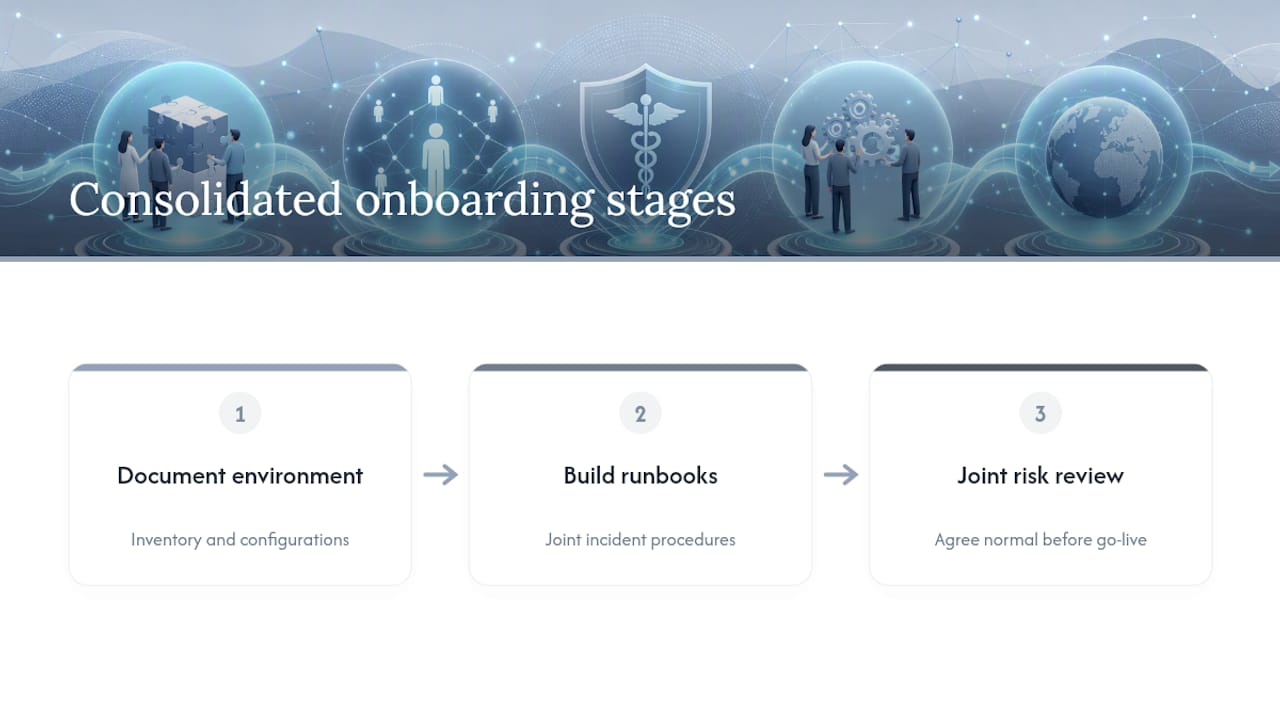
A sound onboarding process for a consolidated engagement typically includes documenting your existing environment in detail, building shared incident runbooks jointly rather than handing you a generic template, and running a joint risk review before go-live so both sides agree on what "normal" looks like before an incident tests the relationship. Consolidation is not a shortcut around due diligence. It's a way to make that due diligence apply consistently across every system you're trusting to a vendor.
What should healthcare leaders actually prioritize first?
Most advice on this topic front-loads the wrong priority. Vendors and consultants love to lead with cost savings, and cost savings are real, but they are also the easiest number to promise and the hardest to verify a year into a contract. What predicts whether an outsourcing arrangement actually works is far less glamorous: how specific your SLAs are on day one, and whether anyone on your side is actually reading the incident reports every month.
The conventional wisdom treats certifications like SOC 2 as a finish line. They're a starting point. A certificate tells you a vendor passed an audit on a specific date. It says nothing about how they'll behave the night your EHR goes down at 3 a.m. Ask for the runbook before you ask for the certificate.
If there's one thing worth prioritizing above everything else in this playbook, it's governance cadence. Not the contract clause about governance. The actual calendar habit of a quarterly business review where someone senior on your side asks hard questions and expects real answers. Contracts protect you on paper. Cadence protects you in practice.
— Nick - Sr. Executive
Why AccountNext-Nexus fits organizations tired of managing four vendors at once
If the checklist above left you counting how many separate vendors currently touch your PHI, that's usually the moment consolidation starts making sense. A consolidated IT and cybersecurity provider can offer 24/7 real-time threat detection, cloud infrastructure management, and compliance support under one unified SLA, rather than coordinating multiple vendors separately.
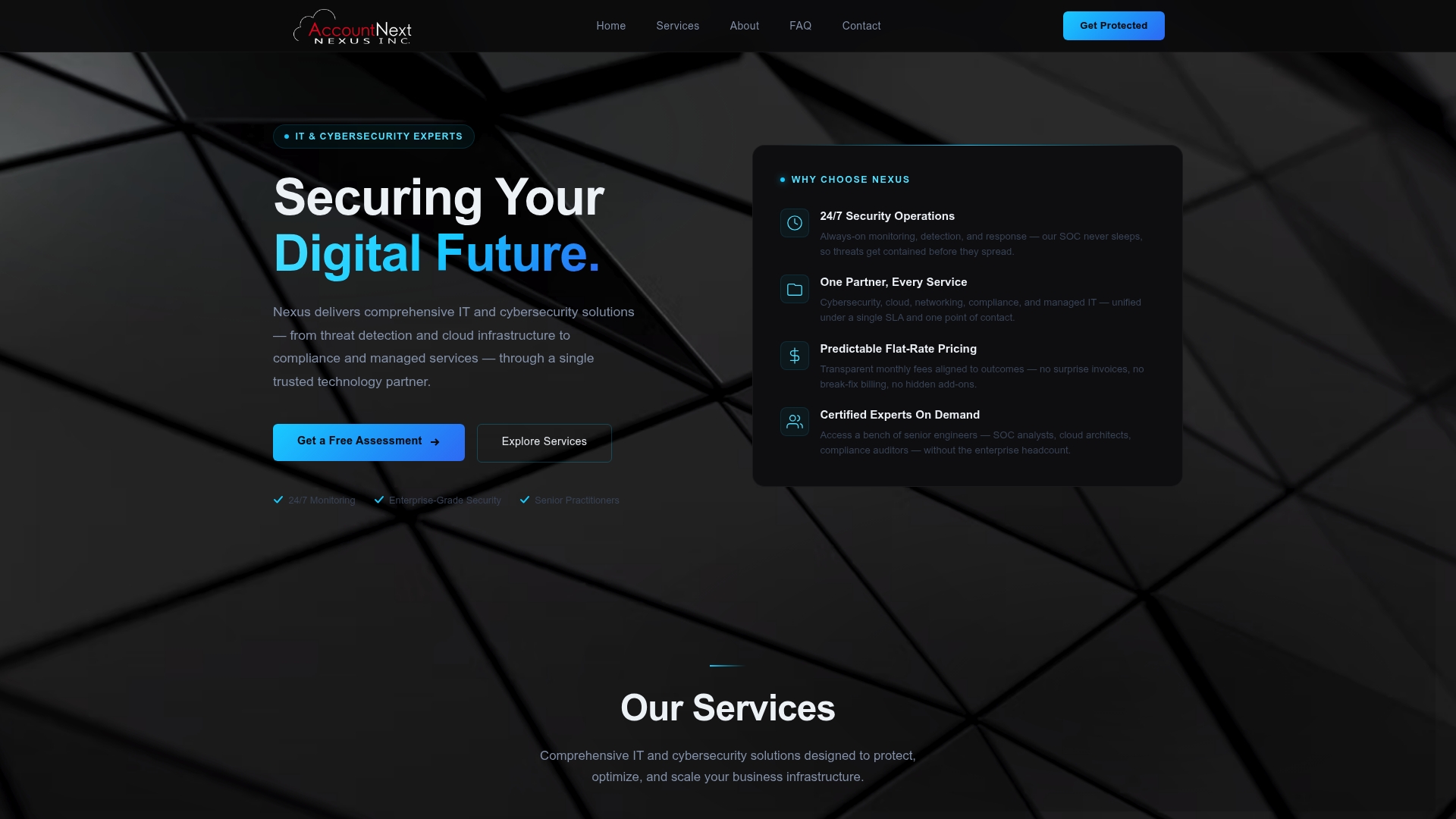
That single-point structure matters most during an actual incident, when speed depends on one team already having full visibility instead of four teams comparing notes after the fact. This consolidated model often comes with transparent pricing and access to experienced IT professionals, reducing the complexity of negotiating separate contracts every renewal cycle and clarifying responsibility during breach responses. If your organization is ready to compare a consolidated approach against the multi-vendor setup you're running today, start by reviewing Nexus's IT and cybersecurity services and requesting a walkthrough of how onboarding and SLA structuring would work for your environment specifically.
Sources
- HHS — Breach notification rule (HIPAA)
- The pros and cons of IT outsourcing in healthcare — Becker's Hospital Review
- Healthcare IT outsourcing: strategies, benefits, and best practices — Zymr