
Baseline: encrypt all ePHI at rest with AES‑256, use TLS 1.2+ (TLS 1.3 preferred) in transit, and centralize keys in an HSM or KMS with documented rotation and custodianship. Nothing else in this article matters more than getting those three things right, because they are what an OCR auditor checks first and what a breach investigator checks second.
Start this week with three moves:
- Inventory every system that stores or touches PHI, including shadow databases and backup archives nobody remembers provisioning.
- Turn on at‑rest encryption for every cloud bucket, database, and volume that inventory turns up.
- Move key custody into a managed KMS or HSM with role‑based access, and stop letting application code hold raw keys.
NIST's SP 800‑66r2 and the HHS SRA Tool give you the exact language auditors expect to see documented. AccountNext-Nexus builds this sequence into most of its healthcare engagements because it closes the widest exposure gaps fastest.
Key Takeaways
Encryption satisfies HIPAA only when AES‑256 at rest, TLS 1.2+ in transit, and documented KMS‑based key custody are paired with evidence auditors can actually verify.
| Point | Details |
|---|---|
| Baseline algorithms | Use AES‑256 at rest and TLS 1.2+ in transit, with TLS 1.3 preferred for new deployments. |
| Separate keys from data | Store KEKs in an HSM or cloud KMS using envelope encryption, never alongside the ciphertext they protect. |
| Automate rotation | Run key rotation on a schedule, roughly every 90 days for high‑sensitivity keys, and verify it executed in the console. |
| Document everything | Keep risk analyses, key management policies, BAA clauses, and rotation logs ready for OCR review at any time. |
| Test restores regularly | Schedule quarterly backup‑restore drills and annual penetration tests that include key‑management scenarios. |
Table of Contents
- Patient data encryption best practices: the 30 to 90 day checklist
- How encryption maps to HIPAA: what auditors want to see
- Encryption levels and recommended algorithms for ePHI
- Key management architecture that actually holds up under audit
- Rolling out encryption across cloud, on‑prem, and endpoints
- Testing, monitoring, and proving encryption stays effective
- Responding to a ciphertext exposure without guessing
- How a managed partner operationalizes these controls
- What actually separates compliant encryption from audit‑ready encryption
- Frequently asked questions
- Sources
Patient data encryption best practices: the 30 to 90 day checklist
Work through this in order. Each step reduces exposure before the next one starts.
- Map PHI exposure surface first. Rank backups, patient portals, application caches, and mobile devices by how much unencrypted data they hold and how often they're accessed.
- Enable server‑side encryption with customer‑managed keys (SSE‑KMS or equivalent) on every storage bucket and database instance touching PHI.
- Turn on full‑disk encryption across laptops, workstations, and any device that can cache PHI locally, even temporarily.
- Enforce TLS everywhere, including internal service‑to‑service traffic that teams often assume is "safe" because it never leaves the data centre.
- Update every Business Associate Agreement to name specific encryption and key‑custody obligations, not vague "reasonable safeguards" language.
- Verify KMS rotation is actually enabled, not just configured. A rotation policy that was never activated is worse than none, because it shows up as a false positive in your own documentation.
- Forward all KMS and HSM audit logs to your SIEM so key access events sit alongside your other security telemetry.
- Set certificate expiry monitoring with alerts at 30 and 7 days out. Expired TLS certificates are a shockingly common, entirely preventable outage and compliance embarrassment.
How encryption maps to HIPAA: what auditors want to see
HIPAA's Security Rule doesn't mandate a specific algorithm. It mandates a documented, risk‑based decision under §164.308(a)(1)(ii)(A), and that distinction trips up more compliance teams than any technical requirement in the rule. Auditors aren't grading your cipher choice. They're grading whether you can prove you thought it through and wrote it down.
The safe harbour provision under the HHS Security Rule framework matters most after a breach: properly encrypted ePHI, with keys that were never compromised, generally doesn't trigger breach notification obligations. That's a meaningful incentive, but it only holds if you can demonstrate the keys stayed secure and the algorithm was current at the time of exposure. The PMI Security Implementation Guide is blunt about this: several major breaches traced back to encryption that existed on paper but wasn't actually enforced, or keys stored next to the data they were meant to protect.
Auditors and OCR investigators typically ask for:
- A current risk analysis that explicitly addresses encryption decisions for each PHI asset class.
- A written key management policy naming custodians and access controls.
- BAA language that specifies encryption and key‑custody responsibilities for every vendor touching PHI.
- Key rotation logs and evidence that rotation actually executed, not just that a policy exists.
- Records from your most recent encryption testing or penetration test.
Documenting all of this through the SRA Tool gives you a structured, auditor‑recognized format rather than a scattered pile of PDFs nobody can find during a review.
Encryption levels and recommended algorithms for ePHI
Different layers of your stack need different tools, and treating encryption as a single checkbox is where a lot of otherwise careful teams go wrong. Disk‑level, database‑level, and field‑level encryption cover different threat scenarios, and skipping one because another is already in place leaves gaps an attacker will find.
- Object and file storage: AES‑256‑GCM, which pairs strong encryption with built‑in authentication so tampered ciphertext gets flagged automatically.
- Disk and volume encryption: XTS‑AES, the standard mode for full‑disk and block‑storage encryption on both laptops and cloud volumes.
- Database columns: AES‑GCM where your database engine supports column‑level encryption, layered on top of transparent data encryption (TDE) rather than replacing it.
- Transport: TLS 1.2 as an absolute floor, TLS 1.3 preferred, with forward secrecy enabled and mutual TLS for internal service meshes handling PHI between microservices.
Field‑level encryption or tokenization earns its complexity for high‑sensitivity identifiers: Social Security numbers, medical record numbers, and free‑text clinical notes that might contain diagnoses or medication details. Tokenizing an MRN means a database breach exposes a meaningless token instead of an identifier that links directly back to a patient record. NIST's guidance on storage encryption treats this layered approach, not any single algorithm, as the actual best practice.
Pro Tip: Don't apply field‑level encryption to every column just because you can. Encrypting non‑sensitive fields adds query latency and operational complexity for zero compliance benefit. Reserve it for direct identifiers and free‑text fields where re‑identification risk is genuinely high.
Key management architecture that actually holds up under audit
Envelope encryption is the pattern almost every serious healthcare security team converges on, and for good reason: it separates the data encryption key (DEK) from the key encryption key (KEK), so compromising one layer doesn't automatically compromise the other. The DEK encrypts your actual PHI. The KEK, stored in an HSM or cloud KMS, encrypts the DEK. Lose the DEK and you can recover it through the KEK. Compromise the DEK alone and the attacker still can't decrypt anything without the KEK, which never leaves the hardware boundary.
A few operational rules separate architectures that pass audit from ones that don't:
- Require dual control for any master‑key operation. No single engineer should be able to unilaterally rotate, export, or delete a KEK.
- Automate rotation rather than relying on someone remembering to do it. A 90‑day cadence is becoming the working norm for high‑sensitivity keys, and it should run without a human trigger.
- Name specific custodians in your key management policy, not just a team or department.
- Retain immutable audit trails of every key access and rotation event. Six years is the commonly recommended retention window, matching HIPAA's general documentation retention expectation.
Industry reviews of encryption practice, including a PMC analysis of implementation patterns, consistently flag immutable logging as the single most commonly missing piece when organizations otherwise have solid encryption coverage. Teams encrypt everything correctly, then can't prove it during a review because the logs were overwritten or never centralized.
Backup and recovery deserve equal weight. Secure key escrow means you can recover from a lost or corrupted KEK without rebuilding your entire encryption scheme from scratch. Test your restore process on a real schedule, not hypothetically, and maintain a re‑encryption playbook you can execute fast if a key is ever suspected compromised. Cloud security controls for healthcare go deeper into how this looks across AWS, Azure, and Google Cloud specifically.

Rolling out encryption across cloud, on‑prem, and endpoints
Different environments need different sequencing, and the order below reflects where exposure tends to concentrate.
- Cloud storage first. Enable SSE‑KMS with customer‑managed keys, turn on default bucket encryption at the account level, and confirm any third‑party vendor holding PHI signs a BAA that names their own KMS practices.
- Databases second. Turn on transparent data encryption as the baseline, add column‑level encryption for direct identifiers, and encrypt every backup and snapshot the same way you encrypt production. Then actually test a restore. An encrypted backup that fails to restore is a disaster recovery failure hiding behind a compliance checkbox.
- Endpoints third. Full‑disk encryption on every laptop and workstation, remote wipe capability for lost or stolen devices, and certificate pinning on mobile apps that sync PHI. Medical IoT devices need network isolation and TLS‑ or VPN‑wrapped traffic, since many can't run modern encryption natively. A STRIDE‑based risk review of connected devices helps identify which ones need that isolation most urgently.
- Backups and archives last but not least. Encrypt on export, keep key custody separate from the storage vendor holding the encrypted archive, and schedule restore and re‑encryption drills quarterly rather than after an incident forces the question.
Testing, monitoring, and proving encryption stays effective
Encryption that was correctly configured eighteen months ago and never checked since is a liability disguised as a control. Configurations drift, certificates expire, and TLS libraries get deprecated quietly in the background.
Automate cipher and TLS scans across your public‑facing and internal endpoints, and run KMS rotation checks on a schedule rather than trusting the policy alone. Forward every KMS and HSM event to your SIEM and keep those logs immutable, because that's the evidence auditors and incident investigators both ask for first.
- Run quarterly configuration scans across storage, databases, and endpoints.
- Schedule an annual penetration test that specifically includes key‑management scenarios, not just network perimeter testing.
- Conduct regular plaintext exposure scans across logs, caches, and temp storage where PHI has a habit of leaking unencrypted.
- Track backup‑restore drills as a standing item, not a one‑time project milestone.
Four metrics tell you whether the program is actually working: encryption coverage as a percentage of known PHI stores, key rotation latency, certificate expiry lead time, and the count of plaintext exposures found and resolved over time.
It usually means nobody's inventory process is catching new systems as they get deployed.*
Responding to a ciphertext exposure without guessing
An exposure involving encrypted data isn't automatically a non‑event, but it isn't automatically a reportable breach either. What you do in the first hours determines which one it becomes.
- Isolate and preserve. Contain the affected systems or snapshots immediately, and pull KMS or HSM access logs before anything gets overwritten or rotated out of retention.
- Check rotation status and access history. Determine whether the keys protecting the exposed data were ever accessed by an unauthorized party, and document that verification step in detail. This is the evidence that determines whether safe harbour applies.
- Make the safe harbour call. If you can prove the keys were never compromised and the algorithm was current, you likely have grounds to avoid breach notification. If you can't prove it, treat the exposure as reportable.
- Remediate. Rotate the affected KEK and DEK, re‑encrypt the exposed dataset, and update any BAA language that needs to reflect lessons from the incident.
- Notify where required. Loop in affected business associates and partners per your BAA terms and applicable notification timelines.
- Close the loop. Run a post‑incident audit, update the risk register, and feed findings back into your next scheduled risk analysis rather than treating the incident as a one‑off.
How a managed partner operationalizes these controls
Most healthcare organizations know what good encryption looks like on paper. Building and maintaining the KMS integration, 24/7 log monitoring, and rotation automation that keeps it running is a different job entirely, and it's the one most internal IT teams are stretched too thin to sustain alongside everything else on their plate.
AccountNext-Nexus typically works through this in four phases with healthcare clients: a full PHI inventory and gap assessment, a pilot rollout of envelope encryption on the highest‑risk systems, phased expansion across the remaining environment, and a verification pass that produces the documentation an auditor will actually ask for.
Before engaging any managed provider for this work, ask for specific evidence, not general assurances:
- Confirmation that their KMS or HSM appliances use FIPS 140‑2 or FIPS 140‑3 validated cryptographic modules.
- A sample KMS audit log extract showing what rotation and access evidence actually looks like in practice.
- A documented incident response process that names decision points for safe harbour determination.
- Clear key custody terms in their own service agreement, not just a promise that "encryption is included."
If a provider can't produce that evidence on request, that's worth treating as a warning sign rather than a formality.
Teams weighing whether to build this in‑house or bring in outside help can find Nexus's cybersecurity and compliance services a useful starting point for comparing what a fully managed KMS and monitoring setup actually involves, including how it integrates with existing EHR infrastructure rather than requiring a rebuild.
What actually separates compliant encryption from audit‑ready encryption
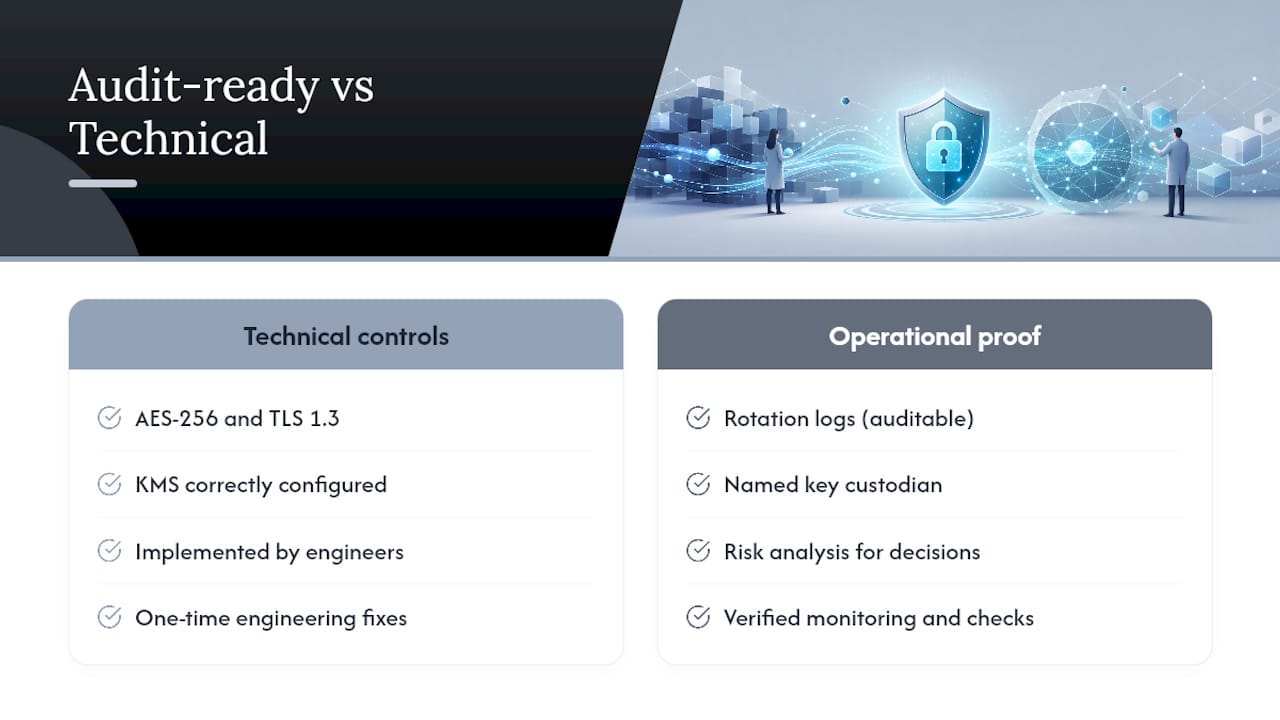
Most healthcare organizations aren't failing on cryptography. They're failing on proof. The algorithms in this article aren't controversial. AES‑256 and TLS 1.3 show up in nearly every serious guidance document, and any competent engineer can implement them correctly in an afternoon. What separates the organizations that sail through an OCR review from the ones that get flagged isn't technical sophistication. It's whether they can produce a rotation log, a named key custodian, and a risk analysis that actually addresses the decision they made.
The conventional advice treats encryption as an engineering problem to solve once, but companies must understand details about platform security and encryption practices for sensitive health apps. That framing is where most programs quietly fail. Rotation policies get configured and never verified. Certificates expire because nobody owned the monitoring. A KMS gets set up correctly during a compliance push, then nobody checks it again until the next audit cycle exposes the gap.
If there's one place to focus first, it's operational verification, not additional cryptographic complexity. A healthcare organization with AES‑256 everywhere and no evidence trail is more exposed than one with slightly less coverage and immutable logs proving every control actually runs.
Frequently asked questions
What is the minimum encryption standard for HIPAA compliance? HIPAA doesn't name a specific algorithm, but AES‑256 for data at rest and TLS 1.2 or higher for data in transit are the de facto industry standards that satisfy the Security Rule's risk‑based requirement when documented properly.
Does encrypting PHI guarantee I don't have to report a breach? Not automatically. Safe harbour under the HIPAA breach notification rules generally applies only when you can prove the encryption keys themselves were never compromised, alongside using a current, strong algorithm.
How often should encryption keys be rotated? Key rotation should be done regularly for high-sensitivity keys protecting PHI, with the specific interval justified by your documented risk analysis, though your documented risk analysis should justify the specific interval you choose.
Do I need field‑level encryption in addition to database encryption? Only for high‑risk identifiers like Social Security numbers, medical record numbers, and free‑text clinical notes. Applying it universally adds performance overhead without a proportional security benefit.
What's the difference between a KMS and an HSM? A cloud KMS is a managed service for storing and controlling access to encryption keys, while a hardware security module (HSM) is a dedicated physical or virtual appliance offering FIPS‑validated key storage. Many healthcare deployments use a KMS backed by HSM‑grade hardware underneath.
How do I know if my encryption program is actually audit‑ready? If you can produce a current risk analysis, a written key management policy naming custodians, rotation logs showing actual execution, and BAA language specifying encryption obligations, you're in reasonable shape. Missing any one of those is the gap auditors find most often.
Sources
For implementation detail beyond this playbook, start with NIST SP 800‑66r2 for algorithm and lifecycle guidance, the HHS HICP technical volumes for defence‑in‑depth context, and the SRA Tool user guide for structuring the risk analysis auditors expect to see documented.