
Cloud security in healthcare is defined as the set of controls, policies, and technologies that protect patient data stored and processed in cloud environments while maintaining compliance with regulations like HIPAA, GDPR, and HITECH. Healthcare organisations using HIPAA-compliant cloud hosting reduce breach risk by 47% compared to on-premises alternatives. That figure alone explains why the role of cloud security in healthcare has moved from a technical concern to a board-level priority. Patient records contain irreplaceable clinical information. A breach does not just expose data; it can delay diagnoses, disrupt care, and expose organisations to regulatory penalties that threaten operational continuity.
What unique security challenges does healthcare face?
Patient data is irreplaceable and directly tied to clinical outcomes. That fact separates healthcare cloud security from standard enterprise security in a fundamental way. A financial services firm can reissue a credit card after a breach. A hospital cannot reissue a patient's medical history.
Healthcare cloud environments must satisfy a layered stack of regulatory demands that most other industries never encounter:
- HIPAA requires administrative, physical, and technical safeguards for all protected health information (PHI) in cloud systems.
- HITECH extends HIPAA enforcement and increases penalties for wilful neglect of data security.
- GDPR applies to any Canadian or international healthcare organisation handling data from European patients.
- FDA risk-based compliance governs cloud-connected medical devices and the software that processes their outputs.
The CIA triad, confidentiality, integrity, and availability, applies with unusual force in healthcare. Availability failures are not just inconvenient; a ransomware attack that takes down an electronic health record system can force clinicians to cancel surgeries. Confidentiality failures carry mandatory breach notification requirements under HIPAA. Integrity failures, where data is altered without detection, can lead directly to misdiagnosis.
The shared responsibility model adds another layer of complexity. Cloud infrastructure providers secure the physical data centres, hypervisors, and network fabric. Healthcare organisations remain responsible for securing the data itself, managing access credentials, configuring applications correctly, and maintaining audit logs. Many breaches occur precisely because healthcare teams assume their cloud vendor handles more than it actually does.

Pro Tip: Map your shared responsibility boundaries in writing before you sign any cloud service agreement. Identify exactly which controls your vendor owns and which your team owns. Gaps in that map are where breaches happen.
What are the most common threats to healthcare cloud security?
Phishing accounts for nearly 16% of healthcare data breaches targeting cloud-connected credentials. That makes it the single most common initial access vector in the sector. Attackers do not need to break through a firewall when they can trick a nurse into entering her credentials on a spoofed login page.
Beyond phishing, the threat landscape for healthcare cloud environments includes:
- Identity compromise: Stolen or weak credentials give attackers persistent access to cloud-hosted EHR systems and billing platforms.
- Human error: Misconfigured storage buckets and overly permissive access policies expose PHI without any attacker involvement.
- Third-party risk: Vendors, contractors, and health information exchanges all represent potential entry points into a healthcare organisation's cloud environment.
- Ransomware: Attackers increasingly target cloud backups alongside primary systems, eliminating the recovery option that once made ransomware manageable.
Healthcare cloud security is shifting from perimeter-first to identity and behaviour-driven controls. The old model assumed that anything inside the network perimeter was trustworthy. That assumption collapses in a hybrid cloud environment where clinicians access systems from hospital workstations, home offices, and mobile devices simultaneously.
Artificial intelligence now plays a practical role in this shift. AI-driven anomaly detection can flag unusual access patterns, such as a user account downloading large volumes of records at 3:00 AM, without requiring a security analyst to manually review thousands of log entries. This reduces alert fatigue and allows security teams to focus on genuine threats rather than noise.
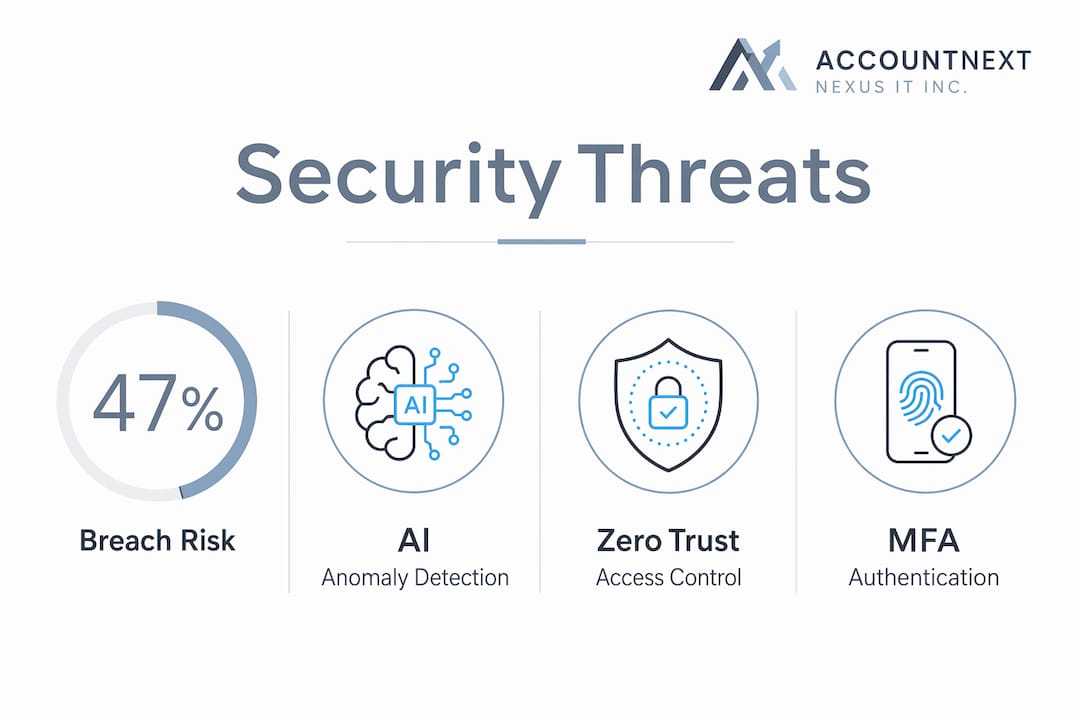
Pro Tip: Treat every cloud credential as a potential breach point. Enforce multi-factor authentication on all accounts with access to PHI, including service accounts and API keys, not just human user logins.
Which cloud security best practices are critical for healthcare?
Zero trust is the foundational methodology for healthcare cloud security in 2026. The principle is straightforward: never trust, always verify, applied to every user, device, and workload attempting to access cloud resources. Zero trust is especially effective in hybrid healthcare environments where staff move between on-premises systems and cloud applications throughout the day.
Implementing zero trust in a healthcare context involves several concrete steps:
- Verify every identity continuously. Do not grant standing access to PHI. Require re-authentication for sensitive actions and use conditional access policies that evaluate device health and location at each login.
- Apply least-privilege access. A billing administrator should not have read access to clinical notes. Segment access by role and review permissions quarterly.
- Automate compliance checks. Tie continuous compliance monitoring to HIPAA and NIST frameworks so that configuration changes trigger automatic policy validation rather than waiting for an annual audit.
- Integrate security as code in CI/CD pipelines. Configuration drift degrades security baselines over time. Automated checks embedded in deployment pipelines catch misconfigurations before they reach production.
- Maintain immutable audit logs. Audit trails and evidence retention are non-negotiable for HIPAA and HITECH compliance. Logs must be tamper-evident and retained for the periods specified by each applicable regulation.
Understanding your cloud security posture is the starting point for all of these steps. A posture assessment maps your current configuration against known standards and identifies the gaps that represent the highest risk.
The comparison below shows how two common approaches to compliance differ in practice:
| Approach | How it works | Regulatory fit |
|---|---|---|
| Annual audit model | Point-in-time review of controls against HIPAA checklist | Meets minimum requirement but misses drift between audits |
| Continuous compliance automation | Real-time monitoring tied to HIPAA and NIST controls with automated evidence collection | Provides ongoing assurance and reduces audit preparation time |
Continuous compliance automation is the stronger approach for healthcare organisations managing dynamic cloud environments. It replaces the anxiety of annual audit preparation with a steady stream of evidence that regulators can review at any time.
Pro Tip: Use your logging and audit trail practices as a compliance asset, not just a security tool. Well-structured logs reduce the time your team spends responding to regulatory inquiries.
How can healthcare administrators implement cloud security without disrupting care?
Security in healthcare is a safety issue, not just an IT function. That framing matters because it changes how administrators prioritise security investments relative to clinical operations. Security controls that interrupt care delivery create their own patient safety risks. The goal is protection that operates in the background, not friction that slows clinicians down.
Identity and access management (IAM) is the core control plane for achieving that balance. Strong IAM means:
- Single sign-on (SSO) so clinicians authenticate once and move fluidly between cloud applications without repeated login prompts.
- Role-based access control (RBAC) so each staff member sees only the data their role requires.
- Automated provisioning and deprovisioning so that access rights update immediately when staff change roles or leave the organisation.
Secure interoperability is the second operational priority. Healthcare data must flow between EHR systems, diagnostic platforms, lab systems, and billing applications. Identity and behaviour-driven controls enable that flow without creating data silos or exposing PHI to unauthorised systems. The alternative, locking data down so tightly that it cannot move, creates its own clinical risk.
Proactive threat detection rounds out the operational picture. AI-driven monitoring tools watch for anomalies across cloud workloads continuously, without requiring manual intervention for every alert. This means your security team spends time investigating real threats rather than sorting through false positives. For healthcare administrators managing lean IT teams, that efficiency is not optional.
The shared responsibility model requires healthcare organisations to own their side of the security equation actively. Relying on a cloud vendor's default settings is not a compliance strategy. Operational discipline, continuous monitoring, and documented controls are what regulators expect to see.
Key takeaways
Effective healthcare cloud security requires continuous operational discipline, not one-time configuration, combining zero trust, automated compliance, and identity-driven controls to protect patient data and meet HIPAA, HITECH, and GDPR obligations.
| Point | Details |
|---|---|
| Breach risk reduction | HIPAA-compliant cloud hosting cuts breach risk by 47% versus on-premises systems. |
| Shared responsibility | Cloud vendors secure infrastructure; healthcare organisations must secure data, identity, and access logs. |
| Zero trust methodology | Apply "never trust, always verify" to every user and workload in hybrid cloud environments. |
| Continuous compliance | Automate HIPAA and NIST checks in CI/CD pipelines to prevent configuration drift between audits. |
| Identity as the control plane | Strong IAM with SSO, RBAC, and automated provisioning protects PHI without slowing clinical workflows. |
Cloud security is a patient safety issue, not just an IT problem
After working with healthcare organisations on cloud security for years, the pattern I see most often is this: administrators treat security as a project with a finish line. They deploy a new tool, pass an audit, and move on. Six months later, configuration drift has quietly eroded the controls they worked so hard to put in place.
The organisations that get this right treat security as an ongoing operational discipline, the same way they treat infection control or medication safety. They do not ask "are we compliant?" once a year. They ask "what changed in our environment this week, and does it meet our standards?" That question, asked continuously and answered with automated evidence, is what separates organisations that survive a regulatory inspection from those that scramble to explain gaps.
The shift to identity and behaviour-driven controls is the most important technical development I have seen in healthcare cloud security in recent years. Perimeter security was always a fiction in healthcare, where data needs to move between systems, sites, and partners constantly. Identity is the real perimeter. When you know exactly who is accessing what, from where, and whether that behaviour matches their normal pattern, you have a security model that actually fits how healthcare works.
My honest view is that most healthcare organisations underinvest in the operational side of cloud security and overinvest in point-in-time tools. A sophisticated security platform that nobody monitors continuously is less valuable than a simpler setup with disciplined, daily attention. Hire for operational rigour, not just technical capability.
— Nick, Sr. Executive
How AccountNext-Nexus supports healthcare cloud security
Healthcare administrators managing cloud security face a real operational challenge: maintaining continuous protection across complex environments while keeping clinical workflows uninterrupted.
AccountNext-Nexus provides 24/7 monitoring and threat detection built specifically for organisations where downtime and data exposure carry direct patient safety consequences. The team brings deep expertise in the shared responsibility model, helping healthcare organisations identify exactly which controls they own and ensuring those controls are configured, monitored, and documented to meet HIPAA, HITECH, and GDPR requirements. Transparent pricing and access to experienced cybersecurity professionals mean your team gets consistent protection without the overhead of building an in-house security operations centre. Visit AccountNext-Nexus to see how consolidated IT and cybersecurity services can reduce your organisation's exposure.
FAQ
What is the role of cloud security in healthcare?
Cloud security in healthcare protects patient data stored and processed in cloud environments while maintaining compliance with HIPAA, HITECH, and GDPR. It covers access controls, encryption, audit logging, and continuous threat monitoring across hybrid cloud systems.
How does HIPAA-compliant cloud hosting reduce breach risk?
Healthcare organisations using HIPAA-compliant cloud hosting reduce breach risk by 47% compared to on-premises systems. Compliant hosting enforces the administrative, physical, and technical safeguards that HIPAA requires for all protected health information.
What is the shared responsibility model in healthcare cloud security?
Cloud providers secure the physical infrastructure and network fabric, while healthcare organisations are responsible for securing data, managing access credentials, and maintaining audit logs. Gaps in understanding this division are a leading cause of healthcare cloud breaches.
Why is zero trust important for healthcare cloud environments?
Zero trust applies "never trust, always verify" to every user and workload, which fits healthcare's hybrid environment where clinicians access systems from multiple locations and devices. Continuous verification prevents attackers from moving laterally after gaining initial access.
What are the most common threats to healthcare cloud data?
Phishing is the leading initial access vector, accounting for nearly 16% of healthcare data breaches targeting cloud credentials. Identity compromise, misconfigured storage, third-party vendor risk, and ransomware targeting cloud backups round out the primary threat categories.