
Managed IT services are an outsourced, subscription-based model where a Managed Service Provider (MSP) takes ongoing responsibility for a company's IT infrastructure, monitoring, and support under a defined Service Level Agreement (SLA). Unlike the old "break/fix" approach where you called someone only after something broke, managed services are proactive. Your MSP watches your systems around the clock, catches problems before they become outages, and keeps your operations running on predictable monthly costs.
Here is what that looks like in practice:
- Proactive monitoring: Your MSP watches servers, networks, and endpoints 24/7, not just when you raise a ticket.
- Defined SLAs: Response times, uptime targets, and performance benchmarks are written into the contract before work begins.
- Predictable billing: Most MSPs charge a flat or near-fixed monthly fee, so IT costs stop being a surprise line item.
- Operational continuity: Problems get resolved faster because your provider already knows your environment.
- Access to expertise: You get a full team of specialists without hiring and retaining them internally.
For Canadian businesses weighing whether to bring IT in-house or outsource it, the SLA structure is the part that changes everything. It shifts IT from a reactive cost centre into a managed, accountable function.
How managed IT services evolved from break/fix to business-critical
The MSP model did not appear fully formed. It grew out of frustration with the old way of doing things.

1990s: Application service providers (ASPs) pioneered remote delivery of IT services, laying the groundwork for what MSPs would become. Early managed services focused narrowly on remote monitoring of servers and networks.
Early 2000s: The break/fix model started showing its limits. Businesses were paying for IT support only when things went wrong, which meant downtime was both unpredictable and expensive. MSPs began offering flat-rate contracts that covered ongoing maintenance, not just emergency repairs.
Mid-2000s to 2010s: Service scope expanded considerably. Mobile device management, managed print services, remote firewall administration, and Security as a Service (SECaaS) all entered the standard MSP catalogue. The shift from "keep the lights on" to "keep the business safe" was underway.
2015 onward: Cybersecurity moved from an optional add-on to a core MSP responsibility. Regulatory pressure, high-profile breaches, and the rise of ransomware forced providers to embed security deeply into every service layer.
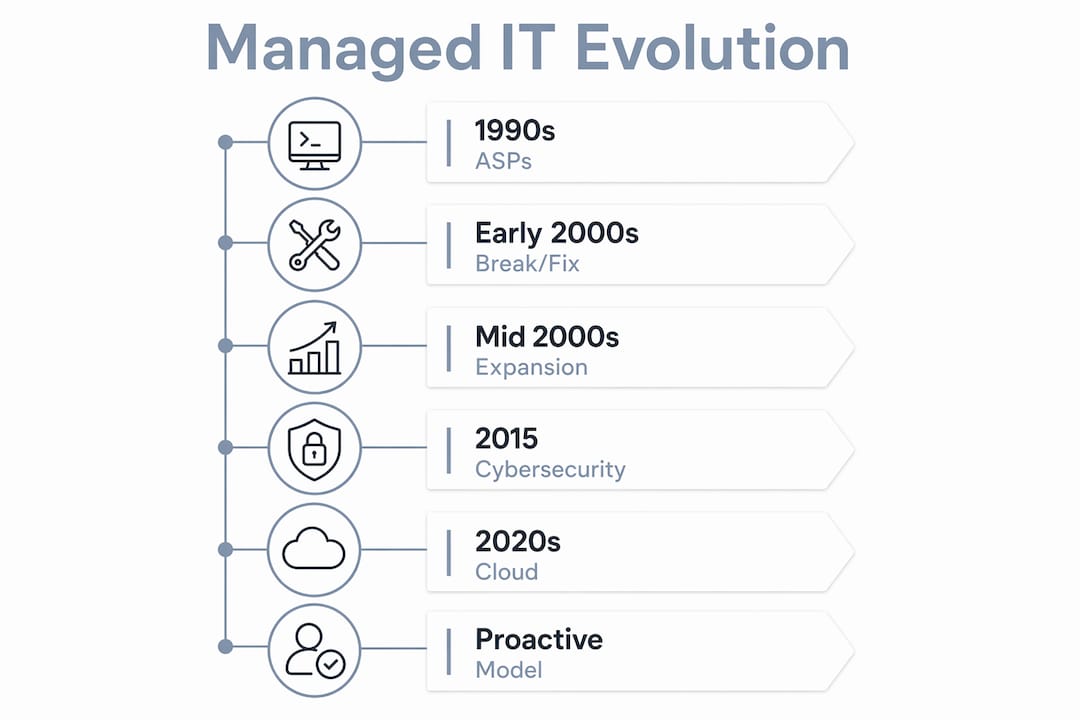
2020s: Cloud migration accelerated the transformation. MSPs now routinely manage hybrid cloud environments, compliance frameworks, and real-time threat detection alongside traditional infrastructure. In Canada, this shift aligns with growing regulatory expectations under frameworks like PIPEDA and sector-specific rules in finance and healthcare.
The through-line across all of it is the move from reactive to proactive. Every major evolution in the managed services industry has pushed providers to get ahead of problems rather than respond to them.
What types of services does an MSP actually deliver?
The term "managed IT services" covers a wide range of functions. Here is what you will typically find in an MSP's service catalogue, with a note on what each one actually does for your business:
- Network management: Monitoring and maintaining routers, switches, firewalls, and connectivity to keep traffic flowing and catch failures early.
- Cloud management: Provisioning, monitoring, and optimising workloads across platforms like Microsoft Azure or AWS, including cloud migration support.
- Endpoint management: Keeping laptops, desktops, and mobile devices patched, secured, and compliant with company policy.
- Helpdesk and end-user support: Tier 1–3 support for staff, handling everything from password resets to application errors, often available around the clock.
- Managed security services: Threat detection, incident response, vulnerability scanning, and compliance management, particularly relevant for regulated industries like healthcare and finance.
- Application management: Monitoring and maintaining business-critical software, including updates, licensing, and performance tuning.
- Disaster recovery and business continuity: Backup systems, recovery time objectives (RTOs), and tested failover plans so a ransomware attack or hardware failure does not become a weeks-long crisis.
- Compliance management: Helping businesses meet requirements under frameworks like SOC 2, ISO 27001, or Canadian privacy legislation.
The mix you need depends heavily on your industry and size. A 50-person professional services firm has different priorities than a 500-person manufacturer with operational technology on the floor. A good MSP scopes the engagement around your actual risk profile, not a generic package.
Pro Tip: Before signing with any provider, ask to see a sample SLA with defined response times for each service tier. Vague language like "best efforts" in an SLA is a red flag.
Why cybersecurity is now the core of every managed IT engagement
Cybersecurity used to be something MSPs bolted on at the end of a proposal. That era is over. Modern MSPs have evolved into central pillars of enterprise risk management by maintaining rigorous security standards across every service they deliver.
The threat environment in Canada has made this shift unavoidable. Ransomware, business email compromise, and supply chain attacks have all increased in frequency and sophistication. Businesses that treat security as a separate budget line from IT management are leaving gaps that attackers actively look for.
What cybersecurity looks like inside a managed IT engagement today:
- Proactive threat detection: Continuous monitoring of logs, endpoints, and network traffic for indicators of compromise, not just known malware signatures.
- Endpoint protection: Managed antivirus, EDR (Endpoint Detection and Response), and device control policies applied across the entire fleet.
- Compliance management: Mapping controls to frameworks like NIST, CIS, or Canadian privacy requirements and producing audit-ready documentation.
- Vulnerability management: Regular scanning and prioritised patching so known weaknesses get closed before they are exploited.
- Incident response: A defined playbook for containing and recovering from a breach, with your MSP acting as first responder.
"Industry experts affirm that MSPs today must embed cybersecurity deeply within their service offerings to meet escalating threat landscapes and regulatory demands, positioning managed IT services as a fundamental risk-management pillar." — ConnectWise, managed IT services industry analysis
The compliance angle is particularly relevant for Canadian businesses. Sectors like banking, insurance, and healthcare face specific regulatory obligations, and an MSP that understands those frameworks saves you from having to hire a dedicated compliance officer on top of your IT team. The security benefits for SMBs are especially pronounced when a single provider handles both the technical controls and the compliance documentation.
How Canadian MSPs are integrating cybersecurity and IT management in 2026
The Canadian managed services market has matured quickly. What separates leading providers from the rest is not the length of their service list. It is how tightly they integrate security into day-to-day IT operations, and how transparently they communicate that to clients.

Best practices in the Canadian market right now centre on a few key areas. First, providers are moving away from siloed security tools toward unified platforms that correlate signals across endpoints, networks, and cloud environments. Second, SLAs are becoming more specific, with defined metrics for mean time to detect (MTTD) and mean time to respond (MTTR) rather than vague uptime guarantees. Third, pricing transparency has become a competitive differentiator. Clients are increasingly wary of opaque billing structures that make it hard to understand what they are actually paying for.
AccountNext-Nexus exemplifies this direction. The firm consolidates cybersecurity, IT infrastructure management, and compliance under one engagement, using real-time threat detection and cloud infrastructure management to give clients a single, coherent view of their security posture. The proprietary methodology means clients are not stitching together outputs from three different vendors.
Vendor lock-in is a real concern in MSP contracts, and Canadian decision-makers are right to scrutinise it. An SLA that lacks explicit provisions for data return, environment documentation, and administrative credential transfer at contract end can leave you in a difficult position if you ever need to switch providers. Effective agreements spell out data ownership, offboarding processes, and transition timelines before the engagement begins, not after a dispute arises.
Pro Tip: Negotiate an exit clause into your MSP contract that requires the provider to deliver complete environment documentation and credential handover within 30 days of termination notice. This protects you regardless of why the relationship ends.
A few competitive advantages that well-structured Canadian MSP engagements deliver:
- Faster incident response because security and IT operations share the same tooling and team.
- Reduced compliance overhead through integrated reporting aligned to Canadian regulatory frameworks.
- Transparent monthly pricing that ties costs to defined service outcomes, not hours billed.
- Scalability as your business grows, without renegotiating the entire contract from scratch.
For businesses evaluating digital transformation strategy alongside their IT decisions, the managed services model offers a way to build a capable, secure foundation without the capital cost of building it internally.
How managed IT services are priced and structured
Pricing in the managed services industry has shifted considerably over the past decade. The traditional cost-plus model, where the provider marks up their costs and passes them to the client, is still common but increasingly giving way to outcome-based approaches that tie fees to measurable results.
The main pricing structures you will encounter:
| Model | How it works | Best suited for |
|---|---|---|
| Flat monthly fee | Fixed price per user or device per month | Businesses wanting predictable IT costs |
| Tiered pricing | Bundled service levels at different price points | Businesses with varying support needs |
| Consumption-based | Billed by usage (storage, compute, tickets) | Businesses with fluctuating IT demand |
| Outcome-based | Fees tied to agreed performance metrics | Mature MSP relationships with clear KPIs |
Most Canadian SMBs start with a flat monthly fee per user or per device. It is the easiest model to budget for and the most common entry point. As the relationship matures and both sides understand the actual workload, moving toward a tiered or outcome-based structure often makes sense.
Setup or transition fees are standard. Most MSPs charge an upfront fee to onboard your environment, document your infrastructure, and deploy their monitoring tools. This is normal and worth paying for a provider who does it thoroughly, because a poorly documented environment is one of the biggest sources of delays when something goes wrong.
What to look for when choosing an IT service provider
Choosing an MSP is not primarily a technology decision. It is a business decision about who you trust to keep your operations running and your data protected.
The criteria that actually separate good providers from average ones:
Defined SLAs with teeth. Response time commitments mean nothing without financial consequences for missing them. Ask what happens if your provider breaches an SLA, and read that section of the contract carefully.
Security-first architecture. An MSP that treats cybersecurity as an add-on rather than a foundation is behind the curve. Ask specifically how security is integrated into monitoring, patching, and incident response, not just what security products they resell.
Canadian regulatory knowledge. If your business operates in healthcare, finance, or any regulated sector, your provider needs to understand the specific compliance requirements that apply to you, including PIPEDA, provincial privacy legislation, and sector-specific rules.
Transparent pricing. You should be able to understand your monthly invoice without a decoder ring. If a provider cannot explain clearly what is included and what triggers additional charges, that is a problem.
References from similar businesses. Ask for references from clients in your industry and of similar size. A provider that excels at managing a 20-person law firm may not be the right fit for a 300-person manufacturer.
Exit provisions. As noted in the cybersecurity section, your SLA should include explicit terms for data return, documentation, and credential handover. This is non-optional.
The role of IT in enterprise resilience has grown considerably, and the provider you choose shapes how well your business weathers disruptions, whether that is a ransomware attack, a cloud outage, or a rapid period of growth.
AccountNext-Nexus: integrated IT and cybersecurity for Canadian businesses
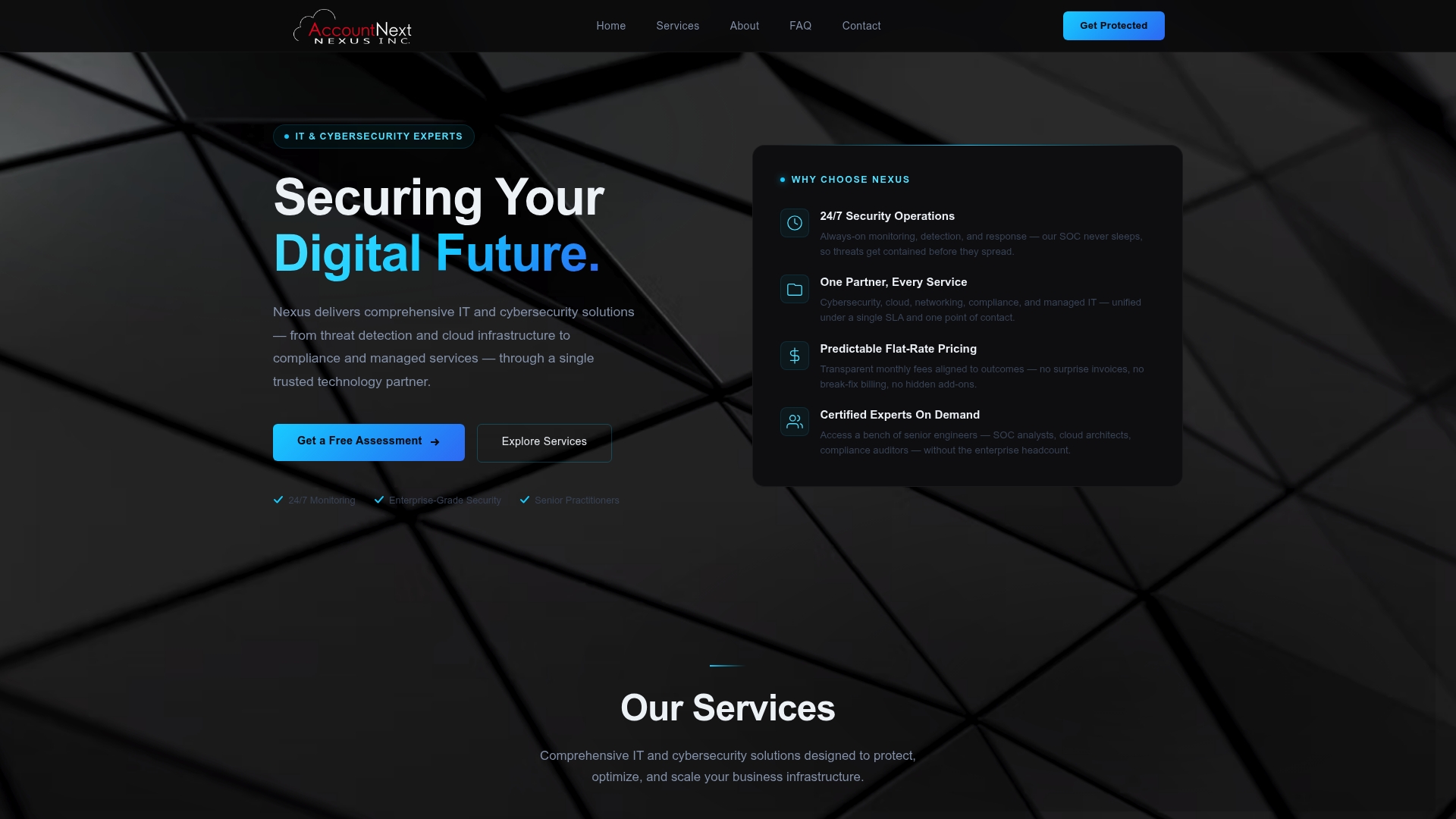
AccountNext-Nexus brings together IT infrastructure management, real-time cybersecurity, and compliance under one engagement, built specifically for businesses that cannot afford fragmented security or unpredictable IT costs. The full service offering covers 24/7 monitoring, threat detection, cloud management, and compliance support, with transparent pricing and direct access to experienced IT professionals.
If you are evaluating managed IT services for your organisation, AccountNext-Nexus offers a straightforward starting point: one provider, one contract, and a clear picture of your security posture from day one.
Key takeaways
Managed IT services deliver the most value when cybersecurity, infrastructure management, and compliance are handled by a single provider under a clearly defined SLA with explicit exit provisions.
| Point | Details |
|---|---|
| MSPs operate proactively | Providers monitor and maintain your environment continuously, not only after problems occur. |
| SLAs define accountability | Response times, uptime targets, and performance benchmarks must be written into the contract before work begins. |
| Cybersecurity is now core | Modern MSPs embed threat detection, endpoint protection, and compliance into every service layer, not as an add-on. |
| Pricing models vary | Flat monthly fees are most common for SMBs; outcome-based pricing suits mature engagements with clear performance metrics. |
| Exit provisions protect you | Your SLA should explicitly cover data return, environment documentation, and credential handover at contract termination. |