
Managed security services (MSS) are defined as outsourced cybersecurity functions delivered by a specialist provider that monitors, detects, and responds to threats on your behalf around the clock. The benefits of managed security services are most immediate for small and mid-sized businesses, where dedicated security operations are rarely affordable in-house. A managed security services provider (MSSP) reduces Mean Time to Detect (MTTD) and Mean Time to Respond (MTTR), the two metrics that determine how much damage a breach actually causes. Compliance frameworks like GDPR and HIPAA add further pressure, and MSSPs deliver the audit-ready reporting those standards demand.
1. What are the benefits of managed security services?
The single greatest advantage is continuous monitoring. 24/7/365 threat detection catches anomalies that in-house teams miss during off-hours, weekends, and holidays. Most breaches begin as low-level signals that go unnoticed for days. An MSSP's security operations centre (SOC) watches those signals in real time and acts before damage spreads.

Rapid incident response is the direct companion to detection. Reducing MTTD and MTTR limits the blast radius of any attack. A breach contained in minutes costs far less than one discovered after days of undetected access. That speed comes from trained analysts running established playbooks, not from improvised responses by generalist IT staff.
Pro Tip: Ask any prospective MSSP for their average MTTD and MTTR figures across their client base. Providers with mature SOC operations can cite specific numbers. Vague answers are a red flag.
The monitoring model works through a combination of automated tools and human review:
- Automated log collection aggregates data from endpoints, firewalls, and cloud environments continuously.
- Security information and event management (SIEM) platforms correlate events and flag suspicious patterns.
- SOC analysts triage alerts, filter false positives, and escalate genuine threats.
- Incident response teams execute containment steps based on pre-agreed playbooks.
- Threat intelligence feeds update detection rules in near real time.
Each layer compensates for the weaknesses of the others. Automation handles volume. Human analysts handle context. Together, they produce a detection capability that no small IT team can replicate alone.
2. Cost savings and resource efficiency
Outsourcing security operations avoids the cost of building an internal SOC from scratch. Subscription-based pricing converts unpredictable capital expenditure into a fixed monthly operating cost. That predictability matters enormously for SMB budgeting, where a single unexpected security hire can derail a quarter's finances.
The cost savings of security services go beyond salary. Recruiting, onboarding, and retaining certified security analysts is expensive and slow. Certifications like CISSP, CEH, and CISM take years to earn. An MSSP brings that expertise on day one, without the recruitment timeline or the risk of losing a key person mid-year.
Internal IT managers freed from security monitoring can focus on projects that directly support business growth. That reallocation of attention is a genuine productivity gain, not just a theoretical one. When your IT team is not chasing alerts, they are building infrastructure, supporting users, and reducing technical debt.
Key cost advantages of managed IT security services include:
- No capital outlay for SOC infrastructure, SIEM licences, or threat intelligence platforms.
- Predictable monthly fees that scale with your organisation's size.
- Reduced liability exposure from faster breach containment.
- Lower training costs as the provider absorbs certification and skills development.
3. Access to specialised expertise and advanced technology
MSSPs employ analysts whose entire career focuses on threat detection and response. That depth of specialisation is difficult to replicate internally at an SMB. A generalist IT manager handles network issues, user support, vendor management, and security simultaneously. An MSSP analyst handles security exclusively.
Aggregated threat intelligence is one of the most underappreciated advantages of security management through an MSSP. Because a provider monitors hundreds of client environments simultaneously, it sees attack patterns across industries and geographies. A threat targeting one client becomes a detection rule that protects all clients. No isolated organisation can build that breadth of visibility.
Advanced technology access follows the same logic. AI-driven threat monitoring and extended detection and response (XDR) platforms cost hundreds of thousands of dollars to licence and operate. MSSPs spread those costs across their entire client base, making enterprise-grade tools accessible to organisations with modest security budgets.
Pro Tip: When evaluating providers, ask specifically whether they use XDR or a traditional SIEM-only approach. XDR correlates data across endpoints, networks, and cloud workloads simultaneously, which produces faster and more accurate detections.
The technology stack a quality MSSP brings typically includes:
- SIEM platforms for centralised log management and correlation.
- XDR tools for cross-environment threat detection.
- Endpoint detection and response (EDR) agents on managed devices.
- Vulnerability scanning and patch management workflows.
- Cloud security monitoring for distributed and hybrid environments.
4. Regulatory compliance and audit preparedness
Managed security services assist directly with compliance by automating the documentation that auditors require. Continuous log management and policy enforcement satisfy the technical controls demanded by GDPR, HIPAA, PCI DSS, and SOC 2. Generating those reports manually is time-consuming and error-prone. An MSSP produces them automatically as a byproduct of normal monitoring operations.
Consistent policy enforcement across distributed environments is equally important. Remote work, branch offices, and cloud workloads create configuration drift. An MSSP applies and audits security policies across every environment continuously, not just during scheduled reviews.
| Compliance requirement | How managed security services address it |
|---|---|
| Audit-ready log retention | Automated collection and storage of security event logs |
| Access control documentation | Continuous monitoring and reporting of user access patterns |
| Incident response records | Documented response timelines and containment actions |
| Policy consistency | Centralised policy enforcement across all environments |
| Risk assessment reporting | Regular vulnerability scans and risk posture summaries |
The financial risk of non-compliance is concrete. GDPR fines reach up to 4% of annual global turnover. HIPAA penalties range into the millions for wilful neglect. An MSSP reduces that exposure by keeping controls current and documentation complete.
5. Scalability and adaptability for growing businesses
Security needs change as businesses grow. Adding a new office, migrating to the cloud, or acquiring another company each introduces new attack surfaces. An MSSP adjusts monitoring scope to cover those surfaces without requiring you to hire additional staff or procure new tools.
Continuous risk assessment and policy tuning keep your security posture aligned with your actual risk profile. A static security configuration becomes outdated quickly. MSSPs review and update detection rules, access policies, and response playbooks as your environment evolves.
Flexible service models also accommodate seasonal or project-based changes in risk. A retail business facing elevated fraud risk during peak shopping periods can increase monitoring intensity temporarily. That kind of dynamic adjustment is not possible with a fixed internal team. The managed security services advantages here are structural, not incidental.
Effective security management treats protection as a continuous process rather than a fixed product. That framing matters for SMBs planning growth. Security that scales with the business is security that actually works.
Key takeaways
Managed security services deliver measurable protection, cost efficiency, and compliance readiness that most SMBs cannot achieve with internal resources alone.
| Point | Details |
|---|---|
| 24/7 monitoring reduces breach impact | Continuous detection lowers MTTD and MTTR, limiting damage from attacks. |
| Subscription pricing controls costs | Fixed monthly fees replace unpredictable SOC build-out and staffing expenses. |
| Aggregated intelligence improves detection | MSSPs share threat data across clients, producing faster and broader coverage. |
| Compliance documentation is automated | Log retention and policy reporting satisfy GDPR, HIPAA, and PCI DSS requirements. |
| Scalability matches business growth | Service scope adjusts to new environments without additional internal hiring. |
Why I think most SMBs underestimate what they are actually buying
The most common mistake I see business owners make is treating managed security as a product purchase. They sign a contract, assume the problem is solved, and move on. Security does not work that way.
What you are actually buying is a relationship with a team that needs to understand your environment deeply. The first 90 days with any MSSP are the most important. That is when detection rules get tuned, false positive rates drop, and the provider learns what normal looks like in your specific network. Skipping that calibration period produces noisy, unreliable alerts.
The second thing most owners miss is the difference between a "monitor and escalate" contract and a "hands-on response" model. The first means the MSSP calls you when something happens. The second means they act. For a business without an internal security team, "monitor and escalate" can leave you exposed at 2 a.m. when no one is available to take that call.
I also want to address the MSP versus MSSP confusion directly. A general IT managed services provider handles helpdesk, patching, and infrastructure. An MSSP specialises in security operations. Many SMBs assume their MSP covers both. That assumption creates gaps that attackers exploit. Clarify the scope in writing before you sign anything.
The businesses that get the most value from managed security are the ones that treat it as an ongoing programme, not a checkbox. Regular reviews, updated incident response plans, and clear escalation paths are what separate organisations that recover quickly from those that do not.
— Nick - Sr. Executive
AccountNext-Nexus managed security for small and mid-sized businesses
AccountNext-Nexus consolidates cybersecurity, IT management, and compliance support under one provider, which eliminates the fragmentation that leaves most SMBs exposed.
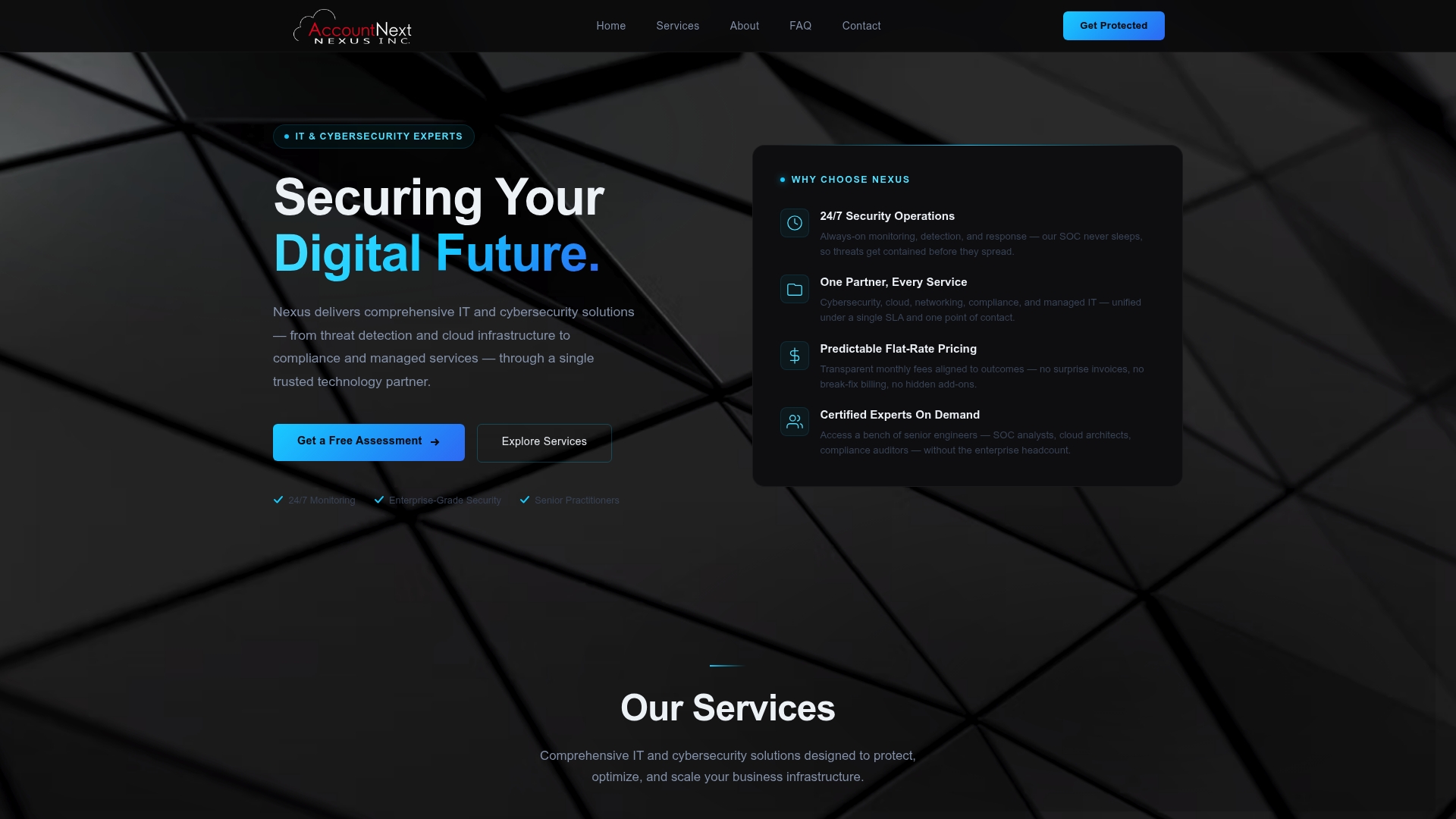
The 24/7 monitoring and threat detection services from AccountNext-Nexus are built specifically for organisations that need enterprise-grade protection without enterprise-grade overhead. Real-time threat detection, cloud infrastructure monitoring, and compliance reporting are delivered by seasoned analysts at transparent, predictable pricing. If your current security posture relies on reactive measures or a general IT provider without dedicated security operations, AccountNext-Nexus offers a direct path to continuous, expert-driven protection. Visit AccountNext-Nexus to see how the service model fits your organisation's size and risk profile.
FAQ
What is a managed security service?
A managed security service is an outsourced cybersecurity function where a specialist provider monitors, detects, and responds to threats on behalf of an organisation. The provider operates a security operations centre (SOC) that works continuously, including outside normal business hours.
How do managed security services work?
MSSPs collect log data from your network, endpoints, and cloud environments, then analyse that data using SIEM and XDR platforms combined with human analyst review. Confirmed threats trigger a response based on pre-agreed playbooks.
Why use managed security instead of building an internal team?
Building an internal SOC requires significant investment in tools, licences, and certified staff. MSSPs provide dedicated analysts and established processes at a predictable subscription cost, which is more accessible for most SMBs.
Do managed security services help with compliance?
Yes. MSSPs automate log retention, policy enforcement, and audit reporting to satisfy frameworks including GDPR, HIPAA, and PCI DSS. That documentation reduces the risk of penalties and simplifies audit preparation.
What is the difference between an MSP and an MSSP?
An MSP (managed services provider) handles general IT functions like helpdesk and patching. An MSSP (managed security services provider) specialises in cybersecurity operations. The two roles are distinct, and assuming one covers the other creates critical gaps in incident response.