
Canadian healthcare organisations face a layered mix of federal and provincial privacy statutes, health-sector-specific legislation, and international rules that can apply when data crosses borders. The primary types of healthcare data compliance regulations affecting Canadian organisations include: the Personal Information Protection and Electronic Documents Act (PIPEDA) for private-sector entities; the federal Privacy Act for public bodies; provincial health information acts such as Ontario's Personal Health Information Protection Act (PHIPA), Alberta's Health Information Act (HIA), British Columbia's Freedom of Information and Protection of Privacy Act (FOIPPA) and Personal Information Protection Act (PIPA), and Quebec's health and access rules; plus international frameworks like GDPR and HIPAA when cross-border data flows are involved.
Here is a quick-reference snapshot of which rules most likely apply to your organisation:
- PIPEDA — private-sector organisations collecting, using, or disclosing personal health information in the course of commercial activity (unless a substantially similar provincial law applies)
- Privacy Act (Canada) — federal government institutions and public bodies handling personal information
- Ontario PHIPA — health information custodians in Ontario (hospitals, physicians, labs, pharmacies, home-care providers)
- Alberta HIA — custodians and trustees in Alberta's health system (regional health authorities, regulated health professionals, pharmacists)
- BC FOIPPA / PIPA — public bodies and private-sector organisations in BC; FOIPPA covers public bodies, PIPA covers private-sector entities
- Quebec health and access rules — health and social services establishments under Quebec's Act Respecting Health Services and Social Services and the Act Respecting Access to Documents Held by Public Bodies and the Protection of Personal Information (Law 25 amendments are now in force)
- GDPR — applies when Canadian organisations process personal data of EU residents, regardless of where the organisation is located
- HIPAA — relevant when Canadian organisations partner with US-covered entities or handle data subject to US federal health programme rules
Enforcement sits with the Office of the Privacy Commissioner of Canada (OPC) at the federal level, and with provincial commissioners: the Information and Privacy Commissioner of Ontario (IPC), the Office of the Information and Privacy Commissioner of Alberta (OIPC Alberta), the Office of the Information and Privacy Commissioner for British Columbia (OIPC BC), and the Commission d'accès à l'information for Quebec.
Key takeaways
Canadian healthcare organisations must navigate multiple overlapping privacy and health information statutes simultaneously, and the organisations that manage this well treat compliance as a continuous governance programme, not a periodic audit.
| Point | Details |
|---|---|
| Start with the right statute | Identify whether you are a public body, a health information custodian, or a private-sector organisation — this determines which law governs you first. |
| Breach notification timelines vary | Quebec Law 25 requires regulator notification within 72 hours; other provinces require notification "at the first reasonable opportunity" — know your shortest timeline. |
| Vendor contracts are not vendor management | Review vendor subprocessors, storage locations, and certifications annually, not just at onboarding. |
| AI tools require explicit consent mapping | Consent obtained for treatment does not extend to model training; document the legal basis for each AI use case separately. |
| AccountNext-Nexus consolidates compliance operations | Unified monitoring, logging, and incident response under a single SLA reduces coordination overhead and accelerates regulator notification. |
Table of Contents
- What does healthcare data compliance actually mean in Canada?
- What are the core Canadian laws governing healthcare data?
- Who does each regulation actually apply to?
- What are the breach notification rules and enforcement risks?
- When do GDPR, HIPAA, or other international rules apply to Canadian organisations?
- How do AI and analytics change your compliance obligations?
- Practical compliance checklist for Canadian healthcare teams
- What compliance officers consistently get wrong
- AccountNext-Nexus helps Canadian healthcare organisations stay compliant
- Sources
What does healthcare data compliance actually mean in Canada?
Three terms get used interchangeably in this space, and conflating them creates real gaps in a compliance programme.
Privacy is about individual rights and the lawful basis for collecting, using, and disclosing personal health information. It answers the question: do we have the right to hold and use this data? Security is the technical and organisational layer that protects data from unauthorised access, loss, or misuse. It answers: are we protecting what we hold? Compliance is the governance programme that ties both together through written policies, staff training, audits, vendor oversight, and corrective action. As industry guidance from ACHC confirms, compliance is an ongoing programme built from policies, leadership, training, monitoring, and corrective action — not a one-time checkbox exercise.
In healthcare operations, all three overlap constantly. An electronic medical record system raises privacy questions (consent, access rights), security questions (encryption, access controls), and compliance questions (audit logs, retention schedules, vendor contracts). Analytics platforms raise them simultaneously across all three dimensions.
What counts as protected health information in Canada?
Canadian statutes use slightly different terminology. PHIPA uses "personal health information" (PHI); the HIA uses "health information"; PIPEDA uses "personal information" with health data treated as sensitive. Practically, the following categories are protected under one or more of these frameworks:
- Medical records, clinical notes, and diagnostic reports
- Prescription records and medication histories
- Diagnostic images (X-rays, MRIs, pathology slides)
- Mental health and addiction treatment records
- Genomic and genetic data
- Health-service billing identifiers and insurance numbers
- Provincial health card numbers
- Device-generated health data (wearables, implanted devices, remote monitoring)
The Privacy Act covers personal information held by federal public bodies, which is broader than health data alone. PIPEDA applies to personal information collected in commercial activity, with health data treated as a sensitive category requiring heightened protection. Provincial health information acts narrow the scope to health-specific data but apply stricter rules within that scope, including mandatory breach reporting and stronger individual access rights.
What are the core Canadian laws governing healthcare data?
The table below maps the principal statutes and regulators against the six dimensions compliance teams most need to compare. Where a provincial law substantially displaces PIPEDA, that is noted.
| Statute / Regulator | Who is covered | Protected data scope | Breach notification | Enforcement and penalties | Cross-border transfers | Consent and individual rights |
|---|---|---|---|---|---|---|
| PIPEDA (federal, private sector) | Private-sector organisations collecting PHI in commercial activity; applies where no substantially similar provincial law exists | Personal information including health data as a sensitive category | Mandatory reporting to OPC and affected individuals for breaches posing "real risk of significant harm" | OPC can investigate, make findings, and seek Federal Court orders; no direct fines under PIPEDA currently, but Bill C-27 (pending) proposes significant penalties | Transfers to third parties (including foreign) permitted with comparable protections; accountability principle applies | Meaningful consent required; individuals have access and correction rights |
| Privacy Act (federal, public sector) | Federal government institutions and public bodies | Personal information held by federal institutions | No mandatory breach notification to individuals under current Act; OPC guidance recommends notification | OPC investigates; Federal Court orders available; no administrative monetary penalties currently | Transfers within federal government permitted; international transfers require comparable protection | Access and correction rights; limited exceptions for national security and law enforcement |
| Ontario PHIPA | Health information custodians (hospitals, physicians, labs, pharmacies, home-care providers, insurers) and their agents | Personal health information as defined in the Act | Mandatory notification to IPC and affected individuals for privacy breaches at the first reasonable opportunity | IPC can order compliance, impose conditions, and refer matters for prosecution; fines up to $100,000 for individuals and $500,000 for organisations | Transfers outside Ontario require comparable protection; agents must comply with custodian's PHIPA obligations | Express or implied consent depending on purpose; strong individual access and correction rights |
| Alberta HIA | Custodians (regulated health professionals, health authorities, pharmacists, operators of health facilities) and their affiliates | Health information as defined in the Act | Mandatory notification to OIPC Alberta and affected individuals for breaches | OIPC Alberta can investigate, make orders, and refer for prosecution; administrative penalties available | Transfers outside Alberta require comparable protection agreements | Consent required for collection, use, and disclosure; access and correction rights |
| BC FOIPPA / PIPA | FOIPPA: public bodies in BC; PIPA: private-sector organisations in BC | Personal information including health data; FOIPPA covers public-body records | Mandatory breach notification to OIPC BC and affected individuals for material breaches | OIPC BC can investigate, make orders, and impose penalties; PIPA allows for civil action | BC FOIPPA restricts storage and access of personal information to Canada unless specific conditions are met; PIPA requires comparable protection | Consent and access rights under both Acts; FOIPPA has stronger residency requirements |
| Quebec health and access rules (Law 25 / Act respecting health services) | Health and social services establishments; private-sector organisations under Law 25 amendments | Personal information including health data; sensitive information receives heightened protection | Mandatory notification to Commission d'accès à l'information and affected individuals for confidentiality incidents | Commission d'accès à l'information can investigate and impose administrative penalties up to $25 million or 4% of worldwide turnover under Law 25 | Transfers outside Quebec require a privacy impact assessment and comparable protection | Explicit consent for sensitive data; strong individual rights including right to de-indexing |
A note on regulatory overlap. When a private vendor processes PHI on behalf of an Ontario hospital, both PHIPA and PIPEDA can be relevant. PHIPA governs the custodian's obligations; PIPEDA may govern the vendor's own commercial data practices if it operates outside the custodian relationship. The IPC has published guidance on this overlap, and custodians should address it explicitly in vendor contracts.
The five primary enforcement bodies each have distinct mandates. The OPC handles federal private-sector and public-body complaints and publishes compliance guidance and enforcement decisions that illustrate programme expectations. The IPC Ontario, OIPC Alberta, OIPC BC, and Commission d'accès à l'information each handle provincial matters and publish their own investigation summaries, which are among the most practical resources available for understanding what commissioners actually expect during an investigation. Compliance teams should bookmark the official sites of each body and monitor their published decisions regularly.
The HHS-OIG General Compliance Programme Guidance provides a useful comparative reference for the seven elements of an effective compliance programme, including information blocking considerations, even though it is a US document. Canadian organisations with US partners or cross-border data flows will find it directly relevant.
Who does each regulation actually apply to?
The answer turns on four questions, and working through them in order usually resolves most ambiguity.
Do you collect, use, or disclose personal health information? If yes, at least one statute applies. The only question is which one.
Are you a public body or a private-sector organisation? Public bodies in each province fall under the relevant public-sector privacy act (FOIPPA in BC, FIPPA in Ontario, FOIP in Alberta, the provincial access act in Quebec). Private-sector organisations fall under PIPEDA unless a substantially similar provincial law applies (Alberta PIPA, BC PIPA, and Quebec's Law 25 have been deemed substantially similar in relevant respects).
Do you provide core health services as a custodian or trustee? If yes, the provincial health information act applies directly: PHIPA in Ontario, HIA in Alberta, and equivalent rules in other provinces. This covers hospitals, regulated health professionals, pharmacies, labs, home-care agencies, and health insurers.
Do you operate across provincial or international borders, or serve EU residents? Cross-border operations can trigger multiple statutes simultaneously.
Common covered parties
- Hospitals, regional health authorities, and community health centres
- Regulated health professionals (physicians, nurses, pharmacists, dentists)
- Laboratories and diagnostic imaging centres
- Health insurers and benefits administrators
- Pharmacies and pharmacy benefit managers
- Cloud and SaaS vendors acting as agents or processors for custodians
- Medical device manufacturers collecting patient telemetry
- Research institutions and clinical trial sponsors handling patient data
A practical example: small clinic using a cloud EHR
A family medicine clinic in Ontario using a US-based cloud EHR vendor is a custodian under PHIPA. The vendor is the clinic's agent and must comply with PHIPA's requirements as directed by the custodian. PIPEDA may also apply to the vendor's own data practices. BC's FOIPPA storage requirements would not apply here, but if the vendor stores data on US servers, the clinic must assess whether comparable protections exist and document that assessment. If any patients are EU residents, GDPR's data processing requirements come into play as well.
Pro Tip: When onboarding any cloud or SaaS vendor, ask explicitly where data is stored, who the subprocessors are, and whether the vendor has signed a data processing agreement that references the specific provincial health information act governing your organisation. A vendor that cannot answer these questions clearly is a compliance liability before a single byte of data is transferred.
What are the breach notification rules and enforcement risks?
Breach notification requirements vary by statute, but the practical steps after discovery are consistent across frameworks.
Immediate breach response steps
- Isolate affected systems to prevent further unauthorised access or data loss, without destroying evidence.
- Preserve evidence — logs, access records, and system states — before any remediation that might overwrite them.
- Notify internal governance immediately: privacy officer, legal counsel, CIO, and executive leadership.
- Assess the breach to determine the nature of the data involved, the number of affected individuals, and the likely harm.
- Notify the relevant regulator as required by statute. Under PIPEDA, notification to the OPC is required for breaches posing real risk of significant harm, with no fixed deadline but an expectation of prompt reporting. Ontario PHIPA requires notification to the IPC at the first reasonable opportunity. Alberta HIA and BC FOIPPA/PIPA have similar prompt-notification requirements. Quebec Law 25 requires notification to the Commission d'accès à l'information within 72 hours of becoming aware of a confidentiality incident.
- Notify affected individuals as required, with enough information for them to take protective action.
- Launch a forensic review to determine root cause, scope, and remediation steps.
- Document everything throughout the process.
Pro Tip: Commissioners investigating a breach will ask for your audit trails, staff training records, vendor contracts, and prior risk assessments. If those records are incomplete or inconsistent, the investigation shifts from "what happened" to "why didn't you have adequate controls." Maintain a breach register even for minor incidents that do not meet the notification threshold — it demonstrates a functioning programme.
Enforcement patterns across Canadian commissioners show a consistent focus on whether organisations had adequate safeguards before the breach, not just whether they responded correctly afterward. The IPC Ontario and OIPC Alberta have both issued orders requiring organisations to implement specific technical controls, conduct third-party audits, and report back to the commissioner on remediation progress. Organisations facing complex incidents should engage legal counsel with privacy law expertise early in the process.
When do GDPR, HIPAA, or other international rules apply to Canadian organisations?
The short answer: more often than most compliance officers expect.
GDPR applies to any organisation that processes personal data of EU residents, regardless of where the organisation is located. A Canadian hospital treating EU tourists, a research institution sharing de-identified data with a European partner, or a health-tech vendor whose patient portal is accessible to EU users can all fall within GDPR's scope. The key triggers are offering goods or services to EU residents or monitoring their behaviour.
HIPAA applies when Canadian organisations act as business associates of US-covered entities, handle data from US federal health programmes, or enter research collaborations governed by US institutional review boards. A Canadian lab processing samples for a US hospital network, for example, may need to sign a HIPAA Business Associate Agreement.
Practical guides confirm that organisations operating across jurisdictions routinely face overlapping obligations from HIPAA, HITECH, GDPR, and interoperability rules simultaneously. Mapping data flows is the only reliable way to identify which regimes apply.
Scenarios that trigger additional obligations
Cloud vendor with US-based backups. If your EHR vendor stores backup copies on US servers, Canadian data may be subject to US legal process (including the CLOUD Act). BC's FOIPPA has explicit residency requirements for public bodies; other provinces have guidance recommending Canadian storage where possible. The minimum controls are a data processing agreement specifying storage location, encryption at rest and in transit, and contractual notification requirements if a foreign government demands access.
Multinational research collaboration. Sharing patient data with a European research partner requires a Data Processing Agreement under GDPR, a privacy impact assessment, and likely Standard Contractual Clauses or equivalent safeguards. The Canadian research ethics board process and provincial health information act requirements apply in parallel.
Governance checks for cross-border data flows
- Legal review of applicable foreign laws before any data transfer agreement is signed
- Data Processing Agreement clauses referencing both Canadian and foreign obligations
- Transfer impact assessment documenting the legal environment in the recipient country
- Data minimisation: transfer only the minimum data necessary for the stated purpose
- Encryption at rest and in transit as a baseline technical control
- Access logging and audit trails covering all cross-border transfers
- Contractual breach notification obligations aligned with the shortest applicable timeline
For organisations whose patient portals serve EU residents, GDPR consent mechanism requirements for web-based interfaces add another layer of obligation that is easy to overlook during a compliance programme build.
How do AI and analytics change your compliance obligations?
AI and analytics tools do not create new laws, but they create new ways to violate existing ones. The compliance risks are specific and worth naming clearly.

Re-identification. Data that has been de-identified under one standard can sometimes be re-identified when combined with other datasets. A model trained on "anonymised" patient records may inadvertently encode identifying information in its outputs. Canadian health information acts require that de-identification meet a defined standard; organisations using AI must validate that de-identification holds after model training and inference.
Unclear lawful basis. Consent obtained for treatment purposes does not automatically extend to training a predictive model. Organisations must map the consent basis for each AI use case explicitly, and in many cases will need fresh consent or a research ethics board approval.
Model drift. A model validated at deployment may perform differently six months later as patient populations or clinical practices shift. Drift can introduce safety risks and, if the model informs clinical decisions, creates liability under both health information acts and professional regulatory frameworks.
Bias and quality risks. A model trained on non-representative data may produce systematically worse outcomes for certain patient groups. This is both an ethical and a regulatory risk, particularly as provincial health authorities begin to develop AI governance frameworks.
AI governance controls auditors expect
- A model inventory listing every AI/ML tool in production, its purpose, the data it uses, and the consent basis
- Data lineage documentation showing where training data came from and how it was de-identified
- Periodic validation reports confirming model performance has not drifted beyond acceptable thresholds
- Human review protocols for any safety-critical AI output (diagnostic support, triage, medication dosing)
- Consent mapping: a record linking each model's data inputs to the consent or legal authority under which that data was collected
- Vendor contracts specifying that AI subprocessors cannot use patient data to train their own models
Pro Tip: When an auditor or commissioner asks about your AI tools, the question they are really asking is: "Do you know what your models are doing with patient data, and can you prove it?" A model inventory with data lineage and validation dates answers that question in one document. Without it, you are explaining your AI governance verbally under pressure, which rarely goes well.
For organisations involved in clinical research, research ethics board requirements and the Tri-Council Policy Statement add obligations around consent, data sharing, and secondary use that sit alongside provincial health information act requirements. Clinical data integrity standards for research environments are increasingly aligned with these governance expectations.
Practical compliance checklist for Canadian healthcare teams
Programme milestones and tactical controls
- Risk assessment (Privacy Officer, CIO, Legal) — Conduct a privacy impact assessment covering all systems that collect, store, or transmit PHI. Map data flows, identify gaps against applicable statutes, and document findings.
- Written policies (Privacy Officer, Legal) — Draft or update a privacy policy, security policy, acceptable use policy, breach response plan, and retention and destruction schedule. Policies must reference the specific statutes that apply to your organisation.
- Staff training (Privacy Officer, HR) — Deliver role-based privacy and security training at onboarding and annually. Document completion. Commissioners routinely request training records during investigations.
- Least privilege and access controls (CIO, IT) — Implement role-based access control so staff can access only the PHI their role requires. Review access rights quarterly and revoke promptly on departure.
- Encryption (CIO, IT) — Encrypt PHI at rest and in transit. Document encryption standards and key management procedures.
- Backups and disaster recovery (CIO, IT) — Test backups regularly and document results. Ensure backup copies are subject to the same access controls and encryption as production data.
- Logging and monitoring (CIO, IT) — Enable audit logging on all systems handling PHI. Retain logs for the period required by applicable statute or commissioner guidance. Review logs for anomalies.
- Retention and destruction (Privacy Officer, Records Management) — Implement a retention schedule aligned with statutory minimums and destroy records securely when retention periods expire.
- Incident response testing (Privacy Officer, CIO, Legal) — Conduct a tabletop exercise at least annually. Test notification workflows against the shortest applicable statutory timeline.
- Third-party management (Privacy Officer, Vendor Manager) — Require data processing agreements from all vendors handling PHI. Assess vendor security posture before onboarding and annually thereafter.
- Periodic audits (Privacy Officer, Internal Audit) — Conduct an internal privacy audit at least annually. Address findings through a documented corrective action plan.
Vendor assessment questions
When evaluating a cloud or SaaS vendor, ask these questions and document the responses:
- Where is data stored, and where are backup copies held? Are all locations within Canada?
- Who are your subprocessors, and do they have access to our data?
- What encryption standards do you use at rest and in transit?
- What is your breach notification timeline, and to whom will you notify?
- Do you hold ISO 27001, SOC 2 Type II, or equivalent certifications? Can you provide the current report?
- Do you have audit rights provisions in your standard contract?
- Can you sign a data processing agreement referencing our applicable provincial health information act?
- Do you train your own AI models on customer data? If so, on what legal basis?
For a deeper procurement framework, vendor compliance assessment guidance provides evaluation criteria and scoring approaches that map directly to these questions.
Pro Tip: A consolidated managed services provider that handles detection, logging, and incident response under a single SLA dramatically reduces the coordination overhead of a multi-vendor environment. When a breach occurs at 2 AM, the difference between one phone call and six is not just operational — it directly affects how quickly you can meet your notification timelines.
Compliance implementation timeline
| Phase | Timeframe | Key activities |
|---|---|---|
| Discovery and risk assessment | Months 1–3 | Privacy impact assessment, data flow mapping, gap analysis against applicable statutes |
| Policy and vendor remediation | Months 3–6 | Draft/update policies, execute data processing agreements, address critical vendor gaps |
| Tooling and monitoring | Months 6 and later | Deploy logging, access controls, encryption, backup testing, incident response tooling |
| Ongoing governance | Month 12 and later | Annual training, audits, vendor reassessments, policy reviews, breach register maintenance |
For cloud security controls specific to healthcare deployments, the implementation timeline above maps directly to the technical controls required under provincial health information acts.
What compliance officers consistently get wrong
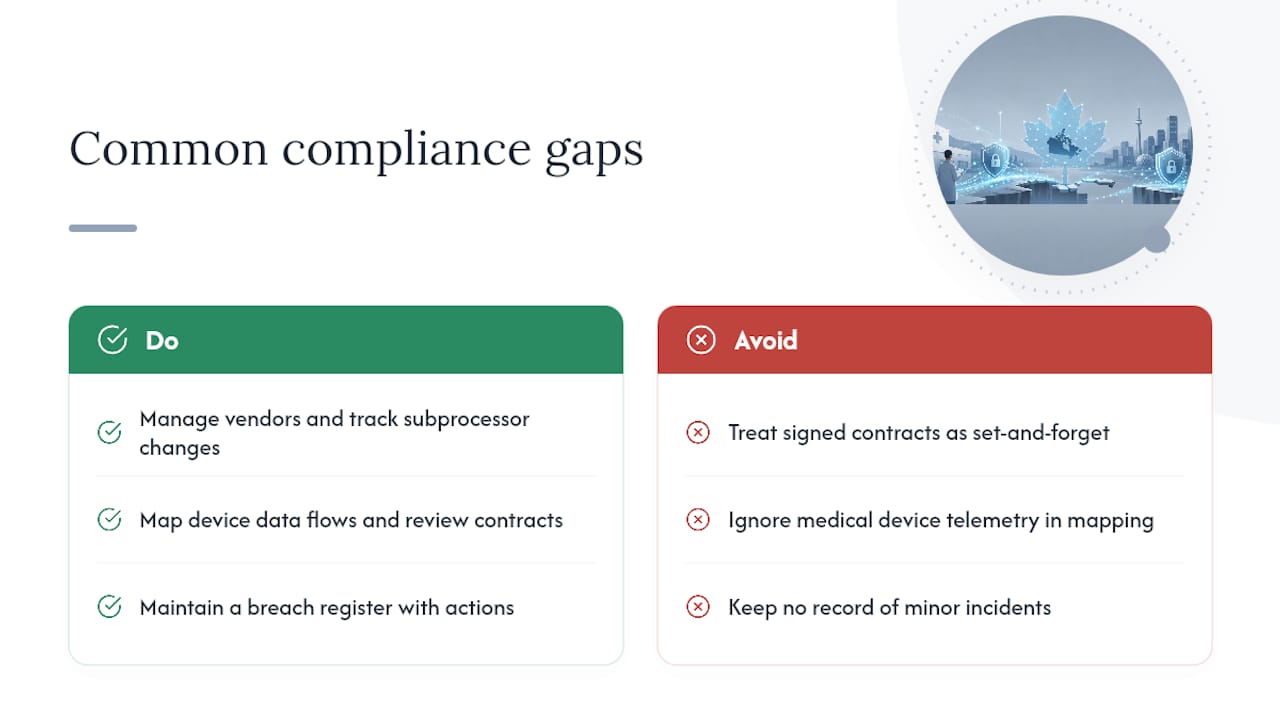
The most common gap in Canadian healthcare compliance programmes is not a missing policy. It is the assumption that a signed vendor contract is the same thing as a managed vendor relationship.
Organisations spend considerable effort negotiating data processing agreements, then file them and move on. Six months later, the vendor has added a subprocessor in a new jurisdiction, changed its encryption standard, or quietly updated its terms of service. None of that triggers a notification under most contracts. The organisation remains contractually protected on paper while the actual risk profile has shifted materially.
The second gap is medical device telemetry. Implanted devices, infusion pumps, remote monitoring equipment, and diagnostic tools all generate data streams that flow to manufacturer servers, often in the US. Most compliance programmes treat these devices as clinical tools rather than data processors, which means the data flows are never mapped, the vendor contracts are never reviewed for privacy compliance, and the data is never included in breach response planning. Medical device cybersecurity guidance addresses this directly, but the compliance programme integration rarely follows.
The third gap is the breach register. Commissioners do not expect perfection. They expect evidence of a functioning programme. An organisation that can produce a breach register showing minor incidents, the assessments conducted, and the corrective actions taken is demonstrating exactly the kind of continuous governance that commissioners look for. An organisation that has no record of any incidents is not demonstrating a clean record. It is demonstrating that it was not looking.
AccountNext-Nexus helps Canadian healthcare organisations stay compliant
Healthcare compliance is not a project with an end date. The regulatory environment shifts, vendors change their practices, and threat actors adapt. What compliance officers actually need is continuous visibility, not a point-in-time assessment.
AccountNext-Nexus delivers 24/7 threat detection and monitoring, incident response, vendor assessments, data residency controls, and compliance audits under a single managed services contract. For healthcare organisations, that means consolidated audit logs ready for regulator review, breach detection timelines measured in minutes rather than days, and a single point of accountability when something goes wrong. No coordinating is needed between a separate SIEM vendor, a separate incident response firm, and a separate compliance consultant at 2 AM.
The practical result: faster breach detection, centralised reporting aligned with provincial notification timelines, and a compliance posture that holds up under commissioner scrutiny. Explore AccountNext-Nexus's managed compliance and cybersecurity services to see how a consolidated model fits your organisation's regulatory obligations.
Sources
Canadian regulators (primary sources)
- Compliance | Office of Inspector General | Government Oversight | U.S. Department of Health and Human Services
- What Is Healthcare Compliance? Definition, Requirements, and Examples
International and contextual references
AccountNext-Nexus implementation resources
This article is general information, not a substitute for advice from a qualified lawyer. Consult a qualified legal professional about your own circumstances before acting on anything here.