
Cloud infrastructure is defined as the combination of physical hardware, virtualisation software, and management tools that enables organisations to access computing resources on demand without owning the underlying systems. The authoritative framework comes from NIST SP 800-145, which specifies five essential characteristics of cloud computing: on-demand self-service, broad network access, resource pooling, rapid elasticity, and measured service. Every legitimate cloud environment must satisfy all five. Understanding these foundations matters whether you are a business planning a digital transformation or an IT team evaluating deployment options for 2026.
What is cloud infrastructure made of?
Cloud infrastructure consists of physical servers, storage devices, networking equipment, virtualisation software, orchestration layers, security and identity management tools, and monitoring systems. These layers do not operate independently. Each one depends on the others to deliver the reliable, on-demand access that defines cloud computing.

The physical layer is the foundation. It includes the servers, storage arrays, and networking hardware housed in data centres. You never see this equipment directly, but every virtual resource you consume runs on it.
The virtualisation layer sits above the physical hardware. Hypervisors partition physical servers into virtual machines (VMs), and container runtimes like Docker or Kubernetes package applications into lightweight, portable units. This layer is what makes resource sharing possible across many tenants or workloads.
- Orchestration and automation layer: Provisions VMs end to end without human input, allocates resources, applies security policies, and connects virtual networks automatically.
- Security and identity management: Controls who accesses what, enforces encryption, and manages compliance policies across the environment.
- Monitoring and governance tools: Track resource consumption, flag anomalies, and feed data into cost management and capacity planning.
Pro Tip: Set up your monitoring and governance tools before you migrate any workloads. Retrofitting governance after the fact costs significantly more time and money than building it in from the start.
The orchestration layer handles provisioning end to end without human intervention. That automation is the core characteristic separating cloud infrastructure from traditional IT resources, where every server build required manual configuration.
What are the main cloud deployment models?
Deployment model selection is driven primarily by security and compliance needs, not cost alone. Highly regulated sectors such as healthcare and financial services routinely choose private or hybrid setups even when public cloud would be cheaper.
| Model | Infrastructure ownership | Best suited for |
|---|---|---|
| Public cloud | Managed by provider, shared | General workloads, startups, variable demand |
| Private cloud | Dedicated to one organisation | Regulated industries, sensitive data |
| Hybrid cloud | Mix of private and public | Organisations needing both control and flexibility |
| Multi-cloud | Multiple public providers | Redundancy, avoiding vendor lock-in |
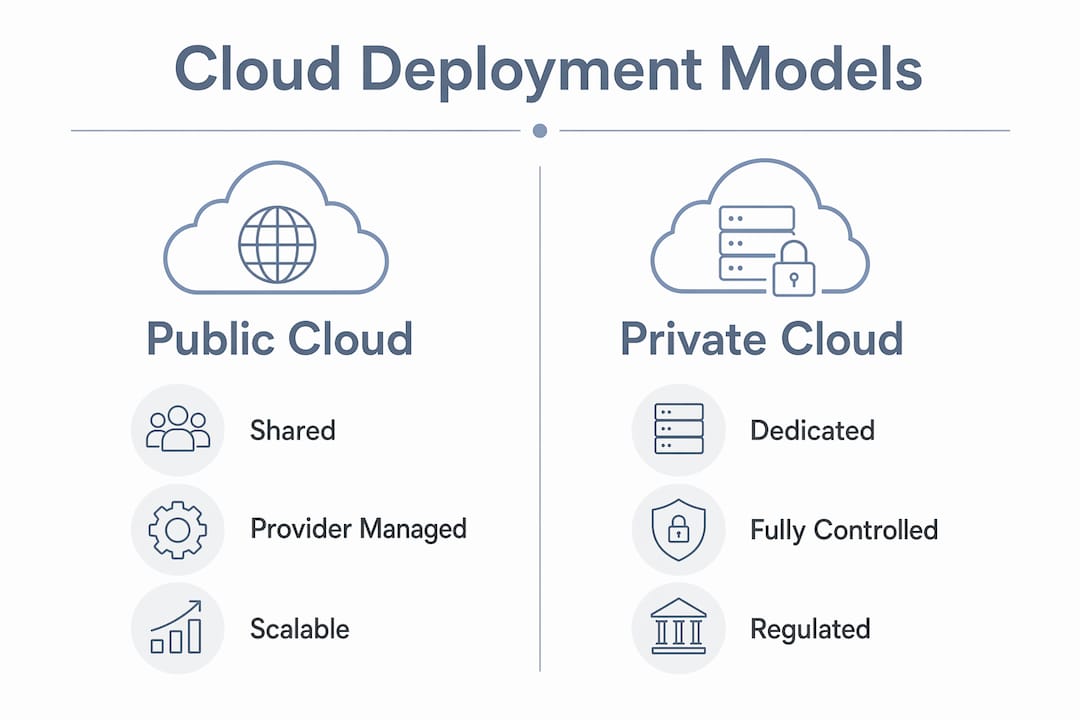
Public cloud suits organisations with variable or unpredictable workloads. The provider manages all underlying hardware, and you pay only for what you consume. The trade-off is less control over where data physically resides.
Private cloud gives your organisation dedicated infrastructure. You control the environment fully, which matters when regulations like PIPEDA, HIPAA, or PCI DSS dictate where data must live and who can access it. The cost is higher, but the compliance posture is cleaner.
Hybrid cloud combines both models. A retailer might run its customer database on a private cloud for compliance reasons while bursting e-commerce traffic to a public cloud during peak seasons. That flexibility is the primary reason hybrid adoption has grown steadily.
Multi-cloud means using more than one public provider simultaneously. Organisations choose this to avoid dependence on a single vendor, access best-in-class services from different providers, or meet geographic data residency requirements. The operational complexity increases, so strong governance is non-negotiable. Understanding shared security responsibilities across providers becomes especially critical in multi-cloud environments.
How does cloud infrastructure deliver financial and operational benefits?
Cloud infrastructure shifts businesses from capital expenditure (CapEx) to operational expenditure (OpEx). Instead of buying servers upfront and depreciating them over years, you pay a monthly bill for what you actually use. That shift frees capital for other priorities.
The operational benefits extend beyond cost structure. Three stand out for most organisations:
- Rapid scalability. You can provision additional compute capacity in minutes rather than weeks. A media company streaming a live event can scale to handle millions of concurrent viewers and then release those resources immediately after. No hardware sits idle.
- Reduced maintenance burden. The provider handles firmware updates, hardware replacements, and data centre operations. Your IT team focuses on applications and services rather than physical infrastructure.
- Faster time to market. Development teams can spin up test environments on demand, run experiments, and tear them down without waiting for procurement cycles. That speed directly affects how quickly products reach customers.
Pro Tip: Right-size your resources from day one. Start with the smallest instance that meets your performance requirements and scale up based on real usage data. Overprovisioning is the most common cause of unexpectedly high cloud bills.
The financial case is real, but it comes with a warning. Overprovisioning without governance can lead to costs that exceed what traditional infrastructure would have cost. Moving to OpEx does not automatically reduce spending. Success depends on automated monitoring, auto-scaling policies, and regular right-sizing reviews. Many organisations discover this the hard way after their first full quarter in the cloud.
What design principles keep cloud infrastructure reliable?
Cloud infrastructure is a complex engineered environment designed with failure in mind. Engineers do not assume hardware will stay up. They build systems that survive hardware failure without any user noticing.
Two concepts underpin that resilience:
- Regions and availability zones. A region is a geographic cluster of data centres. Within each region, availability zones are physically separate facilities with independent power, cooling, and networking. Designing across multiple zones eliminates single points of failure. If one zone loses power, traffic shifts automatically to another.
- Infrastructure as Code (IaC). Tools like Terraform or AWS CloudFormation define infrastructure in version-controlled code files. IaC prevents configuration drift by making every deployment identical and repeatable. Manual provisioning introduces inconsistencies that accumulate into security gaps and outages.
Monitoring is the third pillar of reliability. Without visibility into what your infrastructure is doing, you cannot detect degradation before it becomes an outage. Effective cloud security logging captures events across every layer, from network traffic to application errors, and feeds them into alerting systems that trigger automated responses.
Common pitfalls include single-zone dependency, where teams deploy everything into one availability zone to simplify architecture, and poor resource right-sizing, where instances run at 10% utilisation because no one reviewed them after initial provisioning. Both are avoidable with governance policies set at the start of a project, not after problems appear.
Key takeaways
Cloud infrastructure delivers reliable, cost-efficient computing only when physical hardware, virtualisation, orchestration, and governance layers work together under a clear deployment model matched to your security and compliance requirements.
| Point | Details |
|---|---|
| NIST SP 800-145 defines cloud | All five NIST characteristics must be present for a system to qualify as cloud infrastructure. |
| Deployment model follows compliance | Regulated industries require private or hybrid models regardless of public cloud cost advantages. |
| OpEx savings require governance | Without monitoring and right-sizing, cloud costs can exceed traditional infrastructure spending. |
| IaC prevents configuration drift | Defining infrastructure in code makes deployments repeatable and closes security gaps from manual errors. |
| Availability zones prevent downtime | Distributing workloads across multiple zones eliminates single points of failure in production environments. |
Why most cloud migrations underdeliver (and how to fix that)
After working with organisations across industries on their cloud transitions, the pattern I see most often is this: teams treat cloud infrastructure as a destination rather than a discipline. They migrate workloads, cut the data centre contract, and then discover six months later that their cloud bill is higher than their old hardware costs and their security posture is murkier than before.
The root cause is almost always the same. Cloud infrastructure requires architectural decisions upfront that traditional IT never demanded. Which availability zones will you use? How will you enforce identity policies across a multi-cloud environment? Who owns cost governance? These are not questions you answer after migration. They are the migration.
The second mistake I see is treating deployment model selection as a cost exercise. Public cloud is cheaper on paper. But if your data falls under provincial privacy regulations or sector-specific compliance frameworks, the cheapest option can become the most expensive one after a breach or an audit finding. Regulated organisations that choose private or hybrid models are not being conservative. They are being accurate about their actual risk profile.
The organisations that get cloud right share one habit: they build governance before they build workloads. Monitoring, logging, identity management, and cost controls go in first. Everything else follows. That sequence feels slower at the start and saves enormous effort later. Understanding your cloud security posture before you scale is not optional. It is the difference between a cloud environment that supports your business and one that quietly creates risk.
— Nick, Sr. Executive
How AccountNext-Nexus supports your cloud infrastructure
Running cloud infrastructure without continuous monitoring is like driving without instruments. You may be fine until you are not.
AccountNext-Nexus provides 24/7 IT monitoring and threat detection that covers your cloud environment end to end. Real-time threat detection identifies anomalies before they become incidents. Compliance management keeps your environment aligned with regulatory requirements across deployment models. AccountNext-Nexus consolidates IT management, cybersecurity, and compliance under one service, so your team gets faster incident response and clearer visibility without managing multiple vendors. If your organisation is building or maturing its cloud infrastructure, AccountNext-Nexus gives you the operational foundation to do it securely.
FAQ
What is the cloud infrastructure definition?
Cloud infrastructure is the combination of physical servers, storage, networking hardware, virtualisation software, orchestration tools, and security systems that together deliver on-demand computing resources. NIST SP 800-145 provides the authoritative definition framework, requiring five essential characteristics including resource pooling and rapid elasticity.
What are the types of cloud infrastructure deployment models?
The four main deployment models are public, private, hybrid, and multi-cloud. Selection depends on security requirements, regulatory compliance obligations, and the level of control your organisation needs over its data and systems.
How does cloud infrastructure differ from traditional infrastructure?
Traditional infrastructure requires upfront hardware purchases, manual provisioning, and fixed capacity. Cloud infrastructure uses virtualisation and orchestration to deliver resources on demand, shifting costs from capital expenditure to operational expenditure and enabling rapid scaling.
What components make up cloud infrastructure?
Cloud infrastructure includes physical servers and storage, networking equipment, hypervisors and container platforms, orchestration and automation layers, identity and access management systems, and monitoring and governance tools.
Why does cloud infrastructure sometimes cost more than expected?
Overprovisioning resources without automated governance and right-sizing policies causes costs to exceed projections. Effective cloud cost management requires monitoring, auto-scaling, and regular reviews of resource utilisation to match spending to actual demand.