
An enterprise cybersecurity framework is an organised set of standards, processes, and controls that helps enterprises manage cybersecurity risk by aligning security efforts with business objectives and regulatory compliance. The average cost of a data breach reached $4.88 million, which makes unstructured security approaches a direct financial liability. Two frameworks dominate enterprise adoption: the NIST Cybersecurity Framework (CSF 2.0) and ISO 27001. Both give IT managers a structured vocabulary for risk decisions, budget justification, and audit readiness. Without a framework, security controls remain fragmented, reactive, and disconnected from the business risks they are meant to address.
What is an enterprise cybersecurity framework and why does it matter?
An enterprise cybersecurity framework is the governance backbone of a mature security programme. It defines responsibilities, sets measurable controls, and connects technical security work to business risk tolerance. Frameworks bring consistency and strategic clarity, anchoring security as part of overall business strategy rather than an isolated IT task.

The distinction between a framework and a policy is worth stating clearly. A policy tells staff what to do. A framework tells the organisation how to govern, measure, and improve security across every function. That difference explains why frameworks are referenced in board-level risk discussions, not just IT operations meetings.
For enterprises operating across multiple jurisdictions, a framework also serves as a compliance map. ISO 27001 aligns directly with GDPR and PIPEDA requirements. NIST CSF maps to HIPAA and SOC 2 controls. Choosing the right framework from the start reduces duplicated compliance effort across legal, finance, and IT teams.
What are the core components of an enterprise cybersecurity framework?
Every enterprise cybersecurity framework shares a common architecture, regardless of which standard it follows. The components below represent the functional building blocks that IT managers must address.
- Governance and policy: Defines ownership, accountability structures, and the security policies that set acceptable behaviour across the organisation.
- Risk management: Identifies assets, threat actors, and vulnerabilities, then maps them to business impact. This is the foundation for prioritising controls.
- Identity and access management (IAM): Controls who can access what, under which conditions. IAM is consistently the highest-priority investment in any implementation budget.
- Detection and monitoring: Covers the technologies and processes that surface threats in real time, including SIEM platforms and endpoint detection tools.
- Response and recovery: Defines incident response plans, communication protocols, and recovery time objectives to minimise breach impact.
- Maturity tiers: The NIST CSF 2.0 organises security into six core functions (Govern, Identify, Protect, Detect, Respond, Recover) and four maturity tiers ranging from ad hoc to continuously adaptive. These tiers give IT managers a benchmark for measuring progress over time.
Zero Trust Architecture sits across all of these components as an operating principle. The perimeter-based security model is obsolete; Zero Trust's "never trust, always verify" model is now the foundational approach for distributed enterprise infrastructure. Every component of a framework must be designed with Zero Trust assumptions built in.
Which enterprise cybersecurity frameworks are most widely adopted?
Five frameworks account for the majority of enterprise security programmes globally. Each serves a different primary purpose, and most mature organisations use two or more in combination.
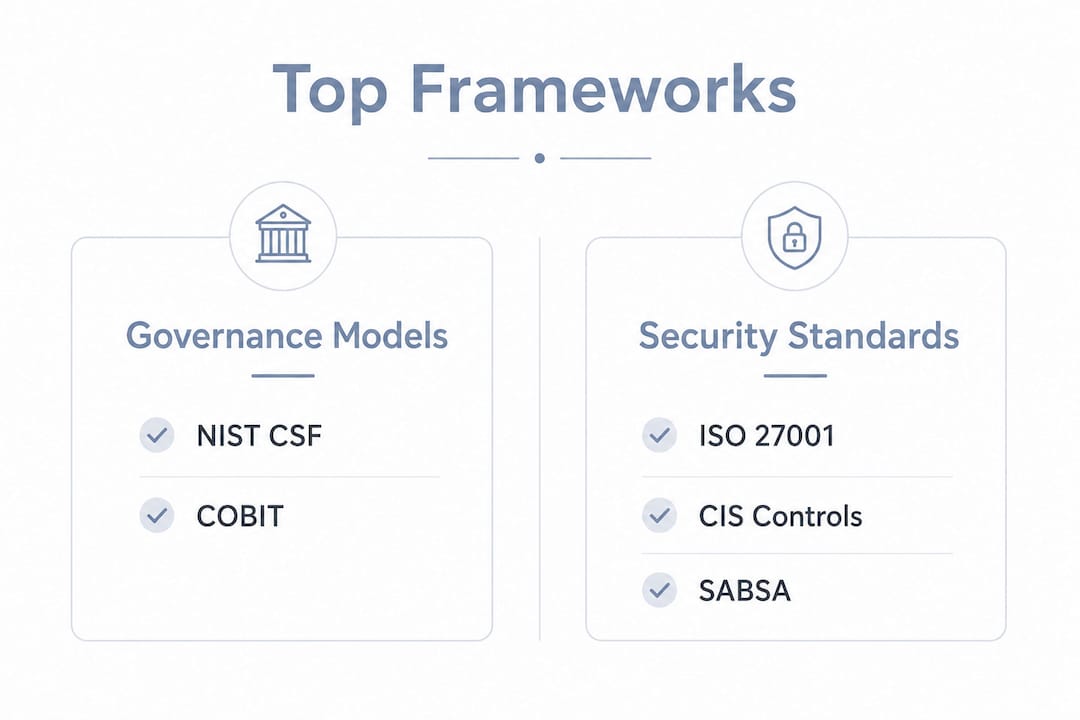
NIST CSF 2.0 is the most widely referenced framework for general enterprise cybersecurity governance. Its six functions provide a common language that bridges technical teams and business leaders, making it the preferred tool for budget justification and goal alignment. The 2024 update added the Govern function, which formalises executive accountability.
ISO 27001 defines an Information Security Management System (ISMS) and offers third-party certification. Certification signals to clients, regulators, and partners that the organisation meets an internationally recognised standard. It is the preferred framework for enterprises operating in regulated industries or across international markets.
CIS Controls (Centre for Internet Security) provides 18 prioritised safeguards ordered by impact. It is particularly useful for organisations that need a prescriptive, actionable starting point rather than a principles-based model. CIS Controls map directly to NIST CSF functions, making them easy to integrate.
SABSA (Sherwood Applied Business Security Architecture) takes a risk-driven, architecture-first approach. It is best suited to large enterprises building security architecture from the ground up, particularly in financial services and critical infrastructure.
COBIT (Control Objectives for Information and Related Technologies) focuses on IT governance and audit readiness. Security teams use COBIT alongside NIST CSF when they need to satisfy internal audit committees and board-level governance requirements.
These frameworks are not mutually exclusive. A common pattern is to use NIST CSF as the primary governance model, ISO 27001 for certification, and CIS Controls for operational prioritisation. The cybersecurity maturity model your organisation selects should reflect its regulatory environment, risk profile, and available resources.
How to implement an enterprise cybersecurity framework in 2026
Effective implementation follows a staged process. Skipping stages is the most common cause of failed deployments.
- Review business context and assets. Map critical assets, data flows, and regulatory obligations before selecting controls. Security controls must reflect actual business risk, not generic threat catalogues.
- Select and tailor your framework. Choose a primary framework based on your industry and compliance requirements. Tailor it to your organisation's risk profile using a current-state profile.
- Conduct a gap analysis. Compare your current security posture against the framework's target profile. Document gaps by function and maturity tier.
- Prioritise by risk. Maturity model best practices recommend focusing first on high-risk areas to show ROI and quick wins rather than attempting to reach top maturity across all areas at once.
- Allocate budget by priority. Invest first in identity and access management, then threat detection and response, then endpoint security, and finally compliance and governance tooling.
- Form a cross-functional governance committee. Cross-functional committees including legal, HR, and finance are required to align security controls with business operations and regulatory compliance. Security cannot be governed by IT alone.
- Deploy controls and integrate monitoring. Implement controls in priority order. Connect detection tools to a central monitoring capability to maintain visibility across the environment.
- Establish continuous monitoring and annual reviews. Treat the framework as a living governance cycle. Review current and target profiles at least annually to address infrastructure drift and emerging threats.
Pro Tip: Map your framework implementation milestones to your organisation's annual budget cycle. Presenting security investments in terms of risk reduction and compliance readiness, rather than technical specifications, significantly improves executive approval rates.
For enterprises managing cloud infrastructure, the enterprise cloud security governance layer adds specific controls for shared-responsibility models that on-premises frameworks do not fully address.
What challenges arise when applying enterprise security frameworks?
Framework implementation fails more often from organisational issues than technical ones. Understanding these pitfalls before deployment saves significant time and budget.
- Treating the framework as a checklist. The most damaging mistake is completing an initial implementation and declaring success. Framework implementation fails when treated as a one-time checklist. It is a continuous governance cycle requiring at least annual reviews of current and target maturity profiles.
- Pursuing full maturity too quickly. Attempting to reach the highest maturity tier across all functions simultaneously drains resources and produces no measurable security improvement. Prioritise high-risk areas first.
- Siloed IT ownership. When security governance sits entirely within IT, it loses the business context needed to make sound risk decisions. Finance, legal, and HR must have defined roles in the governance structure.
- Communication gaps between technical and business teams. Security teams often present findings in technical language that executives cannot act on. Frameworks solve this by providing a common language for risk that both groups can use in budget and strategy discussions.
- Neglecting employee awareness. Technical controls address only part of the risk surface. Common employee cybersecurity vulnerabilities remain a primary attack vector that frameworks must address through training and policy, not just technology.
Pro Tip: When presenting framework gaps to the board, translate each gap into a potential business impact. "We have no documented incident response plan" lands differently than "We cannot meet our 4-hour recovery time objective in the event of a ransomware attack."
How do enterprises measure cybersecurity framework effectiveness?
Measurement turns a framework from a document into a management tool. The table below outlines the key metrics and methods IT managers use to track framework performance.
| Metric or method | What it measures | Why it matters |
|---|---|---|
| Mean Time to Detect (MTTD) | Speed of threat identification | Shorter MTTD reduces dwell time and breach scope |
| Mean Time to Respond (MTTR) | Speed of containment and remediation | Lower MTTR directly reduces breach cost and operational impact |
| Maturity tier progression | Movement across NIST CSF tiers over time | Shows whether governance investment is producing measurable improvement |
| Annual profile review | Gap between current and target maturity profiles | Identifies infrastructure drift and emerging control gaps |
| Security awareness training completion | Percentage of staff completing required training | Tracks human-layer risk reduction across the organisation |
Continuous monitoring technology, including SIEM platforms and endpoint detection and response (EDR) tools, feeds the data that drives these metrics. Metrics without monitoring infrastructure are estimates. Monitoring without metrics produces data that no one acts on. Both are required. A regular security risk assessment process ties these metrics back to the business risk register, closing the governance loop.
Key takeaways
An enterprise cybersecurity framework succeeds only when it operates as a continuous governance cycle, not a one-time compliance exercise, with cross-functional ownership and risk-aligned investment priorities.
| Point | Details |
|---|---|
| Define before you deploy | Select a framework based on your regulatory environment and risk profile before implementing any controls. |
| Prioritise high-risk areas first | Focus initial investment on identity and access management and threat detection to show measurable ROI quickly. |
| Governance requires cross-functional ownership | Legal, HR, and finance must hold defined roles in the security governance committee alongside IT. |
| Treat it as a continuous cycle | Review current and target maturity profiles at least annually to prevent infrastructure drift. |
| Measure with MTTD and MTTR | These two metrics directly connect framework performance to breach cost and business impact. |
Why frameworks fail without cultural integration
I have worked with enterprises that had well-documented NIST CSF implementations and still suffered significant breaches. The documentation was sound. The governance was not. Security was treated as an IT deliverable rather than an enterprise-wide function, and that distinction made all the difference.
The organisations that get the most value from a cybersecurity framework are the ones that embed it into how the business makes decisions, not just how IT operates. When the CFO understands that a gap in identity and access management represents a quantifiable financial exposure, budget conversations change entirely. When legal and HR are active participants in the governance committee, policy enforcement becomes consistent rather than aspirational.
The other pattern I have seen consistently is the maturity trap. Teams set ambitious targets, attempt to close every gap at once, and burn out before the framework produces any measurable improvement. The frameworks that stick are the ones built incrementally, with clear wins at each stage that build organisational confidence and executive support. Zero Trust is a good example. Adopting it as a principle does not require replacing every system overnight. It requires applying the "never trust, always verify" standard to each new control as it is deployed, and revisiting existing controls on a risk-prioritised schedule.
The enterprise vulnerability management process is where I have seen the most immediate ROI from framework adoption. Organisations that formalise vulnerability identification and remediation within their framework structure reduce their exposure window significantly compared to those managing vulnerabilities ad hoc.
— Nick - Sr. Executive
AccountNext-Nexus: continuous monitoring for enterprise security programmes
Implementing a cybersecurity framework creates the governance structure. Maintaining it requires continuous visibility into your environment.
AccountNext-Nexus provides 24/7 threat detection and monitoring services built to support enterprise framework implementations, from NIST CSF to ISO 27001. The team integrates with your existing governance structure, delivering real-time alerts, compliance reporting, and incident response support under one service umbrella. Enterprises working with AccountNext-Nexus reduce the gap between framework documentation and operational security posture. For IT managers who need expert support without building a full in-house security operations centre, AccountNext-Nexus services offer a direct path to continuous, framework-aligned protection.
FAQ
What is an enterprise cybersecurity framework?
An enterprise cybersecurity framework is an organised set of standards, processes, and controls that aligns an organisation's security programme with its business risk tolerance and compliance requirements. NIST CSF 2.0 and ISO 27001 are the most widely adopted examples.
How does NIST CSF 2.0 differ from earlier versions?
NIST CSF 2.0 added a sixth core function, Govern, which formalises executive accountability for cybersecurity risk decisions. Earlier versions covered five functions: Identify, Protect, Detect, Respond, and Recover.
How long does it take to implement a cybersecurity framework?
Implementation timelines vary by organisation size and complexity, but an 8-step staged process is the recognised best practice. Most enterprises complete an initial deployment within 6–18 months, with continuous improvement ongoing after that.
What is Zero Trust and how does it relate to cybersecurity frameworks?
Zero Trust Architecture is an operating model built on the principle of "never trust, always verify." It is now foundational to modern enterprise cybersecurity frameworks, replacing the obsolete perimeter-based security model across distributed infrastructure.
How do enterprises measure whether their framework is working?
The two primary operational metrics are Mean Time to Detect (MTTD) and Mean Time to Respond (MTTR). Annual maturity profile reviews and regular risk assessments complete the measurement cycle.