
Runtime application security is defined as a protection technology that embeds monitoring and enforcement mechanisms directly within an application to detect and block attacks during execution. Unlike perimeter defences or pre-deployment code scans, it operates from inside the application itself, observing every data operation, API call, and control flow decision as they happen. The industry standard term for this approach is Runtime Application Self-Protection, or RASP. Frameworks like the NIST Cybersecurity Framework 2.0 and OWASP explicitly recognise runtime controls as a necessary layer in any defence-in-depth strategy. For IT professionals and security managers, understanding what is runtime application security means understanding the one layer that can stop an exploit that every other tool missed.
What is runtime application security and how does it work?
RASP embeds sensors directly within an application's runtime to monitor, detect, and block malicious activity by analysing code behaviour internally. This is fundamentally different from placing a sensor at the network edge. The protection travels with the application, whether it runs on a cloud server, a container, or a traditional VM.
Once embedded, the agent inspects the following categories of activity in real time:
- Data operations: reads and writes to databases, file systems, and memory, flagging patterns consistent with SQL injection or path traversal
- Control flow: the sequence of instructions the application executes, detecting deviations that signal code injection or deserialization attacks
- API calls: outbound and inbound service requests, identifying abuse of privileged endpoints or unexpected data exfiltration
- System calls: low-level interactions with the operating system, catching attempts to spawn unauthorised processes or escalate privileges
Runtime security instruments code in real time to intercept threats at execution points like database queries or system calls. This means the agent can block an attack at the exact moment the malicious payload reaches a sensitive operation, even when the underlying source code has not yet been patched.
RASP tools operate in two modes. Monitor mode observes and logs suspicious activity without blocking anything. Protection mode actively terminates sessions, rejects requests, or shuts down compromised components within milliseconds. Monitor mode runs for 2–4 weeks during integration before enabling blocking mode. That baselining period is what separates a well-tuned deployment from one that generates constant false positives.

Pro Tip: Start every RASP deployment in monitor mode and treat the first two weeks as a data collection exercise, not a security exercise. The baseline you build during that period is the foundation every future policy decision rests on.
How does runtime security compare to SAST, DAST, and WAFs?
Runtime application security fills a gap that static and perimeter tools cannot close. Each approach has a distinct role, and understanding where each one stops is what drives sound application security best practices.
Static Application Security Testing (SAST) analyses source code before the application is built or deployed. It catches coding errors, insecure patterns, and known vulnerability classes early in the development cycle. SAST cannot see how the application behaves under real traffic, and it produces no protection once the application is live.
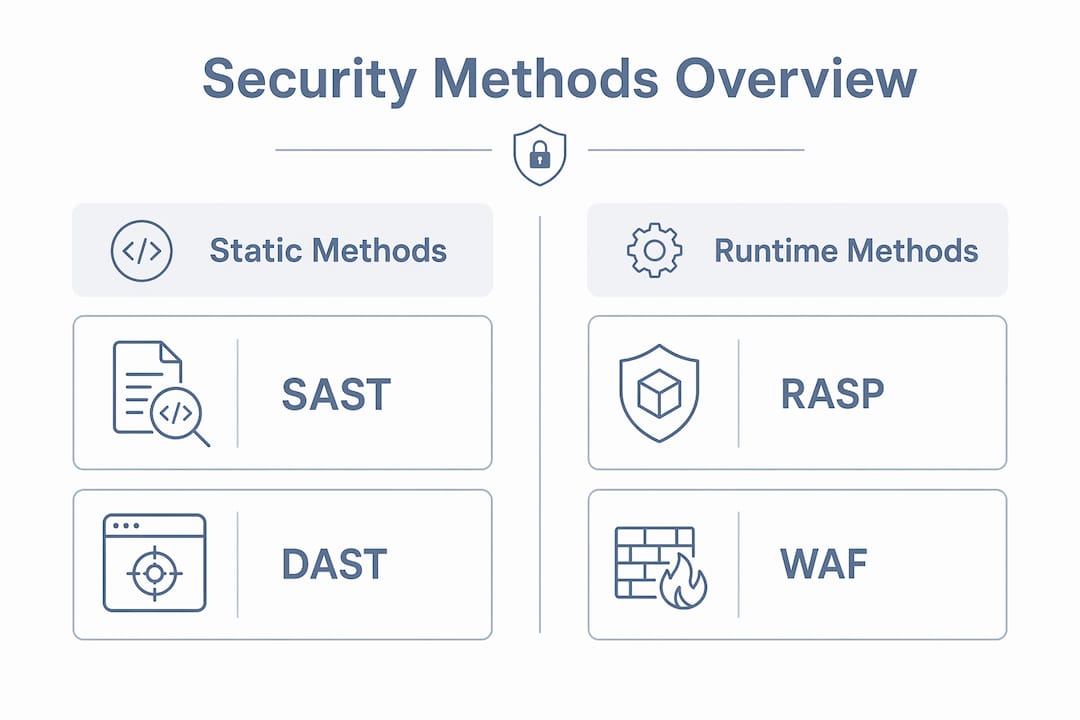
Dynamic Application Security Testing (DAST) sends simulated attacks to a running application from the outside, much like a penetration test. It identifies vulnerabilities that only appear at runtime, but it operates from the network perimeter and has no visibility into internal code execution. A DAST scan is a point-in-time assessment, not continuous protection.
Web Application Firewalls (WAFs) sit between the internet and the application, filtering traffic based on known attack signatures and rules. WAFs are effective against high-volume, signature-based attacks. They fail against novel payloads, encrypted traffic manipulation, and attacks that originate from within the application's own logic, such as a compromised third-party library making legitimate-looking API calls.
| Approach | Where it operates | When it protects | Zero-day coverage |
|---|---|---|---|
| SAST | Source code, pre-deployment | Before release | No |
| DAST | Network perimeter, post-deployment | During testing cycles | Partial |
| WAF | Network perimeter, live traffic | Continuously | Signature-dependent |
| RASP | Inside the application, live execution | Continuously | Yes |
Runtime controls automate actions like terminating sessions or shutting compromised components within milliseconds, reducing attack impact. That speed is only possible because the agent has direct access to the application's internal state. A WAF or DAST tool never has that context. For zero-day and post-deployment threats, runtime security is the only layer that can respond before a human analyst even opens an alert.
Best practices for implementing runtime application security tools
Effective deployment of runtime security tools follows a clear sequence. Skipping steps in that sequence is the most common reason organisations end up with either a tool that blocks legitimate traffic or one that generates so many alerts it gets ignored.
- Deploy in monitor mode first. Baseline normal application behaviour across all environments, including staging and production. Do not enable blocking until you have at least two weeks of clean telemetry.
- Integrate telemetry into your SIEM. Successful runtime security deployments feed real-time alarms into centralised SIEM and incident response platforms, allowing targeted investigation and faster mitigation. Isolated alerts sitting in a separate console create operational fatigue and get missed.
- Define automated response actions by severity. Low-confidence anomalies should trigger logging and analyst review. High-confidence attack patterns, such as confirmed SQL injection attempts, should trigger immediate session termination or privilege escalation blocking without waiting for human approval.
- Share runtime telemetry with development teams. Developers benefit from contextual data highlighting the exact code and logic exploited. That context cuts patching time significantly because developers do not need to reproduce the attack scenario from scratch.
- Review and retune policies quarterly. Application behaviour changes with every release. A policy tuned for version 3.2 of your application may generate false positives or miss new attack surfaces in version 3.5.
- Monitor performance impact continuously. Premature enforcement can cause latency spikes, so track response time metrics before and after each policy change.
Pro Tip: Feed RASP telemetry directly into your SOC ticketing workflow, not just your SIEM dashboards. Analysts who receive a ticket with the exact line of code exploited resolve incidents in a fraction of the time compared to those working from raw log data.
What are the main challenges of runtime application security?
Runtime security is not a set-and-forget solution. Security managers who treat it as one consistently run into the same set of problems.
- Performance overhead: Every intercepted call adds processing time. Poorly configured agents on high-throughput applications can introduce measurable latency. Lightweight agent architectures and selective instrumentation of high-risk execution points reduce this, but it requires deliberate configuration.
- False positive management: Overly aggressive policies block legitimate operations. A payment processing application that blocks an unusual but valid API call pattern during a promotional sale causes real business harm. Tuning is an ongoing responsibility, not a one-time task.
- Integration complexity: Connecting RASP telemetry to existing SOC workflows, SIEM platforms, and ticketing systems requires engineering effort. Organisations with fragmented security infrastructure spend disproportionate time on plumbing rather than analysis.
- Scope limitations: Runtime security protects the application layer. It does not protect the underlying infrastructure, network, or identity systems. An attacker who compromises the host operating system or the cloud control plane operates outside the agent's visibility.
- Cloud-native environments: Containerised and serverless architectures create ephemeral execution environments. Agents must reinitialise with each container instance, and telemetry must be captured before the container terminates. Modern lightweight agents designed for Kubernetes and serverless platforms address this, but legacy RASP tools often struggle.
Runtime security complements Zero Trust and continuous verification frameworks by observing and blocking unauthorised actions in real time. That alignment with Zero Trust is what makes it a durable investment even as infrastructure architectures shift toward cloud-native models.
Key takeaways
Runtime application security works because it operates from inside the application, giving it context that no perimeter or pre-deployment tool can match.
| Point | Details |
|---|---|
| RASP embeds inside the application | Sensors monitor data operations, API calls, and control flow during live execution. |
| Monitor mode is non-negotiable | Baseline normal behaviour for 2–4 weeks before enabling blocking to avoid false positives. |
| SAST, DAST, and WAFs do not replace RASP | Each tool covers a different phase; runtime security is the only layer that stops live zero-day exploits. |
| SOC integration prevents alert fatigue | Feed RASP telemetry into SIEM and ticketing systems so analysts receive context, not just raw alerts. |
| Ongoing tuning is required | Application updates change behaviour; policies must be reviewed quarterly to stay accurate. |
Runtime security as the last line of defence: my honest assessment
I have worked with security teams that deployed RASP and considered the job done. That is the wrong frame entirely. Runtime security is the last line of defence, not the only line. Its value is highest when it sits inside a layered strategy that includes SAST in the development pipeline, DAST in pre-production testing, WAF at the perimeter, and employee security awareness across the organisation.
What I find most teams underestimate is the operational discipline required after deployment. The technology works. The challenge is keeping the policies accurate as applications evolve and keeping analysts engaged with the telemetry rather than tuning it out. Runtime security supports NIST CSF 2.0 by enforcing continuous verification and anomaly detection, but a framework alignment on paper means nothing if the SOC is not acting on the signals.
The teams I have seen get the most from runtime security share one habit: they treat RASP telemetry as a development feedback loop, not just a security alert stream. When a runtime agent flags an unusual deserialization pattern, the best teams route that finding to the developer who owns that code within hours. That closes the loop between detection and remediation faster than any patch management process I have seen.
The threat landscape is not getting simpler. Attackers increasingly target application logic rather than network infrastructure because application defences are often weaker and the payoff is higher. Runtime context awareness is the direct answer to that shift.
— Nick, Sr. Executive
How AccountNext-Nexus supports runtime application security
AccountNext-Nexus provides 24/7 monitoring and real-time threat detection that integrates directly with runtime security deployments across cloud, containerised, and traditional server environments. Security managers working with AccountNext-Nexus gain access to seasoned IT professionals who handle RASP telemetry integration, SOC workflow configuration, and ongoing policy tuning. Rather than managing fragmented tools across separate consoles, clients receive a consolidated view of their application security posture with clear incident response workflows. If your organisation is evaluating runtime security as part of a broader cybersecurity programme, AccountNext-Nexus offers transparent service scoping and direct access to specialists who have deployed these controls across regulated and high-availability environments.
FAQ
What is runtime application security in simple terms?
Runtime application security is a technology that embeds a protective agent inside an application to monitor and block attacks as they happen during execution. It is also known as Runtime Application Self-Protection, or RASP.
How is RASP different from a WAF?
A WAF filters traffic at the network perimeter using attack signatures, while RASP operates inside the application and analyses internal code behaviour, data flows, and API calls. RASP can detect and block attacks that bypass WAF rules entirely, including zero-day exploits.
Does runtime security slow down applications?
Poorly configured RASP agents can introduce latency, particularly on high-throughput applications. Selective instrumentation of high-risk execution points and incremental deployment in monitor mode before enabling blocking significantly reduces performance impact.
What attacks does runtime application security detect?
RASP detects SQL injection, cross-site scripting (XSS), deserialization attacks, path traversal, and unauthorised API abuse by inspecting internal data operations and control flow in real time, even when source code has not been patched.
How does runtime security fit into a Zero Trust strategy?
Runtime security enforces continuous verification and anomaly detection at the application layer, directly supporting Zero Trust principles by blocking unauthorised actions in real time regardless of where a request originates.