
A working zero trust network design starts by defining a narrow protect surface and success metrics before touching a single firewall rule, builds identity and device trust first, and places enforcement as close to the resource as possible with policy decisions automated rather than manually adjudicated. Get those three sequences wrong and every microsegmentation project that follows will fight the network instead of the risk.
TL;DR:
- A successful zero trust design begins with mapping the protect surface and establishing identity and device trust before implementing enforcement points.
- Policy decisions should be automated and placed as close to resources as possible, with regional decision points to reduce latency in complex environments.
- Prioritize consolidating identity providers and deploying strong MFA, device posture verification, and privileged access management early in the process.
- Deploy zero trust incrementally, focusing first on identity and macrosegmentation, then scaling to microsegmentation on the most valuable assets.
- Tracking metrics related to breach containment and asset coverage is more effective for leadership buy-in than counting rules or deployments alone.
Table of Contents
- What is zero trust network design?
- What are the logical components of a zero trust architecture?
- How do you define the protect surface for zero trust?
- Network segmentation and microsegmentation design
- Identity, device trust and access control design
- ZTNA, SASE, or service mesh: which deployment model fits?
- What's a realistic zero trust implementation roadmap?
- Operations, automation, and the pitfalls that sink zero trust projects
- Nexus perspective: operationalizing zero trust in practice
- What actually matters in a zero trust rollout
- How AccountNext-Nexus supports a phased zero trust rollout
- Sources
- FAQ
What is zero trust network design?
Zero trust network design is the discipline of building access controls around individual resources and identities instead of a trusted network perimeter. Every request gets verified, every time, regardless of where it originates.
- Never trust, always verify. No device, user, or workload gets implicit trust because it sits on the corporate network. Every session is authenticated and authorized against current context.
- Least privilege by default. Access is scoped to the specific resource and action needed, not to a subnet or VLAN.
- Assume breach. Design decisions treat compromise as a when, not an if, which is why segmentation and monitoring matter as much as the front door.
- Continuous verification. Trust decisions are re-evaluated throughout a session, not just at login, using signals like device posture and behavioural anomalies.
- Resource-centric focus. The unit of protection is data, applications, assets, and services (often abbreviated DAAS), not network zones.
NIST Special Publication 800-207, Zero Trust Architecture remains the reference definition most enterprise architects design against, and for good reason: it's vendor-neutral, technically precise, and widely adopted by federal and commercial security teams alike. The perimeter model asked "Is this device inside the building?" Zero trust asks "Should this specific identity access this specific resource right now?" That shift in framing is the entire architecture in one sentence.
What are the logical components of a zero trust architecture?
NIST SP 800-207 breaks zero trust architecture into three logical components that do the actual decision-making, plus a set of supporting data sources that feed them.
The Policy Engine (PE) is the brain. It evaluates enterprise policy, threat intelligence, and contextual signals to decide whether a specific access request gets approved, denied, or approved with restrictions. The Policy Administrator (PA) takes that decision and executes it, establishing or terminating the communication path between subject and resource, often by issuing or revoking a session token or credential. The Policy Enforcement Point (PEP) sits at the actual chokepoint. Some kind of gateway, agent, or proxy that enables, monitors, and eventually cuts off the connection.
Feeding all three are policy information points (PIPs): your identity provider for authentication state, your EDR or MDM platform for device posture, SIEM or XDR telemetry for behavioural signals, and data classification systems for sensitivity labels. A PE making decisions without solid PIP feeds is guessing with extra confidence.
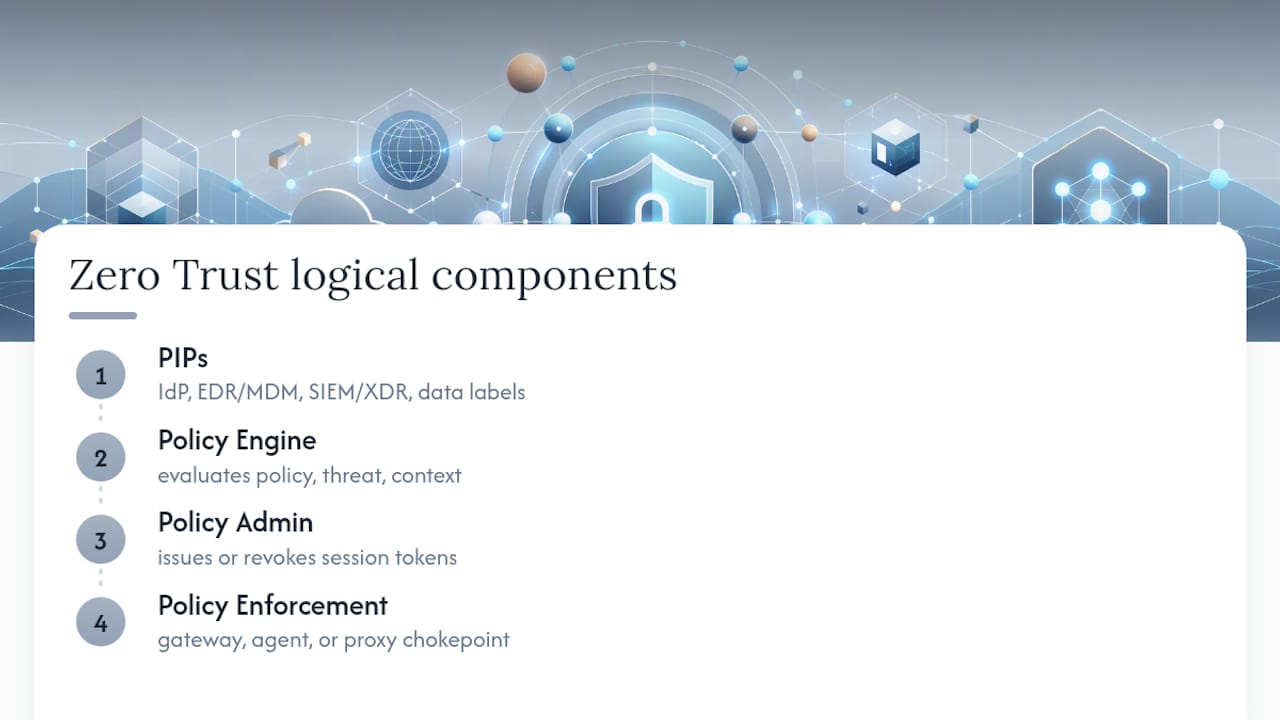
Placement matters more than most teams expect. A centralized PE/PA pair works fine for a single data centre, but distributed enterprises with multiple clouds and regional offices often need regional policy decision points to avoid latency that pushes users toward workarounds. The NCCoE example builds document 19 different implementation patterns precisely because there's no single correct topology. Your PEP count and PDP placement should track where your resources and users actually sit, not where the reference diagram puts them.
How do you define the protect surface for zero trust?
You cannot design enforcement points for a network you haven't mapped. The protect surface, a term John Kindervag coined as the inverse of "attack surface", is the specific set of data, applications, assets, and services that need protection first. Trying to protect everything at once is how zero trust projects stall for eighteen months and get quietly cancelled.
- Inventory your crown-jewel DAAS. Identify the systems that would cause real damage if compromised: customer databases, financial systems, source code repositories, PHI or PII stores. Rank by business impact, not by how interesting the system is to secure.
- Map transaction and data flows around each asset. Use application dependency mapping tools, network flow logs (NetFlow, VPC flow logs), and existing telemetry to trace who and what actually talks to each protected resource, how often, and over which ports.
- Identify the natural chokepoints in each flow. Every flow has a narrowest point, a load balancer, an API gateway, a database proxy, where a PEP can sit without disrupting legitimate traffic.
- Set the enforcement granularity based on what the flow map reveals. A flow with three known clients might warrant a tight allow-list; a flow with hundreds of internal consumers might need broader segmentation first, with tightening as a phase-two goal.
The mapping exercise routinely surfaces communication paths nobody documented, old batch jobs, forgotten service accounts, a legacy reporting tool still pulling nightly extracts. Those surprises are exactly why this step comes before segmentation, not after.
Network segmentation and microsegmentation design
Macrosegmentation divides the network into broad zones (production, development, guest) and stops the worst lateral movement cheaply. Microsegmentation goes further, isolating traffic between individual workloads or even individual processes, and it's what actually contains an attacker who's already inside a zone.
Most enterprise designs end up as a hybrid: macro zones for coarse isolation between environments, with microsegmentation applied selectively to the crown-jewel assets identified in the protect-surface exercise. Applying microsegmentation everywhere on day one is a common overreach that stalls projects under their own policy complexity.
- Host-based enforcement (agents on endpoints and servers) gives granular control and follows the workload if it moves, but adds agent management overhead.
- Network-based enforcement (next-gen firewalls, SDN policies) is easier to manage centrally but struggles with east-west traffic inside a flat subnet.
- Service mesh enforcement (Istio, Linkerd) fits containerized environments naturally, applying mutual TLS and policy at the sidecar proxy level rather than the network layer.
Rule design discipline matters as much as the technology choice. Policies written against static IP addresses rot the moment infrastructure changes; policies written against identity, workload labels, or service tags survive it. Tools that provide audit-ready firewall policy management help catch the rule sprawl that accumulates when every exception gets a one-off entry nobody revisits.
Pro Tip: Tag every segmentation rule with the business justification and review date at creation time. Six months later, nobody remembers why "allow TCP 8443 from subnet C to subnet F" exists, and untraceable rules never get removed, only added to.
Identity, device trust and access control design
Identity is the new perimeter, which means a shaky identity foundation undermines everything built on top of it. Start by consolidating identity providers. Multiple IdPs across an enterprise (a legacy Active Directory domain here, an acquired company's Okta tenant there) create policy blind spots where the PE simply can't get a consistent signal.
- Deploy phishing-resistant MFA. FIDO2 security keys and passkeys close the gap that SMS and push-based MFA leave open to real-time phishing kits.
- Enforce conditional access. Access decisions should weigh device posture, location, and behavioural risk score, not just a valid password.
- Verify device posture before granting access. EDR and MDM integrations confirm patch level, disk encryption, and malware status as PIP inputs to the policy engine. A modern EDR platform is the practical source for this signal in most enterprise stacks.
- Set a clear BYOD policy. Personal devices typically get application-level access through ZTNA brokers rather than full network access, sidestepping the posture-verification gap unmanaged hardware creates.
- Apply privileged access management with just-in-time elevation. Standing administrative access is a liability; JIT elevation with session recording narrows the window an attacker can exploit.
- Extend the same rigour to machine identities. Service accounts, API keys, and secrets need rotation and vaulting discipline, not permanent credentials sitting in a config file.
A tiered rollout that treats privileged access as a starting point rather than an afterthought tends to produce faster, more defensible wins than trying to overhaul every identity flow simultaneously.
ZTNA, SASE, or service mesh: which deployment model fits?
The right deployment technology depends on where the traffic actually needs enforcing, not on which vendor pitch was most convincing.
- ZTNA replaces broad-access VPNs with per-application, identity-aware brokered access, so a compromised laptop can reach the one application it's authorized for instead of the entire subnet. Cloudflare's explanation of zero trust networking captures why this reduces lateral movement risk far more than tunnel-based VPN ever could.
- SASE and SSE converge SD-WAN and security services, secure web gateway, CASB, firewall-as-a-service, into a single policy plane that follows users to branch offices and home networks alike. Cisco's zero trust architecture guidance frames this as the practical answer for distributed workforces that outgrew site-to-site VPN mesh designs.
- SDP and service mesh suit application-layer enforcement, particularly in containerized or microservices environments where mutual TLS between workloads matters more than perimeter control between offices.
Migrating off VPN entirely rarely happens in one step. Most enterprises run ZTNA and legacy VPN in parallel for a defined period, moving application by application as each is validated, rather than flipping a switch and hoping nothing breaks.
What's a realistic zero trust implementation roadmap?
Skip the vendor slide deck that promises full zero trust in a single quarter. The NCCoE's example builds document a crawl, run, scale progression that starts narrow deliberately, because a narrow scope is what makes early wins measurable.
- Crawl phase: identity, credentialing, and access management (ICAM), plus endpoint hygiene. Consolidate identity providers, roll out phishing-resistant MFA, and get EDR coverage to near-complete before attempting network-layer changes. This phase alone often eliminates the majority of easy attack paths.
- Run phase: conditional access and initial macrosegmentation. Layer device posture into access decisions and separate the network into coarse zones around the protect surfaces identified earlier.
- Scale phase: microsegmentation, SDP, and service mesh for the highest-value assets. This is where lateral movement gets genuinely constrained, and it should only start once the identity and macro-segmentation foundation is stable.
Prioritize by risk, cost, and return, not by what's technically interesting. A crown-jewel database with weak segmentation and no MFA on its admin accounts outranks a low-value dev environment every time, regardless of which project is easier to staff.
Forrester's roadmap guidance recommends tracking three metric tiers to keep the project funded and credible with leadership:
- Strategic metrics for the board: reduction in breach blast radius, time to detect and contain lateral movement.
- Operational metrics for security leadership: percentage of assets covered by MFA and EDR, number of assets with defined protect-surface boundaries.
- Tactical metrics for engineering teams: policy rule counts, PEP deployment coverage, mean time to remediate policy exceptions.
Reporting only tactical metrics upward is how good projects lose funding. Executives fund outcomes, not rule counts. Mapping roadmap phases to a defined security maturity model gives non-technical stakeholders a frame they can actually track quarter over quarter.
Operations, automation, and the pitfalls that sink zero trust projects
Telemetry is what turns zero trust from a policy diagram into a functioning control system. Correlating identity logs, network flow data, and endpoint signals into a single view, aligned with continuous diagnostics and mitigation (CDM) principles, is what lets the policy engine make decisions grounded in current reality rather than stale assumptions.
Manual policy management collapses under its own weight past a certain scale. Automating policy lifecycle management (creation, review, expiry, and remediation of drift) is what the NCCoE's implementation work identifies as essential once an organization moves past a handful of segmentation rules.
The pitfalls that recur across failed projects are rarely technical:
- Organizational silos between network, identity, and application teams stall projects more often than any technology gap does. Forrester's own field research names siloed ownership and inconsistent identity sources as leading causes of failure.
- Legacy systems that can't support modern authentication get bolted onto the architecture with compensating controls, which is fine, as long as it's a documented exception, not a silent gap.
- Over-segmentation attempted too early creates policy sprawl nobody can audit or maintain.
- Insufficient telemetry leaves the policy engine making decisions on incomplete information, which quietly defeats the entire point of continuous verification.
Nexus perspective: operationalizing zero trust in practice
Mapping NIST's logical model onto a live enterprise network is the hard part that reference architectures gloss over. AccountNext-Nexus approaches privileged access with a Vault Tier 0 First method: securing the identity systems and domain controllers that everything else depends on before extending controls outward, because a compromised Tier 0 asset makes every other zero trust control irrelevant.
Discovery engagements typically surface the same governance gaps regardless of industry: duplicate identity sources, undocumented service accounts, and segmentation rules with no owner. None of that is unusual, and none of it is a reason to delay. It's simply the starting inventory every phased rollout works from.
What actually matters in a zero trust rollout
Most zero trust advice reads like a shopping list: buy ZTNA, buy microsegmentation, buy a new SIEM, done. That framing gets the order backwards, and it's why so many well-funded projects stall at the eighteen-month mark with half-finished network policies and a leadership team asking pointed questions about ROI.
The research supports a blunter conclusion: identity consolidation and device posture do more risk reduction per dollar than any segmentation project attempted before them. Skipping straight to microsegmentation because it sounds more advanced is the single most common design mistake I see, and it's backwards. A tightly segmented network with weak identity controls just gives an attacker a smaller room to work in, not a locked door.
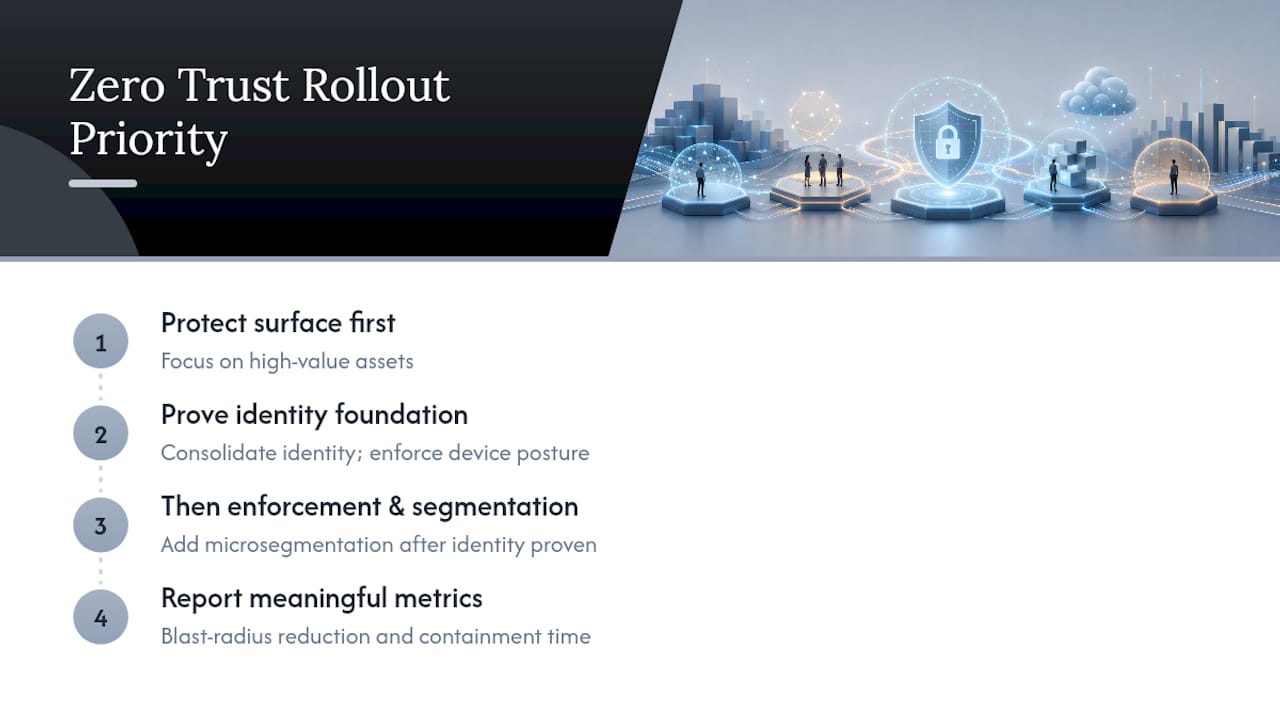
The second underrated point is metrics discipline. Teams that report only rule counts and deployment percentages lose executive sponsorship within a year, because nobody upstairs can tell if the project is working. Teams that report blast-radius reduction and containment time keep their budget, because that's a number a board can act on.
Prioritize the protect surface, prove the identity foundation, then earn the right to get fancy with enforcement. Everything else is sequencing detail.
— Nick - Sr. Executive
How AccountNext-Nexus supports a phased zero trust rollout
Some managed service providers consolidate the identity, endpoint, and network work most zero trust projects split across different vendors, simplifying contract management for your team.

A managed assessment starts with the same protect-surface mapping this article walks through: crown-jewel DAAS inventory, transaction flow mapping, and a gap analysis against your current identity and segmentation posture. From there, engagements typically move into a proof-of-concept on one high-value protect surface before scaling to a phased rollout with defined milestones, deliverables, and the strategic and operational metrics leadership actually wants to see quarter over quarter. Compliance assessments against SOC 2, HIPAA, or ISO 27001 run alongside the technical work rather than as a bolted-on afterthought at the end.
If your team is staring at a zero trust mandate with no clear starting point, book an assessment with Nexus's IT and cybersecurity services and get a protect-surface map and phased plan before your next budget cycle.
Sources
- NIST Special Publication 800-207, Zero Trust Architecture
- Building a zero trust roadmap: a practical guide — Forrester
- Implementing a Zero Trust Architecture - NCCoE
FAQ
What is a zero trust network model?
It's an architecture where no user, device, or workload is trusted by default based on network location. Every access request is verified against identity, device posture, and policy before it's granted, per NIST SP 800-207.
What are the 5 pillars of zero trust?
Definitions vary slightly by framework, but the commonly cited pillars are identity, devices, networks, applications and workloads, and data, each requiring its own verification and protection controls.
How do you design a zero trust network?
Start by defining a narrow protect surface and mapping data flows around it, build identity and device trust as the foundation, then place enforcement points close to resources and expand segmentation in phases, following a crawl, run, scale progression.
What are the disadvantages of a zero trust architecture?
Zero trust adds upfront complexity in mapping flows and consolidating identity, can create friction if conditional access rules are too rigid, and requires ongoing automation investment to prevent policy rules from drifting out of date as infrastructure changes.
Does zero trust require replacing existing security tools?
Not entirely. Many organizations integrate existing identity providers, EDR platforms, and firewalls into the zero trust policy engine rather than replacing them, adding ZTNA brokers or microsegmentation only where the protect-surface mapping shows a genuine gap.