
Managed cloud identity and access management is the recommended path for most organizations trying to consolidate IAM and run it reliably at scale. Building an in-house identity program from scratch now competes against providers who already run continuous monitoring and lifecycle management backed by full delivery centres. If you're weighing a cloud identity access management startup approach against a managed service, the managed route wins for nearly every SMB and mid-market enterprise in scope.
Three reasons drive that recommendation:
- Security posture. Providers like KPMG's managed identity services apply automation and analytics that most internal teams can't staff around the clock.
- Operational resilience and cost. Governance frameworks such as NIST's CSF 2.0 give managed providers a consistent playbook instead of ad hoc processes that break under growth.
- Compliance readiness. Continuous access certification and reporting keep you audit ready instead of scrambling before a SOC 2 renewal.
Pro Tip: Before you sign anything, request a 15-minute scoping call with a provider like AccountNext-Nexus to map your current identity sprawl against what a managed engagement would actually cover.
Key Takeaways
Managed cloud identity and access management reduces long-term operating cost and security risk compared with most in-house builds, provided the contract specifies clear SLAs, integration depth, and non-human identity governance.
| Point | Details |
|---|---|
| Managed IAM is the default | For most SMBs and enterprises, outsourcing beats a custom build on three-year operating cost. |
| Integration depth is the real test | Demand live SCIM provisioning and SAML/OIDC federation proof, not a feature list. |
| Non-human identities need explicit coverage | Service accounts and API keys are commonly left ungoverned unless the contract names them. |
| Timeline runs 8 to 16 weeks | Full steady-state operation typically follows discovery, pilot, and roll-out phases in that window. |
| AccountNext-Nexus consolidates the stack | One SLA covers identity governance, PAM, SSO, and 24/7 monitoring under a single contract. |
Table of Contents
- What managed cloud IAM (managed identity) means in this guide
- Core capabilities you should expect from a managed IAM service
- Business benefits and when outsourcing IAM makes sense
- How a managed IAM engagement actually runs
- What to ask before signing with an IAM provider
- Estimated total cost breakdown and pricing models for managed cloud IAM services
- Detailed implementation timeline from contract signing to full operational status
- Why the "quick fix" mentality on IAM keeps backfiring
- Why Nexus is worth a conversation for managed IAM
- Frequently asked questions
- Sources
What managed cloud IAM (managed identity) means in this guide
Managed cloud identity and access management is a contracted service where a provider operates your identity governance, single sign-on (SSO), multi-factor authentication (MFA), privileged access management (PAM), and directory lifecycle processes under a signed service level agreement (SLA). That's different from buying a standalone IAM product and running it yourself, and different again from building custom tooling in-house.
The distinctions matter for contract language:
- Operations ownership: the provider runs daily monitoring, provisioning, and incident triage.
- Policy ownership: your organization still decides who should have access to what; the provider enforces it.
- Data residency: confirm where identity logs and directory data live, especially if you operate under sector-specific residency rules.
This model aligns naturally with governance frameworks like NIST CSF 2.0, which gives compliance officers a recognizable structure to map vendor deliverables against.
Core capabilities you should expect from a managed IAM service
A serious managed IAM provider covers the full identity stack, not just password resets. At minimum, look for:
- SSO and adaptive MFA across your application estate
- Identity governance and administration (IGA), including access reviews
- Privileged access management (PAM) for admin and service accounts
- Directory management and federation across cloud and on-premises systems
- Automated onboarding and offboarding tied to HR triggers
- Scheduled access certification campaigns
- Continuous monitoring with a 24/7 helpdesk
Integration depth separates a genuinely managed service from a glorified ticket queue. Look for SCIM-based automated provisioning, SAML or OIDC federation standards, and native connectors into directories like Microsoft Entra ID. KPMG's managed identity model explicitly lists platform management, certificate lifecycle handling, and onboarding support as core deliverables, not add-ons. That matters because shallow integrations mean manual workarounds pile up within months, quietly recreating the exact fragmentation you hired a provider to eliminate.
Pro Tip: Ask any prospective provider to show you a live provisioning flow and real connector logs during the sales process, not a slide deck. If they can't demonstrate it, assume the integration is thinner than advertised.
Business benefits and when outsourcing IAM makes sense
Outsourcing IAM tends to deliver five concrete gains: stronger security posture, lower operational cost, faster compliance readiness, quicker onboarding of new applications, and a better login experience for employees. An Intragen analysis notes that valid account abuse remains a leading initial access method in cloud intrusions, which is exactly the gap 24/7 monitoring closes.
Outsourcing usually makes sense when one or more of these apply:
- Your team can't sustain round-the-clock identity monitoring
- You operate across multiple cloud platforms with inconsistent access policies
- A compliance mandate (HIPAA, SOC 2, PCI-DSS) is driving the timeline
- Manual provisioning and deprovisioning are already causing errors
- Non-human identities (service accounts, API keys) have no clear owner
Quick check: if you answered yes to three or more of those, outsourcing is very likely the right call.
How a managed IAM engagement actually runs
Most engagements move through five phases, and skipping any of them is where timelines slip.
- Discovery and scoping — inventory applications, privileged accounts, and existing directory structures.
- Pilot and integration — connect a limited set of applications and validate provisioning flows.
- Roll-out — extend coverage across the full application estate.
- Steady-state operation — the provider runs daily monitoring, helpdesk, and access reviews.
- Continuous improvement — quarterly reviews adjust policy and coverage as your environment changes.
Responsibility splits should be spelled out in the contract, not assumed:
| Responsibility | Typically owned by |
|---|---|
| Day-to-day monitoring and helpdesk | Provider |
| Access policy decisions | Client |
| Incident response execution | Provider, with client sign-off |
| Compliance evidence collection | Provider, reviewed by client |
Before signing, require a documented application inventory, a privileged account inventory, a defined SLA for cutover, and written data-handling playbooks. Skipping this checklist is the single most common reason onboarding drags past its planned window.
What to ask before signing with an IAM provider
Run every vendor conversation against the same structured checklist so comparisons are apples to apples.
- Legal and SLA terms: What uptime and response-time guarantees are in the contract, and what penalties apply if they're missed?
- Operations: What's the staffing model, how many identity specialists are dedicated to your account, and what's the escalation path outside business hours?
- Integrations: Can they demonstrate live SCIM provisioning and SAML/OIDC federation with your existing directory?
- Security and compliance: Do they hold current SOC 2, ISO 27001, or HIPAA attestations relevant to your industry?
- People and staffing: Is the team dedicated or shared across many clients, and how often does staff turnover?
Copy these directly into your RFP:
- "What is your average provisioning time from HR trigger to access grant?"
- "How often do you run access certification campaigns, and who reviews the results?"
- "What is your mean time to resolution (MTTR) for a locked-out privileged account?"
- "Can you provide a redacted sample of a quarterly business review?"
Watch for red flags: vague answers about staffing ratios, reluctance to share compliance attestations, no mention of non-human identity governance for service accounts and API keys, and no documented incident playbook. Track these KPIs from day one: password-reset resolution time, provisioning time per new hire, access certification completion rate, and MTTR for security incidents.
Estimated total cost breakdown and pricing models for managed cloud IAM services
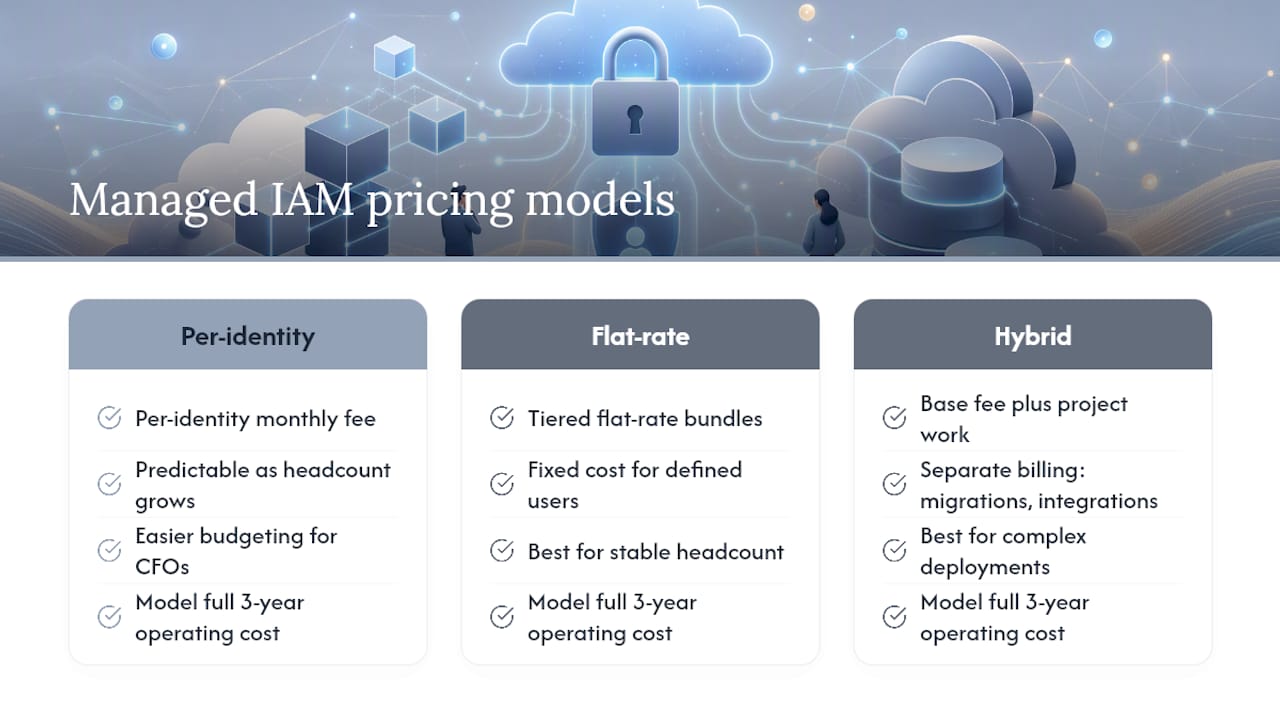
Managed IAM pricing generally follows one of three models: per-identity monthly fees, tiered flat-rate bundles based on user count and feature scope, or hybrid contracts combining a base platform fee with project work for migrations and integrations. Per-identity pricing scales predictably as headcount grows, which makes budgeting easier for CFOs, while flat-rate bundles suit organizations with stable headcount and a defined application list.
The real cost comparison isn't the monthly invoice against a competitor's monthly invoice. It's the monthly invoice against what an in-house build actually costs once you count engineering salaries, ongoing platform maintenance, and compliance overhead. NHIMG's build-versus-buy guidance recommends modelling a full three-year operating cost before committing to either path, because custom builds routinely underestimate lifecycle processes like recertification and offboarding. Practitioner analysis on the build-versus-buy decision similarly finds that buying a mature platform or contracting managed services usually beats custom builds on long-term operating and governance cost, outside a small set of highly specialized use cases.
Ask any provider to break down what's included in the base fee versus billed separately: incident response beyond a defined threshold, new application onboarding, and audit support during a compliance renewal are common places where costs creep. A transparent provider will show you that breakdown before you sign, not after your first invoice.
Detailed implementation timeline from contract signing to full operational status
Expect a realistic managed IAM rollout to run 8 to 16 weeks from signature to steady-state operation, depending on how many applications and directories are in scope. The first two to three weeks cover discovery: inventorying applications, privileged accounts, and existing directory structures so the provider knows exactly what they're inheriting.

Weeks three through six typically cover pilot integration, connecting a first wave of applications and validating that provisioning and deprovisioning actually work end to end before expanding further. Roll-out across the remaining application estate generally takes another four to six weeks, with cutover scheduled around low-risk maintenance windows rather than during a compliance audit or a major product launch.
By week 12 to 16, most engagements reach steady-state operation: the provider is running daily monitoring, the helpdesk is live, and the first access certification cycle has been scheduled. The first quarterly business review usually lands here, giving both sides a documented checkpoint on KPIs like provisioning time and password-reset SLA performance. Organizations with complex multi-cloud estates or heavy legacy integration debt should plan toward the longer end of that window. Anyone promising full production cutover in two weeks for an enterprise-scale environment is either overselling the timeline or underscoping the work.
Why the "quick fix" mentality on IAM keeps backfiring
Most IT leaders treat IAM procurement like buying software: compare feature lists, pick the cheapest tier, sign. That approach consistently underestimates what actually breaks identity programs, which is lifecycle debt, not missing features. A platform with every checkbox ticked still fails if nobody owns quarterly access recertification six months after go-live.
The conventional advice to "start small and expand later" sounds sensible but often just defers the hardest problems. Non-human identities, service accounts, and API keys are the clearest example. They're rarely part of the initial scoping conversation, and by the time someone notices they're ungoverned, dozens of unmonitored credentials have accumulated across your cloud estate.
What should actually drive the decision is a three-year operating cost model, not a first-year invoice comparison. Run that math honestly and the case for a managed provider over an in-house build gets a lot stronger for most organizations, not just resource-constrained ones. Prioritize a provider who can show you their non-human identity governance process in the first sales call. If they can't, that gap will surface eventually, usually during an audit.
Why Nexus is worth a conversation for managed IAM
AccountNext-Nexus consolidates identity governance, PAM, SSO, and 24/7 monitoring under one contract instead of leaving you to stitch together separate vendors for each piece. That single-point consolidation is the practical difference from patching together point solutions: one SLA, one helpdesk, one team accountable for the whole identity stack.
Every engagement runs on documented onboarding playbooks, quarterly business reviews, and reporting against KPIs like provisioning time and access certification completion, backed by compliance assessments for SOC 2, HIPAA, PCI-DSS, and ISO 27001. Vendor coordination is handled directly by AccountNext-Nexus's team, so you're not the one chasing three different providers when an incident response needs to happen fast. Pricing is transparent from the first proposal, and staffing comes from seasoned IT professionals rather than a rotating support queue.
If your identity environment is fragmented across clouds or your team is stretched thin on 24/7 coverage, request a scoping call with AccountNext-Nexus's IT and cybersecurity team to map what a managed engagement would look like for your environment.
Frequently asked questions
Is a managed cloud identity access management startup approach cheaper than building in-house? Usually, once you account for the full three-year operating cost rather than just the first-year invoice. In-house builds routinely underestimate lifecycle processes like recertification and offboarding, which drives long-term cost higher than most teams expect.
What compliance attestations should a managed IAM provider hold? Look for SOC 2, ISO 27001, and HIPAA attestations relevant to your industry, along with documented evidence they can produce during an audit, not just a claim on their website.
How long does a managed IAM rollout typically take? Most engagements reach steady-state operation in 8 to 16 weeks from contract signing, depending on the number of applications and directories in scope.
What KPIs should I track once the service is live? Track password-reset resolution time, provisioning time for new hires, access certification completion rate, and mean time to resolution (MTTR) for security incidents.
Can a managed IAM provider handle non-human identities like service accounts? A capable provider should explicitly govern service accounts, API keys, and workload identities, not just human user accounts. Ask for this in writing before signing.