
To make your cloud infrastructure audit-ready for SOC 2, do three things first: define your scope (which systems touch customer data and which trust services criteria apply), automate evidence collection through your IaC and CI/CD pipelines, and assign a named owner, whether that is an in-house engineer, a virtual CISO, or a managed service. Everything else builds on those three decisions.
SOC 2 is voluntary in Canada, but more than 90% of B2B enterprise procurement processes require evidence of SOC 2 readiness before a deal closes. That commercial reality makes it the de facto standard for Canadian SaaS startups targeting mid-market or enterprise buyers. Alongside it, PIPEDA governs how you handle personal data for Canadian residents, and if you process data belonging to EU citizens, GDPR requires prompt breach notification when applicable, regardless of server location.
The three obligations that matter most at the early stage:
- SOC 2 (market-driven): evidence of SOC 2 readiness is required to close over 90% of enterprise B2B deals; Type I is achievable in 3–6 months; Type II requires 3–12 months of monitored evidence.
- PIPEDA (legal): applies to any personal information collected in the course of commercial activity in Canada; breach notification to the Office of the Privacy Commissioner is mandatory when there is a real risk of significant harm.
- GDPR / HIPAA / PCI-DSS (conditional): GDPR applies when you handle EU personal data; HIPAA when you process US health information; PCI-DSS when you store, process, or transmit payment card data.
Table of Contents
- What does a SOC 2 readiness checklist look like for startups?
- How long does SOC 2 readiness actually take?
- Which core cloud controls should you implement first?
- How do you automate compliance and stay audit-ready continuously?
- In-house, vCISO, or managed service: which model fits your startup?
- What evidence do auditors actually expect for SOC 2?
- Key takeaways
- What most startup compliance guides get wrong
- AccountNext-Nexus helps Canadian startups build and maintain cloud compliance
- Useful sources and next reads
What does a SOC 2 readiness checklist look like for startups?
Start narrow. The single most expensive mistake founders make is scoping too broadly on the first pass. Limit your initial scope to the systems that directly store, process, or transmit customer data.
1. Define scope and pick your trust services criteria
- Decide between Type I (point-in-time design assessment) and Type II (3–12 months of operating effectiveness). Most enterprise buyers accept Type I to unblock a deal, then expect Type II within about a year.
- Identify which trust services criteria apply: Security (CC series) is mandatory; Availability, Confidentiality, Processing Integrity, and Privacy are optional and add audit cost.
- Document the boundary: which cloud accounts (AWS, Microsoft Azure, Google Cloud Platform), services, data stores, and third-party integrations are in scope.
2. Inventory your environment
- List all cloud accounts and projects (AWS accounts, Azure subscriptions, GCP projects).
- Catalogue IaC repositories, service principals, API keys, and data stores that touch in-scope systems.
- Map data flows: where customer data enters, where it rests, and where it exits. The shared responsibility model means your cloud provider secures the underlying infrastructure; configuration, access control, and data protection are yours.
3. Prioritise core controls in the first 30–90 days
- Identity and access management (IAM): least privilege, MFA for privileged accounts, access reviews.
- Encryption at rest and in transit across all in-scope data stores and APIs.
- Centralised logging with immutable retention.
- Automated backups with documented restore tests.
- Secrets management: no hardcoded credentials in repos or container images.
- Network segmentation: VPC/subnet design, security group rules, private endpoints.
4. Automate evidence collection
- Enforce IaC policy-as-code (pre-apply checks in CI) and post-deploy drift detection.
- Export configuration snapshots, access logs, and policy evaluation histories to immutable storage automatically.
- Collect PR approvals and change records as part of your normal CI/CD workflow.
5. Assign ownership
- Name a single owner for compliance: an in-house security engineer, a virtual CISO (vCISO), or a managed service provider.
- Schedule quarterly access reviews and document them.
- Run employee security awareness training and record completion.
How long does SOC 2 readiness actually take?
The phases below reflect typical durations for a Seed-to-Series A SaaS startup. Scope complexity, engineering capacity, and how much is already automated will shift these windows.
| Phase | Typical Duration | Primary Owner |
|---|---|---|
| Assessment and gap analysis typically takes a few weeks | vCISO / managed service | |
| Remediation sprint (core controls) can span several weeks | Engineering + security lead | |
| Evidence automation and Type I audit usually take one to two months | Engineering + auditor | |
| Type II monitoring cycle generally requires several months of evidence collection | Managed service / in-house | |
| Penetration test and third-party scans are typically conducted annually and take a short period | External vendor |
Cost buckets to plan for:
- Engineering hours: the largest variable cost; automation investment here pays back during every subsequent audit.
- Tooling: continuous monitoring, CSPM/CNAPP platforms, IaC static analysis, and SIEM.
- External audit fees: Type I audits typically run lower than Type II; fees vary by auditor and scope.
- vCISO or managed service retainer: often more cost-effective than a full-time hire at Seed stage.
- Penetration testing: annual or on major releases; pen testing evidence is a standard auditor expectation for startups targeting regulated sectors.
Stage-based guidance:
At Seed, keep scope minimal: Security criteria only, core controls automated, and a vCISO on a short retainer for the assessment phase. Pre-Series A, broaden scope to include Availability and Confidentiality if your buyers require it, formalise evidence collection, and begin the Type II monitoring window. By Series A, you need a Type II baseline in hand; enterprise buyers will ask for it during due diligence, and aligning your cybersecurity maturity with your funding stage avoids expensive retrofits.
Which core cloud controls should you implement first?
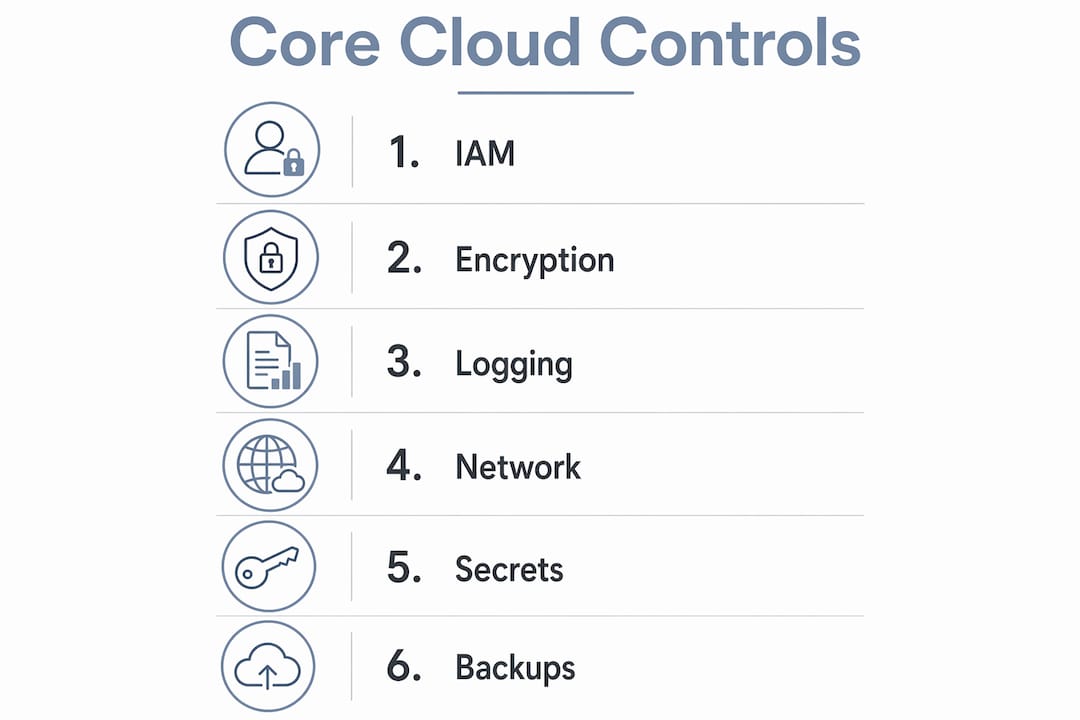
Identity and access management
Least privilege is the baseline. Every service principal, IAM role (AWS), Azure AD managed identity, or GCP IAM binding should have only the permissions it needs for its specific task. Short-lived credentials are preferable to long-lived API keys. MFA is mandatory for any account with privileged access to production. Run access reviews quarterly and document them; auditors will ask for the records.

Encryption
Enforce encryption at rest for all in-scope data stores and encryption in transit (TLS 1.2 minimum, TLS 1.3 preferred) for all API traffic. Manage keys through your cloud provider's KMS or an HSM pattern, set rotation policies, and log every key access event. Key access logs map directly to SOC 2 CC6 evidence.
Logging and monitoring
Centralised logs are non-negotiable. Route cloud provider logs (AWS CloudTrail, Azure Monitor, GCP Cloud Audit Logs) to immutable object storage with a documented retention period. Alerts on privileged access changes, policy violations, and unusual API call patterns give you the real-time detection auditors expect. The role of logging in cloud security goes well beyond compliance; it is your primary forensic record after an incident.

Network controls
Design VPCs and subnets to isolate production from development. Restrict security group rules to the minimum required ports and sources. Use private endpoints for data services wherever possible. For microservices, zero-trust patterns (mutual TLS, service mesh policies) reduce lateral movement risk.
Secrets management
Use a dedicated vault (cloud-native or third-party) for all secrets, API keys, and certificates. Scan IaC repos and container images for hardcoded credentials as part of every CI run. A single leaked secret in a public repo can invalidate months of compliance work.
Backups and recovery
Automate backup schedules for all in-scope data stores, test restores on a documented cadence, and retain logs of both the backup runs and the restore tests. Recovery time and recovery point objectives should be written into your policy and verified, not just stated.
Pro Tip: Map each control to a SOC 2 control objective before you build it. For example, IAM change logs satisfy CC6.1 (logical access) and CC7.2 (monitoring) evidence requirements. Doing this mapping upfront means your engineers build the right log format and retention period the first time, rather than retrofitting evidence after the auditor asks for it.
How do you automate compliance and stay audit-ready continuously?
Continuous monitoring is the difference between an audit that takes two weeks and one that takes two months. When evidence is collected automatically, auditors get reproducible, timestamped artefacts instead of screenshots assembled under deadline pressure.
Automation patterns that matter:
- Shift-left IaC policy enforcement: run policy-as-code checks (tools like Open Policy Agent or Checkov) before a Terraform or OpenTofu plan is applied. Block non-compliant changes at the pull-request stage.
- Post-deploy drift detection: continuously compare live cloud state against IaC-declared state; alert on any divergence. Misconfigured cloud resources are the leading cause of cloud breaches, and drift is how misconfigurations accumulate silently.
- Automated evidence export: link CI/CD run IDs to change records, store signed logs in immutable storage, and export policy evaluation histories on a schedule your auditor can verify.
- Incident response integration: wire your monitoring alerts into a documented incident response workflow so every triggered alert has a recorded response action.
The table below maps automation patterns to practical outcomes for a lean startup team.
| Automation pattern | Detection speed | Engineering effort to integrate | Evidence completeness | Best stage to adopt |
|---|---|---|---|---|
| IaC policy-as-code (pre-apply) | Immediate (pre-deploy) | Low–Medium | High (PR-linked) | Seed |
| Post-deploy drift detection | Near real-time | Low | Medium | Seed |
| CSPM continuous scanning | Near real-time | Low | High | Seed–Pre-A |
| CI/CD evidence automation | Per pipeline run | Medium | Very high | Pre-A |
| SIEM / log correlation | Minutes | Medium–High | High | Series A |
| CNAPP (unified posture + vuln) | Near real-time | Medium | Very high | Series A |
Tool categories explained:
- CSPM (Cloud Security Posture Management): continuously scans for misconfigurations and policy violations across AWS, Azure, and GCP. Good entry point for Seed-stage teams.
- CNAPP (Cloud-Native Application Protection Platform): combines posture management, vulnerability scanning, identity context, and compliance workflows. Worth the investment at Series A when scope broadens.
- IaC static analysis: catches policy violations before infrastructure is provisioned.
- SIEM / log analysis: correlates events across sources to reduce noise; correlated findings with confidence scoring give lean teams action-ready items rather than alert floods.
For startups evaluating tooling categories, a compliance management software comparison can help narrow the field before committing to a platform. Cloud provider-native features (AWS Config rules, Azure Policy, GCP Organisation Policy) cover a meaningful portion of CSPM needs at no additional licence cost and are a practical starting point before adding a dedicated platform.
In-house, vCISO, or managed service: which model fits your startup?
The right engagement model depends on four variables: engineering capacity, time pressure to close enterprise deals, internal risk tolerance, and budget. Here is a stepwise decision flow:
- Do you have an engineer who can own security full-time? If yes, and your runway supports a senior security hire, an in-house engineer makes sense at Series A and beyond. If no, continue.
- Is your audit timeline under six months? If yes, a vCISO or fractional security lead on a fixed-scope retainer is the fastest path to Type I. They bring audit experience, policy templates, and auditor relationships you would otherwise spend months building.
- Do you need 24/7 monitoring and incident response coverage? If yes, a managed service provides better coverage than a fractional hire who is not on-call. A single SLA covering monitoring, incident response, and compliance evidence simplifies vendor risk documentation for enterprise buyers.
- Is your team managing more than three discrete security tools? If yes, consolidating under a managed provider typically reduces administrative overhead versus self-managing point tools. A unified SLA also gives enterprise procurement teams a cleaner vendor risk answer.
What to expect from a vCISO or managed provider:
- Documented SLA covering detection, response, and escalation times.
- Evidence automation: automated export of logs, configuration snapshots, and policy evaluations in auditor-ready format.
- Incident response runbooks and breach notification procedures (including PIPEDA and GDPR timelines).
- Audit support: direct engagement with your SOC 2 auditor to answer evidence questions.
- Quarterly access reviews and policy update cycles.
For Canadian startups, cloud security governance under a managed model also means your provider should be familiar with PIPEDA obligations and Canadian data residency considerations, not just US-centric frameworks.
Contracting advice: structure the engagement as a short assessment retainer (4–6 weeks, fixed fee) followed by a fixed-scope remediation phase, then a recurring monitoring agreement. Avoid open-ended hourly consulting for compliance work; the scope creep is predictable and expensive.
What evidence do auditors actually expect for SOC 2?
Auditors do not want screenshots. They want reproducible, timestamped artefacts with clear ownership and an unbroken chain from the control to the evidence. Here is the minimum artifact set:
- System inventory: documented list of in-scope systems, services, and data stores with owners.
- Access logs: who accessed what, when, from where; exported from cloud provider audit logs to immutable storage.
- Change logs and PR history: IaC repository commit history, approved pull requests, and CI/CD run IDs linked to each change.
- Configuration baselines: point-in-time and continuous snapshots of security group rules, IAM policies, and encryption settings.
- Backup logs and restore proofs: automated backup run records and documented restore test results with timestamps.
- Vulnerability scan results: CSPM findings history and penetration test reports (annual minimum).
- Incident response records: every triggered alert, the response action taken, and closure timestamp.
- Policy documents: information security policy, access control policy, incident response plan, and business continuity plan, all version-controlled.
- Employee training records: completion logs for security awareness training.
Type I vs Type II requirements:
Type I requires evidence that controls are designed and in place at a point in time. Type II requires evidence that controls operated effectively over the monitoring period (typically 3–12 months). The practical difference is that Type II demands continuous log exports, recurring access review records, and a history of drift detection alerts with documented responses, not just a snapshot.
Auditors commonly expect log retention of 12 months for Type II. Store logs in write-once object storage (S3 Object Lock, Azure Immutable Blob Storage, or GCP Bucket Lock) and hash them on ingestion so integrity is provable.
Pro Tip: Build an auditor evidence package as a scheduled CI job: export access logs, policy evaluation histories, and configuration snapshots to a dedicated audit bucket on a weekly cadence. When your auditor requests evidence for a specific date range, you send a folder link, not a week of manual exports.
Key takeaways
Startup cloud compliance comes down to three decisions made early: narrow the scope to what actually touches customer data, automate evidence collection so audits do not require rescue missions, and assign a single owner who is accountable for both controls and documentation.
| Point | Details |
|---|---|
| Scope it narrow first | Limit initial SOC 2 scope to systems that directly touch customer data; add trust services criteria only when buyers require them. |
| Automate evidence from day one | Embed IaC policy checks and log exports in CI/CD so auditor artefacts are produced continuously, not assembled under deadline. |
| Match the model to your stage | At Seed, a vCISO retainer beats a full-time hire; at Series A, 24/7 managed coverage supports enterprise deal requirements. |
| PIPEDA applies regardless of SOC 2 | Canadian startups must meet PIPEDA breach notification obligations independently of any voluntary compliance framework. |
| AccountNext-Nexus covers the full cycle | AccountNext-Nexus delivers assessment, remediation, evidence automation, and 24/7 monitoring under one SLA for Canadian startups. |
What most startup compliance guides get wrong
The standard advice is to "start with SOC 2 early." That is correct but incomplete. The part most guides skip is that SOC 2 scope is an engineering decision before it is a compliance decision. Founders who hand the project to a compliance consultant without first involving their platform engineers end up with a scope that includes every cloud service the company has ever touched, a remediation list that takes a year to clear, and an audit bill that reflects the complexity they created.
The higher-leverage move is to treat scope reduction as a first-class engineering task. Before any consultant draws a boundary, your engineers should map which services actually process customer data, which ones could be excluded by architectural change (moving a logging pipeline outside the production VPC, for example), and which third-party integrations are genuinely necessary in scope. A narrower scope is not a shortcut; it is a deliberate design choice that makes every subsequent phase faster and cheaper.
The second thing guides understate is the cost of late evidence gathering. Auditors prefer reproducible, machine-exported artefacts. When a startup arrives at audit time with six months of screenshots and manually assembled spreadsheets, the auditor's questions multiply because the evidence chain is broken. The fix is not a better spreadsheet template; it is wiring evidence export into the CI/CD pipeline from the first sprint of remediation work. That investment pays back on every audit cycle, not just the first one.
Finally, the managed-service versus in-house debate is usually framed as a cost question. It is actually a coverage question. A vCISO working 10 hours a week cannot respond to a 2 AM incident. A managed provider with a documented SLA can. For Canadian startups handling personal data under PIPEDA, the breach notification obligation does not pause for business hours.
AccountNext-Nexus helps Canadian startups build and maintain cloud compliance
Closing enterprise deals in Canada means arriving at procurement with SOC 2 evidence in hand, PIPEDA obligations documented, and a monitoring SLA your buyer's security team can review. AccountNext-Nexus delivers exactly that, without requiring you to hire a full security team or manage a stack of disconnected tools.
The engagement follows a clear sequence: an assessment that maps your current cloud controls against SOC 2 trust services criteria and PIPEDA requirements, a remediation sprint that closes the critical gaps, evidence automation wired into your IaC and CI/CD pipelines, and then continuous 24/7 monitoring with incident response under a single SLA. Audit support is included, meaning AccountNext-Nexus works directly with your SOC 2 auditor to answer evidence requests and reduce back-and-forth.
For Canadian startups, the practical advantage is jurisdiction-specific experience. AccountNext-Nexus practitioners understand PIPEDA breach notification obligations, Canadian data residency considerations, and the compliance expectations of Canadian enterprise buyers, not just US-centric frameworks. One vendor, one SLA, and no coordination overhead between your monitoring provider and your compliance consultant.
To get started, request a compliance assessment or visit AccountNext-Nexus to schedule a discovery call.
Useful sources and next reads
Standards and authoritative guidance:
- CPA Canada SOC 2 guide: the primary Canadian reference for SOC 2 scope, trust services criteria, and audit requirements.
- AWS shared responsibility model: defines the provider/customer boundary for configuration, data protection, and access controls on AWS.
- Cloud Security Alliance: Cloud Security for SaaS Startups: phase-aligned security guidance for SaaS founders and CTOs, covering architecture, governance, and incident response.
- PCI Security Standards Council: authoritative source for PCI-DSS requirements if your startup handles payment card data.
- ISO 27001: the international information security management standard; relevant when enterprise buyers or regulated sectors require it alongside SOC 2.
- Office of the Privacy Commissioner of Canada: primary source for PIPEDA obligations and breach notification requirements.
AccountNext-Nexus blog reads that map to sections above:
| Article | Relevant section |
|---|---|
| Why misconfigured cloud causes breaches | Core controls, automation |
| Cloud security shared responsibility | Checklist, core controls |
| Role of logging in cloud security | Evidence, core controls |
| Role of penetration testing in startups | Timeline, evidence |
| Cybersecurity maturity model | Timeline, who should own it |
| Enterprise cloud security governance types | Ownership model, governance |
This article provides general information about cloud compliance for startups and does not constitute legal, regulatory, or professional compliance advice. Confirm current PIPEDA obligations, SOC 2 audit requirements, and any applicable regulatory thresholds with a qualified professional for your specific situation.