
Managed detection and response (MDR) is the process through which enterprises outsource continuous cybersecurity monitoring and threat response to specialised external providers. The reason why enterprises adopt managed detection is straightforward: internal security teams cannot keep pace with the speed, volume, and sophistication of modern cyberattacks alone. The MDR market is projected to grow from $6.22 billion in 2026 to $19.01 billion by 2031 at a compound annual growth rate of 24.8%. That trajectory reflects genuine enterprise demand, not vendor hype. Regulations like DORA and NIS2, a global shortage of skilled security staff, and the explosion of hybrid cloud environments are all accelerating managed detection services adoption at a pace that shows no sign of slowing.
What market and security challenges drive enterprises to adopt managed detection?
The cybersecurity threat environment has changed faster than most internal security operations centres (SOCs) can adapt. Attackers now exploit vulnerabilities within minutes of discovery, while the average enterprise SOC is buried under thousands of alerts per day. Traditional monitoring tools generate noise without context, and analysts spend more time triaging false positives than investigating real threats.
Three structural pressures are pushing enterprises toward MDR:
- Talent shortages. The global cybersecurity workforce gap remains severe. Enterprises cannot hire, train, and retain enough qualified analysts to staff a 24/7 SOC at the level modern threats demand. This shortage is one of the primary reasons enterprises choose managed detection over building internal capability.
- Attack sophistication. Ransomware, supply chain compromises, and nation-state intrusions have all increased in frequency and complexity. Attackers use automation and AI to move laterally through networks faster than human analysts can respond without dedicated tooling.
- Hybrid cloud complexity. The expansion of multi-cloud and hybrid infrastructure creates new attack surfaces that traditional perimeter-based security cannot cover. Hybrid cloud growth intensifies demand for MDR services that monitor across distributed environments simultaneously.
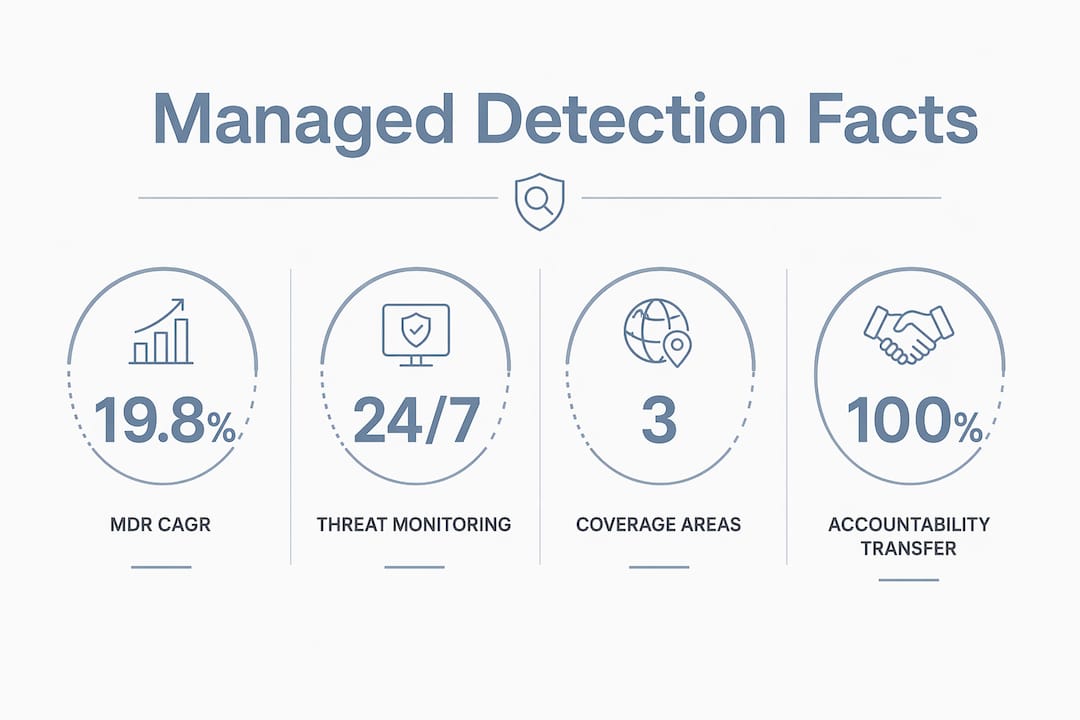
The MDR market's projected CAGR of 19.8% toward 2030 reflects how broadly enterprises recognise these pressures. That growth rate is not driven by marketing spend. It is driven by IT decision-makers who have run the numbers and concluded that outsourcing detection and response is the only viable path forward.
Pro Tip: Before evaluating MDR providers, document your current mean time to detect (MTTD) and mean time to respond (MTTR). These two metrics give you a concrete baseline for measuring provider performance after onboarding.

How do AI and automation enhance managed detection and response capabilities?
AI is not a feature in modern MDR. It is the operational backbone. AI-driven cybersecurity operations are 50% more effective at threat response than those relying on legacy methods. That gap is wide enough to determine whether a breach gets contained in minutes or spirals into a multi-day incident.
The specific capabilities AI brings to MDR include:
- Automated alert triage. AI filters and prioritises alerts at machine speed, so human analysts focus only on confirmed threats rather than sorting through thousands of low-confidence signals.
- Behavioural analysis. Machine learning models establish baselines for normal user and system behaviour, then flag deviations that rule-based systems miss entirely.
- Agentic AI augmentation. 39% of organisations have adopted agentic AI for security operations. These systems act autonomously on defined playbooks, containing threats without waiting for human approval on routine responses.
- Continuous learning. AI models update based on new threat intelligence, meaning detection accuracy improves over time rather than degrading as attacker tactics evolve.
The split in how organisations use AI is telling. Large enterprises augment internal SOC analysts with AI-enabled MDR services, while mid-market firms outsource MDR responsibilities entirely to achieve full accountability transfer. Both models benefit from AI, but the operational model differs based on internal capacity and risk appetite.
Pro Tip: Ask any MDR provider to demonstrate how their AI handles a specific attack scenario relevant to your industry. A provider who cannot walk you through a live or simulated detection workflow is selling a concept, not a proven capability.
Understanding how cyber threats evolve helps you evaluate whether a provider's AI models are trained on current threat intelligence or outdated datasets.
What distinguishes endpoint, network, and cloud coverage in managed detection?
MDR is not a single technology. It is a coverage model that spans three distinct environments, each with its own detection logic and response requirements.
| Coverage area | What it monitors | Key security benefit |
|---|---|---|
| Endpoint | Devices, workstations, servers | Detects malware, lateral movement, and privilege escalation at the device level |
| Network | Traffic flows, DNS, east-west movement | Identifies command-and-control activity and data exfiltration in transit |
| Cloud | Cloud workloads, APIs, identity layers | Secures multi-cloud infrastructure and detects misconfiguration exploitation |
Cloud and hybrid infrastructure growth demands MDR services that secure all three environments uniformly. Gaps between endpoint and cloud coverage are where attackers operate most effectively. A breach that starts on a compromised endpoint often pivots to cloud workloads within hours.
Integration with extended detection and response (XDR) platforms and security information and event management (SIEM) tools is what makes unified coverage possible. XDR correlates signals across endpoints, networks, and cloud layers into a single investigation timeline. SIEM aggregates log data for compliance reporting and forensic analysis. MDR providers that integrate with both eliminate the blind spots that fragmented, point-solution security creates.
Understanding your cloud security posture before engaging an MDR provider helps you identify which coverage gaps are most urgent and which environments carry the highest business risk.
Why is accountability transfer a key benefit of managed detection services?
Accountability transfer is the defining characteristic that separates MDR from traditional managed security services (MSSS). In a standard MSSS arrangement, the provider monitors and alerts. The enterprise still owns the response. In MDR, the provider contractually assumes operational risk and reputational responsibility for detection and response outcomes.
MDR providers contractually assume this operational risk, which distinguishes accountability transfer from mere outsourcing. That distinction matters enormously to boards and legal teams. When a breach occurs, the question of who was responsible for detection and containment has a documented, contractual answer.
Mid-market enterprises value this model most directly. They lack the internal headcount to staff a 24/7 SOC and cannot absorb the reputational damage of a slow or failed response. Full accountability transfer gives them a credible, documented security posture without building it from scratch internally. Large enterprises, by contrast, often prefer a hybrid model where MDR augments an existing internal SOC rather than replacing it entirely.
The nuance worth understanding is that accountability transfer does not mean loss of control. Escalation pathways and decision authority remain with the enterprise for high-stakes actions. The provider handles detection, initial containment, and investigation. The enterprise retains authority over business-critical decisions like system shutdowns or public disclosure.
Pro Tip: Review the escalation matrix in any MDR contract before signing. Clarity on who decides what, and within what timeframe, is the difference between a provider that accelerates your response and one that creates bottlenecks at the worst possible moment.
How do regulatory requirements influence managed detection adoption decisions?
Regulatory compliance is no longer a secondary driver of MDR adoption. For many enterprises, it is the primary one. Regulations like DORA and NIS2 increase the need for documented continuous security monitoring, making MDR partnerships vital for audit readiness.
The compliance case for MDR rests on four specific requirements:
- Continuous monitoring documentation. DORA and NIS2 require enterprises to demonstrate ongoing threat monitoring, not just periodic assessments. MDR providers generate the logs, reports, and audit trails that satisfy these requirements automatically.
- Incident response timelines. Both frameworks mandate defined response times for security incidents. MDR providers contractually commit to response windows that align with regulatory thresholds, giving enterprises a defensible position during audits.
- Third-party risk management. Regulators increasingly scrutinise how enterprises manage security across their supply chains. MDR providers with established compliance frameworks help enterprises demonstrate due diligence beyond their own perimeter.
- Cost efficiency versus internal builds. Strategic MDR partnerships deliver faster and cheaper regulatory adherence than building equivalent internal capabilities. The cost of hiring, tooling, and maintaining a compliance-grade internal SOC far exceeds the cost of a well-structured MDR contract.
The shift toward MDR adoption is increasingly driven by regulatory mandates requiring continuous security monitoring and documented compliance, not just security preferences. Enterprises that treat MDR purely as a security investment are undervaluing what it delivers on the compliance side.
Key takeaways
Enterprises adopt managed detection because internal teams cannot achieve the continuous coverage, regulatory documentation, and rapid response that modern threats and compliance frameworks demand.
| Point | Details |
|---|---|
| MDR market growth | The MDR market grows at 24.8% annually, reflecting genuine enterprise demand driven by cyber complexity and talent shortages. |
| AI effectiveness | AI-driven operations are 50% more effective at threat response, making AI integration a non-negotiable MDR requirement. |
| Accountability transfer | MDR providers contractually assume operational risk, giving enterprises legal assurance and a documented security posture. |
| Regulatory compliance | DORA and NIS2 mandate continuous monitoring and audit-ready reporting, which MDR partnerships deliver more cost-effectively than internal builds. |
| Coverage scope | Effective MDR spans endpoints, networks, and cloud environments, eliminating the blind spots that point-solution security creates. |
What I've learned watching enterprises adopt MDR at scale
The enterprises that get the most from MDR are not the ones with the biggest budgets. They are the ones that treat the provider relationship as a genuine partnership rather than a vendor transaction. I have watched organisations sign MDR contracts and then fail to share internal threat intelligence with their provider, refuse to participate in tabletop exercises, and ignore escalation recommendations during live incidents. The technology works. The relationship has to work too.
The accountability transfer concept is where I see the most confusion. Executives hear "accountability transfer" and assume it means they are off the hook. It does not work that way. What transfers is the operational burden and the contractual responsibility for detection and response quality. Strategic decisions, public communications, and business continuity choices remain with the enterprise. The clearer that boundary is at contract stage, the better the relationship functions under pressure.
My advice to IT decision-makers evaluating MDR in 2026 is to weight regulatory alignment heavily in your provider assessment. The DORA and NIS2 compliance requirements are not going away, and the cost of building audit-ready internal capabilities is prohibitive for most organisations. A provider that can demonstrate how their service maps directly to your specific regulatory obligations is worth significantly more than one offering generic 24/7 monitoring. Ask for a compliance mapping document before you sign anything.
— Nick - Sr. Executive
AccountNext-Nexus: 24/7 managed detection for enterprise security teams
AccountNext-Nexus delivers continuous threat monitoring, expert-led detection, and rapid incident response through a fully managed SOC built for enterprise environments.
AccountNext-Nexus aligns its managed detection services directly with DORA, NIS2, and other regulatory frameworks, providing the audit-ready documentation your compliance team needs without the overhead of building it internally. Every client gets access to seasoned security professionals, real-time threat intelligence, and a service model that scales with your environment. Whether you are managing a hybrid cloud infrastructure or securing dispersed endpoints across multiple regions, AccountNext-Nexus consolidates detection and response under one accountable provider. Learn more about how AccountNext-Nexus protects enterprises around the clock.
FAQ
What is managed detection and response (MDR)?
MDR is a fully managed cybersecurity service where an external provider handles continuous threat monitoring, detection, and incident response on behalf of an enterprise. It differs from traditional managed security services by including active threat hunting and contractual accountability for response outcomes.
Why do enterprises choose managed detection over building an internal SOC?
Enterprises choose managed detection because the cost and complexity of staffing a 24/7 internal SOC exceeds what most organisations can sustain. MDR provides equivalent or superior coverage at lower cost, with faster time to operational maturity.
How does MDR support regulatory compliance with DORA and NIS2?
MDR providers generate the continuous monitoring logs, incident reports, and audit trails that DORA and NIS2 require. This makes MDR a direct compliance tool, not just a security investment.
What is accountability transfer in managed detection?
Accountability transfer is the contractual shift of operational risk and reputational responsibility for threat detection and response from the enterprise to the MDR provider. It gives enterprises legal assurance and a documented security posture without requiring full internal capability.
How does AI improve managed detection and response?
AI automates alert triage, detects behavioural anomalies, and enables agentic response on routine threats. Organisations using AI-driven security operations are 50% more effective at threat response than those using legacy methods.