
An incident response retainer is a prepaid contract with a digital forensics and incident response (DFIR) firm that guarantees priority access to expert responders before a breach ever happens. It buys speed: analysts who already know your environment, contracted response times measured in hours instead of days, and hourly rates locked in well below emergency pricing. It is not insurance. It is the technical muscle that gets deployed when insurance starts asking what actually happened.
TL;DR:
- A well-structured incident response retainer includes 24/7 escalation protocols, real-time forensic tools pre-authorized, and clear scope coverage across cloud, on-prem, and third-party environments.
- Pricing models vary from prepaid hours, fixed access fees, to hybrid bundles, with top-tier plans offering proactive threat hunting and tighter response guarantees costing significantly more.
- SLAs should specify precise response times for acknowledgment, mobilization, active engagement, and on-site arrival, with activation procedures documented and environment inventories pre-authorized.
- Unused proactive hours should be convertible into additional services, and contracts must detail rate cards by role, out-of-hours multipliers, and renewal terms to maximize value.
- A retainer is most cost-effective for organizations holding sensitive or customer data, with key non-negotiables including tooling access, role-based pricing, and proactive work conversion clauses.
Table of Contents
- What does an incident response retainer actually include?
- How much does an incident response retainer cost?
- How do incident response SLAs actually work?
- How do you negotiate and choose a retainer provider?
- Getting value from a retainer before you ever need it
- How does Nexus put retainers into practice?
- When is a retainer worth signing, and what should never be negotiable?
- Getting a retainer set up with AccountNext-Nexus
- Sources
- FAQ
What does an incident response retainer actually include?
A retainer is a contract, not a hotline number pinned to a wall. The strongest ones spell out exactly what the provider owes you before, during, and after an incident, and Gartner's category research on DFIR retainer services identifies forensic evidence preservation, triage, and impact classification as baseline, non-negotiable features rather than premium add-ons.
A well-scoped retainer should give you:
- A 24/7 hotline with a named escalation path, not a generic support inbox.
- Guaranteed mobilization windows for both remote and on-site response.
- Digital forensics: memory capture, disk imaging, log analysis, malware reverse engineering.
- Containment guidance during the incident, not just a post-mortem report weeks later.
- A written incident report suitable for regulators, insurers, and your board.
- Proactive services bundled in, such as readiness assessments and tabletop exercises.
Beyond the service list, the contract language matters as much as the feature list. You want pre-authorization for specific investigative tools and access methods baked in ahead of time, because asking permission mid-breach is exactly the kind of delay a retainer is supposed to eliminate. You also want scope language that defines what "in scope" means: cloud environments, on-prem infrastructure, third-party SaaS, OT systems if you run any. A retainer that only covers your corporate network is not much use when the breach starts in a vendor's Azure tenant.
Ask for the contract to name specific deliverables, not vague categories. "Forensic analysis" is not a deliverable. "Root cause report within 5 business days of containment, memory and disk images preserved for 12 months" is a deliverable you can hold someone to.
How much does an incident response retainer cost?
Retainer pricing splits into three general structures, and picking the wrong one for your organization's size is the most common budgeting mistake procurement teams make.
Prepaid hours work like a bank account: you buy a block of analyst hours upfront, drawn down as needed, refilled or forfeited depending on the contract. Access fee retainers charge a fixed annual rate purely for guaranteed availability and priority response, with actual work billed hourly on top. Hybrid or subscription retainers combine a fixed fee with a bundle of included hours, which tends to suit organizations that want predictable proactive services layered onto emergency coverage. All three models show up consistently in how DFIR firms structure retainer agreements.
Typical 2026 pricing bands: Entry-level priority slots run $5,000 to $15,000 a year, prepaid hour banks and boutique subscription retainers commonly land in a mid-market price range, and Tier 1 enterprise subscriptions with proactive threat hunting can reach high annual prices.
The gap between tiers is not just marketing markup. Cheaper retainers usually carry looser SLAs or narrower scope, while top-tier subscriptions bundle continuous threat hunting and tighter mobilization guarantees, according to pricing analysis from Decryption Digest. Pay attention to what you are actually buying at each price point, not just the sticker.
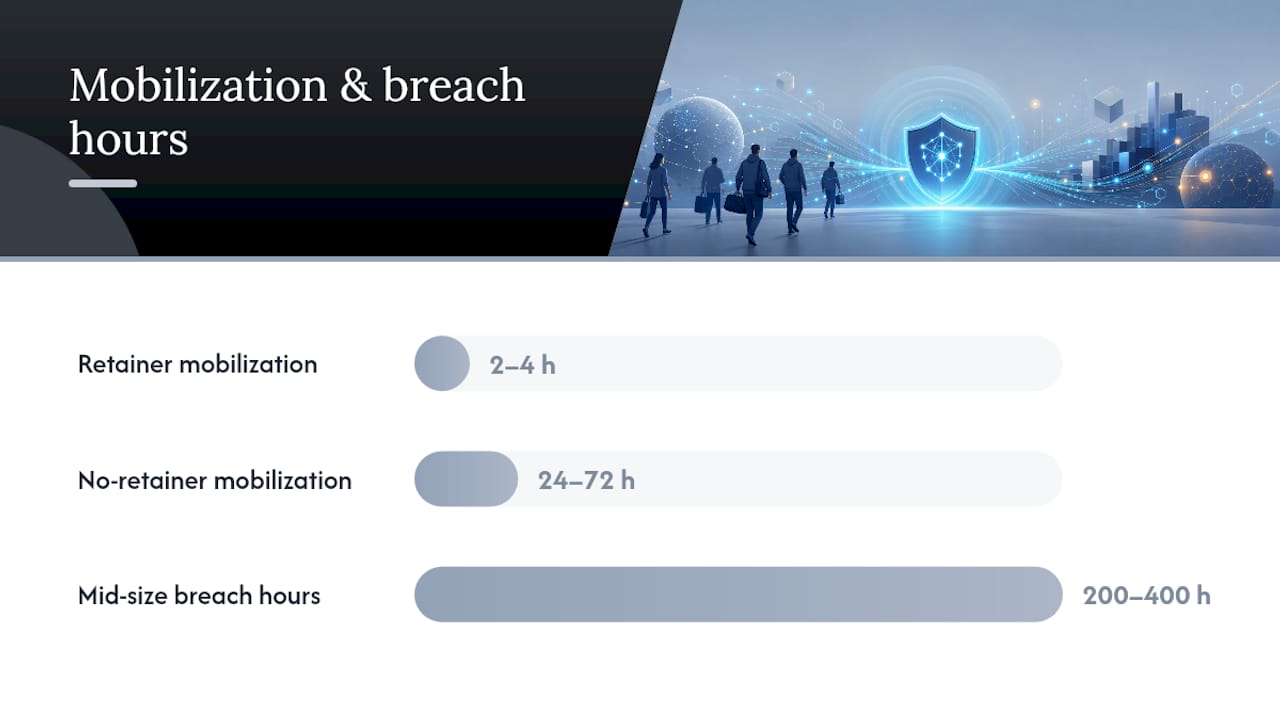
The real financial argument for a retainer shows up in the rate comparison. Retained hourly rates run well below what the same firm charges an organization with no existing contract, and emergency engagements without a retainer can cost 2 to 3 times more, with mobilization stretching to 24 to 72 hours instead of the 2 to 4 hours a retainer typically guarantees. On a mid-size breach running 200 to 400 billable hours, that rate differential alone can cover most of an annual retainer fee.
Watch for the billing details that erode the headline savings:
- Minimum billing increments (some firms bill in 4-hour blocks, even for a 45-minute call).
- Out-of-hours and weekend multipliers, often 1.5x to 2x standard rates.
- Travel time and expenses billed separately from response hours.
- What happens to unused prepaid hours at contract renewal.
How do incident response SLAs actually work?
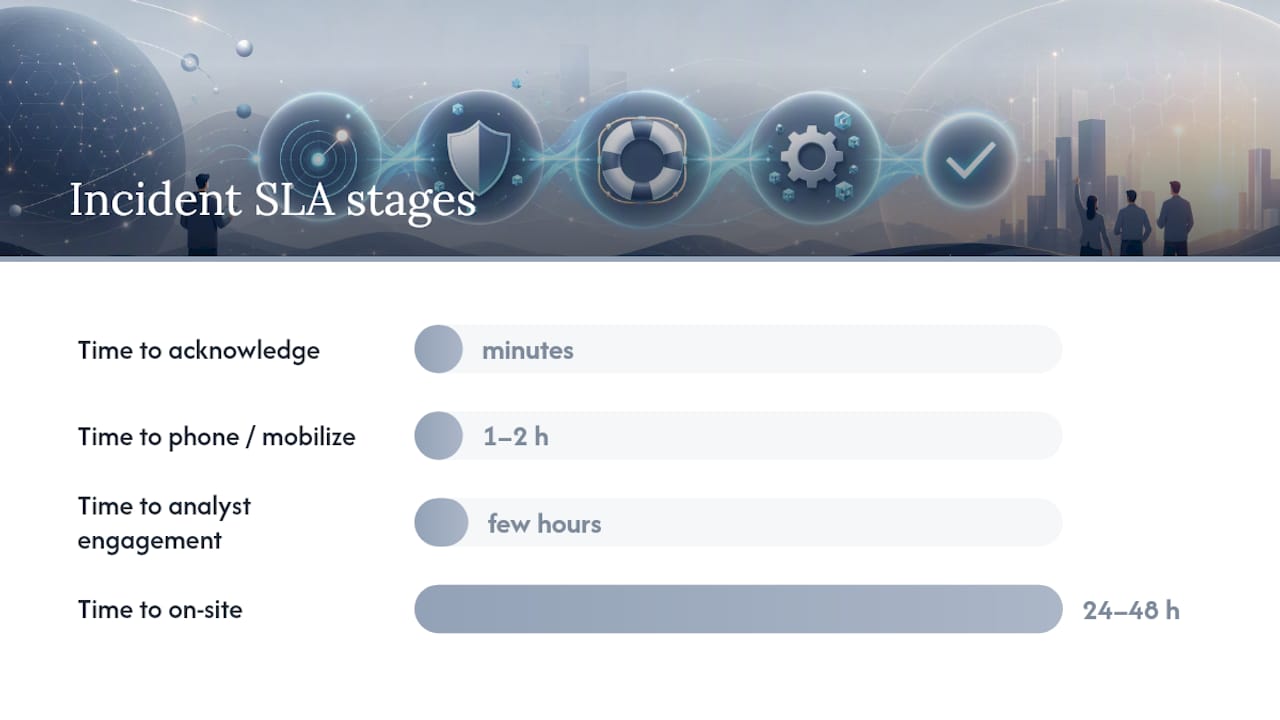
Vendor sales decks love the phrase "rapid response." Contracts need something more precise, because "rapid" means nothing in a dispute. Break the SLA into its component parts and get each one written down as a number, not an adjective.
- Time to acknowledge: how long before a human confirms receipt of your call. This should be minutes, not hours.
- Time to phone/mobilize: when a qualified analyst actually joins a call or bridge. Strong contracts commit to 1 to 2 hours for this step.
- Time to analyst engagement: when active investigative work begins, which may follow mobilization by a few additional hours depending on access requirements.
- Time to on-site: only relevant if physical presence matters (retail point-of-sale breaches, OT environments), typically 24 to 48 hours depending on geography.
Each of these needs its own clock in the contract, because a vendor who quotes "4-hour response" without defining which stage that covers is leaving themselves room to call a voicemail callback a "response."
Activation procedure matters just as much as the SLA numbers. The moment you suspect an incident, timestamp everything: the discovery time, the call to the provider, every subsequent action. Insurers and regulators will ask for this timeline later, and a fuzzy sequence of events weakens both your claim and your legal position.
Pro Tip: Get the provider to confirm in writing that your environment inventory, cloud org IDs, and pre-authorized tool list are stored somewhere accessible even if your primary systems are fully encrypted by ransomware. A retainer that depends on your own compromised network to activate is a retainer that fails you exactly when you need it.
Pre-authorizing investigative tools and handing over an inventory of domains, IP ranges, and critical systems ahead of time materially cuts mobilization delays once an incident actually starts.
How do you negotiate and choose a retainer provider?
Selecting a retainer is a procurement decision as much as a security one, and the people in the room matter. Bring your CISO or IT security lead, your legal counsel, and whoever owns the cyber insurance policy, because each will catch different problems in the same contract.
Start with insurer panel alignment. Many cyber insurers maintain approved DFIR firm lists and may require you to use a panel firm for the claim to be reimbursed, or at minimum to lead the investigation. Check this before signing anything. A retainer with a firm outside your insurer's panel can leave you paying for coverage that does not actually reduce your out-of-pocket cost during a claim. Our guide to meeting cyber insurance requirements covers the controls insurers typically audit before underwriting a policy in the first place.
Push for a detailed rate card broken out by role: junior analyst, senior forensic examiner, incident commander, malware reverse engineer. A flat "blended rate" hides which roles you are actually paying for. Confirm billing increments in writing (hourly, not daily), and get the out-of-hours multiplier stated as a specific number rather than "standard industry rates."
Before signing, run through this list:
- Is the firm on your cyber insurer's approved panel, or will your insurer accept them anyway?
- Are unused proactive hours convertible to other services, or do they simply expire?
- Does the rate card list per-role pricing, not a single blended figure?
- What is the exact out-of-hours and weekend multiplier?
- Who at your organization is authorized to activate the retainer, and is that list current?
Contract term and renewal deserve a specific question too: most retainers run 12-month terms with automatic renewal clauses, and unused prepaid hours often expire rather than roll over unless you negotiate otherwise. Ask explicitly.
Getting value from a retainer before you ever need it
The single biggest mistake buyers make is treating a retainer as a fire extinguisher: bought, forgotten, hoped never to be used. That wastes most of its value. Contract detail matters more than the headline cost, and unused capacity is where that value quietly disappears if the terms do not let you convert it into proactive work.
Onboarding is where the real groundwork happens. A proper onboarding process should produce a documented environment profile: network diagrams, critical asset lists, cloud tenant IDs, EDR deployment coverage, and an escalation contact tree. Store a copy of that profile outside your primary estate, in a secure portal or third-party vault, so it survives a full outage or ransomware encryption event.
From there, use the proactive hours instead of banking them:
- Tabletop exercises twice a year, walking your incident commander and IT leads through a realistic ransomware or business email compromise scenario.
- Readiness assessments annually, checking that your logging, backup isolation, and access controls still match what the retainer team assumed during onboarding.
- Purple-team engagements that pair your defensive team with the retainer's offensive testers to validate detection coverage.
- Threat hunting sprints focused on your specific industry's active threat actors.
A good cadence looks like one tabletop exercise every six months and a readiness assessment annually, with threat hunting scheduled around whatever your industry's threat intelligence flags as active. Our own ransomware tabletop exercise guide walks through how to structure one of these sessions with your team.
Pro Tip: Schedule your first tabletop exercise soon after signing the retainer, not whenever it's convenient. Waiting means the analyst who mobilizes during your first real incident is meeting your environment for the first time under pressure instead of having already walked through it once.
How does Nexus put retainers into practice?
A retainer only performs as promised if it is wired into your existing monitoring, not bolted on as a separate emergency phone number. AccountNext-Nexus builds retainer engagements around the same 24/7 threat detection telemetry that already watches a client's environment, so the retainer team is working from live data the moment an incident triggers, not starting cold.
Onboarding follows a consistent checklist:
- Full asset and cloud tenant inventory across AWS, Azure, and Google Cloud environments.
- Confirmation of EDR visibility and coverage gaps before any incident occurs.
- A tested escalation bridge with named contacts on both sides, refreshed quarterly.
- Pre-authorized access paths for investigative tooling, agreed and documented in advance.
Proactive credits get applied deliberately rather than left to expire. A readiness assessment that finds a logging gap before an attacker finds it is cheaper than discovering that same gap mid-breach, and that is the calculation behind every proactive engagement AccountNext-Nexus schedules with a retainer client. For readers building out the technical side of that visibility, our guide on how endpoint detection and response works explains the telemetry retainer teams actually rely on during an investigation.
When is a retainer worth signing, and what should never be negotiable?
A retainer earns its cost the moment your organization holds sensitive data, runs anything customer-facing, or falls under a compliance regime with breach notification deadlines. Below that threshold, a lighter on-call arrangement may cover you. Above it, the math from a single incident, at 2 to 3 times the emergency rate with mobilization stretched to days instead of hours, tends to settle the argument on its own.
What should never be negotiable: pre-authorized tooling access, a rate card broken out by role rather than a blended number, and explicit language on converting unused hours into proactive work. Everything else is a business decision your organization can size to its own risk tolerance.
If you are unsure where your organization sits on that spectrum, a readiness review is the honest starting point. It tells you what you are actually protecting before you decide how much protection to buy.
— Nick - Sr. Executive
Getting a retainer set up with AccountNext-Nexus
Incident response retainers are often built around a checklist including role-based rate cards, pre-authorized tooling, insurer panel alignment, and proactive hours that convert instead of expire. When monitoring, cloud management, and compliance work are consolidated under one contract, the retainer team can leverage existing knowledge of the environment when an incident occurs.
A readiness review is the practical next step. It walks through your current asset inventory, EDR coverage, and escalation contacts, then maps that against realistic SLA and pricing options before you commit to a term. If your team includes security analysts you're still staffing internally, resources like cybersecurity analyst recruitment can help fill the gaps a retainer doesn't cover on its own. Visit the Nexus IT and cybersecurity services page to request a readiness review and get a pricing conversation started for your organization's specific environment.
Sources
- Incident Response Retainer: DFIR Retainer Agreement Guide | IR-OS
- Incident Response Retainer Pricing 2026: Cost Models, Scoping, and Firm Selection
- Incidentcost
FAQ
What is an incident response retainer?
It's a prepaid contract with a DFIR firm guaranteeing priority access to incident responders at pre-negotiated rates, typically structured as prepaid hours, an access fee, or a hybrid subscription.
What is the difference between incident response and an incident response retainer?
Incident response is the actual work of containing and investigating a breach; a retainer is the contract that guarantees you priority access to that work at reduced, pre-negotiated rates instead of scrambling to find help during an active incident.
What are the stages of incident response?
Most frameworks group the work into preparation, detection and analysis, containment and eradication, and recovery, followed by a post-incident review; a retainer mainly accelerates the detection, containment, and analysis stages by having responders and access already in place.
What is the Microsoft incident response retainer?
Microsoft offers its own incident response retainer service tied to its security tooling and Defender ecosystem, structured similarly to other vendor retainers with prepaid engagement hours; specific terms and pricing are set directly by Microsoft rather than published as a standard industry rate.
How does a retainer interact with cyber insurance?
A retainer and a cyber insurance policy work together but serve different functions: the retainer provides the technical response team, while insurance covers financial loss, and many insurers require using a firm on their approved panel for claims to be reimbursed.