
Managed detection and response (MDR) is a 24/7 managed security service that combines telemetry, threat intelligence, and human analysts to detect, hunt, and contain cyberthreats before they become breaches. For decision-makers with lean IT teams, the core payoff is simple: you get SOC-grade monitoring and rapid containment without hiring, training, or staffing a security operations centre yourself.
TL;DR:
- Ensure the MDR provider covers all critical assets, including cloud workloads and identity systems, not just endpoints, to prevent blind spots.
- Verify how often the provider retunes detection rules based on your incident history, not just generic threat feeds.
- Confirm whether containment actions are autonomous or require client approval to avoid delays during active threats.
- Measure success by monitoring detection and response times, true positive rates, and incident volume trends over several months.
- Recognize that MDR works best as a continuous feedback process and is essential for organizations lacking sufficient staffing for 24/7 security coverage.
Table of Contents
- What is MDR security in practice?
- How does MDR work from alert to resolution?
- What technologies power an MDR service?
- MEDR, MNDR, and MXDR: which MDR type fits your environment?
- MDR vs EDR vs XDR vs MSSP: how do they actually differ?
- How do you choose and implement an MDR provider?
- What metrics prove MDR is actually working?
- Why the "set it and forget it" pitch on MDR is misleading
- How AccountNext-Nexus approaches managed detection and response
- Where to go for deeper MDR research
- Sources
What is MDR security in practice?
MDR pairs technology with trained people. It's not a piece of software you install and forget. It's a service built on three layers: continuous telemetry collection, automated detection logic, and a team of analysts who investigate what the automation flags and decide what to do about it.
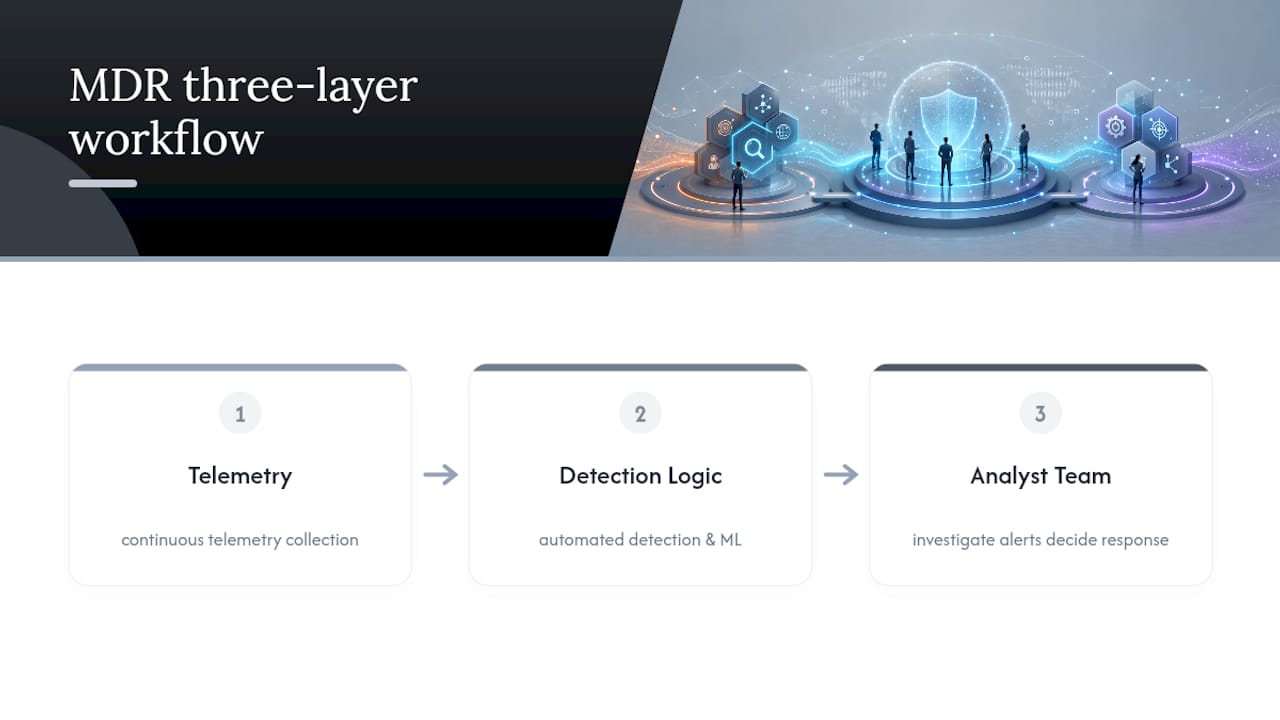
That combination matters because tools alone generate noise, and people alone can't watch everything at once. MDR providers continuously monitor an organisation's networks, endpoints and systems, combining automation, machine learning, and human analysts to catch threats that slip past static defences like traditional antivirus or a firewall rule set.
A typical MDR engagement runs on a security operations centre model, whether the provider staffs it directly or contracts specialists. The SOC watches your environment around the clock, correlates events from multiple sources, and escalates anything that looks like a real threat instead of another false alarm.
What's usually included in an MDR contract
Most MDR service agreements bundle a consistent set of capabilities, though depth varies by vendor and tier. Standard inclusions cover monitoring, threat hunting, containment, incident response, root cause analysis, and scheduled security health checks, delivered under a service level agreement rather than a one-off project.
Here's what that typically breaks down to in a contract:
- 24/7 monitoring of endpoints, network traffic, cloud workloads, and log sources for suspicious activity.
- Proactive threat hunting where analysts search for indicators of compromise that automated tools missed.
- Containment actions such as isolating a compromised endpoint or blocking malicious traffic, often within minutes of detection.
- Incident response support including guided or hands-on remediation when a real breach occurs.
- Root cause analysis after an incident to explain how attackers got in and what changed to prevent a repeat.
- Regular reporting covering detection volume, response times, and emerging risks specific to your industry.
Coverage extends across the assets that actually matter to attackers: laptops and servers, on-premises network segments, AWS, Azure, or Google Cloud workloads, identity systems, and the log data those systems generate. A provider that only watches endpoints and ignores cloud identity logs is offering a partial service dressed up as a full one, so scope is worth confirming line by line before signing anything.
How does MDR work from alert to resolution?
The operational flow behind MDR follows a repeatable lifecycle, and understanding it helps you set realistic expectations for what a provider should deliver on day one versus month six.
- Telemetry ingestion and normalisation. Data from endpoints, network sensors, cloud APIs, and identity providers gets pulled into a central platform and standardised so analysts can correlate events from different sources without manually translating formats.
- Continuous monitoring and alert prioritisation. Detection logic scores incoming events by severity and likely intent. This is where triage does its real work: providers prioritise events so the most critical incidents get immediate attention, cutting the analyst time wasted on false positives.
- Threat hunting and investigation. Analysts don't just wait for alerts. They actively search for patterns that automated rules wouldn't flag on their own, things like unusual lateral movement or a service account authenticating from an unexpected region.
- Containment and remediation. Once a threat is confirmed, the provider acts. That might mean automatically isolating a device, manually disabling a compromised account, or coordinating with your internal team on a broader remediation plan depending on the severity and your agreed response authority.
- Reporting and tuning. After the dust settles, the provider documents what happened, why detection worked (or didn't), and adjusts detection rules to reduce blind spots going forward.
That last step is where a lot of MDR relationships quietly fail. A provider that never revisits its own detection logic after an incident is running the same playbook indefinitely, even as your environment and the threat landscape change around it.
Pro Tip: Ask any MDR provider how often they retune detection rules based on your environment's own incident history, not just generic threat feeds. A provider that can't answer specifically is probably running a one-size-fits-all ruleset across every client.
What technologies power an MDR service?
MDR isn't a single product. It's an operating layer built on top of several distinct technologies, and knowing what each one contributes helps you evaluate whether a vendor's stack actually supports the service they're selling.
Endpoint detection and response (EDR) supplies the granular telemetry from laptops, servers, and workstations, process launches, file changes, network connections, that analysts need to spot malicious behaviour early. Without solid EDR telemetry, an MDR provider is working half-blind on the assets attackers target most often.
SIEM and XDR platforms add correlation and context. A SIEM aggregates logs from firewalls, identity providers, and applications; XDR goes further by correlating signals across endpoint, network, and cloud domains into a single detection timeline. MDR functions as the managed service, the people and process, while XDR is primarily the technology platform underneath it, and the strongest engagements use both together.
Threat intelligence and automation round out the stack. Feeds on known malicious IPs, malware signatures, and attacker tactics get enriched into detection logic automatically, while SOAR (security orchestration, automation, and response) tooling handles repetitive containment tasks so analysts spend their time on judgment calls, not clicking through the same isolation workflow for the hundredth time.
None of that replaces people. The SOC function, the human analysts and threat hunters reviewing what the technology surfaces, is what turns raw detections into a defensible response.
- EDR: endpoint-level visibility and behavioural detection
- SIEM/XDR: cross-domain correlation and event context
- Threat intelligence: enrichment against known attacker infrastructure and tactics
- SOAR: automated containment for common, low-risk actions
- Human analysts: judgment calls, escalation, and hunting beyond automated rules
The Gartner reviews of managed detection and response vendors point to fast, sustained growth in this category, a sign that more organisations are concluding tools alone can't keep pace with adversaries who automate their own attacks.
MEDR, MNDR, and MXDR: which MDR type fits your environment?
Not all MDR services cover the same ground, and the acronyms matter because they signal exactly what's being monitored.
- MEDR (Managed Endpoint Detection and Response) focuses narrowly on endpoints, laptops, servers, workstations. It suits organisations with a straightforward IT footprint and limited cloud exposure, but it leaves network and cloud blind spots uncovered.
- MNDR (Managed Network Detection and Response) centres on network traffic analysis, catching lateral movement and command-and-control activity that endpoint tools miss. It fits environments with significant on-premises infrastructure or complex internal network segmentation.
- MXDR (Managed Extended Detection and Response) combines endpoint, network, cloud, and identity telemetry into one correlated view. Running MXDR lets organisations gain cross-domain correlation alongside managed analyst coverage, addressing both the visibility gap and the staffing gap in a single service.
The trade-offs come down to three things: how much visibility you actually need, how much you're willing to spend, and how complex your integration requirements are. A company running almost entirely in the cloud with minimal on-prem infrastructure gains little from heavy MNDR investment. A hybrid enterprise with legacy data centres, SaaS applications, and a remote workforce is usually better served by MXDR, even though it costs more and takes longer to fully integrate. Smaller organisations without a security team, according to Cisco's overview of managed detection and response, can get SOC-grade capabilities through MDR that they'd struggle to build in-house at any comparable cost.
MDR vs EDR vs XDR vs MSSP: how do they actually differ?
The terminology gets muddy fast, largely because vendors market overlapping capabilities under different labels. Here's the distinction that actually matters for procurement decisions.
EDR and XDR are technology platforms. You buy them, deploy them, and someone on your team (or a partner) has to actually watch them, tune detection rules, and respond to alerts. MDR is a managed service: it includes technology, but the defining feature is the human analyst team watching it around the clock on your behalf.
MSSPs (managed security service providers) overlap with MDR in some areas, particularly monitoring and alerting, but traditionally focus more on log management, compliance reporting, and device management than active threat hunting and containment. Many MSSPs have expanded into MDR-style offerings, which is part of why the line between the two has blurred.
| Model | What you get | Best fit |
|---|---|---|
| EDR/XDR (platform) | Technology and telemetry; you provide the analysts | Organisations with an existing internal SOC |
| MDR (managed service) | Technology plus 24/7 analyst monitoring and response | Teams without in-house SOC capacity |
| MSSP (broader managed security) | Log management, device monitoring, compliance reporting | Organisations needing broad oversight, less active hunting |
| MXDR (hybrid) | Cross-domain platform plus managed analyst team | Complex hybrid environments needing both visibility and staffing |
The practical question isn't which category wins in the abstract. It's whether your gap is a staffing problem or a visibility problem, since MDR primarily solves staffing by supplying 24/7 human coverage, while XDR is primarily about visibility and automated correlation. Most mid-market organisations have both gaps simultaneously, which is why a hybrid MDR plus XDR approach tends to outperform either one alone. If you already have strong internal tooling and a functioning SOC, layering in MSSP-style compliance support might close more gaps than a full MDR contract would.
How do you choose and implement an MDR provider?
Selecting an MDR partner is less about comparing feature checklists and more about verifying that the provider can actually do what their sales deck claims under real conditions.
- Confirm coverage scope first. Does the SLA cover endpoints only, or does it extend to cloud workloads, identity systems, and network traffic? A provider that quietly excludes your AWS environment isn't protecting the assets attackers are most likely to target.
- Ask about response authority. Some providers can isolate an endpoint or disable an account autonomously; others require client sign-off for every containment action. Decision-makers should prioritise clarity on what a provider can do without approval versus what requires escalation, since a delayed approval step during an active breach can cost hours you don't have.
- Verify detection fidelity, not just detection volume. A provider that generates thousands of alerts a month but has a low true positive rate is creating work for your team, not reducing it.
- Check integration requirements against your existing stack. Ask specifically how the provider connects to your current EDR deployment, SIEM, cloud connectors, and identity provider. Rip-and-replace requirements add cost and delay that many buyers don't budget for upfront.
- Push on threat hunting cadence. Ask how often analysts proactively hunt versus purely reacting to automated alerts, and ask for an example of a hunt that caught something automation missed.
- Get escalation paths and reporting cadence in writing. Who gets called at 2 a.m.? What does a monthly report actually contain? Vague answers here are a red flag.
Pro Tip: During vendor calls, ask for a redacted example of an actual incident report the provider generated for another client. A polished sales deck tells you nothing about what you'll receive at 3 a.m. during a real incident; a real report tells you everything.
Watch for vendors who lean heavily on "AI-powered" language without specifying what a human analyst actually reviews, or who can't give a straight answer on containment authority. Those gaps tend to surface during an actual incident, which is the worst possible time to discover them. Reviewing why enterprises adopt managed detection before your first vendor call also helps you separate genuine differentiators from marketing language.
What metrics prove MDR is actually working?
Effectiveness comes down to a handful of measurable numbers, and any provider unwilling to report on them consistently is asking you to trust a black box.
- Mean time to detect (MTTD): how long between an intrusion starting and the provider spotting it.
- Mean time to respond (MTTR): how long between detection and containment action.
- True positive rate: the share of alerts that turn out to be real threats, not noise.
- Containment time: how quickly a confirmed threat gets isolated once flagged.
- Incident volume trends: whether confirmed incidents are trending down over time as detection rules mature.
Properly implemented, MDR can compress detection and response times from months down to hours or minutes, which limits how much damage an attacker can do before being contained. Trend direction matters more than any single month's number. A spike in detected incidents can mean your environment got riskier, or it can mean the provider just got better at catching things they were missing before. Ask which explanation applies before drawing conclusions. Reports should arrive on a set cadence, monthly at minimum, with enough detail to support both board-level summaries and compliance documentation for frameworks like SOC 2 or HIPAA.
Why the "set it and forget it" pitch on MDR is misleading
Most MDR marketing sells the service as a switch you flip once and never think about again. That framing undersells what actually makes an engagement work, and it sets buyers up to under-invest in their own side of the relationship.
The providers that deliver real value treat MDR as a continuous feedback loop between the vendor and your internal team, not a black box you pay to ignore. Your environment changes constantly, new cloud services, new vendors, new remote access patterns, and detection logic that isn't regularly informed by that context goes stale fast. The buyers who get the most from MDR are the ones who show up to quarterly reviews with specifics about what changed in their environment, not the ones who assume the provider will somehow know.
There's also a quieter issue with how MDR gets pitched against building an internal SOC. The comparison is almost always framed as MDR versus nothing, when the real decision for most mid-sized organisations is MDR versus a partial, understaffed internal effort that looks fine on paper and fails during an actual incident. Organisations without at least five dedicated security staff rarely have the bench strength to run 24/7 coverage themselves, no matter how good their tooling is. That's not a knock on internal teams. It's a staffing math problem, and pretending otherwise wastes budget on a SOC that can't actually staff a 3 a.m. shift.
At AccountNext-Nexus, this is exactly the gap the integrated model addresses: consolidated SOC coverage, 24/7 monitoring, and compliance support under one contract instead of stitched-together vendors with separate SLAs and separate blind spots. The proprietary methodologies built into that model exist specifically to shorten the gap between detection and containment, because a fast detection with a slow response still ends in a breach.
— Nick - Sr. Executive
How AccountNext-Nexus approaches managed detection and response
AccountNext-Nexus consolidates 24/7 threat monitoring, incident response, cloud coverage across AWS, Azure, and Google Cloud, and compliance support under a single SLA, so you're not juggling separate contracts and separate teams every time something goes wrong.
That consolidation solves the exact problem this guide has walked through: fragmented tools and disconnected vendors create the visibility and staffing gaps attackers exploit. AccountNext-Nexus's engagement model gives you a single point of contact for detection, containment, and the compliance documentation auditors ask for, whether that's SOC 2, HIPAA, or PCI-DSS. If you're evaluating a pilot, ask specifically what a rapid engagement looks like: scope of coverage, response authority, and reporting cadence, before you sign anything longer term. Review the managed detection and response services AccountNext-Nexus provides and request a scoped conversation about your current coverage gaps.
Where to go for deeper MDR research
For technical definitions and vendor-neutral background beyond this guide, TechTarget's MDR explainer covers detection mechanics in more depth, while Cisco's overview of MDR breaks down SOC-grade capability for smaller teams. For a broader industry lens on where managed security is headed, see CISOSafe's analysis of managed security services.
Sources
- What is Managed Detection and Response (MDR)? | TechTarget
- What Is Managed Detection and Response? (MDR) - Cisco
- MDR vs XDR: Core Differences and When You Need Both - N-able
- What Is MDR? Managed Detection and Response | Microsoft Security