
Most US organizations should budget a broad range for first-year ISO 27001 certification, with costs driven primarily by company size and existing security maturity. That figure covers three buckets: preparation, implementation, and the certification audit itself. Once you're certified, annual surveillance and maintenance costs typically decrease to a smaller portion of your initial year-one spend, assuming your security program remains stable.
TL;DR:
- Vendor quotes are typically broken into multiple line items, with gap analysis and implementation costs representing the largest portions of year-one expenses.
- Certification audit fees depend on auditor days, which are driven by company size, site count, and complexity, with remote audits reducing travel costs for cloud-native companies.
- Ongoing certification costs, including surveillance and recertification, usually amount to 15% to 30% of initial year costs annually, with total three-year expenses often exceeding $75,000 for mid-sized organizations.
- Budgeting should include defining scope precisely, conducting a gap analysis, estimating auditor days, and adding contingency plus internal labor to produce an accurate financial forecast.
- Cost reduction strategies involve tightening scope, automating evidence collection, reusing existing documentation, and phasing certification efforts to avoid unnecessary expenses.
Table of Contents
- How much does ISO 27001 certification cost, line by line?
- What does ISO 27001 cost by company size?
- How do auditors set ISO 27001 audit costs?
- What are ongoing ISO 27001 maintenance costs?
- How do you build an accurate ISO 27001 budget?
- How can you reduce ISO 27001 certification costs?
- How long does ISO 27001 certification take, and what's the internal effort?
- Why do organizations consistently underbudget ISO 27001?
- Get a real ISO 27001 budget number, not another range
- Where to verify these numbers yourself
- Sources
How much does ISO 27001 certification cost, line by line?
Vendor quotes for ISO 27001 rarely arrive as one number. They land as a stack of separate line items, and if you don't know what each one is supposed to cost, you can't tell whether a quote is fair or padded. Here's how the money actually breaks down.
Standards purchase. You'll need the official ISO/IEC 27001 standard and, in most cases, its companion implementation guide, ISO/IEC 27002, sold through the ANSI webstore. These run in the low hundreds of dollars combined. It's a small fixed cost, but skipping it and working from summaries you find online is a common way teams misread control requirements.
Gap analysis or readiness assessment. This is the single most important line item in your budget, because it's what turns a vague estimate into a real number. A consultant reviews your current controls against the standard's 93 Annex A controls and tells you exactly how far you are from ready. Expect this engagement to run from a few thousand dollars for a small, cloud-native company with light infrastructure up to five figures for a mid-sized organization with multiple systems and business units in scope.
Implementation. This is where the bulk of year-one spend lives. If you hire a consultant to build your Information Security Management System (ISMS), write policies, and run the risk assessment, that's typically the largest single line item on the invoice. Organizations that do this work internally trade consultant fees for staff hours, which shows up as an indirect cost rather than a line item, but it's real money either way.
Tooling, testing, training, and documentation. A few sub-costs tend to surprise first-timers:
- Penetration testing to satisfy Annex A control requirements, often costing several thousand dollars depending on scope and asset count
- Compliance automation or GRC tooling subscriptions, if you go that route instead of manual evidence tracking
- Security awareness training for staff, usually a modest per-employee licensing cost
- Policy and procedure documentation, sometimes bundled into consultant fees, sometimes billed separately
Certification audit fees. This goes to the accredited certification body, not to ISO itself. ISO does not issue certificates directly; that job belongs to third-party bodies accredited to perform the assessment. Audit fees scale with auditor days, which we'll break down next.
Costs scale with complexity in a fairly predictable way. More locations, more in-scope systems, more employees, and more third-party integrations all add auditor days and consultant hours. A single-site SaaS company with 30 employees and one cloud environment will land at the low end of every range above. A multi-state healthcare company with on-premises data centres and a dozen applications in scope will land at the high end, or beyond it.
What does ISO 27001 cost by company size?
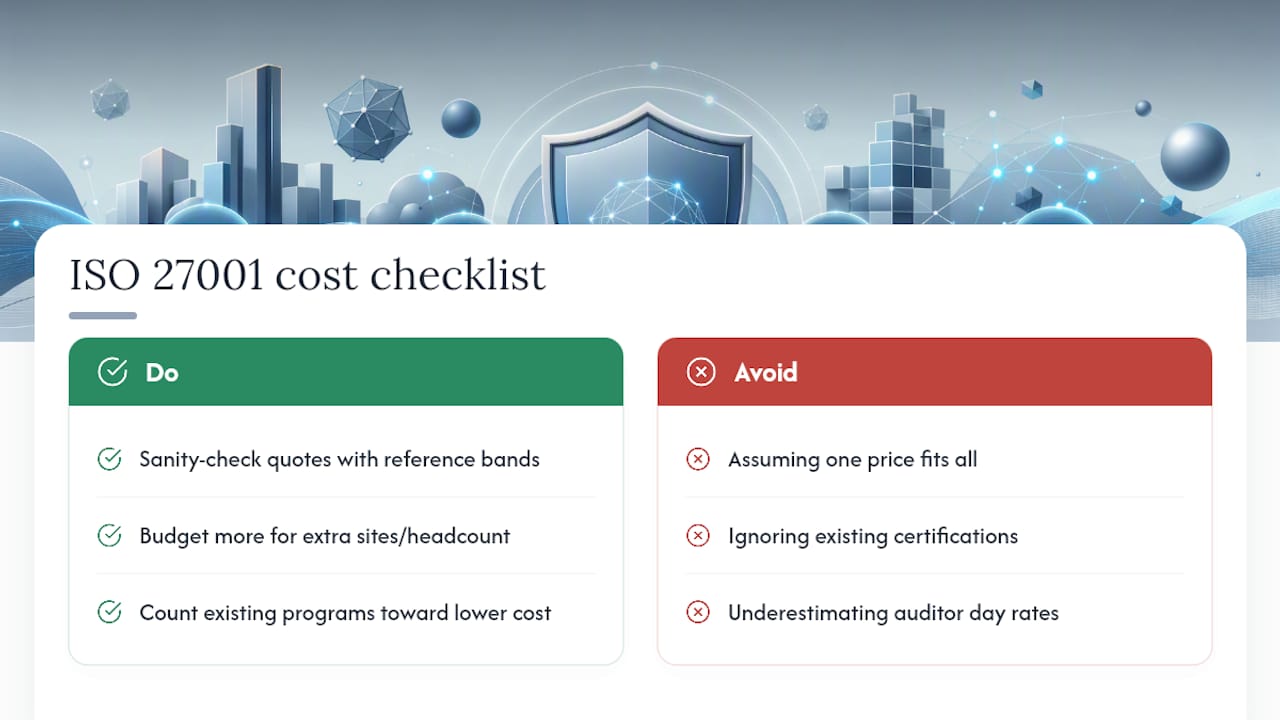
Reference bands help you sanity-check a quote before you've done your own gap analysis. Industry cost guides anchor US first-year totals to company size, and the pattern holds across most vendor pricing: small increases in headcount and site count drive disproportionate increases in audit fees because auditor time is priced by the day.
These bands assume mid-level maturity going in and a single primary site unless otherwise noted. If your organization already runs a formal risk management program, has documented policies, or holds a related certification, expect quotes toward the bottom of your band. If you're starting from scratch with no formal security documentation, budget toward the top, or slightly beyond it for anything above mid-size.
How do auditors set ISO 27001 audit costs?
Certification bodies price audits primarily by auditor days, not by a flat organizational fee. An auditor day is a full day of an accredited assessor's time, and the number of days you need is calculated from your headcount, number of sites, number of in-scope systems, and overall process complexity. Guidance from the International Accreditation Forum on how certification bodies determine audit duration is why two companies of similar size can still get different day counts if one has three offices and the other has one.
US auditor day rates commonly fall in a broad range depending on the certification body and region, and rates in North America tend to run higher than in some other markets.
Pro Tip: Ask your certification body for the exact auditor-day calculation up front. A quote that just states a lump sum without showing days multiplied by rate is much harder to negotiate or benchmark against a competing bid.
The audit itself happens in two stages:
- Stage 1 is a documentation review, checking that your ISMS, policies, and risk assessment exist and are structured correctly, usually the shorter and cheaper of the two.
- Stage 2 is the full assessment, where the auditor tests whether your controls are actually operating as documented. This carries most of the audit fee.
Remote audits, common for cloud-native companies with a single site, cut travel expense entirely. On-site audits for multi-location organizations add travel and lodging costs for the auditor, sometimes several thousand dollars depending on distance and number of locations visited. If Stage 2 turns up a major nonconformity, expect a follow-up audit to close it out, which adds another partial-day fee on top of your original budget.
What are ongoing ISO 27001 maintenance costs?
Certification runs on a three-year cycle, with annual surveillance audits in years one and two and full recertification in year three. Budgeting for this cycle correctly matters as much as budgeting for year one, because plenty of organizations treat certification as a one-time expense and get blindsided by recurring line items.
- Surveillance audits typically cost 15% to 30% of your year-one total, so a small business that spent $20,000 initially might see $3,000 to $6,000 annually for surveillance
- Internal audits, mandatory under the standard, require independence from the team being audited; many smaller organizations outsource this rather than building conflicting reporting lines internally
- Tooling subscriptions for evidence collection or GRC platforms renew annually and should be budgeted as a fixed recurring line
- Recertification in year three costs more than a surveillance audit but generally less than the original year-one spend, since your ISMS is already built and documented
Three-year totals for a small to mid-sized organization commonly land between $10,000 and $75,000 or more, depending heavily on scope stability and whether you expand certification coverage over time.
How do you build an accurate ISO 27001 budget?
Reference ranges are a starting point, not a quote. Here's how to turn them into a number you can actually take to your CFO or into an RFP.
- Define your scope precisely. Decide exactly which products, services, business units, and physical sites fall inside the certification boundary. A tighter scope directly reduces auditor days and consultant hours.
- Run an internal maturity check. Rate your current documentation, access controls, and risk management practices honestly. This tells you whether you sit in the low, mid, or high end of the size band that fits you.
- Commission a gap analysis. Convert the consultant's findings into hours, then hours into dollars using their quoted rate. This step alone is what most cost guides recommend as the difference between a rough guess and a defensible number.
- Estimate auditor days. Ask two or three certification bodies for their day calculation based on your headcount and site count, then multiply by their published or quoted day rate.
- Add contingency and internal labour. Tack on roughly 10% contingency for scope creep or remediation surprises, then add your own staff hours multiplied by a fully burdened hourly rate, not just base salary.
Pro Tip: Get your gap analysis and your certification body quote from two different firms. A consultant who's also selling you the audit has less incentive to scope tightly.
How can you reduce ISO 27001 certification costs?
Cost control doesn't have to mean cutting corners on the audit. It usually means being deliberate about scope and evidence before you ever talk to a certification body.
- Tighten your scope boundary. Every system, site, and process you include adds auditor days. Certify the product or service line customers actually care about first, and expand later if it makes commercial sense.
- Automate evidence collection. Cloud-native organizations running on AWS, Azure, or Google Cloud can often pull access logs, configuration snapshots, and change records automatically, which trims auditor review time more than it costs in subscription fees. This benefit shrinks for organizations running legacy, on-premises infrastructure across multiple sites.
- Reuse existing evidence. If you already hold SOC 2 or ISO 9001, much of your access control, change management, and incident response documentation maps directly onto ISO 27001 Annex A controls, cutting duplicate work.
- Phase your certification. Certify your highest-priority, customer-facing service first rather than your entire company at once. It spreads the cost over time and gets a certificate in customers' hands sooner.
Pro Tip: Reducing auditor days is a bigger lever than negotiating the day rate itself. A tighter scope or better evidence readiness often saves more than haggling over price per day.
How long does ISO 27001 certification take, and what's the internal effort?
Most first-time certifications run six to nine months from kickoff to certificate. Months one and two typically go toward purchasing standards, running the gap analysis, and defining scope. Months two through six cover implementation: writing policies, building the ISMS, and closing control gaps. Months six through nine cover Stage 1 and Stage 2 audits and any remediation in between.
Internal staff hours vary sharply by size:
- A micro or small organization might need 100 to 300 internal hours spread across IT, security, and a project lead
- A mid-sized organization often needs 400 to 800 hours, split across compliance, engineering, and department heads gathering evidence
- Enterprises frequently assign a dedicated internal project manager for the full nine months, on top of hours from every department in scope
Hidden labour costs show up in project coordination meetings, chasing evidence from teams that don't report to compliance, and remediation work after the gap analysis flags weak controls, none of which appear on a consultant's invoice but all of which cost real time.
Why do organizations consistently underbudget ISO 27001?
The single biggest budgeting mistake we see is treating the audit fee as the whole cost and forgetting everything around it. Teams price out the certification body's quote, feel good about the number, and then get blindsided by outsourced internal audit fees, unbudgeted penetration testing, and the travel expense for an on-site Stage 2 visit they didn't anticipate.
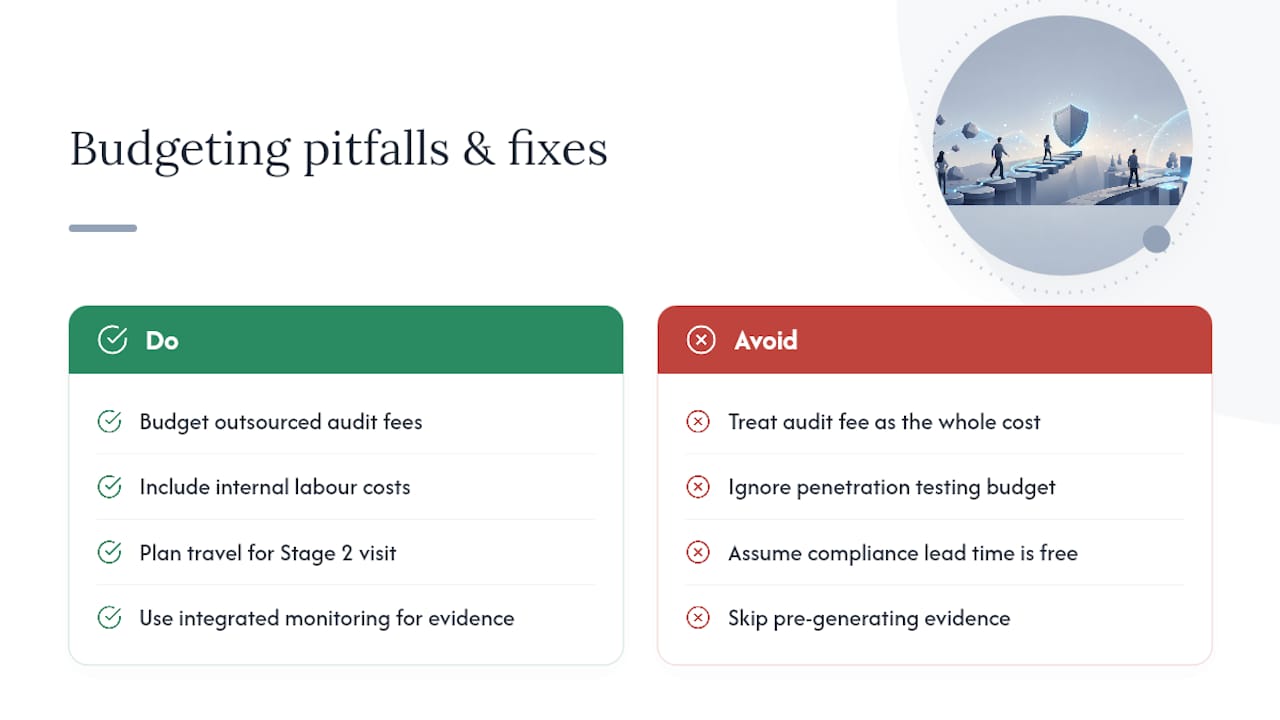
The second mistake is underestimating internal labour. A compliance lead's time isn't free just because it doesn't show up as a line item, and evidence collection across five departments always takes longer than the project plan assumes.
This is exactly where an integrated approach pays off. AccountNext-Nexus's 24/7 monitoring and managed compliance work means the evidence auditors want, access logs, incident response records, change history, is already being generated and organized before the gap analysis even starts. That alone removes weeks of scrambling from a typical certification timeline.
— Nick - Sr. Executive
Get a real ISO 27001 budget number, not another range
Ranges are useful for planning, but they won't tell you what your organization will actually pay. AccountNext-Nexus runs the gap analysis, manages the ISMS build-out, and keeps evidence collection running through its 24/7 monitoring and managed security services, so you're not assembling audit logs by hand three weeks before Stage 2.
If your team is cloud-native with a small footprint, a lean internal effort paired with a solid gap analysis might get you there without heavy outside help. If you're juggling multiple sites, legacy systems, or a compliance team stretched across SOC 2, HIPAA, or PCI-DSS work already, a consultant-heavy DIY approach usually costs more in staff hours than it saves in fees. AccountNext-Nexus consolidates that work under one contract, with transparent pricing instead of a stack of separate vendor invoices. Reach out through the Nexus services page to request a readiness assessment and get a firm estimate scoped to your actual environment, not a size band on a chart.
Where to verify these numbers yourself
For primary documentation, start with ISO's certification overview, which confirms that accredited third-party bodies, not ISO itself, issue certificates and set audit fees. The official standard text and its companion implementation guidance, ISO/IEC 27002, are available for purchase through ANSI's webstore at a small fixed cost. For US-anchored dollar ranges by company size, Factorial's cost breakdown offers a useful cross-check against the bands in this guide.