
Penetration testing is defined as a controlled simulation of a real cyberattack against your systems, carried out by security professionals to find exploitable weaknesses before attackers do. The role of penetration testing in startups is not optional security theatre. It is the most direct way to prove your defences hold under real conditions. Unlike automated vulnerability scans or security code reviews, a penetration test produces proof-based findings tied to actual attack paths. Standards like NIST SP 800-115, SOC 2, and PCI-DSS all recognise penetration testing as a core control, and for good reason. Startups that skip it are betting their business on the assumption that no one will look hard enough.
What are the direct benefits of penetration testing for startups?
The financial case for penetration testing is clear. For every $1 invested in professional penetration testing, organisations save up to $10 in potential breach costs. That ratio makes penetration testing one of the highest-return security investments available to a startup with a tight budget.
Speed of remediation improves just as dramatically. Average remediation time for serious security findings dropped from 112 days in 2017 to 37 days in 2024 among organisations running regular penetration tests. That improvement is not accidental. Repeated testing cycles build team familiarity with the remediation process, cutting the time wasted on triage and internal debate.
The compliance benefits are equally concrete. SOC 2 Type II, PCI-DSS, and ISO 27001 all require evidence of security testing. A well-scoped penetration test generates the documentation auditors need, reducing the time and cost of certification. For startups pursuing enterprise customers or raising a Series A, that documentation also signals maturity to investors and procurement teams.
"Proactive testing prevented an estimated $2.88 billion in losses across tracked programs in 2024. The ROI is not theoretical. It shows up in breach costs avoided, audit fees reduced, and deals closed faster because customers trust your security posture."
Key penetration testing benefits for startups include:
- Cost avoidance: Identifying critical vulnerabilities before a breach is far cheaper than incident response, legal fees, and customer notification.
- Faster remediation: Prioritised, proof-based reports tell your team exactly what to fix and in what order.
- Compliance readiness: Penetration test reports satisfy audit requirements for SOC 2, PCI-DSS, and ISO 27001.
- Investor and customer trust: Demonstrable security processes accelerate enterprise sales cycles and due diligence reviews.
- Security knowledge transfer: Each engagement teaches your internal team how attackers think, building lasting capability.
A security risk assessment pairs well with penetration testing to give you a complete picture of your threat exposure before you scope an engagement.
How does penetration testing differ from vulnerability scanning?
Automated vulnerability scanning and penetration testing are not the same thing. Scans are automated and continuous, while penetration tests involve manual, simulated attacks on deployed systems. Each method has a distinct role, and startups need both.

Automated scanners like those built into cloud platforms or dedicated vulnerability management tools check your environment against databases of known flaws. They run continuously, flag new CVEs quickly, and cost relatively little per scan. Their weakness is that they cannot reason about your specific business logic, chain vulnerabilities together, or test whether a misconfiguration in one system creates a path into another.
Security code reviews sit between scanning and penetration testing. They analyse application source code for logic errors, insecure functions, and design flaws that scanners miss entirely. Code reviews are most valuable early in development, before a feature ships. They catch problems at the cheapest possible moment.
Penetration tests uncover complex business logic flaws and infrastructure issues that automated tools miss. A skilled tester might chain a low-severity misconfiguration with an overprivileged API token and a weak session management flaw to achieve full account takeover. No scanner produces that finding.
Pro Tip: Automate vulnerability scanning continuously, but schedule manual penetration testing strategically around major feature releases or compliance certification timelines. That combination gives you broad coverage without wasting budget on redundant manual work.
The three methods work best together. Scanning provides continuous coverage. Code review catches design flaws early. Penetration testing validates that your deployed environment resists real attack. Treating them as substitutes rather than complements leaves gaps that attackers will find.
What scope of penetration testing does a startup actually need?
Scope is the primary driver of penetration testing cost, more than team size or test duration. Targeted testing reduces cost while still fulfilling investor and compliance requirements. Over-scoping is one of the most common mistakes startups make when commissioning their first test.
Matching scope to startup stage
Early-stage startups with a single web application or API should start there. Authentication flows, data handling, and access control are the highest-risk areas for most SaaS products. A focused web application test covering OWASP Top 10 vulnerabilities delivers strong value at a manageable cost.
As your product matures, scope expands naturally. Cloud infrastructure, internal networks, and social engineering tests become relevant once you have employees handling sensitive data, third-party integrations, or a more complex architecture. The enterprise vulnerability management process provides a useful framework for planning how testing scope should grow alongside your security programme.
When to schedule a penetration test
Timing matters as much as scope. Schedule a penetration test in these situations:
- Before a major product launch or significant architecture change.
- When pursuing SOC 2, PCI-DSS, or ISO 27001 certification.
- When an enterprise customer or investor requests evidence of security testing.
- After a significant breach or security incident at a competitor in your sector.
- Annually at minimum, or after any major infrastructure migration.
Integrating penetration testing early in the product lifecycle identifies risks before they reach production. That timing advantage reduces both remediation cost and reputational exposure.
The critical attack surfaces for most startups, in priority order, are:
- Authentication and session management
- API endpoints handling sensitive or financial data
- Third-party integrations and OAuth flows
- Admin panels and internal tooling
- Cloud storage and identity and access management configuration
Avoid testing everything at once if budget is limited. A focused test on your highest-risk components delivers more actionable findings than a shallow scan of your entire environment.
How to conduct penetration testing and act on the findings
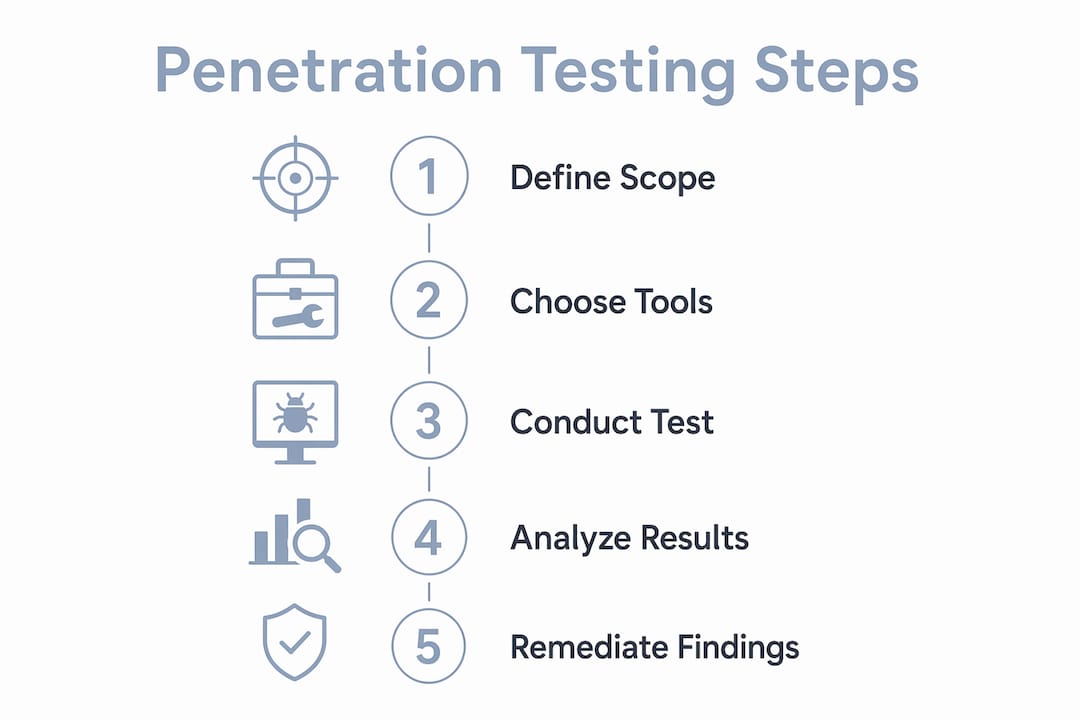
Choosing the right provider determines whether a penetration test produces real security improvement or just a report that sits unread. Providers offering proof-of-concept exploit evidence, prioritised remediation recommendations, and direct client access produce the highest remediation success rates. Ask any prospective provider how they communicate findings to developers, not just to security managers.
Setting up the engagement
Define scope, rules of engagement, and objectives in writing before testing begins. Rules of engagement specify which systems are in scope, what attack techniques are permitted, and how the tester should handle a live critical finding. Without this document, you risk disrupting production systems or creating legal ambiguity.
A collaborative approach between testers and your internal team accelerates remediation. Effective remediation reduces repeat findings and accelerates vulnerability closure. When developers can ask the tester directly why a finding is exploitable, they fix it correctly the first time rather than patching around it.
Measuring programme value over time
Track these key performance indicators across every engagement:
- Mean time to remediate (MTTR): How long it takes to close a finding after it is reported.
- Remediation rate: The percentage of findings closed before the next test cycle.
- Repeat findings: The same vulnerability appearing in consecutive tests signals a process failure, not just a technical one.
- Attack surface coverage: Are you testing more of your environment over time, or the same slice repeatedly?
Manual-first Penetration Testing as a Service (PTaaS) platforms combine expert human testing with modern collaboration and tracking tools. For startups balancing cost and compliance demands, PTaaS offers predictable pricing and continuous assessment between major engagements. Pair this with guidance from a cybersecurity maturity model to understand where penetration testing fits in your broader security growth plan.
Pro Tip: Request a re-test of critical and high-severity findings within 30 days of remediation. This confirms fixes are effective and prevents the same vulnerability from appearing in your next full engagement.
Key takeaways
Penetration testing delivers measurable ROI for startups by identifying real attack paths, accelerating remediation, and satisfying compliance requirements before a breach forces the issue.
| Point | Details |
|---|---|
| ROI is proven | Every $1 spent on penetration testing saves up to $10 in potential breach costs. |
| Remediation speed matters | Regular testing cut average remediation time from 112 days to 37 days by 2024. |
| Scope drives cost | Focus testing on critical assets like authentication and APIs to maximise value on a limited budget. |
| Complement, do not replace | Penetration testing works alongside automated scanning and code reviews, not instead of them. |
| Timing is a strategy | Schedule tests before launches, after architecture changes, and ahead of compliance audits. |
Why annual pentests are already obsolete
The startups I see struggle most with security are not the ones that skip penetration testing entirely. They are the ones that treat it as an annual checkbox. They commission a test in january, receive a report in february, fix the critical findings, and then change their entire cloud architecture by june. By the time the next test arrives, the environment being tested barely resembles what was assessed.
Continuous or periodic penetration testing builds institutional knowledge and muscle memory in teams, improving remediation speed and security posture over time. That compound effect is what separates startups that genuinely improve their security from those that simply generate documentation.
The most practical shift I have seen is moving from annual engagements to quarterly or event-driven tests tied to product milestones. This does not require a larger budget. It requires a smaller, more focused scope per engagement. Test your new payment integration when it ships. Test your new admin portal before it goes live. That approach catches vulnerabilities when they are cheapest to fix and keeps your team in a constant state of security awareness rather than a once-a-year scramble.
The future of penetration testing for startups is PTaaS combined with agile development cycles. Security testing becomes part of the sprint, not an external audit that interrupts it. Founders who build that culture early will spend far less on incident response later.
— Nick - Sr. Executive
How AccountNext-Nexus helps startups build real security
Startups that want penetration testing integrated with continuous monitoring do not need to manage multiple vendors.
AccountNext-Nexus brings penetration testing, 24/7 threat detection, and compliance support under one programme. Findings from each engagement feed directly into ongoing monitoring, so vulnerabilities are tracked to closure rather than filed away. The team works alongside your developers with prioritised, plain-language reports that produce real fixes, not just audit trail documents. If you are preparing for SOC 2, PCI-DSS, or an enterprise sales process, AccountNext-Nexus structures testing to meet those requirements from the first engagement. Explore the full suite of IT and cybersecurity solutions to see how a consolidated approach reduces both cost and risk for growing startups.
FAQ
What is penetration testing in simple terms?
Penetration testing is a controlled cyberattack carried out by security professionals to find real weaknesses in your systems before malicious actors do. It produces proof-based findings showing exactly how an attacker could breach your defences.
How often should a startup run a penetration test?
At minimum, annually. Startups should also schedule tests before major product launches, after significant architecture changes, and when pursuing compliance certifications like SOC 2 or PCI-DSS.
How is penetration testing different from vulnerability scanning?
Vulnerability scanning is automated and checks for known flaws continuously. Penetration testing is manual and simulates real attack chains, uncovering complex business logic flaws and misconfigurations that scanners cannot detect.
What does a penetration test cost for a startup?
Cost is driven primarily by scope. A focused web application or API test costs significantly less than a full-environment assessment. Targeting your highest-risk components first keeps costs manageable while meeting compliance requirements.
What should a startup do with penetration test findings?
Prioritise critical and high-severity findings for remediation within 30 days, then request a re-test to confirm fixes. Track mean time to remediate and repeat findings across engagements to measure security improvement over time.