
Credential stuffing is an automated attack where stolen username and password pairs from previous data breaches are fed into login forms across other websites, exploiting the fact that millions of people reuse the same credentials everywhere. If you do one thing after reading this sentence, enable multi-factor authentication (MFA) on every account you care about. Catalogued under MITRE ATT&CK sub-technique T1110.004, defined by OWASP as the automated injection of stolen credential pairs into login forms, and addressed directly in Canadian Centre for Cyber Security guidance, credential stuffing is one of the most widespread account-takeover methods in use today.
Key takeaways
Credential stuffing succeeds because stolen credentials are abundant, password reuse is widespread, and automation makes large-scale testing trivially cheap — MFA and unique passwords are the two controls that break that equation for individuals and organisations alike.
| Point | Details |
|---|---|
| MFA is the strongest single control | Enable MFA on all accounts; an authenticator app is stronger than SMS codes. |
| Password reuse is the root vulnerability | Use a password manager to generate unique passwords for every site and eliminate reuse entirely. |
| Detection requires cross-account monitoring | Alert on failures spread across many usernames, not just high failure counts on one account. |
| Canada has dedicated guidance | CCCS provides specific controls for Canadian organisations; report incidents at cyber.gc.ca/en/report. |
| AccountNext-Nexus managed detection | AccountNext-Nexus provides 24/7 monitoring, MFA rollout, and incident response under one managed service agreement. |
Table of Contents
- What does a credential stuffing attack look like in practice?
- How a credential stuffing campaign actually runs, step by step
- Why credential stuffing works: the factors that make it so effective
- How credential stuffing differs from brute force and password spraying
- How to detect credential stuffing: what your logs are telling you
- How individuals can protect themselves from credential stuffing
- How organisations should defend systems against credential stuffing
- How a managed security provider prepares and responds to credential stuffing
- What to do immediately when accounts or systems are compromised
- Canada-specific guidance and reporting routes
- Practical resources and tools for checking and defending accounts
- Why credential stuffing is a problem that does not solve itself
- AccountNext-Nexus protects your organisation from credential stuffing
- Sources
What does a credential stuffing attack look like in practice?
Picture this: a retail loyalty database is breached and 10 million email/password combinations are posted to an underground forum. An attacker downloads the list, loads it into an automation tool, and points it at a major Canadian bank's login page. Most attempts fail. But even a success rate of around 2% on a 10-million-record list means roughly 200,000 accounts accessed without the owner's knowledge. The attacker then drains loyalty points, initiates small transfers, or sells verified account access to other criminals.
The attacker needs surprisingly little to run this:
- A credential list (freely or cheaply available on dark-web markets and paste sites)
- An automation tool or script capable of submitting thousands of login attempts per hour
- A proxy network or botnet to rotate IP addresses and avoid rate-limit blocks
The attack affects consumer accounts (banking, retail, streaming), business accounts (corporate email, SaaS platforms), and SSO-protected services where a single compromised identity unlocks multiple internal systems.
How a credential stuffing campaign actually runs, step by step
The lifecycle follows a predictable arc. Understanding each stage is what lets defenders map the right control to the right point in the chain.
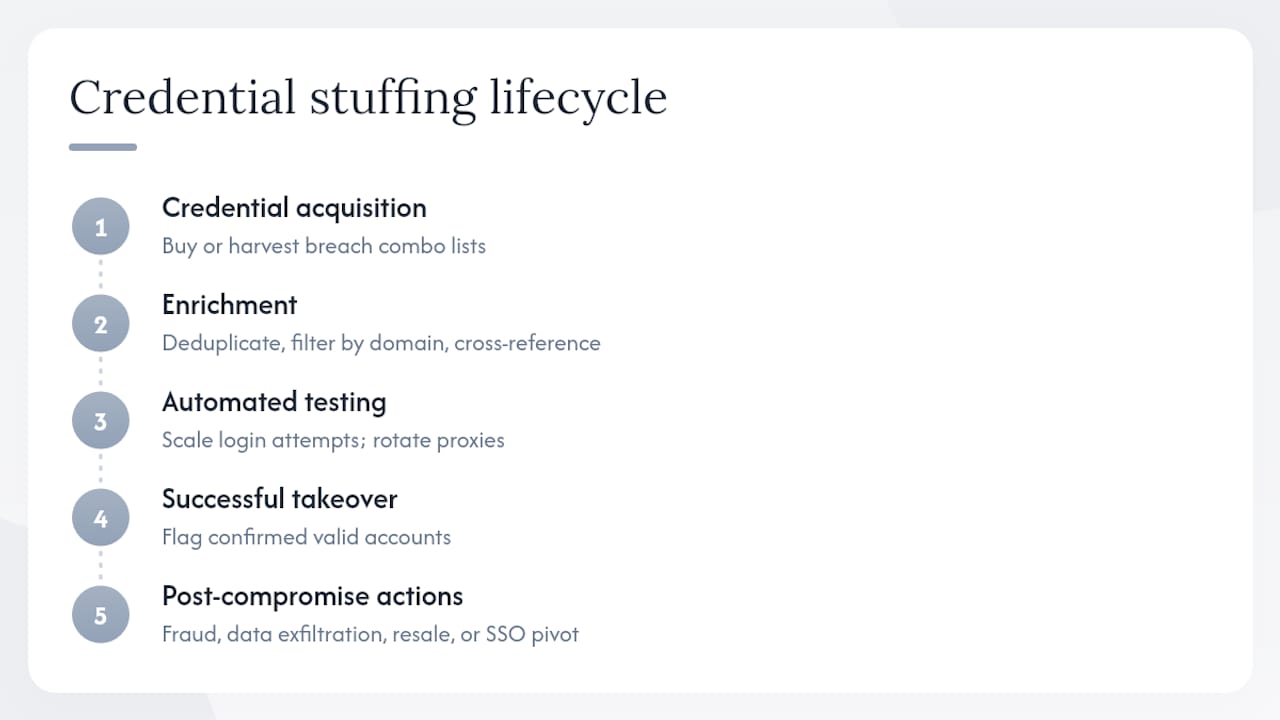
Stage 1: Credential acquisition. Attackers source breach dumps from dark-web markets, paste sites, or by purchasing access to freshly exfiltrated databases. Lists are often "combo lists" that pair email addresses with passwords, making them immediately usable across any site that accepts email as a username.
Stage 2: Enrichment. Before testing, attackers may deduplicate, filter by domain (targeting corporate email addresses), or cross-reference multiple breach lists to build higher-confidence pairs.
Stage 3: Automated testing. OWASP's Automated Threats documentation describes how tools submit credential pairs at scale using headless browsers, web automation frameworks, and proxy rotation to mimic legitimate traffic. Campaigns can run thousands to millions of attempts, distributed across many IP addresses to stay below detection thresholds. Human farms can also be used to manually validate credentials when automation is blocked.
Stage 4: Successful takeover. Valid logins are flagged automatically. The attacker now has a list of confirmed working accounts.
Stage 5: Post-compromise actions. Depending on the target, this means financial fraud, data exfiltration, account resale, or pivoting through SSO into connected enterprise systems. MITRE ATT&CK notes that attackers specifically target SSO and cloud-based federated authentication flows because a single valid credential can unlock an entire application ecosystem.
Why credential stuffing works: the factors that make it so effective
The attack succeeds because of a combination of human behaviour and technical conditions that defenders have been slow to close.
Password reuse is the root cause. When people use the same password on multiple sites, a breach at any one of them exposes every other account that shares those credentials. Using email addresses as usernames compounds this: the same email/password pair works as a universal key across dozens of services. Common employee cybersecurity vulnerabilities like password reuse are well-documented and remain stubbornly common despite years of awareness campaigns.
Breach lists are cheap and enormous. Billions of credential pairs from past breaches circulate on underground markets. Attackers do not need to hack anyone themselves; they simply buy or download what others have already stolen.
Automation makes scale trivial. Running a million login attempts manually would take years. Automated tools compress that into hours, and proxy rotation keeps the traffic looking distributed and organic.
Scale insight: Industry reporting has noted that even a low single-digit success rate on a large breach list can produce thousands of account compromises. A 1% hit rate on a list of one million credentials is 10,000 accounts.
The table below shows how common weak passwords appear in aggregated breach datasets. This illustrates why banned-password policies matter:
Source: Dojo aggregated hacked-password dataset
These passwords appear in breach lists that attackers use directly. Any system that still accepts them is handing attackers a head start.
How credential stuffing differs from brute force and password spraying
These three attack types are often confused, but they operate differently and require different defences.
Credential stuffing tests known, breached username/password pairs. The attacker is not guessing; they already have the credentials. OWASP classifies it as a subset of brute force but operationally distinct because it relies on verified data rather than enumeration.
Brute force systematically tries every possible password combination for a target account. It is slow, noisy, and easily blocked by lockout policies.
Password spraying tries one common password (e.g., "Summer2024!") across many accounts to avoid triggering per-account lockouts.
| Attribute | Credential stuffing | Brute force | Password spraying |
|---|---|---|---|
| Input data | Known breached pairs | Generated guesses | One or few common passwords |
| Accounts targeted | Many accounts simultaneously | Usually one account | Many accounts simultaneously |
| Lockout risk | Low (distributed) | High (concentrated) | Low (one attempt per account) |
| Detection signal | Failures spread across many usernames | Failures concentrated on one username | Low failure count, many accounts |
| Primary mitigation | MFA, breach-list monitoring | Account lockout, CAPTCHA | Lockout, password complexity |
The detection implication is important: credential stuffing produces a pattern of failures spread across many accounts, not a flood of failures on a single account. Defenders who only alert on per-account failure thresholds will miss it entirely.
How to detect credential stuffing: what your logs are telling you
Detection depends on knowing what to look for and where. The signals are there; most organisations just are not tuned to read them.
MITRE ATT&CK T1110.004 identifies authentication failures distributed across many accounts as the primary indicator. Pair that with the following log signals:
- Spike in failed logins across many different usernames in a short window, rather than repeated failures on one account
- Unusual IP patterns: traffic from known proxy services, Tor exit nodes, or data-centre IP ranges that do not match your normal user geography
- Homogeneous user-agent strings: hundreds of login attempts sharing an identical or near-identical browser fingerprint
- Rapid account lockouts across unrelated accounts in the same time period
- Unusual login times: attempts arriving at 3:00 AM local time from IP addresses geolocated to regions inconsistent with your user base
- Token issuance anomalies: sudden spikes in OAuth token requests or refresh-token activity on federated auth endpoints
Good cloud security logging practices are a prerequisite for any of this to work. If your authentication events are not centralised and queryable, you cannot run these detections.
The threshold logic matters. OWASP's prevention guidance recommends monitoring for failures distributed across many usernames rather than only alerting on high failure counts for a single username. A campaign running 10 attempts per account across 50,000 accounts will never trigger a per-account lockout but will show up clearly in aggregate.
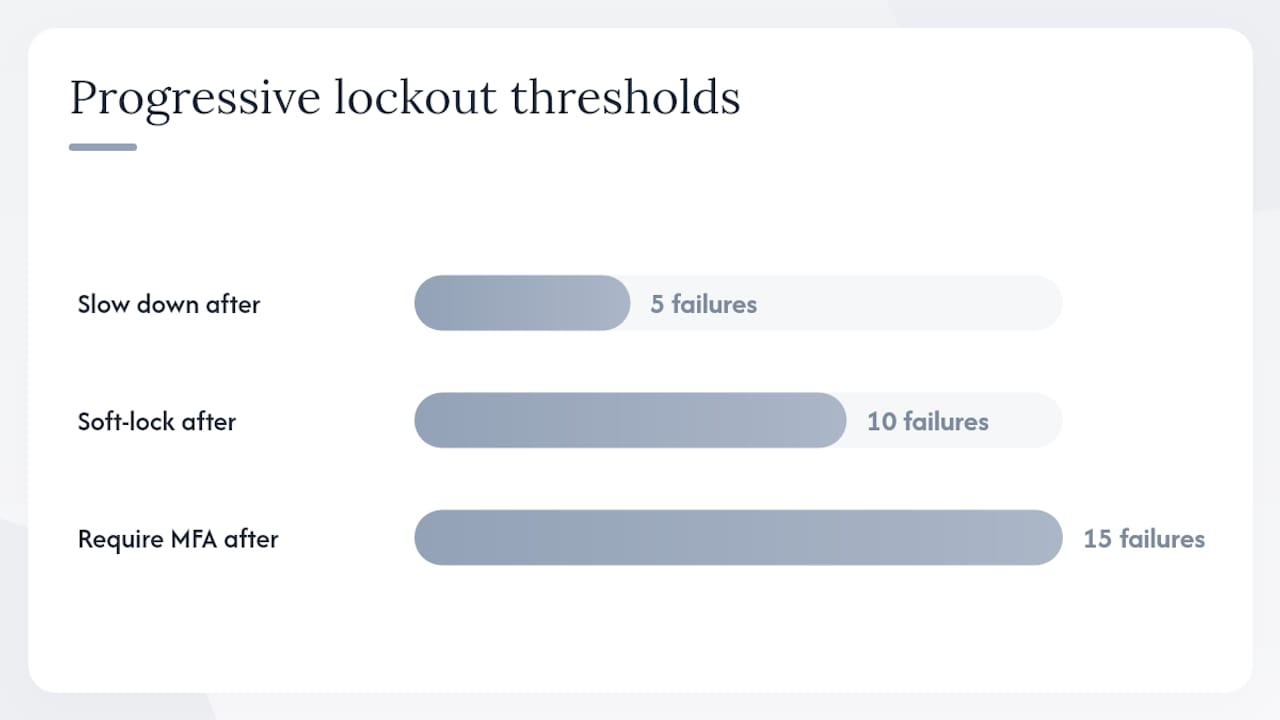
Pro Tip: Tune your lockout policy to frustrate attackers without creating a denial-of-service risk for real users. A progressive throttle (slow down after 5 failures, soft-lock after 10, require MFA challenge after 15) is more effective than a hard lockout that attackers can weaponise to lock out legitimate users.
How individuals can protect themselves from credential stuffing
The personal defence is straightforward. The hard part is actually doing it.
- Check whether your credentials have been exposed. Services like Have I Been Pwned (haveibeenpwned.com) let you search your email address against known breach databases. This is free and takes 30 seconds.
- Change any reused passwords immediately. If you use the same password on more than one site, every one of those accounts is at risk the moment any one of them is breached.
- Enable MFA on every account that supports it. An authenticator app (Google Authenticator, Microsoft Authenticator, or Authy) is stronger than SMS-based codes, which can be intercepted via SIM-swapping. Most major Canadian banks, government portals, and cloud services now support app-based MFA.
- Use a password manager. Tools like Bitwarden, 1Password, or Dashlane generate and store unique, complex passwords for every site. You remember one strong master password; the manager handles the rest. This single change eliminates password reuse entirely.
- Review account recovery options. Recovery email addresses and phone numbers are often the weakest link. Make sure they are current, secured with their own MFA, and not shared across accounts.
OWASP's credential stuffing prevention guidance frames MFA as the strongest single control available to individuals. Everything else is complementary. If you only do one thing, that is it.
How organisations should defend systems against credential stuffing
Organisational defence requires depth. No single control stops a determined campaign; the goal is to make each stage of the attack expensive enough that attackers move on.
Authentication controls:
- Enforce MFA on all high-value accounts, administrative interfaces, and SSO entry points
- Implement step-up authentication for sensitive actions (fund transfers, password changes, privilege escalation)
- Protect account recovery flows with the same rigour as primary login, since attackers pivot to recovery when MFA blocks the front door
Rate limiting and throttling:
- Apply progressive throttling at the authentication endpoint: slow responses after repeated failures, not just hard blocks
- Throttle at the IP, device fingerprint, and session level simultaneously, since attackers rotate IPs but often reuse device characteristics
Bot management and CAPTCHA:
- Deploy bot management solutions that analyse behavioural signals (mouse movement, keystroke timing, request cadence) rather than relying solely on IP reputation
- Use CAPTCHA challenges as a friction layer on high-failure IP ranges, but do not rely on CAPTCHA alone; sophisticated tools solve them automatically
Credential hardening:
- Maintain a banned-password list seeded from known breach datasets and block common weak passwords at registration and reset
- Hash stored passwords with bcrypt, scrypt, or Argon2; MD5 and SHA-1 hashed passwords from breached databases are trivially cracked and re-used
Monitoring and detection:
- Centralise authentication logs and build alerts for the distributed-failure patterns described in the detection section
- Ingest commercial or open-source credential breach feeds to proactively identify when your users' credentials appear in new dumps
- Instrument SSO and federated auth endpoints specifically; MITRE ATT&CK notes these are frequent targets because a single valid credential unlocks multiple systems
Operational practices:
- Run periodic credential stuffing simulations as part of penetration testing to validate that controls actually work
- Train staff to recognise and report unusual account activity
- Document your authentication architecture so incident responders know exactly which endpoints to contain when a campaign is detected
How a managed security provider prepares and responds to credential stuffing
A managed security provider like AccountNext-Nexus approaches credential stuffing as an ongoing operational problem, not a one-time configuration task. The checklist below reflects what a mature managed detection and response (MDR) engagement covers:
Ongoing monitoring:
- 24/7 authentication log analysis with custom rules tuned to distributed-failure patterns
- Continuous ingestion of breach intelligence feeds to flag when client credentials appear in new dumps
- Anomaly detection across SSO, federated auth, and API authentication endpoints
Preventive configuration:
- MFA rollout support across all user populations, including legacy systems that require integration work
- Bot-mitigation policy design and tuning, including progressive throttling and device-fingerprint analysis
- Banned-password list management and credential hardening reviews
Incident playbook when a stuffing campaign is detected:
- Contain: Block the highest-confidence malicious IP ranges and user-agent patterns immediately
- Enrich: Pull full authentication logs for the affected window; correlate with breach intelligence to identify which credential list is likely in use
- Block: Expand blocking rules based on enriched indicators; force MFA challenges on all accounts showing suspicious activity
- Notify: Alert the client's security team and, where accounts are confirmed compromised, prepare customer notification
- Remediate: Force password resets on compromised accounts, revoke active sessions and tokens, review and close any post-compromise access
- Review: Conduct a post-incident review to identify detection gaps and update monitoring rules
Why enterprises adopt managed detection comes down to exactly this: the speed and depth of response that a dedicated team with purpose-built tooling can deliver versus what an in-house team stretched across other priorities can realistically manage.
What to do immediately when accounts or systems are compromised
Speed matters. The longer a compromised session stays active, the more damage an attacker can do.
For individuals:
- Change the compromised account's password immediately to a unique, strong password generated by a password manager
- Revoke all active sessions on the affected account (most platforms offer a "sign out everywhere" option)
- Enable MFA if it was not already active
- Check all other accounts that shared the same password and change those too
- Review recent account activity for unauthorised transactions, sent messages, or changed settings
- Report the compromise to the service provider and, if financial fraud occurred, to your financial institution and the Canadian Anti-Fraud Centre (CAFC) at antifraudcentre.ca
For administrators:
- Force password resets on all accounts showing suspicious authentication activity
- Revoke active sessions and OAuth tokens for affected accounts
- Block the identified malicious IP ranges and user-agent patterns at the WAF or load balancer
- Preserve authentication logs before any rotation or purging cycle removes evidence
- Notify affected users with clear instructions: what happened, what they should do, and what you are doing
- Escalate to your incident response team or managed security provider for forensic analysis
- File a report with the Canadian Centre for Cyber Security (CCCS) at cyber.gc.ca/en/report
On notification language: keep customer communications factual and specific. Tell users which service was affected, what type of information may have been accessed, and the exact steps they should take. Vague notifications erode trust faster than the incident itself.
Canada-specific guidance and reporting routes
The Canadian Centre for Cyber Security (CCCS) has published ITSP.30.035, a dedicated guidance document for protecting web application systems against credential stuffing. It is the authoritative Canadian reference for both technical and non-technical controls.
Key CCCS recommendations from that guidance:
- Implement MFA as the primary control, with layered defences for any flows where MFA cannot be enforced immediately
- Apply rate limiting and progressive throttling at authentication endpoints
- Monitor authentication logs for the distributed-failure patterns that characterise stuffing campaigns
- Maintain an incident response plan that specifically addresses credential-based attacks
Reporting routes for Canadian organisations:
- Canadian Centre for Cyber Security: Report cyber incidents at cyber.gc.ca/en/report. The CCCS provides technical assistance to critical infrastructure operators and federal institutions.
- Canadian Anti-Fraud Centre (CAFC): For fraud resulting from account takeovers, report at antifraudcentre.ca or call 1-888-495-8501.
- Office of the Privacy Commissioner of Canada (OPC): If a credential stuffing attack results in a breach of personal information, organisations subject to PIPEDA must report to the OPC and notify affected individuals. Reporting is mandatory when the breach creates a real risk of significant harm.
- Provincial privacy commissioners: Quebec organisations are subject to Law 25 (formerly Bill 64), which has its own breach notification requirements administered by the Commission d'accès à l'information (CAI).
Availability considerations: CCCS guidance acknowledges that aggressive lockout policies can be weaponised to deny service to legitimate users. Canadian organisations should design their throttling and lockout policies to frustrate attackers without inadvertently locking out their own customers, particularly in sectors like financial services and healthcare where account access is time-sensitive.
Practical resources and tools for checking and defending accounts
For individuals (all available in Canada):
- Have I Been Pwned (haveibeenpwned.com): free breach-check service; search your email against hundreds of known breach databases
- 1Password, Bitwarden, Dashlane: password managers with Canadian data residency options and cross-platform support; Bitwarden is open-source and free for personal use
- Google Authenticator, Microsoft Authenticator, Authy: TOTP-based MFA apps supported by virtually every major Canadian bank, government portal, and SaaS platform
For organisations:
- SIEM platforms (Splunk, Microsoft Sentinel, IBM QRadar): centralise authentication logs and run custom detection rules for distributed-failure patterns
- Bot management solutions: platforms that analyse behavioural signals beyond IP reputation; look for vendors that offer device fingerprinting, behavioural biometrics, and real-time challenge injection
- Credential breach monitoring feeds: commercial services that ingest dark-web dumps and alert you when your users' credentials appear; ask vendors whether they cover Canadian breach sources specifically
- UEBA (User and Entity Behaviour Analytics): detects anomalous authentication patterns that static rules miss; particularly useful for SSO environments
When evaluating any tool, ask three questions: Does it cover federated auth and SSO endpoints, not just standard login pages? Can it detect distributed-failure patterns across accounts rather than only per-account thresholds? Does it integrate with your existing SIEM or logging infrastructure?
The NCSC's guidance on credential stuffing tools is also worth reviewing for defenders who want to understand the attacker tooling they are up against; understanding what the tools do makes it easier to tune detections against their specific signatures.
Why credential stuffing is a problem that does not solve itself
Most organisations treat credential stuffing as a perimeter problem: block the bad IPs, add a CAPTCHA, done. That framing misses the real dynamic.
The breach lists driving these attacks are not going away. Every new data breach adds millions of fresh credentials to the pool attackers draw from. The tools are cheap and widely available. And the economics are straightforward: even a 1% success rate on a large list is profitable enough to keep running campaigns indefinitely.
What actually changes the outcome is making each individual account resistant to takeover regardless of whether the credentials are already compromised. MFA does that. A password manager that generates unique credentials does that. Monitoring that catches a campaign in the first hour rather than the first week does that.
The organisations that handle this well are not the ones with the most sophisticated perimeter defences. They are the ones that assume credentials will be stolen eventually and have built their authentication architecture to survive that assumption. That means MFA everywhere, breach monitoring as a continuous process, and incident response that can move in minutes, not days.
AccountNext-Nexus protects your organisation from credential stuffing
Credential stuffing campaigns do not wait for your security team to have bandwidth. AccountNext-Nexus delivers 24/7 authentication monitoring, MFA rollout support, bot-mitigation policy design, and full incident response under a single managed service agreement, so your organisation has the coverage it needs without building and staffing a security operations centre from scratch.

The difference is response time. When a stuffing campaign hits, AccountNext-Nexus's team contains, enriches, and blocks within the same shift, then walks your team through remediation and post-incident review. No fragmented vendors, no gaps between your logging tool and your response team. Explore AccountNext-Nexus's cybersecurity services or contact the team to request a consultation and find out how managed detection maps to your specific authentication environment.
Sources
- Credential stuffing | OWASP Foundation
- Brute Force: Credential Stuffing, Sub-technique T1110.004 - Enterprise | MITRE ATT&CK®
- Credential Stuffing Prevention - OWASP Cheat Sheet Series
- ITSP.30.035 Strategies for Protecting Against Credential Stuffing Attacks
- Credential stuffing - Wikipedia
- NCSC news — use credential stuffing tools