
Cloud misconfiguration is defined as any deviation from established security best practices in cloud environment settings, and it is the leading cause of cloud data breaches worldwide. Security teams often focus on external threats, but the real exposure sits inside their own configurations. Over 80% of cloud configuration errors originate from manual setup or oversight, not sophisticated zero-day exploits. The 2025 global average breach cost reached $4.44 million, climbing to $10.22 million in the United States. Those figures reflect what happens when cloud settings fail quietly, without triggering a single alert. Understanding the mechanics behind these failures is the first step toward stopping them.
Why misconfigured cloud causes breaches: the core mechanics
Cloud misconfiguration creates breaches by leaving known attack surfaces open and unguarded. The industry term for this class of vulnerability is "cloud security misconfiguration," and it covers everything from storage permissions to identity policies. Three fault lines appear in almost every incident report.
Public storage buckets are the most visible example. Open storage buckets and wildcard permissions are frequently created for temporary use and then forgotten, leaving sensitive data accessible to anyone with the bucket URL. An attacker does not need credentials. A simple HTTP request returns the data.

Overly permissive IAM roles are the second major fault line. When a developer assigns a wildcard permission such as s3:* or ec2:* to a service account, that account becomes a skeleton key. Attackers who compromise any workload running under that role inherit every permission attached to it. The blast radius expands instantly.
Open network ports complete the triad. SSH on port 22 and RDP on port 3389, left exposed to the public internet, are scanned continuously by automated tools. A misconfigured security group rule that allows 0.0.0.0/0 inbound traffic on these ports gives attackers a direct path into compute resources.
Common misconfiguration types and their primary risk:
- Public S3 buckets or Azure Blob containers: Unauthenticated data exposure to the public internet
- Wildcard IAM permissions: Privilege escalation and lateral movement across services
- Open SSH/RDP ports: Direct remote access for credential-stuffing and brute-force attacks
- Disabled MFA on root or admin accounts: Account takeover with stolen credentials
- Unencrypted data at rest or in transit: Data theft without needing to bypass access controls
- Hardcoded secrets in CI/CD pipelines: Credential theft enabling long-term persistent access
Pro Tip: Run a query against your cloud provider's native policy analyser, such as AWS IAM Access Analyzer or Azure Policy, to surface any resource granting public access. Fix those before anything else.
What drives cloud configuration errors in organisations?
Human error is the primary driver, but the conditions that produce that error are structural. Cloud environments are complex, change rapidly, and involve multiple teams with overlapping responsibilities.
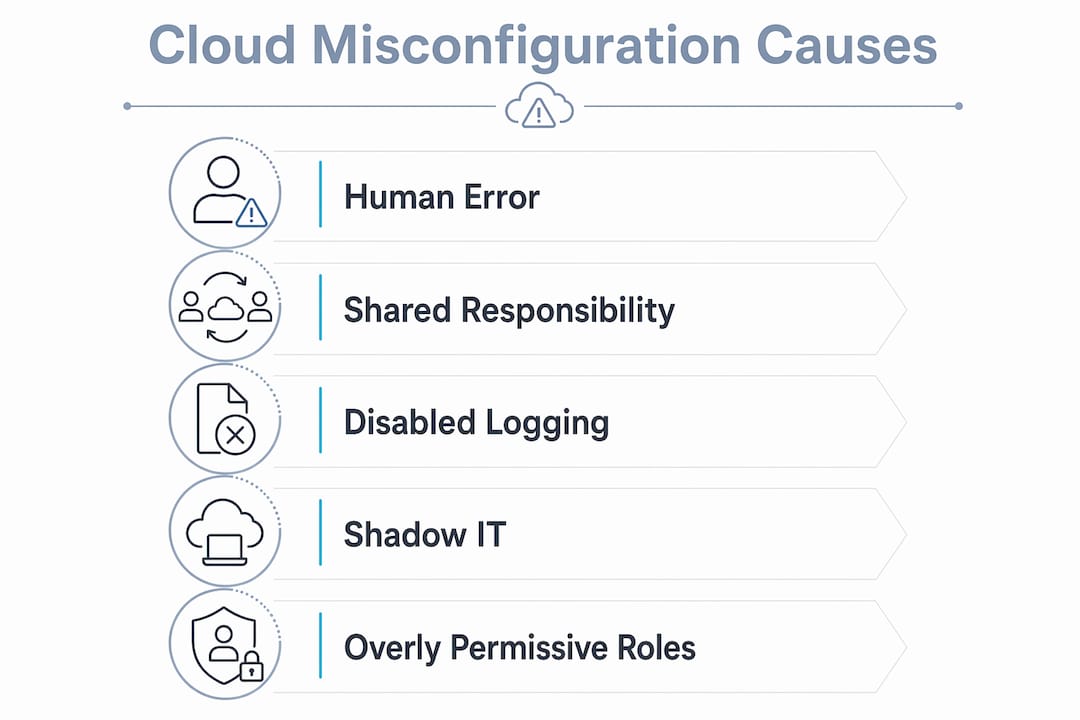
Shared responsibility confusion is the most underestimated cause. Cloud providers secure infrastructure, but customers must configure identity, access, and logging. Many organisations assume the provider handles more than it does. That assumption leaves customer-configured security settings unchecked, and those gaps become lateral movement opportunities for attackers. The shared responsibility model is well-documented, yet misunderstood in practice far more often than security teams admit.
Rapid provisioning compounds the problem. Teams spin up resources in minutes to meet delivery deadlines. Governance and security review cannot keep pace with that speed. Copying on-premises firewall rules into cloud environments creates public exposure because the threat model in cloud differs fundamentally from a data centre. What blocked lateral movement on a private network does nothing when the resource is internet-facing by default.
The four most common organisational drivers of misconfiguration errors:
- Knowledge gaps: Engineers skilled in on-premises infrastructure apply familiar mental models to cloud services that behave differently.
- Speed over governance: Deployment velocity is rewarded; security review is treated as optional friction.
- Unclear ownership: Multiple teams share a cloud account with no single owner responsible for security posture.
- Insufficient logging: Many organisations fail to monitor CloudTrail and Azure Activity Logs properly, allowing breaches to go unnoticed for months or years.
"Rapid cloud provisioning without embedding security creates a culture of manual quick fixes, increasing error likelihood. Security must be integrated into deployment pipelines, not bolted on afterward."
Disabled logging and shadow IT assets blind security teams entirely. Resources provisioned outside formal IT processes carry no audit trail. When a breach occurs, there is nothing to investigate. The role of logging in cloud security is not optional infrastructure. It is the difference between a contained incident and a months-long dwell time.
How do attackers chain misconfigurations to escalate breaches?
Attackers rarely rely on a single misconfiguration. They chain multiple minor errors together to escalate privileges and expand access across an environment. Each step exploits a gap that looks minor in isolation.
A documented 2025 case illustrates the speed of this approach. A single attacker used AI workflows to perform credential discovery, secrets theft, and rapid lateral movement across AWS services within 72 hours. That timeline is shorter than most organisations' incident response cycles. By the time an alert fires, the attacker has already moved.
The chain typically follows this pattern:
- Initial access: A hardcoded API key in a public GitHub repository or an open RDP port provides the entry point.
- Credential discovery: The attacker queries instance metadata services or scans environment variables for additional secrets.
- Privilege escalation: A wildcard IAM role attached to the compromised workload grants access to additional services.
- Lateral movement: The attacker pivots across S3 buckets, databases, and compute resources using the escalated permissions.
- Persistence: Long-lived static credentials embedded in CI/CD pipelines maintain access even after the initial entry point is closed.
- Impact: Data exfiltration, ransomware deployment, or cryptomining using privileged EC2 instances.
AI-assisted attack workflows reduce the time between initial access and full environment compromise. Compromised AI gateway infrastructure led to cryptocurrency mining abusing privileged EC2 instances, demonstrating that AI gateways consolidating credentials and permissions are high-value targets. The core intrusion pattern is not new. The speed and scale are.
Practitioners recommend prioritising misconfigurations that are both reachable and exploitable within the actual network architecture, rather than working through a theoretical checklist. A public S3 bucket containing internal logs is a higher priority than a permissive role attached to a workload with no internet exposure. Context determines real risk.
Pro Tip: Map your cloud environment's attack paths using a graph-based tool before your next security review. Visualising which misconfigurations connect to sensitive data stores changes how teams prioritise remediation.
What strategies prevent misconfiguration-related breaches?
Prevention requires integrating security into the deployment process, not reviewing it afterward. The following approaches address both the technical and organisational drivers of cloud configuration errors.
Embed security into CI/CD pipelines
Infrastructure as Code (IaC) validation tools scan Terraform, CloudFormation, and Bicep templates before deployment. Misconfigurations are caught at the pull request stage, not after a resource is live. This approach removes the dependency on manual review and scales with deployment velocity.
Enforce least privilege and MFA
Every IAM role and service account should carry only the permissions required for its specific function. Wildcard permissions should be blocked by policy. Multi-factor authentication must be enforced on all human accounts, particularly root and administrative roles. These two controls eliminate the most common privilege escalation paths.
Deploy Cloud Security Posture Management (CSPM)
CSPM tools provide continuous monitoring of cloud configurations against security benchmarks such as the CIS Controls and NIST SP 800-53. They surface drift from approved baselines in real time and generate prioritised remediation queues. A strong cloud security posture requires continuous assessment, not point-in-time audits.
Address lift-and-shift security debt
Organisations that migrated workloads from on-premises to cloud without rearchitecting security controls carry inherited misconfigurations. Firewall rules, network segmentation models, and access policies designed for private data centres do not translate directly. A dedicated remediation sprint targeting these legacy configurations reduces exposure significantly.
Prevention approach comparison:
| Approach | What it addresses | When to apply |
|---|---|---|
| IaC scanning in CI/CD | Misconfigurations before deployment | At pull request or merge |
| CSPM continuous monitoring | Drift from approved baselines post-deployment | Ongoing, real-time |
| IAM least-privilege enforcement | Wildcard permissions and privilege escalation | At role creation and review |
| MFA on all admin accounts | Credential-based account takeover | Immediately, no exceptions |
| Legacy configuration remediation | Lift-and-shift security debt | Scheduled sprint or audit cycle |
Pro Tip: Set a policy-as-code rule that blocks any deployment creating a resource with public access unless it passes an explicit exception review. This single guardrail stops the most common misconfiguration class before it reaches production.
Key takeaways
Cloud misconfiguration is the primary cause of cloud breaches, and preventing it requires embedding security controls into deployment pipelines, enforcing least privilege, and maintaining continuous visibility across all cloud assets.
| Point | Details |
|---|---|
| Misconfiguration drives most breaches | Over 80% of cloud configuration errors come from manual setup, not external exploits. |
| Shared responsibility is widely misunderstood | Customers must configure identity, access, and logging. Providers do not do this for you. |
| Attackers chain minor errors quickly | AI-assisted workflows can compromise a full AWS environment in as little as 72 hours. |
| Logging gaps extend dwell time | Disabled CloudTrail or Azure Activity Logs allow breaches to go undetected for months. |
| Prevention belongs in the pipeline | IaC scanning and CSPM tools catch misconfigurations before and after deployment. |
What I've learned about cloud misconfiguration after years on the front lines
The pattern I see most often is not ignorance. It is confidence misplaced in the wrong direction. Teams that have been running cloud workloads for years develop a sense of familiarity that substitutes for actual visibility. They know their architecture. They trust their setup. They have not had an incident yet.
That confidence is exactly what attackers count on. The environments I have reviewed with the longest undetected dwell times are not the ones with the most complex configurations. They are the ones where someone turned off CloudTrail logging to reduce costs two years ago and nobody noticed. They are the ones where a developer created a public S3 bucket for a one-week project and then left the company.
The organisations that manage this well share one trait: they treat security posture as a live metric, not a quarterly audit result. They have alerts on configuration drift. They review IAM permissions on a schedule. They run IaC scans in every pipeline. None of this is exotic. All of it requires discipline.
The emerging threat I watch most closely is the AI gateway attack pattern. As organisations consolidate credentials and permissions through AI infrastructure, those gateways become single points of catastrophic failure. The evolving tactics attackers use against cloud environments are not fundamentally new. They are familiar techniques applied to new, higher-value targets. The defence is the same as it has always been: reduce the attack surface, monitor continuously, and respond faster than the attacker can pivot.
— Nick - Sr. Executive
How AccountNext-Nexus supports cloud misconfiguration prevention
AccountNext-Nexus provides 24/7 monitoring and threat detection designed specifically for organisations managing complex cloud environments. The team specialises in identifying configuration drift, enforcing security baselines, and responding to incidents before they escalate.
For IT and cybersecurity teams dealing with the pressure of rapid cloud growth and limited internal capacity, AccountNext-Nexus consolidates cloud security posture management, compliance monitoring, and incident response under one programme. There is no gap between detection and action. Explore managed cloud security services to see how AccountNext-Nexus can reduce your organisation's misconfiguration exposure with transparent pricing and experienced professionals who work directly in your environment.
FAQ
What is cloud misconfiguration?
Cloud misconfiguration is any cloud setting that deviates from established security best practices, such as public storage buckets, wildcard IAM permissions, or open network ports. These errors create exploitable vulnerabilities that attackers use to access sensitive data.
Why do cloud misconfigurations happen so often?
Over 80% of cloud configuration errors result from manual setup and human oversight, compounded by shared responsibility confusion and the speed of cloud provisioning. Teams frequently assume cloud providers handle more security than they actually do.
How quickly can attackers exploit a misconfiguration?
AI-assisted attack workflows allow a single attacker to chain credential discovery, privilege escalation, and lateral movement across an entire cloud environment within 72 hours. Detection windows are shrinking as attack tooling improves.
What is the most effective way to prevent cloud configuration errors?
Integrating IaC scanning into CI/CD pipelines catches misconfigurations before deployment, while CSPM tools monitor for drift after resources are live. Enforcing least-privilege IAM policies and MFA on all administrative accounts eliminates the most common escalation paths.
How much does a cloud breach cost on average?
The 2025 global average cost of a data breach was $4.44 million, rising to $10.22 million in the United States. Organisations subject to GDPR or PCI-DSS face additional regulatory penalties on top of direct breach costs.