
Dark web exposure means copies of your personal or organisational data — credentials, financial records, session tokens, or internal documents — are circulating on darknet marketplaces, criminal forums, or malware logs. Treat any confirmed appearance as an actionable signal, not a passive notification.
If you've just received an alert, do these first:
- Change the exposed password immediately, and any account where you reused it
- Enable multi-factor authentication (MFA) on every affected account
- Check account activity logs for logins you don't recognise
- Preserve a screenshot or copy of the alert as evidence
- If financial identifiers (SIN, credit card numbers, banking credentials) are involved, contact your bank and place a fraud alert with Equifax Canada and TransUnion Canada
- Report to the Canadian Centre for Cyber Security if your organisation's data is involved
- Escalate to legal counsel and an incident response (IR) retainer if session tokens, internal documents, or ransomware leak-site postings are part of the exposure
Pro Tip: Don't wait for a second alert. The window between when data appears on a criminal market and when it gets used is often measured in hours for session tokens, not days.
Key takeaways
Dark web exposure means your data is already circulating in criminal markets — the only effective response combines immediate remediation with the prevention controls that stop it from happening again.
| Point | Details |
|---|---|
| Definition | Dark web exposure is data appearing on darknet marketplaces, forums, or malware logs, regardless of how it got there. |
| Immediate priority | Change passwords, enable MFA, revoke sessions, and contact credit bureaus if financial identifiers are involved. |
| Highest-urgency finding | Session tokens and infostealer logs require incident-level response; historical credential pairs require resets and MFA. |
| Top prevention controls | Enforced MFA, password managers, EDR on endpoints, and short-lived session tokens reduce exposure risk most. |
| Canadian resources | Report to the Cyber Centre (cyber.gc.ca), credit bureaus (Equifax Canada, TransUnion Canada), and the Canadian Anti-Fraud Centre. |
Table of Contents
- What is dark web exposure, and how does it differ from ordinary data loss?
- How does your data end up on the dark web?
- What types of data appear on the dark web, and what harm can they cause?
- How do dark web monitoring services actually work?
- What should you do immediately when exposed data is found?
- How do you reduce the risk of dark web exposure over time?
- What tools and services are available in Canada to check your dark web exposure?
- Incident-response checklist for organisations after a dark web finding
- Common myths and legal questions about the dark web in Canada
- Detection is the last line of defence, not the first
- Sources
What is dark web exposure, and how does it differ from ordinary data loss?
The internet has three layers most people never think about separately. The surface web is everything indexed by Google and Bing — the part you navigate daily. The deep web sits behind logins and paywalls: your online banking portal, a hospital patient record system, a corporate intranet. Neither of those is inherently dangerous.
The dark web is a different matter. It runs on anonymising networks, primarily Tor (.onion addresses), that mask both the server's location and the visitor's identity. ISO's overview of the dark web describes it as a dual-use space: journalists, activists, and whistleblowers use it for legitimate anonymity, but the same architecture enables criminal marketplaces, stolen-data forums, and ransomware leak sites that operate with near-impunity.
Dark web exposure is not the same as a breach. It is the moment when copies of your data — credentials, tokens, PII, or internal files — appear on darknet channels or malware logs, regardless of how they got there. The original breach may have happened at a third-party vendor you've never heard of.
That distinction matters for triage. If an employee's email and password appear in a breach dataset from a retail loyalty programme they used personally, that's third-party exposure. If internal source code or session tokens appear on a ransomware leak site, that's a direct exfiltration event and demands a different response entirely.
The Canadian Centre for Cyber Security (cyber.gc.ca) is the primary Canadian reference point for definitions, guidance, and incident-handling steps when data surfaces on dark web leak sites.
How does your data end up on the dark web?
Several distinct paths lead from your systems to a criminal marketplace, and the path determines the urgency of your response.
Data breaches at organisations that hold your information are the most common source. A retailer, healthcare provider, or SaaS vendor gets compromised, and the stolen database gets sold or posted. You may not hear about it for months.
Phishing and credential harvesting are faster. A convincing email tricks an employee into entering credentials on a fake login page. Those credentials can appear in criminal markets within hours.
Infostealer malware is the highest-urgency vector. Tools like Redline Stealer and Raccoon Stealer silently extract browser-saved passwords, session cookies, and autofill data from an infected machine. The resulting logs get packaged and sold on Telegram channels and dedicated markets. Aura's research on dark web risks reported that infostealer infections generated 642 million exposed credentials from 13.2 million infections in a single recent period. Session tokens extracted this way can bypass MFA entirely — the attacker doesn't need your password if they have a valid session cookie.
Ransomware exfiltration follows a different model. Ransomware groups increasingly steal data before encrypting it, then post samples on dedicated leak sites to pressure victims into paying. Seeing your organisation's name on one of those sites is a public incident, not a private one.
Misconfigured cloud storage (an S3 bucket left public, an Azure Blob without access controls) and insider leaks round out the picture. Third-party vendor breaches are a growing source: your data sits in a supplier's system, and their breach becomes your exposure.
The typical timeline from compromise to criminal market listing ranges from days to weeks for traditional breach data. Infostealer logs often appear within 24–72 hours.
What types of data appear on the dark web, and what harm can they cause?
Not all exposed data carries the same risk. Prioritise your response based on what was found.
- Credentials (username + password pairs): Used for account takeover and credential-stuffing attacks. Risk rises sharply with password reuse across accounts.
- Session tokens and browser cookies: Allow attackers to impersonate an authenticated user without a password, bypassing MFA. These are the highest-urgency finding in any infostealer log.
- Financial data (card numbers, banking credentials, SIN): Enables direct fraud, fraudulent credit applications, and identity theft. In Canada, a compromised Social Insurance Number can be used to file fraudulent tax returns or open credit accounts.
- Personally identifiable information (PII) — name, address, date of birth, health card numbers: Fuels targeted phishing, social engineering, and identity fraud. Medical records command a premium on criminal markets because they contain stable identifiers that can't be changed like a password.
- Corporate intellectual property, internal documents, and source code: Leaked IP can damage competitive position, expose trade secrets, and trigger regulatory scrutiny. Source code with hardcoded API keys or credentials is particularly dangerous.
- Email archives and internal communications: Enable spear-phishing attacks crafted with insider knowledge, making them far more convincing than generic attempts.
Dark web risk research clusters the primary harms into financial fraud, identity theft, malware delivery, and law-enforcement exposure for victims who inadvertently interact with criminal services. For organisations, the impact of dark web exposure extends to regulatory penalties, reputational damage, and operational disruption when internal systems or credentials are involved.
How do dark web monitoring services actually work?
Dark web monitoring is not a single technology. It's a collection of techniques with meaningful gaps between them.
At the most basic level, breach-indexing services like Have I Been Pwned aggregate data from publicly disclosed breaches and let you search by email or domain. They're free, fast, and useful for spotting historical credential exposure. What they don't cover: active criminal markets, private Telegram channels, infostealer log markets, or ransomware leak sites that haven't been indexed.
Active dark web monitoring goes further. Commercial services deploy crawlers and human analysts across Tor-accessible forums, paste sites, Telegram groups, and dedicated criminal marketplaces. They scrape ransomware leak sites, monitor infostealer log markets, and flag when your domain, email addresses, or specific keywords appear. Experian's explanation of dark web monitoring positions this as scanning hidden parts of the internet to detect compromised identity data — a useful framing, though the actual scope varies considerably by provider.
| Monitoring type | What it covers | Cadence | Best for |
|---|---|---|---|
| Breach-indexing (e.g., Have I Been Pwned) | Publicly disclosed breach datasets | On-demand or periodic | Quick domain checks, historical exposure |
| Commercial dark web monitoring | Forums, Telegram, paste sites, some markets | Continuous or daily | Organisations needing broader coverage |
| Infostealer log monitoring (e.g., Hudson Rock Cavalier) | Browser-saved credentials, session tokens from malware logs | Near real-time | High-urgency session token and cookie exposure |
| Ransomware leak site monitoring | Extortion postings and sample data | Continuous | Organisations in high-target sectors |
| Managed monitoring with IR integration | All of the above, plus SIEM integration and response | 24/7 | Enterprises and regulated industries |
Limitations matter. No monitoring service covers the full dark web. Private channels, encrypted markets, and offline transactions are invisible to crawlers. Alerts can be stale — data found today may have been circulating for weeks. False positives occur when common names or shared email formats match unrelated records. Monitoring also cannot guarantee deletion; once data is copied and distributed, it's effectively permanent.
Continuous monitoring paired with SIEM integration is appropriate for organisations handling sensitive data or operating in regulated sectors. A one-off scan tells you where you stood at a point in time. It says nothing about what appeared yesterday.
What should you do immediately when exposed data is found?
The first 24–72 hours after a confirmed dark web finding determine how much damage gets contained.
For individuals
- Change the exposed password on the affected account and every other account where you used the same password.
- Enable MFA on the affected account and, while you're at it, every account that supports it.
- Review account activity for unrecognised logins, devices, or transactions in the past 30–90 days.
- Contact your bank if any financial credentials or card data were exposed. Request new card numbers and review recent transactions.
- Place a fraud alert with Equifax Canada and TransUnion Canada if your SIN, date of birth, or other identity documents were part of the exposure. Both bureaus offer fraud alerts and credit monitoring services.
- Report to the Canadian Anti-Fraud Centre (1-888-495-8501) if you've experienced or suspect identity fraud.
For organisations
- Preserve evidence before taking any remediation action. Screenshot the finding, note the source, and document the timestamp. This is required for regulatory notification and legal review.
- Scope the exposure. Determine what data type was found, which systems or accounts it relates to, and whether it indicates a third-party breach or direct exfiltration.
- Contain immediately. Force password resets for affected accounts. If session tokens are involved, revoke all active sessions for the affected users — not just the exposed ones.
- Audit access logs for the affected accounts and systems, looking for anomalous logins, privilege escalation, or lateral movement in the 30–90 days prior.
- Engage your IR retainer. If internal documents, session tokens, or ransomware leak-site postings are part of the finding, treat this as a security incident, not a monitoring alert.
- Notify legal counsel to assess breach-notification obligations under Canada's Personal Information Protection and Electronic Documents Act (PIPEDA) and applicable provincial privacy laws.
- Report to the Canadian Centre for Cyber Security via cyber.gc.ca, which provides containment and notification guidance specifically for dark web leak scenarios.
The Cyber Centre's guidance (ITSAP.00.115) frames a dark web finding as a security event requiring a structured response, not a passive notification to file and forget.
A finding should be escalated to a full incident when it includes session tokens, internal documents, source code with credentials, or a ransomware leak-site posting. Historical email/password pairs from a third-party breach are lower urgency but still require password resets and MFA enforcement.
Infostealer logs showing 642 million exposed credentials from a single period illustrate why the volume of credential exposure in criminal markets makes continuous monitoring — not periodic checks — the appropriate baseline for any organisation handling sensitive data.
How do you reduce the risk of dark web exposure over time?
Prevention is cheaper than response. These controls are ordered by impact-to-effort ratio for small and mid-sized organisations.
Technical controls (highest impact)
MFA on everything. Phishing-resistant MFA (hardware keys, passkeys) is the single highest-impact control against credential-based attacks. App-based TOTP is better than SMS; hardware keys are better still. Enforce it at the identity provider level, not as an optional setting.

Password managers and no reuse. Password reuse is what turns one exposed credential into ten compromised accounts. A password manager (Bitwarden, 1Password, Dashlane) eliminates reuse and generates credentials that can't be guessed. Pair this with a policy that prohibits storing passwords in browsers on shared or unmanaged devices.
Session-token hygiene. Short-lived tokens, forced re-authentication after idle periods, and binding sessions to device fingerprints reduce the window an attacker has to exploit a stolen cookie. This is a configuration decision in your identity provider and application layer.
Endpoint protection against infostealers. Endpoint detection and response (EDR) tools detect infostealer behaviour before exfiltration completes. Malwarebytes and CrowdStrike both offer endpoint protection with infostealer detection capabilities. Patch endpoints promptly — infostealers frequently exploit unpatched browser vulnerabilities.
Policy and people controls
Least privilege. Accounts should access only what they need. An employee whose credentials are stolen shouldn't give an attacker access to your entire file share or production database.
Third-party security requirements. Vendor contracts should require breach notification timelines, minimum security standards, and the right to audit. Third-party risk is one of the most common paths to dark web exposure, and contractual controls are one of the few levers you have over it.
Employee training. Common employee vulnerabilities — credential reuse, phishing susceptibility, lax handling of API keys — are the human-layer failures that feed criminal markets. Structured training through resources like Total Cyber Academy's dark web course gives non-technical staff the context to recognise and avoid the behaviours that lead to exposure.
Operational controls
Run a Have I Been Pwned domain search monthly as a baseline. Supplement it with infostealer log checks (Hudson Rock Cavalier) for higher-risk roles. Integrate commercial dark web monitoring alerts into your SIEM so findings trigger workflows rather than sitting in an email inbox. Maintain an active IR retainer so you're not sourcing a response team during an incident.
Pro Tip: For organisations with limited security budgets, invest in MFA enforcement and a password manager before spending on monitoring. Monitoring tells you when data has already escaped. MFA and password hygiene reduce the chance it escapes in the first place.
What tools and services are available in Canada to check your dark web exposure?
The right tool depends on what you're trying to learn and how quickly you need to know it.
Free, self-serve checks are the right starting point for most organisations. Have I Been Pwned's domain search indexes confirmed breach datasets and returns employee email addresses that have appeared in known breaches — free, fast, and a reasonable monthly habit. Hudson Rock's Cavalier tool focuses on infostealer logs and surfaces browser-saved credentials and session tokens that breach indexes miss entirely. Both are recommended starting points for organisations running an initial domain check.
Commercial dark web monitoring platforms go beyond public breach data. They crawl Tor forums, Telegram channels, paste sites, and criminal marketplaces continuously, alerting on your domain, email patterns, or specific keywords. Experian's consumer-facing monitoring is one example of how this category works at the individual level; enterprise platforms operate at greater depth and integrate with SIEM and ticketing systems.
Managed monitoring with IR integration is the appropriate choice for organisations in regulated sectors (healthcare, financial services, critical infrastructure) or those that have already experienced an incident. A managed provider monitors continuously, triages alerts, and can activate an IR retainer without the delay of sourcing a team under pressure.
| Option | Coverage | Best for | Limitation |
|---|---|---|---|
| Free breach-indexing (Have I Been Pwned) | Public breach datasets | Monthly domain checks, baseline awareness | No criminal market or infostealer coverage |
| Infostealer log checks (Hudson Rock Cavalier) | Malware log markets | High-urgency session token and cookie exposure | Requires interpretation; not continuous |
| Commercial dark web monitoring | Forums, Telegram, paste sites, markets | Organisations needing broader, continuous coverage | Cost; coverage gaps in private channels |
| Managed monitoring with IR retainer | Full-spectrum, integrated with response | Regulated industries, high-risk environments | Higher investment; requires vendor selection |
For individuals, credit monitoring through Equifax Canada and TransUnion Canada provides a complementary layer: it won't catch credential exposure, but it will flag fraudulent credit applications that follow identity theft.
Incident-response checklist for organisations after a dark web finding
Follow this sequence after confirming that organisational data has appeared on the dark web.
- Detect and document. Record the source, data type, timestamp, and any identifiers (email addresses, domain references, file names). Preserve screenshots. Do not alter or delete the original finding.
- Triage. Classify the finding: third-party breach (lower urgency) versus direct exfiltration or ransomware leak site (incident-level). Identify which systems, accounts, or data categories are involved.
- Contain. Revoke active sessions for affected accounts. Force credential resets. Block any identified attacker infrastructure at the firewall or DNS level if indicators of compromise (IoCs) are available.
- Eradicate. If infostealer malware is suspected, isolate and reimage affected endpoints. Remove any attacker-planted persistence mechanisms identified during log review. Patch the vulnerability or misconfiguration that enabled the exposure.
- Recover. Restore systems from clean backups where needed. Verify integrity before reconnecting to production. Re-enable accounts only after credential resets and MFA enforcement are confirmed.
- Notify and review. Assess breach-notification obligations under PIPEDA and applicable provincial laws. Report to the Canadian Centre for Cyber Security for national-level guidance. Notify affected individuals if required. Conduct a post-incident review to close the gap that led to exposure.
Regulatory note: PIPEDA requires organisations to report breaches of security safeguards to the Office of the Privacy Commissioner of Canada when there is a real risk of significant harm to individuals. Time-sensitive notification obligations mean legal counsel should be engaged at step 2, not after containment is complete. Preserve all evidence throughout — deletion of logs or findings before legal review can create additional liability.
Common myths and legal questions about the dark web in Canada
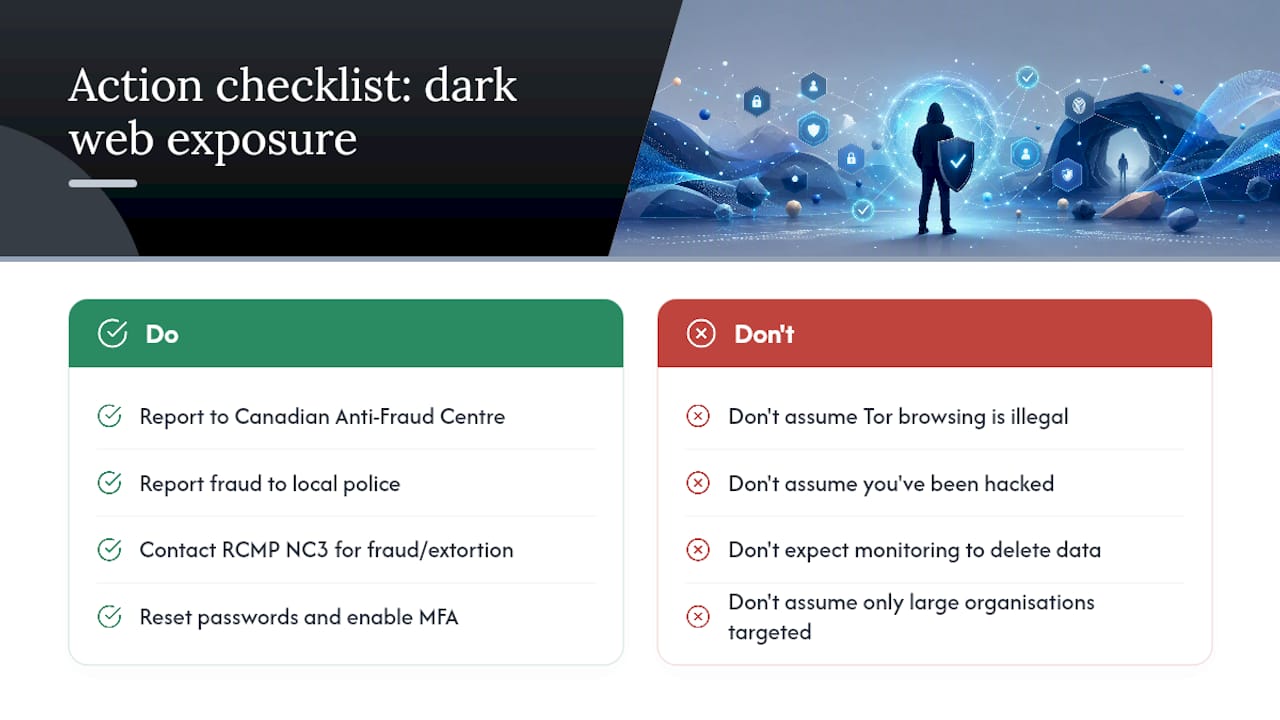
Myth: Browsing the dark web is illegal in Canada. Using Tor or visiting .onion sites is not, by itself, a criminal act. What you do there determines legality. Purchasing stolen data, accessing child sexual abuse material, or participating in criminal markets are illegal regardless of the network used. The network is neutral; the activity is not.
Myth: If your data is on the dark web, you've been hacked. Not necessarily. The most common cause of dark web exposure is a breach at a third party — a retailer, a SaaS vendor, a loyalty programme — that held your data. Your own systems may be entirely uncompromised.
Myth: Dark web monitoring services can remove your data. They cannot. Once data is copied and distributed across criminal networks, deletion is not technically possible. Monitoring tells you the data is there; remediation (password resets, MFA, fraud alerts) limits what an attacker can do with it.
Myth: Only large organisations are targeted. Criminal markets don't discriminate by company size. Infostealer malware infects any unprotected endpoint. Small businesses are frequently targeted precisely because their defences are thinner.
On Canadian law: Being a victim of a dark web exposure does not create criminal liability. Organisations that experience a breach have notification obligations under PIPEDA and may face regulatory review. Individuals who discover their data on the dark web should report to the Canadian Anti-Fraud Centre and, where financial fraud has occurred, to local police. Consult Canada for links to relevant federal agencies and sector-specific reporting channels.
When to involve law enforcement: if you have evidence of active fraud, extortion (ransomware), or a targeted attack, contact the RCMP's National Cybercrime Coordination Centre (NC3) in addition to the Cyber Centre. The Cyber Centre handles technical guidance; NC3 handles criminal investigation.
This article provides general information, not legal or professional advice. Confirm your specific notification obligations with qualified legal counsel and the Office of the Privacy Commissioner of Canada.
Detection is the last line of defence, not the first
The framing that bothers me most in conversations about dark web monitoring is when organisations treat it as a security programme. It isn't. It's a detection capability — and a partial one at that. By the time a monitoring service flags your data, the exposure has already happened. The credential has already been harvested. The session token is already for sale.
The organisations that handle this well don't just buy monitoring. They invest in the controls that stop data from reaching criminal markets in the first place: enforced MFA, password managers, EDR on every endpoint, short-lived session tokens, and third-party contracts that require breach notification within hours, not weeks. Monitoring sits on top of that foundation as an early-warning system, not a substitute for it.
For organisations that have outgrown self-serve tools but haven't yet built an internal security operations capability, managed monitoring with an integrated IR retainer is the practical middle ground. You get continuous coverage, alert triage, and a response team that can activate without the delay of sourcing one mid-incident. AccountNext-Nexus offers 24/7 monitoring and threat detection as part of a managed security service that integrates dark web alerting with incident response — worth considering if your current setup is a monthly HIBP check and a hope for the best.
The dark web isn't going away. Criminal markets are more organised, infostealer toolkits are cheaper, and the volume of exposed credentials grows every year. The question isn't whether your data will appear. It's whether you'll know quickly enough to do something about it.
Sources
The resources below are organised by use case: government guidance first, then practical tools, then background reading.
- ISO - What is the dark web? Myths, realities and cybersecurity risks
- Security guidance for dark web leaks (ITSAP.00.115)
- Is the Dark Web Dangerous? The Real Risks You Need To Know
Have I Been Pwned is a one-off or periodic check tool — run it on demand or monthly. Hudson Rock Cavalier is best used reactively when an infostealer infection is suspected. Commercial and managed monitoring platforms are continuous by design and appropriate when periodic checks are insufficient for your risk profile. The Cyber Centre guidance is the authoritative Canadian reference for any organisation navigating a confirmed dark web exposure event.