
Medical device security is the practice of protecting connected medical devices, their firmware, software, networks, cloud services, and the data they carry from cyberthreats — with the explicit goal of preserving patient safety and maintaining the confidentiality, integrity, and availability (CIA triad) of health information across the device's total product life cycle (TPLC). In Canada, Health Canada and the Canadian Centre for Cyber Security (Cyber.gc.ca) set the primary guidance framework, complemented by international standards including IEC 62304, IEC 62443, and ISO/IEC 27001.
The scope is broader than most teams initially assume:
- Devices and firmware: implantables, infusion pumps, imaging systems, patient monitors, and home-monitoring IoMT endpoints
- Software and networks: device operating systems, clinical applications, hospital Wi-Fi, and the APIs connecting devices to cloud back-ends
- Data flows and life cycle: PHI in transit and at rest, from design and pre-market through post-market surveillance and eventual decommissioning
Core security objectives span authenticity (verifying device and user identity), authorisation (controlling who can issue commands), availability (keeping devices operational when patients need them), confidentiality (protecting health data), and secure updatability (applying patches without disrupting clinical workflows or invalidating regulatory certification).
Table of Contents
- Why threat actors target medical devices
- How threat actors compromise medical devices
- Impacts of medical device security failures
- Who is responsible across the device life cycle
- What the Canadian regulatory and standards landscape requires
- Concrete protections: manufacturer controls vs. HDO controls
- How to assess and prioritise medical device security risk
- Illustrative scenarios and lessons learned
- Practical implementation checklist for Canadian manufacturers and HDOs
- Final recommendations and immediate next steps
- Key takeaways
- Why continuous security is the only honest answer
- AccountNext-Nexus: managed security for Canadian healthcare
- Useful sources and further reading
Why threat actors target medical devices
Attackers do not go after medical devices because they are easy — though many are. They go after them because the payoff is exceptional on multiple dimensions.

Protected health information (PHI) commands a premium on criminal markets because it contains enough detail to enable identity fraud, insurance fraud, and targeted extortion. A single patient record typically includes name, date of birth, insurance identifiers, and diagnosis history. That combination is far more durable than a stolen credit card number.
Beyond data theft, devices serve as pivot points. A networked infusion pump or imaging workstation sits inside the hospital's clinical network, often with trusted relationships to other systems. Compromising one device can give an attacker lateral movement into administrative systems, electronic health records, or even building management infrastructure. Ransomware operators have learned this well: locking clinical devices creates immediate pressure on hospital leadership to pay, because the alternative is cancelled procedures and diverted patients.
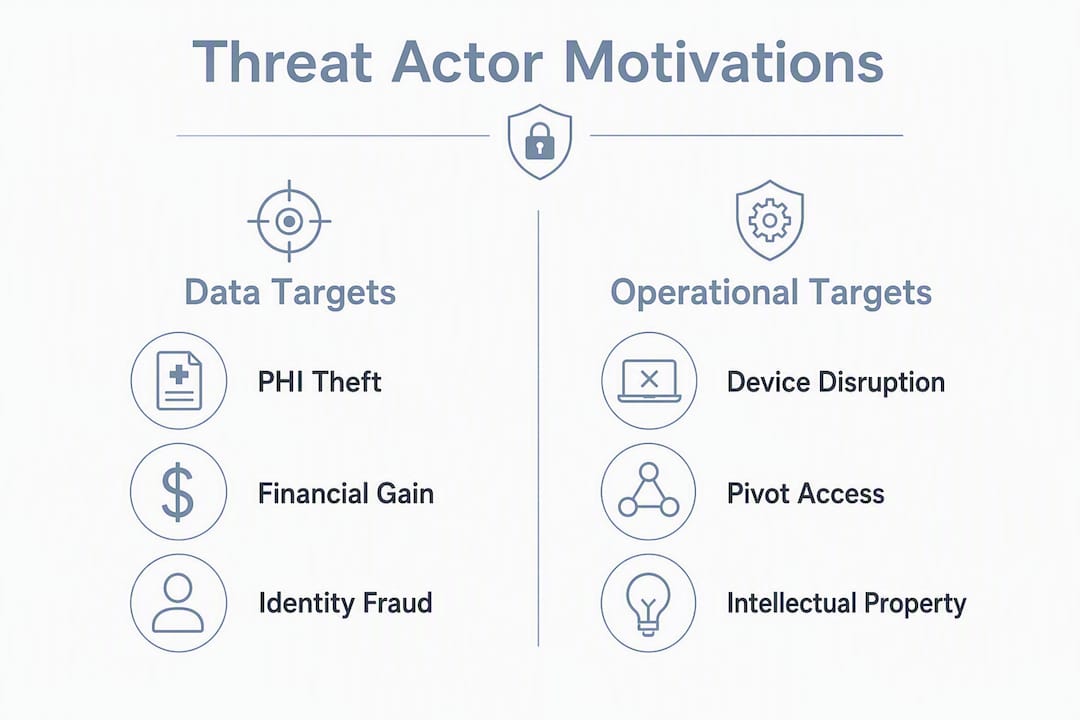
Intellectual property is a less-discussed but real motivation for nation-state actors. Medical device manufacturers hold proprietary algorithms, drug-delivery protocols, and clinical trial data. A sophisticated adversary targeting a Canadian device manufacturer is often after that IP, not the hospital network downstream.
The asymmetry is stark. Many devices run unpatched operating systems, have default credentials that were never changed, and connect to networks that were not designed with segmentation in mind. The cost to an attacker of probing these targets is low. The cost to a hospital of a disrupted device is measured in patient care, not just dollars.
In 2020, a ransomware attack on Düsseldorf University Hospital in Germany disrupted clinical operations severely enough that a patient requiring emergency care had to be redirected to another facility. While causation in that specific case remains debated, the scenario illustrates the direct line between device and network compromise and patient harm.
How threat actors compromise medical devices
The following attack vectors are ordered roughly by frequency and relevance in Canadian healthcare environments. Each carries a one-line mitigation pairing.
-
Unpatched firmware: Firmware vulnerabilities persist for years on devices that lack an automated update path. Mitigation: maintain a firmware version register and coordinate vendor-verified updates on scheduled maintenance windows. Threat modelling with STRIDE helps identify which unpatched components carry the highest exploitability.
-
Supply-chain vulnerabilities: — Third-party components, open-source libraries, and contract manufacturing introduce risks that the device manufacturer may not fully audit. Mitigation: require a software bill of materials (SBOM) from vendors; include security clauses in procurement contracts.
-
Insecure APIs and cloud interfaces: As devices increasingly offload data to cloud back-ends, poorly secured APIs become an attack surface. Mitigation: enforce OAuth 2.0 or equivalent; audit API permissions regularly. Guidance on cloud security in healthcare covers this in depth.
Canadian health environments face a compounding factor: a large installed base of legacy devices in public hospitals, a growing number of home-monitoring IoMT endpoints connecting over residential broadband, and shared networks where clinical and administrative traffic co-mingle. Each of these raises the baseline exposure.
Impacts of medical device security failures
The consequences of a compromised medical device split across three categories, and the clinical ones tend to get underweighted in budget conversations.

Clinical impacts are the most direct. A compromised infusion pump could deliver an incorrect drug dose. A ransomware attack that takes imaging systems offline delays diagnosis for every patient in the queue. Loss of continuous monitoring capability on a cardiac ward creates gaps in patient observation that clinicians cannot fully compensate for manually. Regulatory guidance and expert consensus frame cybersecurity failures explicitly as potential patient-safety events, not merely IT incidents.
Operational impacts are severe and often underestimated in duration. Forensic investigation, device re-certification, and clinical re-validation after a breach can take weeks. Cancelled procedures generate backlog that takes months to clear. Reputational damage affects patient trust, staff morale, and a hospital's ability to attract clinical talent. For device manufacturers, a publicly disclosed vulnerability can trigger regulatory review, product recalls, and loss of market access.
Regulatory and legal consequences in Canada are specific. Health Canada expects manufacturers to report post-market safety issues, and a cybersecurity incident that affects device safety or performance falls within that obligation. Failure to report can affect a device licence and market access. Health delivery organisations (HDOs) face obligations under provincial privacy legislation and the federal Personal Information Protection and Electronic Documents Act (PIPEDA) when PHI is exposed. The Canadian Centre for Cyber Security also expects critical infrastructure operators, including major hospitals, to report significant incidents.
Who is responsible across the device life cycle
Responsibility for medical device security does not sit with any single team. It is distributed across a chain of stakeholders, and gaps appear precisely where handoffs are unclear.
| Stakeholder | Primary obligations | Practical actions |
|---|---|---|
| Manufacturer | Secure design, threat modelling, SBOM, post-market vulnerability monitoring, coordinated disclosure | Integrate security into QMS; publish a vulnerability disclosure policy; issue timely, verified patches |
| Health delivery organisation (HDO) | Asset inventory, network segmentation, RBAC, monitoring, clinical safety review of patches | Maintain a device register; segment clinical networks; define patch approval workflows |
| Clinician / clinical engineering | Safe device operation, reporting anomalies, physical access control | Follow device-specific security procedures; report unexpected behaviour promptly |
| Cloud / third-party service provider | Secure API design, data encryption, access logging, contractual security commitments | Meet SLA security requirements; provide audit logs on request; notify HDO of incidents |
| Health Canada / Cyber.gc.ca | Regulatory oversight, guidance publication, incident coordination | Issue pre-market and post-market guidance; publish advisories; coordinate national response |
AdvaMed's foundational principles position this as a partnership model: manufacturers run vulnerability-monitoring programmes and maintain disclosure channels; HDOs plan mitigations without disrupting care; and regulators provide the framework within which both operate. Coordinated vulnerability disclosure — where a researcher or HDO notifies the manufacturer privately before public disclosure — is the mechanism that keeps this partnership functional.
What the Canadian regulatory and standards landscape requires
Canada does not yet have a single dedicated medical device cybersecurity regulation equivalent to the FDA's 2023 final guidance, but the framework is substantive and growing.
Canadian authorities:
- Health Canada — expects cybersecurity to be addressed across the total product life cycle, from design and pre-market submission through post-market surveillance. Guidance recommends integration with safety risk management and references international standards from the International Medical Device Regulators Forum (IMDRF).
- Canadian Centre for Cyber Security (Cyber.gc.ca) — publishes ITSAP.00.132, Cyber Security for Connected Medical Devices, which gives HDOs and manufacturers practical controls and incident-reporting expectations.
International standards commonly referenced in Canadian submissions:
FDA guidance as an international reference: The FDA's 2023 final guidance on Cybersecurity in Medical Devices: Quality System Considerations and Content of Premarket Submissions is widely cited in Canadian regulatory submissions as a benchmark, even though it is a U.S. instrument. Canadian manufacturers exporting to the U.S. must comply with it directly; those selling only in Canada use it as a reference for state-of-the-art expectations.
For a detailed breakdown of how these standards map to Health Canada's submission requirements, the medical device cybersecurity guidelines compliance guide covers the current framework.
Concrete protections: manufacturer controls vs. HDO controls
Security controls split cleanly by who owns the device versus who deploys it. Both sides have non-negotiable responsibilities.
| Control area | Manufacturer actions | HDO actions |
|---|---|---|
| Asset visibility | Publish SBOM; document all third-party components | Maintain a live device register with firmware versions and network locations |
| Secure design | Threat modelling (STRIDE); security risk assessment alongside ISO 14971 | Review manufacturer security documentation before procurement |
| Access control | Enforce least-privilege by default; no shared credentials | Implement RBAC; rotate credentials at deployment and staff changes |
| Patching | Issue cryptographically signed, vendor-verified updates with clinical impact notes | Define patch approval workflow; test in staging before clinical deployment |
| Network security | Minimise exposed interfaces; document required ports | Segment clinical device networks; restrict lateral movement |
| Monitoring | Provide audit log capability; support SIEM integration | Deploy EDR/NDR on clinical networks; alert on anomalous device behaviour |
| Incident response | Maintain a vulnerability disclosure channel; commit to response timelines | Maintain an incident response plan covering device-specific scenarios |
| Supply chain | Audit third-party components; contractual security requirements for suppliers | Require SBOM and vulnerability disclosure policy in procurement contracts |
Immediate priorities (0–30 days): complete a device asset inventory, identify devices with default credentials, and confirm network segmentation between clinical and administrative traffic.
Medium-term (30–90 days): establish a firmware version register, define a patch approval workflow with clinical engineering, and implement RBAC across all device management interfaces.
Pro Tip: Standard IT patch cycles do not work for medical devices. A firmware update may invalidate regulatory certification or disrupt a clinical workflow mid-shift. Coordinate update windows with clinical engineering and biomedical staff, and require vendor-verified patch notes that explicitly address clinical impact before any update goes live.
Pro Tip: Staff credential hygiene is one of the fastest wins available to an HDO. Cybersecurity awareness training that covers device-specific credential handling — not just general phishing awareness — reduces the insider-threat and credential-reuse vectors simultaneously.
How to assess and prioritise medical device security risk
Not every device carries equal risk, and most HDOs cannot remediate everything at once. A triage framework keeps effort proportional to clinical impact.
- Decide: mitigate or compensate: — If a patch is available and vendor-verified, schedule it. If the device is legacy and a patch is not forthcoming, implement compensating controls — network isolation, enhanced monitoring, manual override procedures — and document the decision for Health Canada post-market reporting purposes.
Timeline and cost drivers to plan for: firmware complexity and regression testing, regulatory re-verification for Class II and Class III devices, clinical acceptance testing, vendor coordination lead times, and supply-chain delays for hardware-dependent fixes. Legacy devices with long service lives present a particular challenge because their hardware may not support modern update mechanisms at all, requiring compensating controls as a long-term posture rather than a temporary bridge.
The cybersecurity maturity model framework provides a structured way to benchmark current capability and prioritise investment across this triage process.
Illustrative scenarios and lessons learned
Scenario 1: Ransomware affecting device availability
A mid-sized Canadian regional hospital experienced a ransomware infection that propagated from an administrative workstation onto the clinical network because network segmentation between the two environments was incomplete. Imaging systems and several networked patient monitors became unavailable for approximately 36 hours while the IT team isolated affected systems.
What went wrong: Flat network architecture allowed lateral movement; no NDR was in place to detect unusual traffic before encryption began.
Immediate mitigation: Emergency network isolation of clinical VLANs; manual monitoring protocols activated; vendor contacted for device recovery procedures.
Long-term fix: Full network segmentation project implemented; NDR deployed on clinical segments; incident response plan updated to include device-specific recovery runbooks.
Lesson: Segmentation is not optional. A single flat network means one compromised endpoint can reach every device.
Scenario 2: Exploited remote update channel
A manufacturer's remote update mechanism for a line of patient monitoring devices used an unauthenticated HTTP endpoint to deliver firmware packages. A researcher demonstrated that an attacker with network access could push a modified firmware image, altering alarm thresholds.
What went wrong: The update channel lacked cryptographic signature verification; the vulnerability was not identified during pre-market testing.
Immediate mitigation: HDOs were advised to block outbound connections from affected devices to the update server until a patch was available; manual alarm checks were added to clinical protocols.
Long-term fix: Manufacturer redesigned the update mechanism with signed packages and mutual TLS; UL 2900 testing was added to the verification programme.
Lesson: Update channels are attack surfaces. Treat them with the same rigour as any externally exposed interface.
Scenario 3: Legacy infusion pump awaiting vendor patch
A hospital's biomedical engineering team identified that a widely deployed infusion pump model ran firmware with a known buffer-overflow vulnerability. The manufacturer confirmed a patch was 18 months away due to regulatory re-certification requirements.
What went wrong: The device was procured without a contractual commitment to timely patching; no compensating controls were in place.
Immediate mitigation: Devices were moved to an isolated VLAN with no internet access; physical USB ports were taped and logged; enhanced monitoring was added.
Long-term fix: Procurement policy updated to require a vulnerability disclosure policy and patch timeline commitment from all device vendors before purchase.
Lesson: Procurement is a security control. Require patch commitments in the contract before the device arrives on the ward.
Practical implementation checklist for Canadian manufacturers and HDOs
30-day actions (triage and visibility)
- Manufacturer: Complete or update the SBOM for all active product lines; confirm a vulnerability disclosure channel is published and staffed.
- HDO security team: Run an asset discovery scan across all clinical network segments; produce a device register with firmware versions, network locations, and clinical criticality ratings.
- HDO security team: Audit credentials on all networked devices; identify and remediate default or shared credentials within 30 days.
- Clinical engineering: Confirm that all devices have a designated biomedical contact and that anomaly-reporting procedures are documented and communicated to ward staff.
60-day actions (controls and process)
- Manufacturer: Integrate threat modelling (STRIDE or equivalent) into the development process for all products under active development; document results alongside ISO 14971 risk files.
- HDO security team: Implement or verify network segmentation between clinical device VLANs and administrative networks; test segmentation with a controlled scan.
- HDO security team / clinical engineering: Define a patch approval workflow that includes clinical impact assessment, staging environment testing, and a coordinated maintenance window process.
- Procurement / legal: Add vulnerability disclosure, patch timeline, and forensic evidence retention clauses to all new device procurement contracts. The role of procurement in cybersecurity outlines model clause language.
90-day actions (programme and governance)
- Manufacturer: — Establish a post-market vulnerability monitoring programme; subscribe to relevant CVE feeds and ISAC alerts (H-ISAC for healthcare); set internal SLAs for patch release.
Contract clause essentials to require from vendors: written vulnerability disclosure policy with response timelines; commitment to coordinated maintenance windows; support for forensic evidence retention (logs, images) for a minimum of 12 months; notification obligation within 72 hours of a confirmed breach affecting the device.
Final recommendations and immediate next steps
The single most impactful action most Canadian HDOs can take right now is completing a device asset inventory. You cannot protect what you cannot see, and many organisations discover unexpected devices on their clinical networks that no one formally registered.
For manufacturers, the equivalent starting point is publishing a vulnerability disclosure policy. Without one, researchers and HDOs have no reliable channel to report issues, and problems fester until they become public incidents.
Beyond those two anchors, the following steps move the programme forward:
- Review Health Canada's TPLC guidance — and confirm your post-market surveillance programme captures cybersecurity events as potential safety signals.
- Consult Cyber.gc.ca's ITSAP.00.132 — for HDO-specific controls and incident-reporting expectations.
Quick wins that demonstrate value to leadership: a before-and-after credential audit showing the positive impact of eliminating default credentials; a network segmentation map showing clinical device isolation; and a firmware version register demonstrating improvements in devices running current, vendor-supported firmware. These three metrics are concrete, measurable, and directly tied to reduced exposure.
For a managed implementation path, AccountNext-Nexus offers 24/7 monitoring, incident response, and compliance assessments that map directly to the checklist above.
Key takeaways
Medical device security requires manufacturers and HDOs to share responsibility across the full device life cycle, with patient safety as the non-negotiable priority.
| Point | Details |
|---|---|
| CIA triad and patient safety | Medical device security protects confidentiality, integrity, and availability of health data, with patient safety as the primary driver. |
| Shared responsibility model | Manufacturers, HDOs, clinicians, cloud providers, and Health Canada each hold distinct, non-delegable obligations across the TPLC. |
| Top technical priorities | Asset inventory, network segmentation, RBAC, and vendor-verified patch workflows are the highest-impact controls for most Canadian HDOs. |
| Start within 30 days | Run an asset discovery scan, audit default credentials, and confirm a vulnerability disclosure contact for every networked device. |
| AccountNext-Nexus managed services | AccountNext-Nexus provides 24/7 monitoring, managed patching coordination, and compliance assessments aligned to Health Canada and Canadian Centre for Cyber Security requirements. |
Why continuous security is the only honest answer
The framing I see most often in healthcare security conversations is the project framing: get compliant, pass the audit, move on. It is understandable — hospitals are under-resourced and the regulatory checklist feels like a finish line. But medical device security does not have a finish line.
Threat actors update their techniques faster than most device manufacturers release patches. The attack surface grows every time a new IoMT device connects to a clinical network. And the consequences of getting it wrong are not a data breach notification and a fine — they are a patient who does not get the care they need when they need it.
The organisations that handle this well treat security as an operational discipline, not a compliance exercise. They maintain continuous visibility into what is on their network, they have tested relationships with their device vendors, and they have an incident response plan that clinical staff have actually read. That posture requires ongoing effort, which is exactly why a managed service model makes sense for most HDOs: the alternative is building and retaining a specialised team internally, which most Canadian health organisations cannot sustain.
The 30/60/90-day checklist in this article is a genuine starting point, not a complete programme. The complete programme is the one that keeps running after day 90.
AccountNext-Nexus: managed security for Canadian healthcare
Canadian healthcare organisations face a specific challenge: the devices, networks, and regulatory obligations described in this article require specialised expertise that most internal IT teams were not hired to provide. Hiring for it is slow and expensive; leaving gaps is not an option when patient safety is on the line.
AccountNext-Nexus delivers 24/7 threat monitoring and incident response purpose-built for organisations that need continuous coverage without building a dedicated internal security operations centre. The service covers managed patching coordination, network segmentation review, RBAC implementation, and compliance assessments mapped to Health Canada, ISO/IEC 27001, and HIPAA requirements — all under a fixed-fee model with a single SLA.
For manufacturers, the compliance assessment service addresses pre-market cybersecurity documentation requirements and post-market vulnerability monitoring programme design. For HDOs, the managed monitoring service provides the continuous visibility that makes the asset inventory and anomaly detection steps in the checklist above operational rather than theoretical.
Contact AccountNext-Nexus to book a security assessment and get a clear picture of your current device security posture within two weeks.
Useful sources and further reading
Canadian authorities:
- Canadian Centre for Cyber Security — ITSAP.00.132: Cyber Security for Connected Medical Devices
- Health Canada — Cybersecurity for medical devices: recommended best practices during design, development and deployment
International standards and guidance:
- FDA — Cybersecurity in Medical Devices: Quality System Considerations and Content of Premarket Submissions (Federal Register, 2023)
- AdvaMed — Foundational Principles for Medical Device Cybersecurity
Practical testing and implementation resources:
- Medical Device Product Security — Open Textbook Library (University of Minnesota)
- AccountNext-Nexus — Medical device cybersecurity guidelines: 2026 compliance guide
- AccountNext-Nexus — Healthcare network security best practices for Canadian IT teams
This article provides general information about medical device security practices and standards. It is not legal, regulatory, or professional advice. Confirm current Health Canada requirements and applicable standards with a qualified regulatory professional or legal counsel before making compliance decisions.