
Every successful AWS migration follows the same sequence: assess your portfolio, mobilize your landing zone and teams, then migrate and modernize in waves. That's the AWS-prescribed structure, and skipping straight to "lift and shift" without the first two phases is the single most common reason migrations stall.
Start this week with:
- A quick inventory of servers, databases, and dependencies (even a spreadsheet counts)
- A Migration Readiness Assessment to score people, process, and platform gaps
- A minimal landing zone: one account structure, baseline IAM, and network guardrails
- A short list of 5 to 10 low-risk apps for your first migration wave
Key Takeaways
A successful AWS migration depends on running assess, mobilize, and migrate & modernize as connected phases, backed by the right 7 Rs decision per app and a migration factory built for scale.
| Point | Details |
|---|---|
| Follow the three phases | Sequence assess, mobilize, and migrate & modernize; don't skip straight to moving workloads. |
| Match strategy to workload | Use the 7 Rs framework and reserve refactor for apps where the business case justifies it. |
| Build the landing zone first | A correctly configured landing zone prevents rebuilding security controls per application. |
| Run waves, not a big bang | Use short sprints, pilot wave 1, and retrospectives to refine the migration factory pattern. |
| Bring in Nexus for gaps | Nexus supports assessment, landing zone build, and wave execution when internal capacity or expertise is limited. |
Table of Contents
- What are the three phases of an AWS migration guide?
- Which of the 7 Rs fits each application?
- How do you plan governance for a cloud migration?
- Which AWS tools match each migration phase?
- How does a migration factory run in practice?
- What timeline and cost should you expect?
- When should you bring in a managed migration partner?
- Detailed risk management strategies during migration phases
- Best practices for involving and training teams during migration
- Post-migration optimization and performance tuning on AWS
- What experienced migration leaders wish they'd known sooner
- How Nexus supports your AWS migration
- Sources
What are the three phases of an AWS migration guide?
Assess answers whether you're ready and what you're moving. It produces a portfolio inventory, dependency maps, and a directional business case. Mobilize builds the foundation, meaning your landing zone, security baseline, skills plan, and migration factory processes, so migration at scale doesn't mean rebuilding controls for every app. Migrate and modernize is where workloads actually move, get validated, and get optimized, one wave at a time.
The phases aren't strictly linear. Discovery continues into mobilize, and lessons from early migration waves feed back into how later waves are planned, a loop AWS's own guidance treats as core to the model rather than a fallback.
| Phase | Primary deliverable | Example workstream |
|---|---|---|
| Assess | Portfolio inventory, dependency map, business case | Migration Readiness Assessment (MRA) |
| Mobilize | Landing zone, skills plan, migration factory setup | Account structure, IAM baseline, sprint cadence |
| Migrate & modernize | Migrated, validated, optimized workloads | Wave execution, cutover, post-migration tuning |
- Assess: inventory, prioritize, build the cost case
- Mobilize: stand up the landing zone and train the team
- Migrate & modernize: run waves, validate, tune performance
Which of the 7 Rs fits each application?
AWS's seven migration strategies give you a decision framework rather than a single answer. Here's what each one means in practice:
- Retire — decommission apps nobody uses anymore. Free money, and every portfolio has more of these than leaders expect.
- Retain — keep it on-premises for now, usually because of compliance, licensing, or a looming replacement.
- Rehost — move the workload as-is, usually with AWS Application Migration Service.
- Relocate — shift a VMware environment to AWS with minimal changes, often using VMware Cloud on AWS.
- Repurchase — drop the custom app and buy a SaaS equivalent.
- Replatform — make targeted improvements (managed database, containerized runtime) without a full rebuild.
- Refactor — rearchitect for cloud-native patterns when the business case justifies the investment.
Weigh each decision against business driver, technical fit, cost and effort, and how tangled the dependency web is. In large enterprise portfolios, the bulk of applications land in rehost or replatform. Reserve refactor for the handful of apps where performance or scaling actually demands it. Trying to refactor everything is how migration timelines double.
How do you plan governance for a cloud migration?
Your landing zone is the technical backbone: networking, IAM roles, logging, and security baselines defined once and reused across every workload, not rebuilt per application. Skipping this step is one of the most common causes of migrations that stall at scale.

Layer the AWS Cloud Adoption Framework perspectives, business, people, governance, platform, security, operations, on top to find organizational gaps, then apply the Well‑Architected Migration Lens to catch architecture risks before they become production incidents.
Governance essentials:
- Change control process with clear approval gates
- A communication plan reaching every stakeholder team, not just IT
- Runbooks for cutover, rollback, and incident response
- Compliance mapping to whatever frameworks apply (SOC 2, HIPAA, PCI-DSS)
- Assign an owner for each landing zone control
- Review governance cadence every sprint, not quarterly
Pro Tip: Run one-to-two week sprints with a retrospective after every wave. AWS's own guidance on migration programs treats this cadence as central to catching pattern problems before they repeat across dozens of applications.
Which AWS tools match each migration phase?
Picking the wrong tool for a workload type is how teams waste weeks. AWS's service decision guide maps tools to phase and workload type clearly enough to shortcut most of that guesswork.
Migration factory patterns turn tools like MGN and DMS into repeatable, automated processes rather than one-off manual efforts, the difference between migrating 20 servers and migrating 2,000. Reach for third-party tooling only when a workload has a requirement none of these services cover well, like a niche mainframe emulation need.
How does a migration factory run in practice?
A migration factory standardizes the technical and human process so wave 50 runs as smoothly as wave 1. AWS's guidance on mobilizing large-scale migrations frames this as reusing the patterns and automation built during a pilot wave, not reinventing them each time.
- Discovery: confirm inventory and dependencies for the wave's apps.
- Build: configure replication (MGN, DMS), networking, and target environments.
- Test: validate functionality, performance, and security controls before cutover.
- Cutover: switch traffic, monitor, and confirm success against gating criteria.
- Rollback readiness: keep the source environment available until validation clears.
Run wave 1 as a pilot with a one or two-week sprint cadence, then hold a retrospective before defining wave 2's pattern. That's precisely where AWS recommends short sprints and inception retrospectives to iterate quickly.
Pro Tip: Automate the repetitive parts first, replication setup, DNS cutover scripts, validation checks, even before your team feels "ready." The pilot wave's whole purpose is proving that automation works at small scale before you bet 200 servers on it.
What timeline and cost should you expect?
A small pilot often runs several weeks end to end. Mid-size programmes may stretch for several months. Large enterprise migrations with hundreds of apps commonly run over an extended period in waves. AWS's application portfolio assessment guidance suggests discovery in weeks 1 to 5, prioritized assessment by week 7, and detailed planning through week 14.
Build your cost case directionally, comparing current infrastructure and labour spend against projected AWS costs plus migration effort.
Directional benchmark: organizations citing AWS Cloud Adoption Framework research have reported cost-per-user reductions around 27% alongside less downtime post-migration, useful directional inputs, not guarantees for your specific portfolio.
- Track migration velocity (apps per sprint)
- Track cutover success rate and rollback rate
- Track cost per migrated application
When should you bring in a managed migration partner?
Bring in outside help when you see these gaps:
- No in-house team has run a migration at this scale before
- Security and compliance requirements (HIPAA, PCI-DSS, SOC 2) exceed current staff expertise
- Migration velocity needs to jump beyond what internal teams can sustain
- You need landing zone and migration factory built correctly the first time
A competent partner delivers a working migration factory, a hardened landing zone, and genuine knowledge transfer, not a black box your team can't maintain afterward. Many organizations run a mixed model: internal teams own business context and app knowledge, while the partner runs the factory and specialized tooling.
Detailed risk management strategies during migration phases
Migration risk isn't one thing. It shifts shape across the three phases, and treating it as a single checklist item is how teams get blindsided.
During assess, the biggest risk is incomplete discovery: an undocumented dependency between two systems that nobody flags until cutover day. Counter this with automated discovery tooling rather than relying purely on interviews, and build a dependency map before you commit to a wave sequence.
During mobilize, the risk shifts to the landing zone itself. A poorly configured landing zone creates security gaps that get replicated across every application that lands on it afterward, which is far more expensive to fix retroactively than to get right once. Run a security review of the landing zone before wave 1 touches it.
During migrate and modernize, cutover risk dominates: performance regressions, data sync failures, or an unexpected dependency surfacing mid cutover. Mitigate this with clear rollback criteria defined before cutover starts, not improvised during an incident. Keep source systems live until validation passes a defined checklist, not a gut feeling.
Cross-cutting all three phases: compliance risk. If you're migrating regulated workloads, map every control (encryption, access logging, audit trails) to its AWS equivalent before the wave, not after. A misconfigured cloud environment is one of the most common root causes behind post-migration security incidents, and most of them trace back to skipped validation steps rather than exotic attacks.
Best practices for involving and training teams during migration
The technical plan is rarely what sinks a migration. It's the people side. Migration guidance consistently points to organizational change, skills gaps, and operating model shifts, as the actual failure point in large programmes, far more often than the technology itself.
Start by identifying who owns what after migration. Application teams that assumed someone else would manage patching, monitoring, and incident response on AWS are in for an unpleasant surprise. Clarify shared responsibility explicitly, in writing, before wave 1 launches, not after an incident exposes the gap.
Train teams in layers rather than one giant workshop. Give infrastructure teams hands-on time with the landing zone and IAM model early. Give application teams exposure to their specific migration pattern (rehost versus replatform) closer to their wave date, so the training is still fresh when they need it.
Involve application owners in wave planning decisions rather than dictating a sequence to them. Teams that feel ambushed by a migration date resist it, sometimes actively, by finding technical reasons to delay. Teams that helped choose their wave date show up ready.
Build a feedback loop from each wave's retrospective back into training material. If wave 3 revealed a gap in how teams understood rollback procedures, fix that gap in the training before wave 4, not after another team hits the same problem.
Post-migration optimization and performance tuning on AWS
Migration doesn't end at cutover. The workloads that get abandoned right after go-live are the ones still running on oversized instances, unoptimized storage classes, and default configurations nobody revisited.
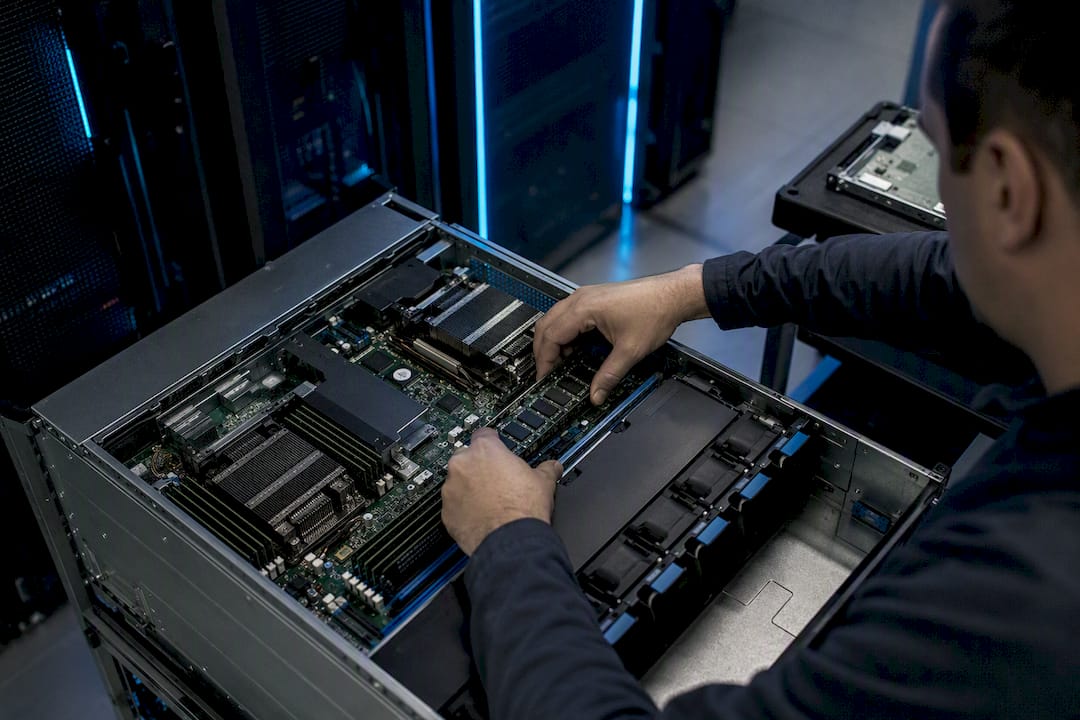
Start with rightsizing. Most rehosted workloads are provisioned to match their old on-premises specs, which usually overshoots what's actually needed once you factor in AWS's elasticity. Review CPU, memory, and storage utilization 30 to 60 days post-migration and resize accordingly.
Next, revisit architecture decisions that were deliberately deferred during the rush to migrate. A database that got a straight rehost might now be a strong candidate for replatforming to a managed service like Amazon RDS or Aurora, cutting operational overhead considerably.
Security posture deserves a dedicated post-migration review, not an afterthought. Confirm that security posture monitoring is actually running against production configurations, not just the pre-migration checklist. Vulnerability scanning cadences should shift to match your new cloud-native security tooling, which often differs meaningfully from on-premises scanning approaches.
Finally, revisit cost. Reserved Instances, Savings Plans, and storage tiering decisions made during migration under time pressure are rarely optimal on day one. A quarterly cost review catches drift before it compounds into a budget problem nobody can explain.
What experienced migration leaders wish they'd known sooner
Speed and modernization pull against each other constantly. Rehosting fast gets workloads off legacy infrastructure quickly, but it defers the harder architectural decisions. Centralized landing zone control keeps things consistent, but it can frustrate application teams who want autonomy over their own stack.
Three lessons repeat across enterprise migrations: dependency mapping always takes longer than anyone budgets for, the landing zone decision you make in week 2 haunts you for years if you get it wrong, and teams that skip a retrospective after wave 1 repeat the exact same mistakes in wave 5.
Nexus has watched these patterns play out across client environments enough times to know which ones actually predict trouble.
How Nexus supports your AWS migration
Running discovery, landing zone setup, and wave execution in-house while also keeping daily operations running is a lot to ask of one team. Nexus handles cloud migration and management across AWS as one piece of a broader IT and cybersecurity practice, so your migration factory, security controls, and compliance requirements get built by the same team instead of stitched together after the fact.
That matters most in the assess phase, where a rushed or incomplete Migration Readiness Assessment sets the tone for everything after it. Nexus can run that assessment, help you build the landing zone AWS's own foundation playbook treats as the critical prerequisite, and stay on as your wave-by-wave partner or hand off a fully documented factory to your internal team. If you're weighing whether to migrate solo or bring in support, start with a migration readiness conversation and get a straight answer on where your gaps actually are.
Sources
- Overview