
Adopt a role-mapped, LMS-driven training programme with documented evidence and scheduled reviews. That single sentence is what Canadian auditors want to see reflected in your records. If you do nothing else this quarter, take these three steps: map every staff role to its regulatory risk profile, assign baseline compliance courses through your learning management system (LMS) before staff begin patient-facing work, and activate automated tracking so completion timestamps, quiz scores, and attestation statements generate without manual effort.
Those three actions address the core obligations that Canadian healthcare regulators examine: privacy and security training under the Personal Information Protection and Electronic Documents Act (PIPEDA) and provincial equivalents, workplace safety under provincial occupational health and safety legislation, fraud and billing integrity under provincial health ministry expectations, and the audit evidence requirements that accreditation bodies such as Accreditation Canada assess during on-site reviews. An audit-ready compliance training programme does not happen by accident. It is built deliberately, documented meticulously, and reviewed on a schedule.
Pro Tip: Set your LMS to auto-enrol new hires the moment their HR record is created. Waiting until day one orientation means the window for pre-start privacy acknowledgement is already closed.
Table of Contents
- What Canadian laws actually require from healthcare compliance training
- Who needs what training, and when does it have to happen?
- What core topics must every healthcare compliance programme cover?
- How do you build a programme that actually holds up to scrutiny?
- How do you know if the training is actually working?
- What records do auditors actually want to see?
- What happens when training gaps get found by regulators?
- Why IT controls and staff training must work together
- Your implementation checklist and timeline
- Key takeaways
- The gap most compliance programmes never close
- How AccountNext-Nexus supports your compliance programme
- Authoritative sources and further reading
What Canadian laws actually require from healthcare compliance training
The regulatory framework driving healthcare compliance training in Canada is layered, and no single federal statute covers everything. Compliance officers need to map training obligations across at least four distinct legal domains.
Federal and provincial privacy law sits at the top. PIPEDA governs federally regulated health entities and sets the baseline for consent, breach notification, and safeguard obligations. Quebec's Law 25 (Act 25) is currently the most prescriptive provincial privacy statute in Canada, requiring documented privacy impact assessments and mandatory breach reporting to the Commission d'accès à l'information (CAI). Alberta's Health Information Act (HIA) and Ontario's Personal Health Information Protection Act (PHIPA) impose similar obligations on provincially regulated health custodians. Each of these statutes expects staff to understand what constitutes personal health information (PHI), how to handle it, and what to do when a breach occurs.
Workplace safety legislation is entirely provincial. Every province has its own Occupational Health and Safety (OHS) Act, and all of them require employers to train workers on hazards specific to their role. In healthcare, that means WHMIS 2015 (the Workplace Hazardous Materials Information System), bloodborne pathogen exposure procedures, and violence and harassment prevention, the last of which is now a mandatory training topic in Ontario, British Columbia, Alberta, and most other provinces.
Accreditation standards from Accreditation Canada's Qmentum programme require organisations to demonstrate that staff are trained and competent in patient safety, infection prevention and control (IPAC), and medication safety. These standards are assessed through document review and staff interviews during on-site surveys.
Health ministry and payer expectations round out the picture. Provincial ministries that fund healthcare services expect billing staff to understand provincial fee schedule rules, and they audit for upcoding, unbundling, and documentation gaps. The federal Criminal Code also applies to fraud against public health programmes.
| Regulatory domain | Primary Canadian instrument | Training obligation |
|---|---|---|
| Privacy and PHI | PIPEDA, PHIPA, HIA, Law 25 | PHI handling, breach response, consent |
| Workplace safety | Provincial OHS Acts, WHMIS 2015 | Hazard-specific, violence prevention |
| Accreditation | Accreditation Canada Qmentum | Patient safety, IPAC, medication safety |
| Billing integrity | Provincial health ministry rules | Fee schedule, documentation, fraud |
| Infection prevention | Public Health Agency of Canada guidance | IPAC protocols, PPE, outbreak response |
Pro Tip: Download your provincial OHS Act's healthcare-specific guidance and cross-reference it against your current training catalogue once a year. Regulations update quietly, and a missed amendment is the kind of gap that shows up in an audit, not in your inbox.
Who needs what training, and when does it have to happen?
Not every staff member carries the same risk profile, and assigning identical training to a receptionist and a pharmacist wastes time while leaving real gaps uncovered. The starting point is a role-risk matrix that maps each position to the regulatory obligations and hazards it actually touches.
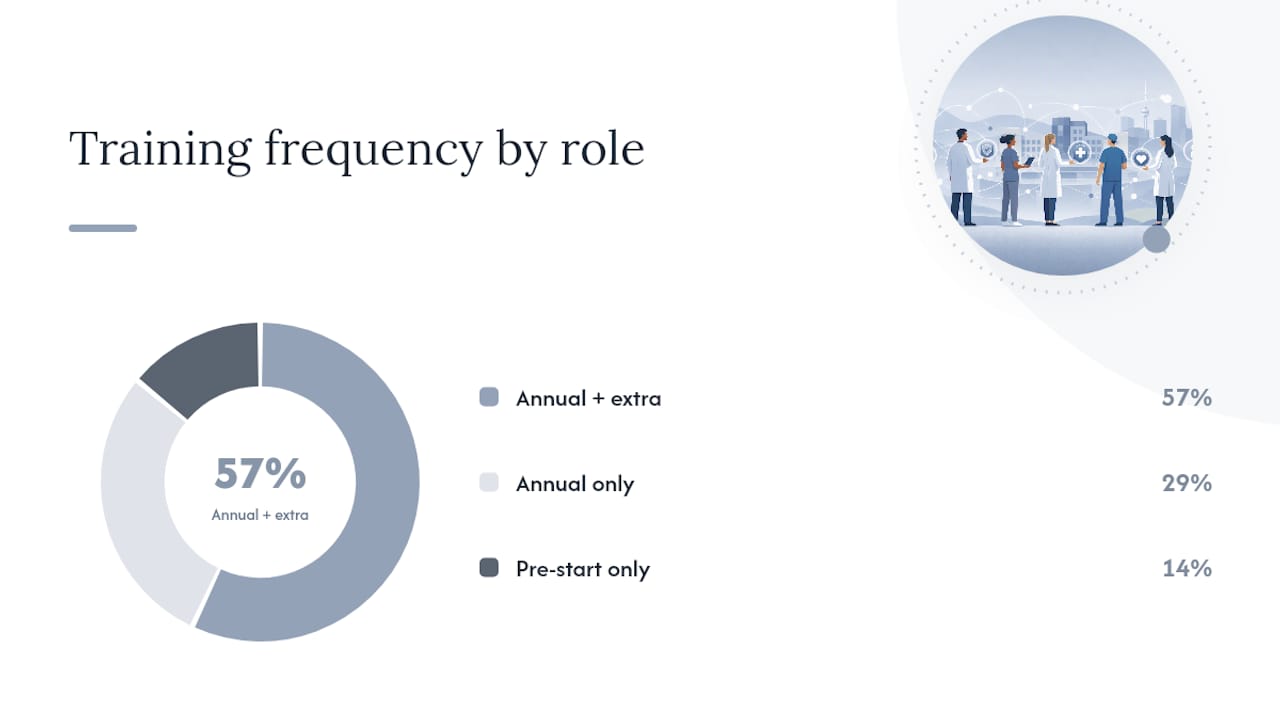
Healthcare compliance training frameworks consistently recommend four training trigger points: pre-start or day-one onboarding, within the first 30 days, at 90 days for role-specific depth modules, and annually for refreshers. Role changes and incidents add a fifth and sixth trigger.
| Role category | Core modules | Specialised modules | Frequency |
|---|---|---|---|
| Clinical (nurses, physicians, allied health) | Privacy/PHI, WHMIS, IPAC, violence prevention | Medication safety, clinical documentation, consent | Annual + incident-triggered |
| Administrative | Privacy/PHI, workplace violence, billing basics | Fee schedule rules, records management | Annual |
| Billing and coding | Privacy/PHI, fraud and abuse, documentation | Provincial fee schedule, audit response | Annual + policy-change triggered |
| IT and cybersecurity | Privacy/PHI, access management, incident response | Medical device hygiene, vendor controls | Annual + threat-triggered |
| Leadership and management | All core modules | Compliance programme oversight, reporting obligations | Annual |
| Contractors and vendors | Privacy/PHI basics, site-specific safety | Role-specific per contract | Pre-access + annual |
| Volunteers | Privacy/PHI basics, workplace violence | Role-specific | Pre-start |
Exceptions and accommodations need their own paper trail. A staff member who cannot complete standard e-learning due to a disability, language barrier, or technology access issue should have an alternative pathway documented: a competency assessment, an in-person session with a qualified trainer, or a translated module. The accommodation itself, the rationale, and the outcome all belong in the training record.
Pro Tip: Tie your LMS enrolment rules directly to your HR system's job-title field. When someone changes roles, the system should automatically drop irrelevant modules and assign the new role's curriculum within 24 hours, without a coordinator having to remember to do it manually.
Training is also an investment in retention. Organisations that invest consistently in employee training and development see longer average tenure, which matters in a sector where turnover is a persistent operational risk.
What core topics must every healthcare compliance programme cover?
A defensible compliance training programme covers eight topic areas at minimum. The CITI Program's healthcare compliance curriculum structures these around the seven elements of an effective compliance programme, which maps cleanly onto Canadian regulatory expectations.
1. Privacy and information security (PHI/ePHI) Learners must identify what constitutes PHI under applicable Canadian law, apply minimum-necessary access principles, recognise a reportable breach, and follow the organisation's breach notification procedure. Assessment: scenario-based quiz where learners classify incidents as reportable or not.
2. Infection prevention and control (IPAC) Learners must demonstrate correct hand hygiene technique, apply appropriate PPE for their role, and follow outbreak protocols. Assessment: skills demonstration or observed practice for clinical staff; knowledge check for administrative staff.

3. WHMIS and workplace hazard safety Learners must read a Safety Data Sheet (SDS), identify WHMIS 2015 pictograms, and apply safe handling procedures for hazardous products in their work area. Assessment: practical identification exercise.
4. Workplace violence and harassment prevention Learners must recognise early warning signs of escalating behaviour, apply de-escalation techniques appropriate to their role, and report incidents through the correct channel. Assessment: scenario-based simulation.
5. Billing integrity and fraud prevention Billing and coding staff must distinguish between upcoding, unbundling, and appropriate billing; identify documentation requirements for each service billed; and know the reporting pathway for suspected fraud. Assessment: case-based coding exercise.
6. Documentation and consent Learners must apply the organisation's documentation standards, obtain and record informed consent correctly, and understand retention obligations under provincial law. Assessment: documentation audit exercise using sample records.
7. Medication safety Clinical staff must apply the "five rights" of medication administration, recognise high-alert medications, and follow the organisation's double-check protocol. Assessment: scenario with a simulated medication order.
8. Clinical and administrative ethics Learners must identify conflicts of interest, apply the organisation's gift and disclosure policy, and know the whistleblower protection provisions available to them under Canadian law.
Scenario-based learning and microlearning consistently outperform passive slide decks for retention and on-the-job behaviour change. A 10-minute scenario module followed by a brief knowledge check the next day produces better recall than a 45-minute lecture. Build your curriculum around that finding, not around what is easiest to produce.
Pro Tip: For each module, write the assessment question before you write the content. If you cannot write a question that tests a real behaviour, the learning objective is not specific enough.
How do you build a programme that actually holds up to scrutiny?
Building a programme that satisfies auditors and changes behaviour requires more than uploading PDFs to a shared drive. The steps below reflect what audit-ready training programmes have in common.
Step 1: Regulatory mapping. List every applicable statute, standard, and accreditation requirement. Note the specific training obligation each creates (who, what, how often, what evidence).
Step 2: Role-risk matrix. Cross-reference your staff roles against the regulatory map. Assign a risk tier (high, medium, low) to each role based on PHI access, patient contact, and billing authority.
Step 3: Curriculum design. Build or procure modules for each required topic. For high-risk roles, prioritise scenario-based delivery and skills demonstrations over passive reading. For lower-risk roles, short microlearning modules with knowledge checks are proportionate and effective.
Step 4: Delivery mix. Online modules handle conceptual content at scale. In-person or live virtual sessions work better for hands-on skills like PPE donning, evacuation drills, and de-escalation practice. A blended approach gives you both coverage and depth.
Step 5: Assessment and remediation. Every module needs a pass threshold (typically 80% for compliance topics). Learners who fail get an automatic remediation assignment, not a manual email from a coordinator.
Step 6: Documentation. Every completion event generates a timestamped record with the learner's name, job title, module title, score, and attestation. These records are your audit evidence.
What should your LMS actually do?
An LMS for healthcare compliance is not a content library. It is an evidence management system that happens to deliver training. Before you sign a contract, confirm these capabilities:
- Automated enrolment triggered by HR data (hire date, job title, location, role change)
- Configurable reminder rules (7-day, 3-day, 1-day before deadline)
- Completion certificates with tamper-evident timestamps
- Audit log export in CSV or PDF within minutes
- Role-based enrolment groups that update automatically
- Reporting API or native dashboard showing completion rate, pass rate, and overdue learners by department
- Support for SCORM and xAPI content standards so you are not locked into one content vendor
Vendor evaluation questions to ask before you commit:
- How does your system handle role changes and automatic re-enrolment?
- Can you produce a full training transcript for a named employee within 10 minutes?
- What is your data retention policy, and can we export all records if we leave?
- Do you have Canadian data residency options?
LMS analytics and data-driven L&D approaches let organisations identify knowledge gaps before incidents occur, rather than discovering them during an audit or after a breach. That shift from reactive to proactive is the single biggest operational benefit of a well-configured LMS.
Pro Tip: Run a quarterly "red list" report: every learner who is overdue or has failed a module twice. Send it to department managers, not just the compliance team. Shared accountability closes gaps faster than compliance-only follow-up.
How do you know if the training is actually working?
Completion rates are necessary but not sufficient. A 98% completion rate with a 60% average pass score on a privacy module tells you people clicked through without learning. The KPIs below give a more complete picture.
| KPI | What it tells you | Reporting cadence |
|---|---|---|
| Completion rate by role | Coverage gaps by department | Monthly |
| Pass rate by module | Content or comprehension issues | Monthly |
| Time to completion | Engagement (very fast = skimming) | Quarterly |
| Assessment score variance | Identifies outlier knowledge gaps | Quarterly |
| Repeat failure rate | Flags learners needing alternative support | Monthly |
| Incident rate post-training | Behaviour change indicator | Quarterly |
| Overdue rate by manager | Accountability signal | Monthly |
Workforce compliance reporting tools can automate many of these dashboards, pulling data from your LMS and HR system into a single view that compliance leaders and auditors can read quickly.
For continuous improvement, run a sample audit quarterly: pull 10 random training records and verify that each one is complete, correctly dated, and matches the learner's current role. Learner surveys after each module (three questions, two minutes) surface content quality issues before they become systemic. Targeted remediation, reassigning a module to everyone who scored below threshold in a specific question cluster, is more effective than blanket retraining.
Pro Tip: Track the gap between training completion and the next related incident. If your workplace violence training completes in March and incident reports spike in September, your annual refresh cycle is too long for that topic.
What records do auditors actually want to see?
The records that matter most to Canadian healthcare auditors are specific and non-negotiable. Training documentation requirements include, at minimum: employee name, job title, date of training, topics covered, delivery format, assessment results, and trainer credentials for instructor-led sessions.
A complete audit-ready record set includes:
- Training rosters with completion timestamps for every module
- Quiz scores and pass/fail status per attempt
- Attestation statements (signed or electronically acknowledged)
- Course content snapshots (version and date of the content completed)
- Trainer qualifications for any instructor-led component
- Exception and accommodation records with rationale and outcomes
- A training matrix showing which roles are assigned which modules
Retention guidance: Align with the longest applicable requirement. Provincial OHS legislation typically requires safety training records for the duration of employment plus a defined period after termination (commonly two years in most provinces, though this varies). Privacy training records should be retained for at least six years to align with PHIPA's limitation period in Ontario. Check your specific provincial requirements and document your retention schedule in writing.
Running a self-audit before a regulator visits:
- Pull the training matrix and confirm every active role has a current assignment.
- Run an overdue report and resolve or document exceptions.
- Verify that course content reflects current policy (check version dates).
- Confirm trainer qualifications are on file for all instructor-led sessions.
- Produce a sample audit packet for three randomly selected employees and time how long it takes.
Pro Tip: Build your audit packet as a standing export template in your LMS. When a regulator calls, you want to produce complete records in under 30 minutes, not spend two days pulling spreadsheets.
If your self-audit reveals gaps, document the gap, the corrective action, and the completion date. A documented gap with a remediation plan is far better than an undocumented gap discovered by an auditor.
What happens when training gaps get found by regulators?
The consequences of inadequate healthcare compliance training in Canada are material, and they land on multiple fronts simultaneously.
Privacy breaches are the most visible risk. Under PIPEDA and provincial equivalents, a breach involving PHI triggers mandatory notification to the affected individuals and, in most provinces, to the relevant privacy commissioner. The Office of the Privacy Commissioner of Canada (OPC) and provincial commissioners have the authority to investigate, issue findings, and recommend corrective action. Quebec's CAI can impose administrative monetary penalties under Law 25. Reputational damage from a publicised breach often outlasts any regulatory penalty.
Workplace safety orders from provincial OHS inspectors can include stop-work orders, compliance orders, and administrative penalties. In Ontario, the Occupational Health and Safety Act allows fines for employers who fail to train workers on workplace violence and harassment. In British Columbia, WorkSafeBC can issue penalty assessments for training failures.
Accreditation impacts are slower but serious. Accreditation Canada can issue required organizational practices (ROPs) with "failure to meet" designations that require corrective action plans and follow-up surveys. Losing accreditation status affects funding eligibility in many provinces.
Payer sanctions apply when provincial health ministries audit billing practices and find documentation or training failures. Repayment demands, billing suspensions, and exclusion from provincial programmes are all possible outcomes.
Pro Tip: When a regulator contacts you, your first call should be to legal counsel. Your second should be to pull your training records for the staff involved. Those records are your primary defence.
Why IT controls and staff training must work together
Privacy and security training does not operate in isolation from your IT environment. A staff member who completes a PHI module but has access to 10 times more patient records than their role requires is still a breach risk. The training and the technical controls have to reinforce each other.
The integration points that matter most in Canadian healthcare settings include:
- Access management: Training on minimum-necessary access means nothing if your identity and access management (IAM) system does not enforce role-based permissions. Staff should be trained on what they are permitted to access, and the system should make it technically difficult to access anything else.
- Phishing simulations: Employee cybersecurity vulnerabilities are most effectively addressed when simulated phishing campaigns run alongside awareness training. Simulation results identify who needs targeted follow-up, not just who clicked a link.
- Medical device hygiene: Clinical staff who interact with connected medical devices need training on password hygiene, software update procedures, and reporting anomalous device behaviour. IT staff need training on medical device cybersecurity risk assessment and patching cycles.
- Incident response: Staff training on breach recognition and internal reporting must align with your documented cyber incident response plan. If the training says "call the privacy officer" but the incident response plan says "call IT first," you have a gap that will cost you time during an actual breach.
- Vendor controls: Third-party training content vendors and LMS providers who handle PHI are business associates under Canadian privacy law. They need to be assessed for security controls before you sign a contract.
Cloud security controls for PHI are a specific area where training and IT must align: staff need to know which cloud platforms are approved for PHI, and IT needs to enforce those boundaries technically.
AccountNext-Nexus supports healthcare organisations in building exactly this kind of integrated posture: compliance assessments mapped to HIPAA, SOC 2, and ISO 27001 frameworks, 24/7 threat monitoring, and vendor security evaluations that feed directly into your compliance programme's third-party risk documentation.
Your implementation checklist and timeline
A realistic first-phase rollout runs three to six months. The table below shows the key milestones.
| Month | Milestone | Owner |
|---|---|---|
| 1 | Regulatory mapping complete; role-risk matrix drafted | Compliance officer |
| 1–2 | LMS selected or configured; HR integration tested | IT / HR |
| 2 | Core curriculum built or procured; content reviewed for Canadian applicability | Training coordinator |
| 2–3 | Pilot with one department; feedback collected | Training coordinator |
| 3 | Full rollout; automated enrolment active; reminder rules configured | Compliance officer / IT |
| 4–6 | First KPI review; content gaps addressed; self-audit completed | Compliance officer |
Primary cost drivers to budget for:
- LMS licensing (per-seat or flat-fee annual contracts vary widely; Canadian data residency options may carry a premium)
- Content creation or customisation (off-the-shelf modules need Canadian regulatory review before use)
- Trainer hours for instructor-led components (IPAC, violence prevention, evacuation drills)
- Assessment tooling if not included in your LMS
- Legal review of training content for regulatory accuracy
Common sticking points and how to handle them:
- Leadership buy-in: Frame training as liability reduction, not administrative overhead. Regulatory penalties and breach costs are concrete numbers that resonate with finance committees.
- Content relevance: US-produced off-the-shelf content references HIPAA, OSHA, and the False Claims Act. Canadian staff notice the mismatch. Budget for a Canadian regulatory review of any imported content.
- Completion rates in clinical settings: Nurses and physicians have limited desk time. Microlearning modules under 10 minutes, accessible on mobile, close more gaps than hour-long e-learning courses.
Pro Tip: Run your pilot in a department that has a compliance-minded manager. Early success data from a credible internal champion is more persuasive to sceptical departments than any policy mandate.
Key takeaways
A role-mapped, LMS-driven healthcare compliance training programme with documented evidence and scheduled regulatory reviews is the most defensible posture for Canadian healthcare auditors.
| Point | Details |
|---|---|
| Map roles to risk first | Build a role-risk matrix before assigning any courses; it determines what training is required and defensible. |
| LMS is your evidence system | Automated tracking, timestamped completions, and exportable audit logs are what regulators actually examine. |
| Three KPIs to monitor monthly | Track completion rate, pass rate, and overdue rate by department; act on the overdue list before auditors do. |
| Retain records for the longest applicable period | Align retention to the strictest provincial requirement that applies; document your retention schedule in writing. |
| AccountNext-Nexus integrates IT and compliance | For teams that need IT controls, vendor assessments, and incident response aligned with their training programme, AccountNext-Nexus provides a single-vendor solution. |
The gap most compliance programmes never close
The conventional wisdom in healthcare compliance training is that the hard part is getting people to complete the modules. It is not. Completion is a logistics problem, and a well-configured LMS solves it. The harder problem is the gap between what staff say they understand and what they actually do under pressure.
A privacy module with a 95% pass rate does not mean 95% of your staff will handle a misdirected fax correctly at 4:30 PM on a Friday. It means 95% of them answered the right questions on a knowledge check. Those are different things, and auditors who interview staff during on-site reviews know the difference immediately.
The programmes that hold up best under scrutiny are the ones that treat training as a continuous feedback loop rather than an annual checkbox. They run phishing simulations and debrief the results. They review incident reports for training signals. They ask staff what they actually do when a situation arises, not just what the policy says. And they document all of it, because documentation is what turns good intentions into audit evidence.
The integration of IT controls with staff training is where most Canadian healthcare organisations still have meaningful gaps. A staff member who knows the policy but operates in a system with misconfigured access controls is not protected. Neither is the organisation. Closing that gap requires compliance and IT to work from the same risk map, not separate ones.
How AccountNext-Nexus supports your compliance programme
Healthcare compliance programmes generate a significant IT and security burden: LMS hosting decisions, PHI data residency requirements, vendor security assessments, incident response readiness, and audit evidence management all require technical infrastructure that most compliance teams do not own.
AccountNext-Nexus gives healthcare organisations a single point of accountability for the IT and cybersecurity layer that sits beneath their compliance programme. That means 24/7 threat monitoring, compliance assessments mapped to SOC 2, HIPAA, and ISO 27001 frameworks, vendor security evaluations for third-party training content providers, and incident response support that aligns with your documented breach notification procedures. When an auditor asks for evidence of your technical safeguards, your team can produce it without a three-week scramble.
The Nexus IT and cybersecurity services page details the full scope. For compliance officers who want to discuss how IT controls and training documentation can be aligned before the next audit cycle, the starting point is a consultation at accountnext-nexus.com.
Authoritative sources and further reading
The sources below are the primary references Canadian compliance officers should bookmark and cite during audit preparation.
-
Office of the Privacy Commissioner of Canada (OPC) — priv.gc.ca: The federal authority on PIPEDA compliance, breach reporting, and privacy impact assessments. Essential for any organisation subject to federal privacy law.
-
Provincial privacy commissioners — Ontario's Information and Privacy Commissioner (ipc.on.ca), Alberta's OIPC (oipc.ab.ca), and Quebec's CAI (cai.gouv.qc.ca) each publish guidance specific to health information in their province.
-
Public Health Agency of Canada — IPAC guidance — canada.ca/en/public-health: The national reference for infection prevention and control protocols, including outbreak management and PPE standards.
-
Accreditation Canada — accreditation.ca: Publishes the Qmentum standards and Required Organizational Practices that drive training obligations for accredited facilities.
-
Canadian Centre for Occupational Health and Safety (CCOHS) — ccohs.ca: The national resource for WHMIS 2015 training requirements, workplace violence prevention, and OHS compliance guidance.
-
Healthcare Compliance Pros — audit-ready training guide — How to set up and run audit-ready compliance training: Practical framework for regulatory mapping, LMS automation, and audit packet preparation. Note: US-focused; apply Canadian regulatory equivalents.
-
CITI Program — Introduction to Healthcare Compliance — citiprogram.org: Covers the seven elements of an effective compliance programme and major fraud and abuse topics. Useful as a curriculum reference; confirm Canadian regulatory applicability before use.
-
SHRM — Comprehensive guide to development and training — shrm.org: Supports data-driven L&D strategy and LMS analytics for identifying knowledge gaps proactively.
This article provides general information about healthcare compliance training in Canada. It is not legal or regulatory advice. Confirm current requirements with the applicable provincial regulator, your legal counsel, or a qualified compliance professional before implementing any training programme.