
A NIST CSF assessment is a structured, voluntary process that measures how well your organization's cybersecurity practices align with the outcomes defined in the NIST Cybersecurity Framework 2.0. It produces two core artefacts: a Current Profile documenting what you actually do today, and a Target Profile capturing where you need to be. The gap between them becomes your prioritised roadmap. No certification exists, no regulator mandates it, and there is no fee to use it. Any organisation, from a 12-person credit union in Halifax to a Crown corporation in Ottawa, can run one.
The core components of a NIST CSF assessment include a Current Profile documenting existing cybersecurity practices against the framework's outcomes; a Target Profile defining desired outcomes based on risk tolerance, regulatory obligations, and strategic priorities; a Gap analysis identifying the delta between current and target states; and a Prioritised roadmap sequencing remediation by business risk and available resources. The adoption is voluntary with no mandatory requirements, no formal certification, and no cost to access the framework.
What does NIST CSF 2.0 actually cover?
CSF 2.0, released in February 2024, organises cybersecurity risk management around six core functions, 22 categories, and 106 subcategories. The taxonomy is sector-neutral and technology-neutral, which is precisely why it travels so well across industries and borders.
The six functions, in brief:
- Govern: establishes cybersecurity risk strategy, policies, roles, and accountability at the executive level. This is the new addition in 2.0.
- Identify: builds understanding of assets, risks, and the threat environment the organisation faces
- Protect: implements safeguards to limit or contain the impact of a cybersecurity event
- Detect: develops capabilities to find and analyse potential incidents continuously
- Respond: defines actions to take once an incident is confirmed, including communication and containment
- Recover: restores affected systems and operations, and incorporates lessons learned
The addition of Govern is the most consequential structural change. It lifts cybersecurity out of the IT department and places it alongside finance and reputation as a board-level risk. For Canadian organisations navigating PIPEDA obligations, provincial privacy legislation, and sector-specific regulators, that shift has real teeth. Understanding how these functions connect to broader enterprise cybersecurity frameworks helps leadership see the full picture.
CSF Tiers (Partial, Risk Informed, Repeatable, Adaptive) complement the functions by characterising how rigorous your risk governance practices are. They are not maturity scores to chase; they are context for your profiles.

How to conduct a NIST CSF assessment, step by step
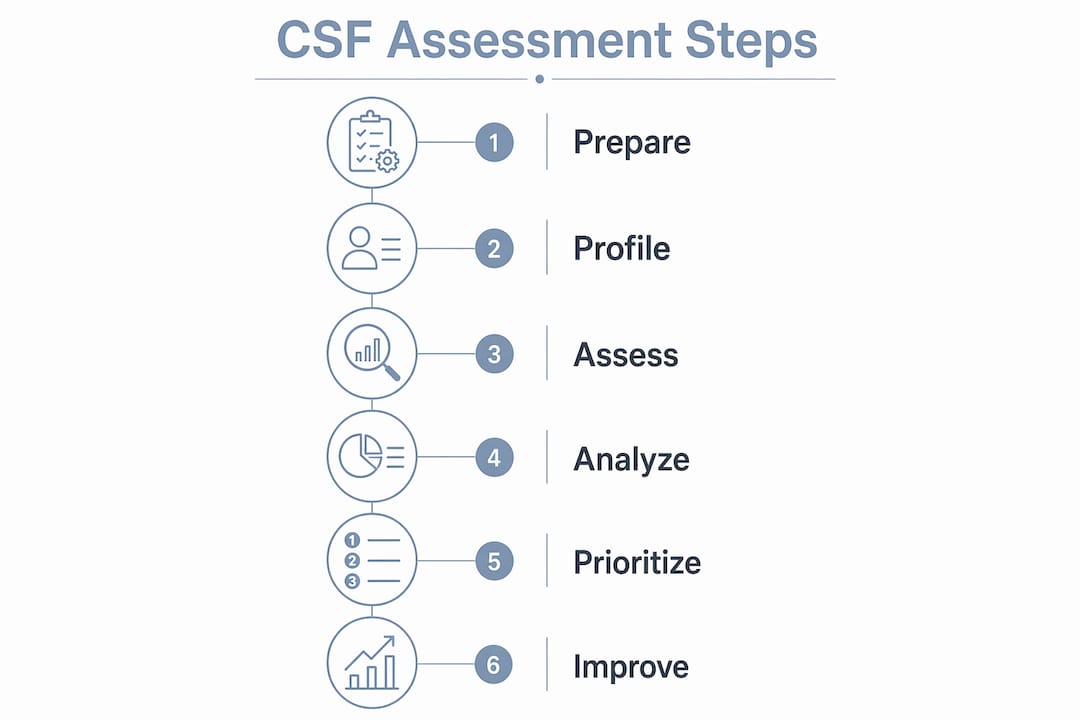
The official five-step process moves from scoping through to ongoing monitoring. Here is how to run it in practice.
- Scope the assessment. Define which business units, systems, and processes are in scope. A hospital network and its administrative offices may warrant separate profiles.
- Build the Current Profile. Review policy documents, interview practitioners, and audit your tool inventory. Score each subcategory on a maturity scale from 0 to 4, where 0 means the outcome is not addressed and 4 means it is fully achieved and continuously improved.
- Aggregate scores. Roll subcategory scores up to categories, then to functions, then to an overall maturity rating. This gives leadership a single-page view of posture.
- Define the Target Profile. Use your organisation's risk appetite, compliance obligations (think OSFI B-13 for financial institutions, or provincial health privacy rules), and strategic priorities to set target scores per subcategory.
- Perform gap analysis. Compare Current and Target Profiles to identify where the largest gaps sit and what the business impact of each gap is.
- Build a prioritised action plan. Sequence remediation by risk impact, not by ease of closure. A gap in Detect.Continuous Monitoring often carries more business risk than a gap in Recover.Communications.
- Implement, monitor, and update. Execute controls, track progress using Key Performance Indicators and Key Risk Indicators, and refresh the profile at a defined cadence.
The table below illustrates how scoring and gap analysis might look for three sample subcategories.
| CSF subcategory | Current score (0–4) | Target score (0–4) | Gap | Priority |
|---|---|---|---|---|
| ID.AM-1: Asset inventory | 2 | 4 | 2 | High |
| PR.AC-1: Identity management | 3 | 4 | 1 | Medium |
| DE.CM-1: Continuous monitoring | 1 | 3 | 2 | High |
Pro Tip: Score the Current Profile based on evidence, not aspiration. If a policy exists but is never tested, score it as partially implemented at best. Inflated current scores redirect resources away from real risks and produce a roadmap that looks good on paper but fails in a breach.
Which templates and tools make the assessment easier?
NIST publishes a free Microsoft Excel-based Organisational Profile template that supports side-by-side comparison of Current and Target Profiles. It is the fastest way to get started without building your own scoring sheet from scratch. The CSF 2.0 Reference Tool lets you browse, search, and export all 106 subcategories in both human-readable and machine-readable formats, which is useful when you need to map outcomes to NIST SP 800-53 controls or ISO/IEC 27001.
Key resources available at no cost:
- NIST Organisational Profile Template (Excel): pre-built columns for Current and Target Profiles, gap tracking, and priority fields
- CSF 2.0 Reference Tool: searchable subcategory database with links to over 50 informative references
- Implementation Examples: concrete, verb-driven actions per subcategory that bridge strategic outcomes and day-to-day controls
- Community Profiles: sector-specific baselines (including a published ransomware Community Profile from the NCCoE) that can seed your Target Profile
- Quick-Start Guides: role-specific entry points for small businesses, enterprise risk managers, and supply chain teams
No official certification is attached to any of these tools. Third-party consultants and GRC platforms also offer assessment support, at varying cost, but the DIY path using NIST's own resources is fully viable for organisations with internal cybersecurity capacity.
Pro Tip: Connect your CSF scoring sheet to your existing IT asset register and risk register from day one. Assessments that live in a standalone spreadsheet tend to go stale within months; ones wired into live data stay relevant.
Best practices for Canadian organisations applying CSF 2.0
CSF 2.0's broad international adoption makes it well-suited for Canadian organisations that must satisfy multiple regulatory regimes simultaneously. The framework's outcomes are not country-specific, so they map cleanly onto OSFI guidelines, Quebec Law 25, and sector-specific requirements without requiring a parallel compliance programme.
The Govern function deserves particular attention here. It requires formal risk appetite statements, clear assignment of cybersecurity roles, and embedding security into enterprise risk governance. For many Canadian mid-market firms, that is a cultural shift, not just a documentation exercise. Boards that have historically treated cybersecurity as an IT budget line now need to engage with it the way they engage with credit risk or regulatory exposure.
Practical best practices for Canadian teams:
- Involve operational practitioners (not just managers) when building the Current Profile; they know what actually happens versus what the policy says
- Avoid the checklist mentality: the CSF is a risk management tool, not an audit pass/fail exercise
- Use NIST's Implementation Examples to translate subcategory outcomes into controls that satisfy Canadian regulatory language
- Map CSF assessment results to your existing compliance obligations to avoid duplicating effort across frameworks
- Prioritise gaps by risk impact, not by the number of subcategories affected
- Leverage sector-specific Community Profiles as a starting point for your Target Profile, then adjust for your organisation's specific threat environment
- Engage security and compliance partners when internal capacity is limited for the Govern or Identify functions
CSF adoption has grown steadily across Canadian financial services, healthcare, and critical infrastructure sectors, driven partly by federal guidance and partly by the practical reality that cyber incidents now carry material financial and reputational consequences.
How do you sustain improvement after the assessment?
Completing an assessment is the start, not the finish. The CSF's design assumes a continuous feedback loop: implement controls, monitor their effectiveness, and update your Organisational Profile as the threat environment and your organisation's priorities shift.

Key Performance Indicators tied to specific subcategories (mean time to detect, patch coverage rates, phishing simulation results) give you objective evidence that the action plan is working. Key Risk Indicators flag when conditions are changing faster than your controls can keep up. Both feed back into the profile at your next review cycle, which most organisations run annually at minimum and quarterly for high-priority functions like Detect and Respond.
Connecting your cloud security posture management to CSF outcomes is particularly valuable for organisations running hybrid or multi-cloud environments, where asset visibility gaps tend to be the largest source of unaddressed risk. Understanding your cybersecurity maturity model trajectory over successive assessments also gives leadership a credible narrative for board reporting.
Common pitfalls during a CSF assessment and how to avoid them
The most common failure mode is treating the assessment as a compliance exercise rather than a genuine risk management conversation. Teams score subcategories optimistically to avoid uncomfortable conversations with leadership, and the resulting roadmap targets the wrong problems.
A second pitfall is scope creep. Trying to assess every system, every vendor, and every process in a single pass produces a sprawling, low-confidence result. Starting with a defined scope, completing it rigorously, and expanding in subsequent cycles produces far more usable output.
Third: organisations frequently skip the Govern function because it feels abstract compared to technical controls. That is exactly backwards. Without a defined risk appetite and clear accountability, every prioritisation decision in the roadmap becomes a negotiation rather than a policy-driven choice.
Finally, the gap analysis often produces a list of 40-plus remediation items with no clear sequencing. The fix is straightforward: rank gaps by the combination of likelihood and business impact, not by how easy they are to close. A gap in continuous monitoring that leaves you blind to lateral movement is more urgent than a documentation gap in recovery planning, even if the documentation fix takes an afternoon.
What does a successful CSF assessment look like in practice?
A Canadian financial services firm running its first CSF 2.0 assessment might discover that its Detect function scores consistently at 1 out of 4 across monitoring subcategories, while its Protect function sits at 3. The gap analysis makes the investment case clear: the organisation has built strong preventive controls but has limited visibility into what is happening on its network right now. The Target Profile sets Detect subcategories to 3, the action plan funds a security information and event management deployment, and the next assessment cycle validates the improvement.
A mid-sized healthcare organisation in Ontario might use a Community Profile as its Target Profile baseline, then adjust priorities based on its specific patient data obligations under provincial legislation. The Govern function work surfaces the fact that no executive owns cybersecurity risk formally; the assessment produces a board resolution assigning that accountability before any technical controls are purchased.
These scenarios share a common thread: the assessment's value comes from the honest conversation it forces, not from the score it produces.
AccountNext-Nexus helps Canadian organisations run CSF assessments that actually move the needle
Fragmented security programmes are the norm, not the exception, for Canadian mid-market organisations. AccountNext-Nexus consolidates cybersecurity assessment, real-time threat detection, and compliance support under one programme, so the gap between your CSF roadmap and your live security posture closes faster than it would with disconnected point solutions.

AccountNext-Nexus brings seasoned practitioners who have worked through CSF 2.0 assessments across Canadian financial services, healthcare, and technology organisations. The team handles Current Profile development, gap analysis, and Target Profile definition, then stays engaged through the remediation cycle with 24/7 monitoring and threat detection tied directly to your CSF outcomes. Pricing is transparent, engagements are scoped to your organisation's size and complexity, and there is no long-term contract required to get started. Contact AccountNext-Nexus to scope your CSF assessment and get a clear picture of where your organisation stands.
Key takeaways
A NIST CSF assessment produces the most value when the Current Profile is built on evidence, gaps are prioritised by business risk, and results feed into a continuous monitoring programme rather than a one-time report.
| Point | Details |
|---|---|
| Six functions structure the framework | CSF 2.0 covers Govern, Identify, Protect, Detect, Respond, and Recover across 22 categories and 106 subcategories. |
| Score honestly on a 0–4 scale | Each subcategory is scored 0–4; inflated scores misdirect resources toward perceived compliance rather than real risk. |
| Govern is the critical new addition | The Govern function requires formal risk appetite statements and board-level accountability, not just IT-level policy. |
| Free tools are available from NIST | The Excel Organisational Profile template and CSF 2.0 Reference Tool are free, with no certification attached. |
| AccountNext-Nexus supports the full cycle | AccountNext-Nexus delivers CSF assessments, gap analysis, and ongoing monitoring for Canadian organisations under one programme. |