
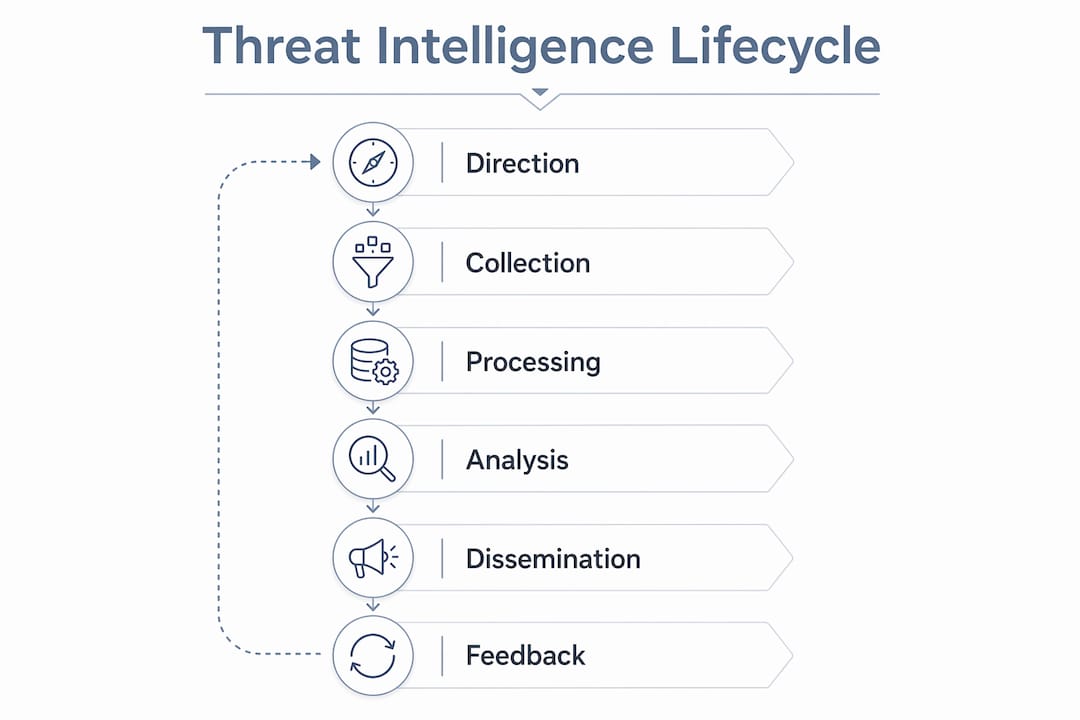
Threat intelligence works by collecting raw threat data from dozens of sources, converting it into contextualised knowledge through a structured six-stage lifecycle, and delivering outputs that let security teams act before attackers establish a foothold. The result is shorter attacker dwell time, sharper alert prioritisation, and a shift from reactive incident response to proactive defence. The six-stage lifecycle — Direction, Collection, Processing, Analysis, Dissemination, and Feedback — maps directly to four intelligence types: strategic, operational, tactical, and technical. Each type feeds a different stakeholder, from the CISO to the SOC analyst.
Pro Tip: The single most important distinction in any programme is between threat data (raw IOCs) and threat intelligence (contextualised analysis that answers who, why, and how). Ingesting IOC feeds alone is not a mature programme.
Table of Contents
- How threat intelligence works: the six-stage lifecycle
- Which intelligence type does your team actually need?
- Where does threat data come from, and what are the trade-offs?
- How raw data becomes a decision: processing and analysis in practice
- What intelligence outputs look like and how teams use them
- Automation and AI: what they handle well and where humans stay in charge
- Who benefits and how do you measure it?
- Why threat intelligence programmes fail and how to avoid it
- Operationalising threat intelligence inside Canadian organisations
- Key takeaways
- The operational reality most guides skip
- AccountNext-Nexus: managed threat intelligence for Canadian security teams
- Authoritative references and further reading
How threat intelligence works: the six-stage lifecycle
The lifecycle is not linear in practice — it is a continuous loop where each completed cycle informs the next. Here are the six stages and what each must deliver.
-
Direction/Planning — Define intelligence requirements: what assets need protection, who the likely adversaries are, and what questions the programme must answer. The output is a prioritised requirements document that scopes every downstream activity.
-
Collection — Gather raw data from internal telemetry (logs, EDR alerts, network flows), external commercial feeds, OSINT, dark web monitoring, government advisories, and sector ISAC sharing. The output is a raw data corpus aligned to requirements.
-
Processing — Normalise, deduplicate, translate, and tag the collected data so it is machine-readable and consistent. An automated pipeline ingesting phishing IOCs, for example, strips duplicates, resolves domain variants, and tags each entry with source confidence. The output is a clean, structured dataset ready for analysis.
-
Analysis — Correlate processed data, map TTPs to MITRE ATT&CK, attribute activity to threat actors, and assign confidence scores. A concrete example: multiple phishing domains and malware samples resolve to a single coordinated campaign targeting Canadian financial institutions. The output is finished intelligence with context, confidence, and recommended action.
-
Dissemination — Deliver the right format to the right audience at the right cadence. CISOs receive executive summaries; SOC analysts receive machine-readable IOCs integrated into SIEM; threat hunters receive TTP profiles. The output is consumed intelligence that drives decisions.
-
Feedback — Stakeholders formally evaluate what was useful, what was noise, and what questions remain unanswered. That input directly adjusts the requirements in stage one. Without formalised feedback, the programme drifts from business priorities.
Pro Tip: Skipping Direction is the single most common reason programmes fail. Without defined requirements, teams collect irrelevant data, analysts drown in noise, and outputs have no measurable business value. Assign a requirements owner before you ingest a single feed.
Which intelligence type does your team actually need?
The four types answer different questions and serve different consumers. Matching type to audience is what makes dissemination useful rather than overwhelming.
Strategic intelligence answers why. It covers geopolitical threat trends, sector targeting patterns, and adversary motivations. The consumer is leadership — CISOs, board risk committees, and senior IT directors. The format is a concise written brief, typically monthly or quarterly, that translates technical risk into business impact.
Operational intelligence answers how. It profiles attacker campaigns: infrastructure, tooling, and likely next steps. Threat hunters and incident responders consume this to build hunt hypotheses or anticipate lateral movement. A typical deliverable is a campaign profile describing a ransomware group's initial access methods and preferred persistence mechanisms.
Tactical intelligence answers what to detect right now. It covers TTPs mapped to MITRE ATT&CK and drives detection engineering. A SOC team uses a new TTP report to write a SIEM detection rule within hours of publication. Cadence is near-real-time.
Technical intelligence is machine-readable artefacts: IP addresses, file hashes, domain names, YARA rules, and STIX bundles. SOC and IR teams consume this directly through automated feeds into SIEM, NGFW, and endpoint platforms. It is the highest-volume, shortest-lived type — an IP block list can be stale within 24 hours.
Where does threat data come from, and what are the trade-offs?
Collection design determines the quality ceiling for everything downstream. More sources is not better — aligned sources are.
Common source categories and their trade-offs:
| Source category | Freshness | Fidelity | Cost | Primary consumer |
|---|---|---|---|---|
| Internal telemetry (logs, EDR, network) | Real-time | High | Low (already owned) | SOC, IR |
| Commercial threat feeds | Near-real-time | Medium–high | Medium–high | SOC, threat hunters |
| OSINT (open web, social media, paste sites) | Variable | Low–medium | Low | Analysts, hunters |
| Deep/dark web monitoring | Hours–days | Medium | High | Analysts, IR |
| ISAC/ISAO sector sharing | Hours–days | High (peer-validated) | Low–medium | Risk, IR, SOC |
| Government advisories (e.g., Canadian Centre for Cyber Security) | Days | High | Free | All teams |
Collection methods worth knowing:
- API pulls from commercial feeds and threat intelligence platforms (TIPs) automate ingestion but require normalisation pipelines to handle format differences.
- Syslog forwarding and SIEM connectors bring internal telemetry into the pipeline with low latency.
- Third-party risk partnerships and ISAC memberships provide peer-validated intelligence that commercial feeds often miss.
- Human collection (analyst research, dark web monitoring) is high-effort but surfaces context that automated feeds cannot.
Pro Tip: Prioritise internal telemetry first. Your own logs carry the highest-fidelity signal about what is actually happening in your environment. External feeds are most valuable when they are filtered against your specific asset inventory and threat model — not ingested wholesale.
How raw data becomes a decision: processing and analysis in practice
Processing prepares raw collection for efficient and accurate analysis. The steps are largely automated because volume makes manual handling impractical.
A typical enrichment pipeline works like this: an analyst submits a suspicious IP. The pipeline appends ASN ownership, geolocation, historical sighting count, passive DNS records, related domains, and a reputation score from multiple sources. By the time a human sees it, the IP is no longer an anonymous address — it is a known command-and-control node linked to a ransomware campaign active in the Canadian financial sector, with three prior sightings in the last 30 days. That context cuts analyst time-to-first-decision significantly.

Analysis goes further. Correlation connects disparate signals: a phishing domain registered last week, a malware hash seen in an EDR alert, and a C2 IP flagged in a partner feed may all resolve to a single threat actor. Mapping those TTPs to MITRE ATT&CK turns a collection of artefacts into a detection and hunting roadmap. Attribution — assigning activity to a named or tracked threat group — requires human judgement, not just pattern matching. Confidence scoring is equally human-dependent: an analyst must weigh source reliability, corroboration, and recency before assigning a high-confidence label to a finding.
Automation handles high-volume enrichment and pattern detection reliably. Complex attribution, connecting non-linear events across months of data, and interpreting geopolitical context remain human tasks.
What intelligence outputs look like and how teams use them
Finished intelligence takes several forms. The format must match the consumer, or the intelligence sits unread.
Common deliverables:
- IOC lists (IP addresses, domains, file hashes, URLs) — ingested directly into SIEM, NGFW, and endpoint platforms for automated blocking or alerting.
- YARA rules — pushed to EDR and malware analysis platforms for file-level detection.
- TTP profiles — used by threat hunters to build hypotheses and by detection engineers to write new SIEM rules.
- MITRE ATT&CK mappings — link observed TTPs to the framework so teams can identify detection gaps and prioritise coverage.
- STIX/TAXII bundles — machine-readable packages for automated exchange between platforms and partner organisations.
- Playbooks — step-by-step IR guides triggered by specific intelligence findings (e.g., a confirmed ransomware precursor IOC triggers a containment playbook). See the enterprise incident response checklist for a practical template.
- Executive briefs — concise risk narratives for leadership, translating IOC counts into business impact language.
Integration checklist for SIEM, SOAR, and TIP:
- Push IOCs to SIEM with a defined expiry date — stale IOCs inflate false positives.
- Version TTP profiles and detection rules so analysts know which iteration is active.
- Configure SOAR playbook triggers on high-confidence IOC matches, not all matches.
- Track uptake: measure how many pushed IOCs generated an alert or action within 30 days.
- Deliver executive briefs on a fixed cadence (monthly minimum) with a standard template so leadership can track trend direction.
Automation and AI: what they handle well and where humans stay in charge
Automation is not optional at scale — the data volumes involved in modern threat intelligence make manual processing a bottleneck. But automation is a force multiplier for analysts, not a replacement.

Automation handles high-volume enrichment, deduplication, IOC ingestion, pattern detection across large datasets, and machine-readable format conversion reliably and quickly. A well-configured TIP can process thousands of IOCs per hour, append enrichment metadata, and push confirmed matches to SIEM without analyst involvement.
Human analysts remain necessary for complex attribution, connecting non-linear events separated by weeks or months, interpreting geopolitical context behind a campaign, and validating high-impact findings before they trigger major defensive actions. An automated system can flag that an IP belongs to known ransomware infrastructure. Only a human can assess whether that finding, in the context of your organisation's current exposure and the attacker's known targeting criteria, warrants an emergency response versus a standard alert.
Pro Tip: Keep a human-in-the-loop model for any intelligence finding that would trigger a significant defensive action — network segmentation, account suspension, or executive notification. Automate the triage; keep humans on the decision.
Who benefits and how do you measure it?
The importance of threat intelligence is clearest when you can show stakeholders what changed after the programme was in place.
Stakeholder map:
- CISO — receives strategic briefs that inform security investment decisions and board reporting.
- SOC analysts — work from enriched, prioritised alerts rather than raw log noise; false positive rates drop.
- IR teams — enter incidents with pre-built playbooks and known attacker TTPs rather than starting from zero.
- Risk and compliance — use intelligence outputs to evidence control effectiveness and support regulatory reporting.
- IT operations — receive patching prioritisation based on actively exploited vulnerabilities relevant to the organisation's stack.
Practical KPIs to track:
- Mean time to detect (MTTD) — does it decrease after a targeted feed and SIEM rule change?
- Mean time to respond (MTTR) — do playbook-triggered responses close faster than manual ones?
- Percentage of alerts triaged to a threat intelligence finding — measures programme relevance.
- Number of meaningful IOCs actioned (blocked, hunted, or escalated) per reporting period.
- Reduction in false positives after feed filtering and enrichment tuning.
A concrete example: a SOC team introduces a targeted ransomware precursor feed filtered to their sector and asset profile, then writes three new SIEM detection rules based on the associated TTPs. Over 90 days, MTTD for ransomware-related alerts drops, and the percentage of those alerts tied to an intelligence finding rises. That is a measurable programme outcome you can present to a board. Tracking cybersecurity maturity alongside these KPIs gives leadership a fuller picture of programme progress.
Why threat intelligence programmes fail and how to avoid it
Most programme failures trace back to a small set of avoidable mistakes.
Common failure modes:
- Skipping Direction — the most frequently cited root cause. No requirements means no filter on collection, which means analysts face a firehose of low-value data.
- Data intoxication — subscribing to too many feeds without defined requirements leads to alert fatigue and poor analysis outcomes. More feeds is not a proxy for better intelligence.
- Poor dissemination — delivering the wrong format to the wrong audience. An IOC list sent to a CISO and an executive brief sent to a SOC analyst are both useless.
- No formalised feedback — without assigned owners and deadlines for feedback, the loop never closes and the programme drifts from business priorities.
- No KPI alignment — measuring output volume (number of IOCs ingested) rather than outcome (MTTD reduction) makes it impossible to demonstrate business value.
Practical checklist to fix these failures:
- Define intelligence requirements before selecting any feed or tool.
- Map consumers to intelligence types and agree on format and cadence with each stakeholder.
- Filter and normalise all incoming data through an enrichment pipeline before analyst review.
- Schedule dissemination formats on a fixed calendar — ad hoc delivery is not a programme.
- Formalise feedback: assign an owner, set a deadline, and document how stakeholder input changed the next collection cycle.
- Report on outcomes (MTTD, MTTR, false positive rate) not just outputs.
Pro Tip: Start small. A focused pilot covering one asset class — say, your internet-facing infrastructure — with one or two targeted feeds and a single measurable KPI is far more likely to succeed than a broad programme launched all at once. Iterate based on feedback before expanding scope.
Operationalising threat intelligence inside Canadian organisations
Canadian teams have specific resources and obligations that shape how a programme should be built. Here is an actionable checklist and a sample playbook outline you can adapt immediately.
Operationalisation checklist:
- Define intelligence requirements tied to your organisation's risk register and critical assets.
- Select sources: start with the Canadian Centre for Cyber Security advisories (free, high-fidelity, Canada-specific), one commercial feed aligned to your sector, and your own internal telemetry.
- Map tooling integrations: confirm your SIEM, SOAR, and TIP can ingest STIX/TAXII and support automated IOC expiry. See the enterprise threat detection integration guide for integration patterns.
- Assign roles: a requirements owner (typically a senior analyst or threat intelligence lead), a dissemination owner per stakeholder group, and a feedback coordinator.
- Set reporting cadence: daily IOC pushes to SIEM, weekly tactical briefs to SOC leads, monthly strategic briefs to CISO.
- Build formal feedback gates: a 30-minute monthly review where stakeholders score intelligence relevance and flag gaps.
Canadian operational notes:
- Use Canadian Centre for Cyber Security advisories as a baseline — they are tailored to the Canadian threat environment and carry government authority.
- Consider provincial data residency requirements when selecting cloud-hosted TIP or SIEM solutions. Some sectors (healthcare, financial services) face specific obligations under provincial privacy legislation.
- Join your sector ISAC where one exists (e.g., FS-ISAC for financial services, H-ISAC for healthcare) to access peer-validated intelligence that commercial feeds rarely surface.
Sample playbook outline — ransomware precursor detection:
- Trigger: SIEM alert matches a high-confidence ransomware precursor IOC from the intelligence feed.
- Triage: SOC analyst confirms the match, checks enrichment metadata (ASN, historical sightings, confidence score).
- Escalation decision: if confidence is high and the matched asset is critical, escalate to IR lead immediately.
- Containment: IR team isolates the affected endpoint per the containment runbook; SOAR automates network segmentation.
- Stakeholder notification: CISO notified within one hour; brief includes asset, IOC context, and initial containment status.
- Post-incident feedback: IR lead documents whether the intelligence was accurate and timely; feedback submitted to the requirements owner within 48 hours.
Pro Tip: Scope your 90-day pilot by a single asset class and one measurable KPI — MTTD for that asset class is a clean, defensible metric. A narrow pilot with clear results is far easier to fund and expand than a broad programme with ambiguous outcomes.
Key takeaways
Threat intelligence works when the six-stage lifecycle is followed in full, Direction is treated as a non-negotiable first step, and outputs are formatted for the specific consumer receiving them.
| Point | Details |
|---|---|
| Direction comes first | Undefined requirements are the leading cause of programme failure — assign a requirements owner before selecting any feed. |
| Match type to consumer | Strategic, operational, tactical, and technical intelligence serve different audiences; wrong format means the intelligence goes unused. |
| Automate enrichment, keep humans on decisions | Automation handles volume; human analysts handle attribution, geopolitical context, and high-impact escalation calls. |
| Measure outcomes, not outputs | Track MTTD, MTTR, and false positive reduction — not IOC ingestion volume — to demonstrate business value. |
| AccountNext-Nexus consolidates the programme | AccountNext-Nexus delivers real-time threat detection, SIEM/SOAR integration, and compliance support under one managed service for Canadian organisations. |
The operational reality most guides skip
There is a gap between how threat intelligence programmes are described in frameworks and how they actually run inside organisations. Most guides present the lifecycle as a clean, sequential process. In practice, the feedback stage is where programmes quietly die.
Teams invest in collection and processing tooling, stand up feeds, and push IOCs to SIEM. Then they declare the programme operational. What they rarely build is a formal mechanism for stakeholders to say "this was useful" or "this was noise." Without that signal, the requirements document from stage one never gets updated. Six months later, the programme is still collecting data aligned to last year's threat model, and analysts are wondering why the outputs feel irrelevant.
The fix is not complicated, but it requires discipline. Treat feedback as a formal deliverable with an assigned owner and a deadline, exactly as you would treat a detection rule or an executive brief. The feedback loop is what separates a programme that improves from one that stagnates. At AccountNext-Nexus, formalising that loop is one of the first things we address when working with organisations that have existing intelligence infrastructure but declining stakeholder confidence in outputs.
One practical recommendation: schedule a 30-minute monthly review with each stakeholder group, use a simple relevance score (1–5) for each intelligence product delivered that month, and document how the scores change collection priorities for the next cycle. That single habit compounds over time.
AccountNext-Nexus: managed threat intelligence for Canadian security teams
Fragmented security tools mean fragmented intelligence. AccountNext-Nexus consolidates threat detection, SIEM/SOAR integration, and compliance monitoring into a single managed service — so your team gets finished intelligence delivered to the right people, not a pile of raw feeds to sort through.
For Canadian organisations building or maturing a threat intelligence programme, AccountNext-Nexus provides 24/7 real-time threat detection, cloud infrastructure management, and compliance support with transparent pricing and no hidden complexity. The managed detection and response service covers the full intelligence lifecycle — from requirements definition through to dissemination and feedback — backed by seasoned practitioners who understand the Canadian threat environment. If your programme is generating data but not decisions, that is exactly the gap AccountNext-Nexus is built to close. Talk to the Nexus team to scope a 90-day pilot for your organisation.
Authoritative references and further reading
These sources are worth bookmarking for ongoing programme development.
- MITRE ATT&CK — the definitive framework for mapping adversary TTPs to detection and hunting activities. Use it to translate intelligence findings into detection coverage gaps.
- Canadian Centre for Cyber Security — Canada's primary source for government-backed threat advisories, sector alerts, and guidance documents. Free, high-fidelity, and Canada-specific.
- STIX/TAXII (OASIS standard) — the machine-readable format and transport protocol for structured threat intelligence sharing. Essential for automated exchange between platforms and partner organisations.
- Microsoft Security — Cyber Threat Intelligence — a solid practitioner overview covering intelligence types, platform capabilities, and integration with SIEM and XDR.
- Sector ISACs — FS-ISAC (financial services), H-ISAC (healthcare), and equivalent Canadian sector groups provide peer-validated intelligence that commercial feeds rarely surface. Membership is worth the investment for organisations in regulated sectors.
- How cyber threats evolve — AccountNext-Nexus's overview of attacker TTP evolution, useful context for building strategic intelligence requirements.