
Security operations, or SecOps, is the integration of IT operations and security practices into a unified function designed to continuously detect, investigate, and respond to cyber threats. Rather than treating security as a separate department that reviews work after the fact, SecOps unifies threat detection, incident response, vulnerability management, and security monitoring under one coordinated programme. The result is faster response times, better threat visibility, and a security posture that actually keeps pace with how attackers operate.
The four core functions of any SecOps programme are:
- Threat detection: Continuous monitoring across networks, endpoints, cloud environments, and identities to spot anomalies before they become incidents.
- Incident response: Structured workflows for containing, eradicating, and recovering from confirmed threats.
- Vulnerability management: Ongoing scanning and remediation of weaknesses before adversaries can exploit them.
- Security monitoring: Establishing baselines for normal activity so deviations trigger the right alerts, not noise.
Two frameworks anchor most mature SecOps programmes. The NIST Cybersecurity Framework 2.0, updated in 2024, organises cybersecurity activity around five functions: Identify, Protect, Detect, Respond, and Recover. ISO/IEC 27001 complements this by standardising the information security management system (ISMS) an organisation uses to manage risk continuously. Together, they give SecOps teams a structured, auditable foundation rather than a patchwork of ad hoc controls.
How does SecOps differ from DevOps and DevSecOps?
The three terms overlap enough to cause real confusion, but their objectives are distinct.
DevOps brings development and IT operations together to accelerate software delivery. The focus is speed and collaboration: shorter release cycles, fewer deployment failures, faster recovery from outages. Security is not the primary concern.
DevSecOps takes DevOps and weaves security into every phase of the software development lifecycle. The defining principle is "shifting security left," meaning security checks happen during design and coding rather than after deployment. DevSecOps teams run static code analysis, dependency scanning, and container security checks as part of the build pipeline.
SecOps is different in scope and cadence. It is not about the software pipeline. SecOps governs the day-to-day defence of a live production environment: monitoring alerts, triaging incidents, hunting threats, and managing vulnerabilities across the entire attack surface. Where DevSecOps asks "is the code we are shipping secure?", SecOps asks "is the environment we are running secure right now?"
| Dimension | SecOps | DevOps | DevSecOps |
|---|---|---|---|
| Primary goal | Protect live environments | Accelerate software delivery | Secure the development lifecycle |
| Team focus | Security analysts, incident responders | Developers, IT operations | Developers, security engineers |
| Typical activities | Monitoring, triage, incident response, threat hunting | CI/CD pipelines, deployment automation | Code scanning, container security, shift-left testing |
| Timeframe | Continuous, real-time | Release-cycle driven | Build and test phases |
| Key frameworks | NIST CSF 2.0, ISO/IEC 27001 | DORA metrics, Agile | OWASP, SAST/DAST tooling |
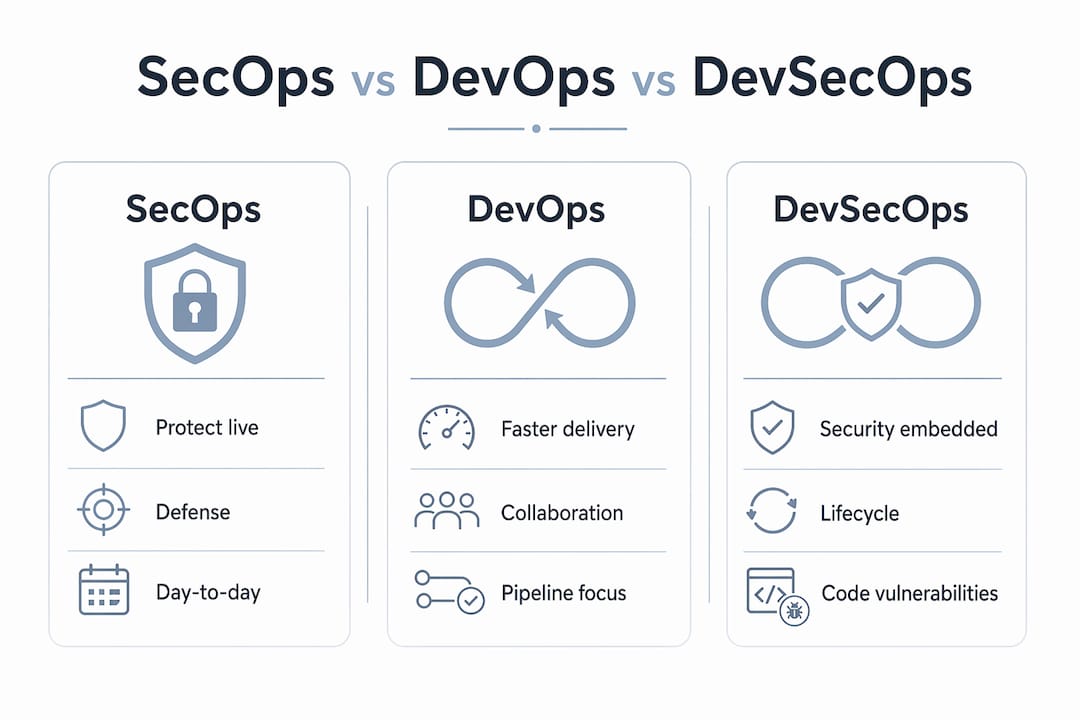
The practical takeaway: a mature organisation needs all three. DevSecOps keeps vulnerabilities out of new code; SecOps catches what slips through and defends against external threats that have nothing to do with your own software.
What roles and components make up a security operations team?
A SecOps programme runs on three pillars: people, processes, and technology. Getting any one of them wrong undermines the other two.

Core processes inside a security operations centre (SOC) follow a repeatable workflow. Analysts ingest alerts from monitoring tools, triage them for severity, investigate confirmed threats, escalate to specialists when needed, contain the incident, and then document everything for post-incident review. Continuous monitoring across networks, endpoints, cloud services, and identities is what makes this workflow possible around the clock.
Key roles and what they actually do:
| Role | Primary responsibilities | Typical tools |
|---|---|---|
| SOC Manager | Oversees operations, sets priorities, reports to leadership | Dashboards, ticketing systems |
| Security Analyst | Alert triage, initial investigation, escalation | SIEM, SOAR |
| Incident Responder | Containment, eradication, recovery for confirmed incidents | EDR, forensic tools |
| Threat Hunter | Proactive search for hidden threats that automated tools miss | Threat intelligence platforms, XDR |
| Security Engineer | Builds and maintains security infrastructure and detection rules | SIEM, firewall, identity platforms |
Core technologies tie the team together:
- SIEM (Security Information and Event Management): Aggregates and correlates log data from across the environment in real time, giving analysts a centralised view of activity.
- SOAR (Security Orchestration, Automation, and Response): Automates repetitive tasks like data enrichment and ticket updates so analysts can focus on decisions that require human judgement.
- EDR (Endpoint Detection and Response): Provides deep visibility into endpoint behaviour and enables rapid isolation of compromised devices.
- Identity security solutions: Centralised vaults and session isolation automatically rotate privileged credentials and secrets, closing one of the most exploited gaps in IT environments.
Collaboration across these roles is not optional. Security engineers and analysts must share a unified platform so that detection rules reflect what responders actually encounter in the field. Without that feedback loop, the SOC ends up chasing the wrong signals.
What challenges do security operations teams face most often?
The most common SecOps challenges are not technical failures. They are organisational and operational ones that technology alone cannot fix.
Alert fatigue sits at the top of nearly every SOC team's list of frustrations. When monitoring tools generate thousands of alerts per day, analysts cannot realistically investigate each one. False positives pile up, genuine threats get buried, and the team starts tuning out notifications that should matter.
Siloed teams compound the problem. IT operations teams measure success by uptime and deployment speed. Security teams measure it by protection and compliance. Those incentives conflict, and without a shared platform or shared accountability, each group optimises for its own metrics while gaps open between them.
Credential and secrets management is a persistent weak point. Configuration management tools, automation platforms, and service orchestration solutions each carry their own administrative accounts and API keys. Operations teams sometimes hard-code secrets directly into automation scripts, which then get pushed to repositories like GitHub where they can be exposed publicly. Manual rotation is infrequent and error-prone.
Skill shortages affect Canadian organisations as much as anywhere. Experienced threat hunters and incident responders are genuinely scarce, and retaining them in a competitive market is expensive. Smaller organisations often cannot staff a full 24/7 SOC internally.
Tool sprawl creates blind spots. When analysts must switch between a SIEM, a separate EDR console, a cloud security platform, and a vulnerability scanner, context gets lost between tools. Each handoff is a potential gap.
Balancing speed and security remains a daily tension. Development and operations teams push for rapid deployments; security teams push back with controls that slow things down. Without a shared SecOps culture, this tension produces either insecure deployments or frustrated developers who find workarounds.
Best practices for building a strong security operations programme
The most effective SecOps programmes share one characteristic: security is embedded into IT workflows from the start, not bolted on afterward. Bridging the gap between IT operations (uptime focus) and security (protection focus) requires shared KPIs and unified tooling, not just goodwill.
Practical steps that make a measurable difference:
-
Adopt NIST CSF 2.0 and ISO/IEC 27001 as your structural foundation. These frameworks provide auditable, risk-based processes rather than a checklist you complete once and forget.
-
Invest in SOAR automation for repetitive tasks: alert enrichment, log correlation, and initial containment actions. This frees analysts for complex investigations and reduces the time between detection and response.
-
Implement continuous vulnerability scanning tied to a remediation SLA. Scanning without a defined timeline for patching is just documentation of your own weaknesses.
-
Unify your tooling so analysts work from a single pane of glass. XDR platforms that correlate data across endpoints, network, cloud, and identity reduce the context-switching that creates blind spots.
-
Integrate regulatory compliance into your monitoring workflows. Frameworks like PIPEDA in Canada, PCI-DSS, and GDPR require timely reporting and audit trails. Building compliance checks into your incident management process means you are not scrambling after a breach.
-
Run tabletop exercises quarterly. Simulated incidents reveal gaps in your runbooks before a real attacker does.
Pro Tip: Embed security engineers directly into IT orchestration workflows rather than keeping them in a separate security silo. When the team that builds automation pipelines and the team that monitors them share the same tools and the same incident queue, credential management and secrets rotation happen automatically rather than as an afterthought.
A cybersecurity maturity model gives you a structured way to assess where your programme sits today and what the next realistic improvement looks like. Most organisations discover they are stronger on detection than on response, which is where the real damage happens.
What emerging technologies are reshaping security operations?
AI-powered automation is the single biggest shift in how modern SOCs operate. Leading security vendors now treat AI integration as the primary driver of SecOps efficiency, using machine learning to analyse data volumes that no human team could process manually, surface subtle patterns, and automate initial triage decisions. The analyst still makes the call on high-stakes incidents, but AI handles the sorting.
Key shift: Modern SOCs are moving from perimeter defence to continuous, intelligence-driven defence across the entire attack surface, including on-premises systems, cloud environments, endpoints, and user identities.
Other developments worth tracking:
- Extended Detection and Response (XDR): XDR platforms unify telemetry from endpoints, networks, cloud, and identity into a single correlated view, replacing the fragmented SIEM-plus-EDR model that creates gaps between tools.
- Threat intelligence platforms: Integrating external feeds on attacker tactics, techniques, and procedures (TTPs) into daily operations lets SOC teams prioritise the vulnerabilities actively being weaponised rather than working through a generic list.
- Hybrid SOC models: Organisations that cannot staff a full internal SOC are increasingly combining internal tier-one analysts with managed SOC services for overnight coverage and advanced analytics. The tradeoff is that external providers need clean, business-specific log data and context to detect subtle or targeted threats rather than generic ones.
- Cloud-native security operations: As workloads shift to AWS, Azure, and Google Cloud, SOC teams need cloud-native monitoring tools that understand ephemeral infrastructure and serverless functions, not just traditional network perimeters.
- Resilience over perimeter defence: The framing is shifting from "keep attackers out" to "assume breach and recover fast." Mean Time to Detect (MTTD) and Mean Time to Respond (MTTR) are the metrics that matter most in this model.
The enterprise threat detection landscape in 2026 rewards organisations that treat their SOC as a living system, continuously refining detection rules based on real incidents rather than running static configurations year after year.
How AccountNext-Nexus advances security operations for Canadian organisations
AccountNext-Nexus is built around the problem that most Canadian organisations face: security tools that do not talk to each other, IT and security teams that operate in separate silos, and no clear owner for the gap between them. The approach is to consolidate those functions under one managed programme rather than add another point solution.
What that looks like in practice:
- 24/7 threat monitoring and rapid incident response: AccountNext-Nexus provides around-the-clock SOC coverage so Canadian businesses are not exposed during off-hours, which is when many targeted attacks land. The monitoring and threat detection service covers networks, endpoints, cloud infrastructure, and identities from a single platform.
- Proprietary integration methodology: Rather than dropping a SIEM into an existing environment and calling it done, AccountNext-Nexus maps each client's IT environment, identifies the credential and secrets management gaps that create the most exposure, and builds a unified detection and response workflow from the ground up.
- Canadian compliance expertise: PIPEDA, provincial privacy legislation, and sector-specific requirements like those in financial services and healthcare shape how incident reporting and audit trails must be structured. AccountNext-Nexus builds compliance monitoring into the SecOps workflow rather than treating it as a separate audit exercise.
- Transparent pricing: Security budgets in Canada are under pressure. AccountNext-Nexus publishes clear service tiers so organisations can plan without discovering hidden costs after onboarding.
- Access to experienced professionals: Threat hunters and incident responders with real-world experience are hard to hire and harder to retain. AccountNext-Nexus clients get access to that expertise without carrying the full cost of building an internal team.
The IT resilience framework that underpins the AccountNext-Nexus approach aligns directly with NIST CSF 2.0 and ISO/IEC 27001, so clients working toward certification or regulatory compliance are building on a recognised foundation rather than a proprietary one.
Ready to consolidate your security programme? AccountNext-Nexus managed services give Canadian organisations 24/7 SOC coverage, compliance-ready monitoring, and a team that treats your security posture as a continuous programme, not a project.
Security operations in Canadian organisations: real-world context
Canadian organisations face a specific threat environment shaped by their proximity to the United States, their role in critical infrastructure sectors like energy, finance, and healthcare, and the regulatory requirements that come with operating in multiple provinces.
The financial services sector offers a clear illustration of how SecOps matures under pressure. Canadian banks and credit unions operate under OSFI (Office of the Superintendent of Financial Institutions) guidelines that require documented incident response capabilities, regular testing, and timely breach notification. Institutions that had invested in mature SOC programmes before the wave of ransomware attacks recovered faster and reported lower remediation costs than those relying on ad hoc security measures. The difference was not the tools they used. It was the repeatable processes and the trained teams behind them.
Healthcare organisations across Ontario, British Columbia, and Alberta have faced a different challenge: legacy systems that were never designed for network connectivity are now connected, and the attack surface has expanded faster than security programmes could adapt. Hospitals that have adopted continuous vulnerability scanning tied to a defined remediation timeline have reduced their exposure to known exploits, even when full system replacement is years away.
Municipal governments present a third pattern. Smaller IT teams, tight budgets, and a wide range of public-facing services make full internal SOC coverage impractical. The hybrid model, where a managed provider handles overnight monitoring and advanced threat hunting while internal staff manage day-to-day operations, has become the practical standard for mid-sized Canadian municipalities. The key lesson from organisations that have made this work is the one Cloudflare's SOC research surfaces: external providers need clean, business-specific log data and context to detect subtle threats. Generic log feeds produce generic alerts.
Across all three sectors, the organisations that have built effective security operations share a common trait. They treat SecOps as a continuous programme with defined metrics, regular testing, and clear ownership, not as a compliance checkbox reviewed once a year.
Key takeaways
Effective security operations requires integrating people, processes, and technology into a continuous programme built on frameworks like NIST CSF 2.0 and ISO/IEC 27001, with automation handling triage and humans controlling critical decisions.
| Point | Details |
|---|---|
| Four core functions | Threat detection, incident response, vulnerability management, and security monitoring form the foundation of any SecOps programme. |
| SecOps vs. DevSecOps | SecOps governs live environment defence; DevSecOps secures the software development pipeline. Both are needed, but they solve different problems. |
| Alert fatigue is the top operational risk | High alert volumes and false positives cause analysts to miss real threats; SOAR automation and XDR correlation are the primary mitigations. |
| Frameworks provide structure | NIST CSF 2.0 and ISO/IEC 27001 give SecOps teams auditable, risk-based processes rather than ad hoc controls. |
| Hybrid SOC models work for mid-sized organisations | Combining internal analysts with managed services balances cost, coverage, and expertise for organisations that cannot staff a full 24/7 internal SOC. |