A SOC 2 readiness assessment is the single most effective way to avoid audit exceptions: a structured, auditor-aligned gap review followed by a control matrix, run before your observation period opens. Most teams should pair this with an auditor unless they already have SOC experience in-house. Start now with two moves: lock your scope in writing, and open a control matrix mapped to the Trust Services Criteria.
TL;DR:
- Conduct a control-mapped gap review at least three to six months before the planned observation window to identify and fix weaknesses in controls.
- Prioritize automating evidence collection, especially for access management and monitoring, to reduce costs and improve evidence quality.
- Include only relevant Trust Services Criteria, focusing on security, and avoid expanding scope unnecessarily to prevent additional costs and exceptions.
- Address common first-time audit gaps such as access drift, poor evidence quality, vendor risks, unpatched systems, and weak documentation, with automation where possible.
- Schedule a mock audit at least three months before observation deadlines to reveal fixable gaps and ensure readiness for fieldwork.
Table of Contents
- What is a SOC 2 readiness assessment?
- Why run a readiness assessment before the formal audit?
- SOC 2 readiness checklist: the six-step process
- Mapping your scope to the AICPA Trust Services Criteria
- Common gaps auditors find and how to fix them
- How long does readiness take, and what does it cost?
- Running a mock audit before you lock the observation window
- Nexus perspective: readiness as a report-quality investment
- Get your SOC 2 readiness assessment done right, faster
- Sources
What is a SOC 2 readiness assessment?
A readiness assessment is a dry run of your SOC 2 audit. You test your controls against the criteria an auditor will use, find the gaps while they're still cheap to fix, and walk into fieldwork with evidence already organized instead of scrambled together during observation.
You have three ways to run one, and picking the wrong one is a common, costly mistake.
- Self-assessment: your compliance or security team runs the gap analysis internally, using the Trust Services Criteria as the checklist. Works if someone on staff has actually been through a SOC 2 cycle before.
- Auditor-aligned assessment: a third-party firm (often not your eventual auditor) reviews your control design and evidence, mapping explicitly to what an assessor will ask for.
- Auditor-performed readiness: your actual audit firm runs the readiness phase, which tightens alignment but requires care around independence rules.
Teams with no prior SOC exposure who try pure self-assessment tend to underestimate evidence quality standards, which is exactly where exceptions get written up later. Practitioners at Aprio warn that skipping proper readiness commonly produces exceptions and qualified opinions.
Why run a readiness assessment before the formal audit?
Skipping readiness is how organizations end up with an exception on the books before fieldwork even starts, according to Aprio's warning to first-time SOC 2 clients. Exceptions delay the report, invite qualified opinions, and force awkward conversations with customers who were counting on a clean attestation to close their own deals.
Readiness flips that risk. You surface weak controls while there's still time to fix them, and buyers reading your eventual report see fewer caveats. Auditor involvement matters most for teams with no SOC history, where the gap between "we think we're compliant" and what an assessor actually requires tends to be widest.
SOC 2 readiness checklist: the six-step process
Run readiness as a sequence, not a checklist you tick in random order. Frameworks built around this process generally follow these six stages:
- Plan and scope. Draw a two-page diagram naming every service, piece of infrastructure, and third party inside the audit boundary. Vague scope is the single biggest source of wasted audit hours later.
- Build the control matrix. Structure it with one row per control: the Trust Services Criteria reference, an owner, the specific evidence artifact, whether it's automated or manual, the date it was last tested, and a remediation deadline if it's failing. Every row needs a named owner and one specific evidence artifact, whether that's a file path or a log stream; rows missing either become the exceptions auditors flag first.
- Collect evidence. Don't rely on a single test of one instance. Sample across the observation period historically, and push toward automating roughly 45 to 55% of Common Criteria evidence rather than pulling screenshots by hand.
- Produce a gap register. Rank each finding by audit risk, not by how easy it is to fix. Assign an owner and a hard deadline to every line.
- Remediate. Work the highest-risk gaps first. Track progress against the deadlines you just set.
- Run a mock audit. Schedule it about three months before observation start, and leave room in your timeline for at least one retest cycle.
Pro Tip: Treat the control matrix as a living document, not a one-time deliverable. Teams that update it monthly catch drift (a config change, an offboarded vendor) before it becomes a finding six months later.
Mapping your scope to the AICPA Trust Services Criteria
The AICPA's Trust Services Criteria set the framework every SOC 2 report is built on. Security is mandatory for every engagement. Availability, Confidentiality, Processing Integrity, and Privacy are optional, and you add them only when a customer contract or regulatory requirement actually demands it.
Most readiness gaps concentrate in CC6, the access control family under Security. Auditors expect to see specific, checkable evidence there:
- Access provisioning and deprovisioning logs tied to HR events, not a manual spreadsheet
- Quarterly (at minimum) access reviews with sign off from a named owner
- Multi-factor authentication enforcement records for privileged accounts
- Network segmentation diagrams that match what's actually deployed, not what was designed two years ago
Resist the urge to add every optional criterion "just in case." Adding Availability or Confidentiality when no customer is asking for it inflates scope, cost, and the number of controls that can generate exceptions, without buying you anything a customer actually values.
Common gaps auditors find and how to fix them
The same five problem areas show up across most first-time SOC 2 engagements, and CISA's own guidance on exploited weak controls points at several of them directly.
- Access management drift. Terminated employees retain system access longer than policy allows. Fix it with automated deprovisioning tied to your HR platform, not a ticket someone forgets to close.
- Weak evidence quality. A single screenshot from one point in time doesn't prove a control operated all year. Fix it by automating log capture across the full period.
- Vendor risk blind spots. Third parties with access to customer data but no security review on file. Fix it with a standing vendor questionnaire and annual reassessment cadence.
- Monitoring and patching gaps. Unpatched systems and alerts nobody actually reviews are exactly the kind of weak control CISA flags as routinely exploited. Fix it with defined patch SLAs and documented alert triage.
- Thin documentation. Policies exist but nobody can show they were followed. Fix it with retention policies and a consistent evidence naming convention.
Pro Tip: Fix access management and monitoring first. They're quick wins with automation, while vendor risk programs and documentation overhauls are the slower, program-level changes that take a full quarter to mature.
How long does readiness take, and what does it cost?
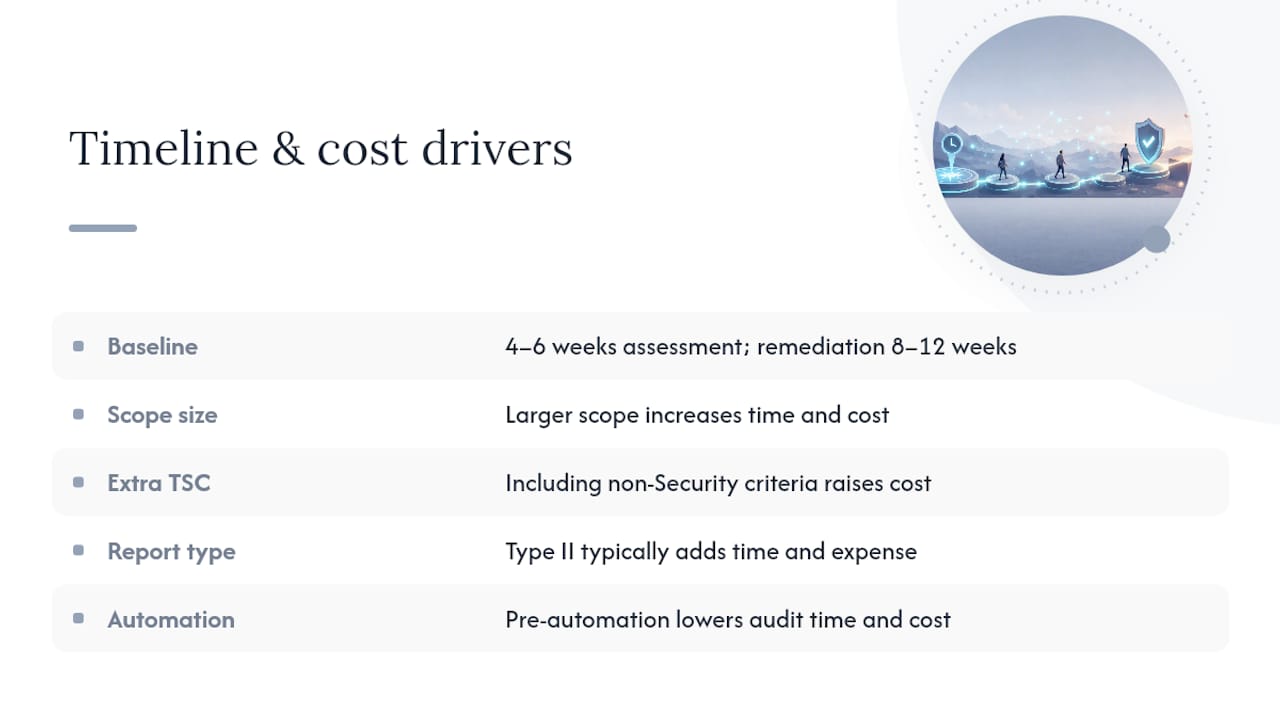
Budget four to six weeks for a focused readiness assessment covering a reasonably scoped environment. Remediation of the gaps it surfaces usually runs another eight to twelve weeks, depending on how much is automation work versus policy rewrites. That means you should start readiness three to six months before your intended observation window opens, not three weeks before.
Cost swings on scope size, how many Trust Services Criteria beyond Security you're including, whether you're pursuing a Type I or Type II report, and how much of your evidence collection is already automated. Organizations that automate evidence ahead of time consistently spend less time, and less money, in the audit itself. Readiness done properly is what prevents the expensive rework that follows a failed first attempt.
Running a mock audit before you lock the observation window
A mock audit should feel like the real thing: an assessor-style evidence request list, sampling pulled across the full period rather than a single snapshot, and no advance warning on which controls get tested. Readiness frameworks that build this into the process find it commonly surfaces meaningful gaps that are still fixable at that stage, precisely because it happens with enough runway left before fieldwork.

Prioritize whatever the mock audit finds by risk, especially issues involving access control or evidence integrity. Allow enough time for retesting before finalizing observation dates with your audit firm. Only lock the observation period after your mock audit retest returns satisfactory results or when remaining issues are documented with credible remediation plans.
Nexus perspective: readiness as a report-quality investment
Readiness gets treated as paperwork by teams that haven't been through fieldwork before, but it's really where report quality gets decided. Automated evidence pipelines and managed monitoring cut the manual sampling burden that causes most last-minute scrambles. For organizations without in-house SOC experience, that gap between "we think we're ready" and what an assessor actually requires is where AccountNext-Nexus's security orchestration approach earns its place, turning evidence collection from a fire drill into a running process.
— Nick - Sr. Executive
Get your SOC 2 readiness assessment done right, faster
AccountNext-Nexus runs SOC 2 readiness the way your eventual auditor will grade it: a structured gap review against the Trust Services Criteria, a control matrix with named owners and evidence artifacts, and a mock audit before you commit to observation dates. Where most teams burn weeks on manual screenshot collection, our approach leans on continuous evidence automation and 24/7 monitoring already built into our managed services, so the audit trail is already there when fieldwork starts.
Whether you need a standalone readiness assessment, a mock audit, or ongoing managed SOC support to keep evidence current between audit cycles, our practitioners handle it under one contract instead of three vendors. If your cloud environment is part of the scope, our guidance on cloud security posture pairs directly with the control matrix work. For a partner-side checklist you can cross-reference, Ventis Consulting's cybersecurity assessment checklist for SMBs covers adjacent ground worth reviewing.
Book a SOC 2 readiness assessment with AccountNext-Nexus and get a scoped gap register back before you commit to an observation window.
Sources
- AICPA Trust Services Criteria
- CISA alert: weak security controls exploited
- How to Run a SOC 2 Readiness Assessment: A 7-Step Framework (2026)
- SOC 2 readiness assessment: don’t start with an exception on the books (Aprio)