
A Secure Software Development Lifecycle (Secure SDLC) is a software engineering approach that integrates security controls, testing, and governance into every phase of development, from initial requirements through post-release monitoring, rather than treating security as a final checkpoint before shipping. For Canadian organisations, the practical case is straightforward: vulnerabilities caught during design cost a fraction of what they cost after a breach, and frameworks like NIST SP 800-218 (SSDF), OWASP SAMM, and Microsoft SDL give teams a structured, auditable path to get there.
The industry term you will see in standards documents is SSDLC or Secure SDLC. The phrase "secure software development lifecycle" is the plain-language version of the same concept, and both are used interchangeably in this guide.
Why this matters right now for Canadian teams:
- Fixing a vulnerability in production typically costs many times more than catching it during design or code review, a pattern documented across multiple IBM and NIST studies.
- PIPEDA and sector-specific rules (PHIPA in Ontario, PIPA in Alberta and B.C.) require demonstrable security controls, and a Secure SDLC produces the audit evidence those frameworks demand.
- The Canadian Centre for Cyber Security explicitly recommends secure-by-design principles aligned with NIST and OWASP guidance for federal and critical-infrastructure software.
This guide covers: the six core Secure SDLC phases and their artefacts, common vulnerability classes and where they enter the pipeline, foundational practices and tooling categories, NIST SSDF / OWASP SAMM / Microsoft SDL framework comparisons, roles and governance, KPIs, a phased implementation roadmap, and a 30/90/180-day checklist.
Table of Contents
- Why does a secure SDLC matter more than bolt-on security?
- What are the six secure SDLC phases, and what does each one produce?
- Which vulnerabilities does a Secure SDLC specifically address?
- What foundational practices should every team adopt first?
- How do NIST SSDF, OWASP SAMM, and Microsoft SDL compare, and which fits your organisation?
- Who owns what in a Secure SDLC programme?
- Which tool categories should Canadian teams integrate, and where do they fit?
- How do you measure whether your Secure SDLC is actually working?
- What does a realistic Secure SDLC adoption roadmap look like?
- How AccountNext-Nexus operationalises a Secure SDLC for Canadian clients
- Your 30/90/180-day checklist to get started
- Key takeaways
- Security as quality, not as a gate
- AccountNext-Nexus: managed Secure SDLC services for Canadian organisations
- Authoritative sources and further reading
Why does a secure SDLC matter more than bolt-on security?
The goal of a Secure SDLC is not to make developers into security specialists. It is to make security a property of every release, the same way performance or reliability is. OWASP's Developer Guide puts it plainly: security must live inside the same lifecycle as development, because a parallel security process will always be deprioritised when sprint pressure builds.
The concrete organisational benefits break down into three categories:
- Lower incident rate. Automated gates in CI/CD catch injection flaws, dependency vulnerabilities, and secrets before they reach production.
- Cheaper remediation. A finding in a pull request takes minutes to fix. The same finding after a production incident involves forensics, customer notification, possible regulatory reporting under PIPEDA, and reputational cost.
- Auditable compliance evidence. Threat models, SAST-clean PR records, software composition analysis (SCA) reports, and release attestations are exactly the artefacts that SOC 2, ISO 27001, and PIPEDA assessors ask for.
Two misconceptions slow adoption more than anything else. The first is that security is a specialist task that belongs to a dedicated AppSec team. The second is that developers must become full-time security experts to participate. Neither is true. Palo Alto Networks' Secure SDLC guidance notes the reliable model is to support developers with tools, training, and a security champions programme so security is achievable without slowing delivery.
Pro Tip: Assign one security champion per squad before you invest in any new tooling. A champion who understands both the codebase and the threat model will do more to reduce your vulnerability density than any scanner running without human context.
Embedding security early also aligns engineering speed with risk appetite. Teams that run threat detection integration alongside their delivery pipeline get real-time risk evidence rather than a quarterly audit surprise.

What are the six secure SDLC phases, and what does each one produce?
Modern Secure SDLC practice treats the six phases as parallel perspectives, not a waterfall. In a sprint-based or continuous-delivery environment, several phases are active simultaneously, and artefacts from one feed the next.
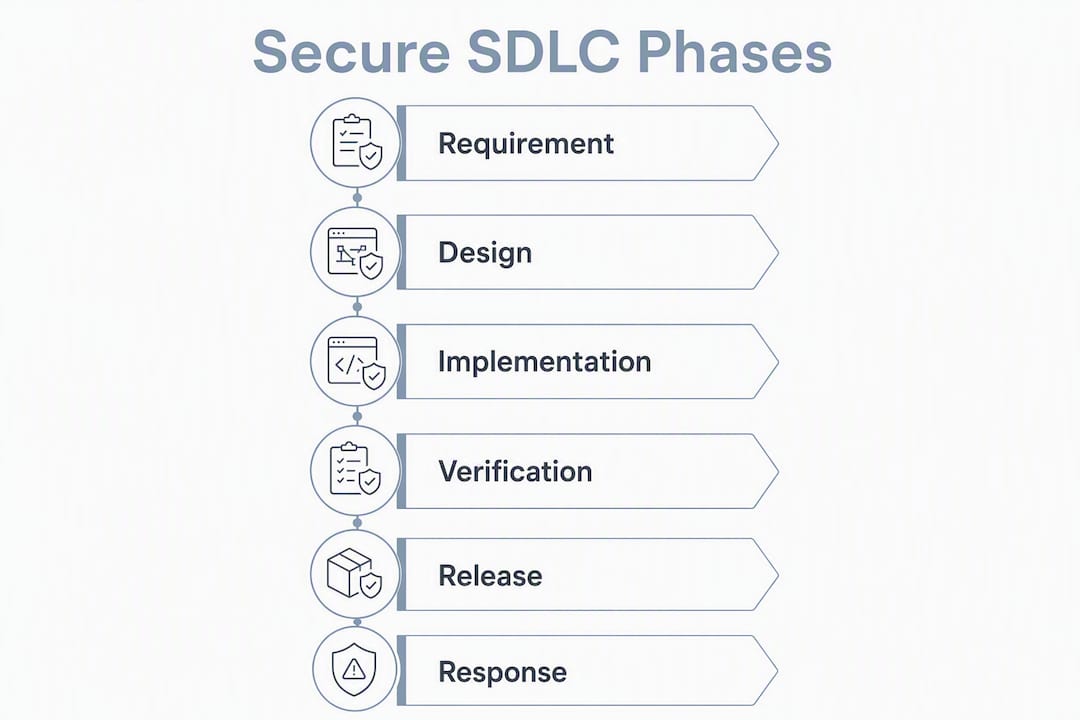
| Phase | Core security activities | Artefacts to produce |
|---|---|---|
| Requirements | Identify regulatory constraints (PIPEDA, PCI-DSS, HIPAA), define abuse cases, set security acceptance criteria | Security requirements document, abuse-case register, compliance mapping |
| Design / Threat modelling | Run STRIDE or LINDDUN threat models, apply secure-by-default and least-privilege principles | Threat model document, data-flow diagrams, risk register |
| Implementation | Enforce secure coding standards (OWASP Top 10 mitigations), run SAST on every PR, manage dependencies via SCA | SAST-clean PR records, SCA reports, peer-review checklists |
| Verification / Testing | DAST against staging, IAST in integration tests, focused penetration testing for high-risk services | DAST scan reports, pentest findings, regression test results |
| Release / Deployment | Policy-as-code gates in CI/CD, IaC scanning before provisioning, release attestation sign-off | Release attestation document, IaC scan report, deployment runbook |
| Response / Maintenance | Runtime monitoring, vulnerability disclosure process, patch SLAs, incident retrospectives | Incident records, CVE patch log, monitoring dashboards |
A few integration notes for CI/CD pipelines are worth spelling out. SAST runs on every pull request, blocking merge on critical findings. SCA runs at build time and again on a scheduled basis to catch newly published CVEs in existing dependencies. IaC scanning gates infrastructure changes before they reach a staging or production environment. Release attestation, a signed record that all gates passed, feeds directly into audit evidence packages.
For sprint-based teams, the practical cadence looks like this: threat model updates happen at the start of any sprint that introduces a new data flow or external integration. SAST and SCA are continuous. A focused penetration test on the highest-risk service runs at least once per quarter or before any major release.
Pro Tip: Treat the threat model as a living document in your version control system, not a one-time workshop output. A threat model that lives in Git gets reviewed in pull requests and stays accurate as the architecture evolves.
NCSC guidance on secure design reinforces that structured threat modelling and secure-by-default configuration choices made at the design phase reduce exploitable surfaces across the entire software lifetime, not just at initial release.
Which vulnerabilities does a Secure SDLC specifically address?
The vulnerability classes that a Secure SDLC is designed to prevent are not random. They cluster around predictable failure modes in how software is built, configured, and maintained.

Supply-chain and dependency vulnerabilities are the most pervasive. Even perfectly written application code can be undermined by a vulnerable third-party library. Microsoft's Secure SDLC guidance is direct on this: continuous SCA and supply-chain telemetry are necessary across the lifecycle, not just at initial build. The SolarWinds and Log4Shell incidents are the canonical examples of what happens when dependency monitoring is absent.
Secrets and credential leakage typically enter the codebase during implementation when developers hard-code API keys, database credentials, or tokens. A secrets scanner running as a pre-commit hook and again in CI catches these before they reach a repository, public or private.
Misconfigured cloud infrastructure and IaC is the third major class. In cloud-native environments, the attack surface includes not just code but also Terraform, CloudFormation, and Kubernetes manifests. Policy-as-code tools scan these files before deployment and block configurations that open storage buckets publicly, disable encryption, or grant overly broad IAM permissions.
Other common classes include injection (SQL, command, LDAP), broken authentication, insecure deserialisation, and insecure defaults. These map cleanly to the OWASP Top 10 and are addressed primarily during the implementation and verification phases through SAST rules and DAST probes.
Prioritisation principle: Small teams with limited AppSec capacity should address supply-chain dependencies and secrets management first, since both are fully automatable and deliver immediate, measurable risk reduction. Larger engineering organisations should layer in IaC scanning and runtime telemetry next, since their cloud footprint creates proportionally more misconfiguration exposure.
How these classes map to phases matters for tooling decisions. SCA belongs in implementation and runs continuously in production. IaC scanning belongs at the release gate. DAST belongs in verification against a running environment. Secrets scanning belongs at pre-commit and CI. Getting the mapping right means findings surface at the point where they are cheapest to fix.
What foundational practices should every team adopt first?
Embedding security early reduces post-release fixes, lowers breach probability, and produces the compliance evidence that regulators and auditors expect. The following practices, in rough priority order, give teams the highest return on their security investment.
-
Threat modelling. Run a structured threat model (STRIDE is the most widely adopted method) for every new service and for any sprint that introduces a new data flow, external integration, or privilege boundary. The output is a risk register that drives security requirements and test cases.
-
Secure requirements and abuse cases. Before writing code, define what the system must not do. Abuse cases translate threat model findings into testable acceptance criteria that QA and security can verify.
-
Secure coding standards and peer review. Adopt a language-specific secure coding standard (OWASP's language-specific cheat sheets are a practical starting point) and enforce it in code review. Peer review with a security lens catches logic flaws that automated tools miss.
-
Software Composition Analysis (SCA). Scan all third-party dependencies at build time and on a scheduled basis. Tools in this category include Snyk, Dependabot, OWASP Dependency-Check, and Black Duck. SCA findings should block release when a critical CVE has a known fix available.
-
Static Application Security Testing (SAST). Run SAST on every pull request. Tools include Semgrep, Checkmarx, Veracode, and SonarQube. Tune rules to reduce false positives before enforcing blocking gates, or developer trust in the tool erodes quickly.
-
Dynamic Application Security Testing (DAST) and Interactive Application Security Testing (IAST). DAST probes a running application from the outside (tools: OWASP ZAP, Burp Suite). IAST instruments the application from within during integration tests for deeper coverage. Both belong in the verification phase.
-
Secrets management. Use a secrets manager (HashiCorp Vault, AWS Secrets Manager, Azure Key Vault) and enforce pre-commit secrets scanning (tools: Gitleaks, truffleHog, detect-secrets). Never store credentials in source control.
-
Infrastructure-as-Code (IaC) scanning. Scan Terraform, CloudFormation, and Kubernetes manifests before deployment. Tools include Checkov, tfsec, and Terrascan. Gate infrastructure changes on a clean scan result.
-
Runtime telemetry and monitoring. Runtime application security and centralised logging close the feedback loop between production behaviour and the next development cycle. Anomalies in production should feed directly into the threat model.
Pro Tip: The security champions pattern scales developer enablement without scaling the AppSec headcount. Select one champion per squad, give them dedicated training time (OWASP AppSec courses, SANS DEV courses), and measure their impact through squad-level vulnerability density trends. Champions who see their metrics improve stay engaged; those who receive no feedback quietly disengage.
For cloud-native security tooling specifically, the toolchain needs to cover code, containers, IaC, and runtime simultaneously, since each layer has its own attack surface.
How do NIST SSDF, OWASP SAMM, and Microsoft SDL compare, and which fits your organisation?
Three frameworks dominate Secure SDLC adoption in Canada and internationally. They are complementary rather than competing, and most mature programmes draw from more than one.
| Framework | Primary strength | Best fit | Canadian compliance relevance |
|---|---|---|---|
| NIST SSDF (SP 800-218) | Prescriptive practice catalogue with assurance levels; maps to executive orders and supply-chain requirements | Organisations supplying software to government or regulated sectors; teams needing auditable evidence | Aligns with Canadian Centre for Cyber Security guidance; referenced in federal procurement requirements |
| OWASP SAMM | Maturity assessment model across five business functions; measures current state and targets improvement | Teams wanting to benchmark maturity and build a multi-year roadmap | Widely used in Canadian financial services and healthcare AppSec programmes |
| Microsoft SDL | Developer-facing controls and tooling integration; strong on threat modelling (STRIDE) and CI/CD gates | Engineering teams on Microsoft Azure or with a Windows-heavy stack; teams wanting prescriptive developer checklists | Applicable regardless of cloud provider; threat modelling methodology is stack-agnostic |
NIST SP 800-218 organises practices into four groups: Prepare the Organisation (PO), Protect the Software (PS), Produce Well-Secured Software (PW), and Respond to Vulnerabilities (RV). Each practice has defined tasks and example notional implementations, making it straightforward to map to existing sprint ceremonies and artefacts.
OWASP SAMM assesses maturity across Governance, Design, Implementation, Verification, and Operations. Running a SAMM assessment before selecting a framework gives leadership a defensible baseline and a prioritised improvement roadmap, which is useful when making the business case for investment.
Microsoft SDL's threat modelling methodology and its developer security training curriculum are freely available and stack-agnostic. Teams that are not on Azure still benefit from the STRIDE methodology and the SDL's secure coding and testing checklists.
Mapping to Canadian compliance needs:
- The Canadian Centre for Cyber Security's Baseline Cyber Security Controls for Small and Medium Organizations and its guidance for critical infrastructure explicitly reference NIST and OWASP as acceptable frameworks.
- PIPEDA requires "appropriate safeguards" proportionate to the sensitivity of personal information. A documented Secure SDLC with threat models, SAST records, and release attestations is strong evidence of appropriate safeguards.
- Sector-specific rules (OSFI B-10 for financial institutions, PHIPA for Ontario health data) require demonstrable security controls in software that handles regulated data. Framework artefacts serve as that demonstration.
Quick-start artefacts to produce first:
- A completed OWASP SAMM assessment (establishes baseline, takes one to two days with the right team)
- Threat models for your two highest-risk services
- A security requirements template mapped to your top regulatory obligations
- A CI/CD gate configuration document showing where SAST, SCA, and secrets scanning run
For a broader view of how these frameworks interact with enterprise governance, the enterprise cybersecurity framework guide covers the governance layer in detail.
Who owns what in a Secure SDLC programme?
Diffusion of ownership is the most common reason Secure SDLC programmes stall after a promising pilot. Every control needs a named owner, and every escalation path needs a defined SLA.
| Role | Primary responsibilities | Key artefacts owned |
|---|---|---|
| Product Manager | Define security acceptance criteria; prioritise security findings in backlog; approve release attestations | Security requirements document, release sign-off |
| Engineering Lead | Enforce secure coding standards; own SAST gate configuration; escalate architectural risks | PR review records, SAST configuration, architecture decision records |
| AppSec / Security Team | Threat modelling facilitation; pentest coordination; framework governance; escalation triage | Threat models, pentest reports, policy documents |
| DevOps / SRE | Pipeline gate configuration; IaC scanning integration; runtime monitoring; incident response | Pipeline configuration, IaC scan results, runbooks |
| Security Champions | Squad-level security coaching; first-line triage of SAST/SCA findings; threat model participation | Finding triage records, squad security metrics |
| QA | Security regression testing; DAST execution; abuse-case verification | DAST reports, test case records |
| Legal / Compliance | Regulatory mapping; breach notification obligations; vendor contract security clauses | Compliance mapping, vendor security assessments |
A security steering committee, meeting monthly at minimum, provides the governance layer. Its mandate covers reviewing KPI trends, approving policy changes, adjudicating risk acceptance decisions, and escalating systemic findings to executive leadership. Release attestation, a signed record that all defined gates passed before a release, is the operational artefact that connects the steering committee's policy decisions to what actually ships.
Escalation SLAs should be defined in writing. A common starting point: critical findings (CVSS 9.0+) require a remediation plan within 24 hours and a fix within seven days; high findings (CVSS 7.0–8.9) require a fix within 30 days; medium findings within 90 days. These SLAs feed directly into MTTR metrics and compliance evidence.
Enterprise cloud security governance structures provide a useful reference for organisations building the committee layer for the first time.
Which tool categories should Canadian teams integrate, and where do they fit?
Tool categories matter more than specific vendor choices, because the right integration point determines whether a tool actually changes developer behaviour or just generates a report nobody reads.
- Pre-commit hooks: Secrets scanners (Gitleaks, truffleHog, detect-secrets) and lightweight linters. Fast feedback, zero CI cost, catches the most embarrassing class of finding before it ever reaches a repository.
- CI build (every commit): SAST (Semgrep, SonarQube, Checkmarx, Veracode), SCA (Snyk, Dependabot, OWASP Dependency-Check, Black Duck), and IaC scanning (Checkov, tfsec, Terrascan). These gate the pull request or build and block merge on critical findings.
- PR checks: Code review checklists enforced via branch protection rules; SAST results surfaced directly in the PR interface so developers see findings in context.
- Pre-release gates: Policy-as-code enforcement (Open Policy Agent, Conftest) that validates the full release package against defined security policies before promotion to production.
- Runtime: Runtime Application Self-Protection (RASP), Web Application Firewall (WAF), and centralised security monitoring with SIEM integration. These catch what pre-release controls miss and feed findings back into the threat model.
For Canadian organisations on AWS, Azure, or Google Cloud, most of these tools are available as SaaS with data residency options in Canadian regions, which matters for PIPEDA compliance when scan results contain code or data samples. On-premise deployment is available for Semgrep, SonarQube, and OWASP Dependency-Check for teams with strict data-sovereignty requirements.
Measuring tool effectiveness requires tracking false positive rates per tool. A SAST tool generating more than 30% false positives on your codebase will be ignored by developers within weeks. Tune rules aggressively in the first 30 days of deployment, and track the ratio of actionable findings to total findings as a health metric.
Pro Tip: Start with one SAST tool and one SCA tool, fully integrated and tuned, before adding DAST or IAST. Two well-configured tools that developers trust will reduce vulnerability density faster than six tools generating noise.
How do you measure whether your Secure SDLC is actually working?
Metrics without context are noise. The goal is a small set of KPIs that reflect real risk reduction and can be explained to a non-technical executive or an auditor.
| KPI | What it measures | Healthy trend |
|---|---|---|
| Vulnerabilities per release | Total security findings introduced per release cycle | Decreasing quarter-over-quarter |
| Vulnerability density | Findings per 1,000 lines of code | Decreasing as SAST coverage and coding standards mature |
| Mean Time to Remediate (MTTR) | Average days from finding discovery to verified fix | Decreasing; critical findings tracked separately |
| Gate pass rate | % of builds passing all security gates without manual override | Increasing as false positives are tuned out |
| % SAST-clean PRs | PRs that pass SAST with zero critical/high findings | Increasing as developer enablement matures |
| SCA findings trend | New critical CVEs introduced via dependencies per sprint | Decreasing; zero critical unpatched CVEs in production |
| Threat model coverage | % of services with a current (less than 12 months old) threat model | Increasing for Tier 1 services |
Dashboard design matters. A single-pane view showing vulnerability density by squad, MTTR by severity, and gate pass rate by pipeline gives engineering leads and the security steering committee the information they need in under two minutes. Centralised logging infrastructure feeds the runtime side of this dashboard.
One metric to avoid: raw finding counts without normalisation. A team that ships ten times more code than another will always show more findings. Density metrics (per release, per 1,000 lines) make squads comparable and prevent gaming through reduced shipping velocity.
Linking KPIs to business risk is what makes the programme sustainable. When MTTR for critical findings maps directly to the organisation's breach-notification window under PIPEDA, security investment becomes a compliance cost, not a discretionary one.
What does a realistic Secure SDLC adoption roadmap look like?
Phased adoption beats a big-bang rollout every time. The following roadmap is calibrated for a Canadian organisation with an existing development team and no formal Secure SDLC programme.
| Phase | Timeline | Focus | Key deliverables |
|---|---|---|---|
| Discover and scope | Days 0–30 | Inventory services, assess current controls, select pilot service | Asset inventory, OWASP SAMM baseline assessment, pilot scope document |
| Pilot | Days 30–90 | Implement core controls on one high-risk service | SAST + SCA in CI, secrets scanning, first threat model, baseline KPIs |
| Expand | Days 90–180 | Roll out to additional services, add DAST and IaC scanning, train champions | Security champions programme, DAST integration, IaC gate, release attestation process |
| Optimise and measure | Post-180 days | Mature measurement, policy-as-code, framework alignment, continuous improvement | KPI dashboards, policy-as-code gates, NIST SSDF or OWASP SAMM re-assessment |
High-level cost considerations for Canadian organisations:
- Tool licensing: Open-source tools (OWASP ZAP, Dependency-Check, Semgrep Community, Checkov) reduce initial cost significantly. Commercial tools (Snyk, Checkmarx, Veracode) add per-developer or per-scan licensing, typically in the range of several hundred to several thousand Canadian dollars per developer annually depending on tier and bundle.
- Security champions: Budget four to eight hours per champion per sprint for training, triage, and programme activities. This is staff time, not a cash outlay, but it needs to be protected in sprint planning.
- Professional services: Threat modelling facilitation, policy drafting, and framework alignment (NIST SSDF mapping, OWASP SAMM assessment) are areas where external expertise accelerates the pilot phase. A focused engagement of two to four weeks covers the discovery and pilot phases for most mid-sized teams.
- Managed services: For organisations without in-house AppSec capacity, a managed Secure SDLC service bundles tooling, monitoring, release attestation, and compliance support under a single SLA, removing the need to hire and retain scarce AppSec talent.
Pro Tip: Pick the pilot service based on risk, not convenience. The highest-risk service, the one handling the most sensitive data or with the most external attack surface, gives you the most meaningful baseline KPIs and the strongest business case for expanding the programme.
Secure SDLC phases in a continuous-delivery environment are perspectives rather than sequential stages, so the roadmap above should be understood as a maturity progression, not a project plan with hard handoffs.
How AccountNext-Nexus operationalises a Secure SDLC for Canadian clients
The gap between understanding a Secure SDLC conceptually and running one in production is where most programmes stall. AccountNext-Nexus bridges that gap through a structured engagement model designed for Canadian organisations that need to move quickly without building an internal AppSec team from scratch.
A typical client engagement follows this flow:
- Discovery (weeks 1–2): Asset inventory, OWASP SAMM baseline assessment, regulatory mapping (PIPEDA, sector rules), identification of the highest-risk service for the pilot.
- Policy and framework mapping (weeks 2–4): Security requirements template, threat model for the pilot service, CI/CD gate configuration plan, compliance evidence mapping to NIST SSDF or OWASP SAMM.
- Pilot integration (weeks 4–8): SAST and SCA deployed in CI, secrets scanning enabled, IaC scanning configured, baseline KPIs established, security champions identified and onboarded.
- Automated gates and monitoring (weeks 8–12): Policy-as-code gates active, DAST integrated in staging, runtime monitoring and centralised alerting live, release attestation process operational.
- Operational handoff and continuous improvement: Monthly KPI reviews, quarterly threat model updates, annual SAMM re-assessment, ongoing 24/7 monitoring with incident response SLA.
Clients receive a defined set of deliverables: threat models for in-scope services, pipeline gate configurations with documented policies, security champion training modules, KPI dashboards, and updated incident playbooks. The compliance evidence package, covering all artefacts required for SOC 2, ISO 27001, or PIPEDA assessments, is maintained continuously rather than assembled at audit time.
AccountNext-Nexus's 24/7 monitoring and incident response capability means that when a runtime anomaly or a newly published CVE affects a client's production dependencies, the response begins immediately, not at the next business day.
Your 30/90/180-day checklist to get started
30-day actions (discover and pilot)
- Inventory all services and dependencies — List every application, its data classification, and its third-party dependency tree. Owner: Engineering Lead. Acceptance: complete asset register with data sensitivity tags.
90-day actions (expand controls)
- Integrate SAST in pull requests. Deploy Semgrep, SonarQube, or equivalent. Tune rules to under 20% false positive rate before enforcing blocking. Owner: DevOps + Security Champion. Acceptance: SAST runs on every PR; critical findings block merge.
- Define and document release attestation. Create a release checklist that records which gates passed before each production deployment. Owner: Engineering Lead + AppSec. Acceptance: first signed attestation produced.
- Run a focused penetration test. Scope to the pilot service. Owner: AppSec (internal or external). Acceptance: pentest report with findings triaged and remediation owners assigned.
- Baseline KPI review. Compare current vulnerability density and MTTR to the 30-day baseline. Owner: AppSec. Acceptance: written summary shared with steering committee.
180-day actions (mature and automate)
- Apply IaC scanning before every infrastructure deployment. Deploy Checkov or tfsec in the infrastructure pipeline. Owner: DevOps. Acceptance: IaC scan gates block deployments with critical misconfigurations.
- Automate policy-as-code gates. Implement Open Policy Agent or Conftest to enforce release policies programmatically. Owner: DevOps + AppSec. Acceptance: policy violations block promotion to production without manual override.
- Embed verification artefacts in the release pipeline. SAST reports, SCA reports, and IaC scan results are automatically attached to each release record. Owner: DevOps. Acceptance: audit package auto-generated per release.
- Mature measurement dashboards. All seven core KPIs tracked in a shared dashboard, reviewed monthly by the steering committee. Owner: AppSec. Acceptance: dashboard live, first monthly review completed.
- Conduct OWASP SAMM re-assessment. Compare to the 30-day baseline. Owner: AppSec. Acceptance: maturity delta documented and next-cycle targets set.
Key takeaways
A Secure SDLC embeds security controls, artefacts, and automated gates into every development phase, producing auditable compliance evidence and reducing remediation cost by catching vulnerabilities before production.
| Point | Details |
|---|---|
| Security belongs inside the lifecycle | Separating security into a parallel process causes teams to deprioritise it under sprint pressure, per OWASP guidance. |
| Start with SCA and secrets scanning | Both are fully automatable and deliver immediate risk reduction; they are the highest-return first investments for any team size. |
| Three frameworks, one programme | NIST SSDF provides prescriptive practices, OWASP SAMM measures maturity, and Microsoft SDL delivers developer-facing controls; most mature programmes use all three. |
| Canadian governance references | The Canadian Centre for Cyber Security and PIPEDA both require demonstrable security controls; Secure SDLC artefacts are the evidence. |
| AccountNext-Nexus managed approach | AccountNext-Nexus operationalises Secure SDLC for Canadian clients through discovery, pilot integration, automated gates, 24/7 monitoring, and audit-ready evidence packages. |
Security as quality, not as a gate
There is a framing problem at the heart of most failed Secure SDLC programmes: organisations treat security as a gate the software must pass through before shipping, rather than as a property the software either has or does not have. The gate model creates adversarial dynamics. Developers see security as something that blocks releases. Security teams see developers as people who cut corners. Both sides are right about the other, and the programme stalls.
The shift that actually works is treating security the same way mature engineering organisations treat reliability or performance: as a measurable attribute of the system, tracked continuously, owned by the team that builds the system, and improved through the same feedback loops as everything else. When a SAST finding appears in a pull request, it is a code quality issue, not a security audit failure. When MTTR for critical vulnerabilities decreases quarter-over-quarter, it is an engineering achievement, not a compliance checkbox.
Automation is what makes this shift possible at scale. A security champion cannot review every line of code. An AppSec team cannot attend every sprint. But a well-configured SAST tool running on every PR, a secrets scanner on every commit, and an SCA report on every build can surface the majority of high-risk findings at the moment they are cheapest to fix, without requiring a security specialist in the room.
The organisations that get this right share one characteristic: they measure security outcomes the same way they measure delivery outcomes. Vulnerability density trends, MTTR, and gate pass rates sit on the same engineering dashboard as deployment frequency and change failure rate. When security metrics are invisible, security is invisible. When they are visible, teams improve them.
AccountNext-Nexus: managed Secure SDLC services for Canadian organisations
Most Canadian development teams have the talent to build secure software. What they lack is the AppSec infrastructure to design, deploy, and maintain a Secure SDLC programme while shipping product. AccountNext-Nexus fills that gap directly, without requiring you to hire a full AppSec team or manage a fragmented stack of point tools.
The engagement model is built around your delivery pipeline, not around a generic framework checklist. AccountNext-Nexus handles discovery, OWASP SAMM baseline assessment, threat modelling, CI/CD gate configuration, security champions training, and compliance evidence packaging, all under a single SLA. Clients get 24/7 monitoring and incident response as part of the same contract, so a newly published CVE in a production dependency triggers an immediate response, not a next-day ticket.
For Canadian organisations with PIPEDA, SOC 2, ISO 27001, or sector-specific compliance obligations, the audit-ready evidence package, maintained continuously as a byproduct of normal delivery, is often the single most valuable deliverable. No more scrambling to assemble artefacts before an assessment.
Talk to the AccountNext-Nexus team about scoping a pilot engagement for your highest-risk service. Discovery to first gate in 30 days.
Authoritative sources and further reading
The following resources are the primary references used throughout this guide. Each is annotated for where it is most useful.
-
NIST SP 800-218, Secure Software Development Framework (SSDF) — The authoritative prescriptive practice catalogue for Secure SDLC. Use this for policy drafting, framework alignment, and producing auditable evidence for government or regulated-sector clients. The four practice groups (PO, PS, PW, RV) map directly to sprint artefacts.
-
OWASP Developer Guide — Secure Development and Integration — Practical developer-facing guidance on integrating security into the same lifecycle as development. Use this for developer training materials and for making the case to engineering leadership that security belongs inside the sprint.
-
Microsoft Secure Development Lifecycle — Developer-facing controls, STRIDE threat modelling methodology, and supply-chain monitoring guidance. Use for developer training, CI/CD gate design, and SCA programme justification.
-
Canadian Centre for Cyber Security — The authoritative Canadian governance reference for Secure SDLC alignment. Use for mapping framework choices to Canadian regulatory expectations and for federal or critical-infrastructure procurement requirements.
-
AccountNext-Nexus — IT & Cybersecurity Solutions — Managed Secure SDLC services, 24/7 monitoring, incident response, and compliance support for Canadian organisations.